Exit Cards and Formative Assessments

Image by:  Nattavut


This particular post stems from the above tweet.

Most educators understand that formative assessments can be a valuable tool in teaching and learning.  I’ve found that formative assessments play a pivotal role in my instruction as an educator.  Specifically, I’ve found that exit cards can be a powerful tool in analyzing student learning.  If you’re unfamiliar with the idea of using exit cards as a formative assessment tool, click here.  Below, I’ll give you a brief overview on why and how I use exit cards in the classroom setting.

Why?

It’s not required, but I feel as though exit cards  give me an opportunity to quickly assess students’ understanding of the objectives taught for a particular lesson.

Procedure

In my experience exit cards work well near the end of a lesson.   During that time, the students fill out a small half sheet of paper that includes 1-3 questions related to the objectives taught during a specific lesson.

The questions may be multiple choice, but they generally include some type of written response that demonstrates an understanding of the objectives.

I don’t grade the exit cards (A or B …) instead I put a check on exit cards that show understanding and a subtraction sign that reminds the student and teacher that extra support may be needed.  The exit cards are placed in each student’s portfolio and can be utilized during parent/teacher conferences.  Periodically, I may conference with a student to review their exit cards and set goals based on the conversation.

Students are also given an opportunity to review the exit card slips before an assessment and may even journal about their academic growth in my class.

How often?

I may give exit cards once or twice per week or more frequently as needed.

Next steps?

The exit cards can be utilized to engage students in self-reflection activities (journaling or individual student conferences).  The exit cards can also be reviewed in class to give examples of correct answers.  I’m also planning on using exit cards beyond math and incorporate them into other content areas.

Here is one resource that may be beneficial in communicating what makes a “good” exit card with question and response examples.  I was also thinking that exit cards could be created and shared with a team of teachers and discussed during grade level meetings.


Student Growth Mindset

Image by:  S. Miles


Students that have an intrinsic drive to learn often retain information and are able to apply their learning in practical situations.  When students develop a growth mindset, they become much more goal oriented, which is a valuable skill to learn at a young age.  When students take responsibility for their own learning and understand the pivotal role that they play, a growth mind set begins to set in.  How do we as educators promote a growth mindset?  I have provided a list of activities that can be used to inspire students to become more responsible for their own learning in order to nurture a growth mindset.

1.)  Students communicate how they feel about their learning …

  • Students  become more aware of how metacognition plays a role in learning
  • Students review their latest assignment/test and reflect on their performance
  • Students complete a plus/delta chart on their weekly performance
  • Students analyze classroom achievement data and set goals based on the results
2.)  What happens after reflecting via journaling is vital …                    


  • Students monitor their progress to ensure that they are making steady progress towards their goal
3.)  Next …
  • Look at specific areas of concern for continuous improvement

What do you do to encourage student responsibility in the classroom?

Math and Sports

            Image by:  Idea G.


To be honest, it was a memorable Superbowl game last night.  Watching the game brought back many memories from past professional sports games, specifically the Chicago Bulls dynasty in the 1990s.  One memory that caught up with me dealt with middle school math.  I started to enjoy math in middle school.  I started to view sports as percentages, ratios, and decimals.  This started my journey in appreciating math. Most of my students watched the Superbowl and I think that this is a great opportunity to delve into statistics as well as data analysis concepts in the classroom.

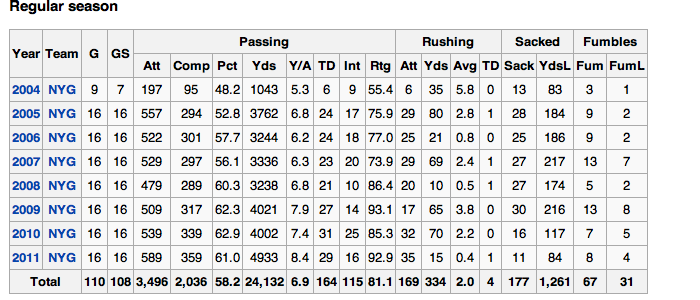
Let’s take Eli Manning as an example ….

*All of the football images and statistics were found on Wikipedia

Let’s take a look at Eli’s statistics:


Using Eli Manning’s statistics, we can view trend data.  Here are some questions to ask the students:

  • How many yards do you think Eli will pass for next year?
  • How many games do you think Eli will play next year?
  • Predict Eli’s passing rating for the 2012 season?  Explain your prediction.
  • Do you notice any trends?  If so, can you explain why the trends exist?

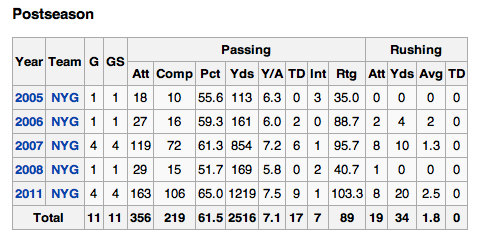
After asking the questions above, we can take a gander at Eli’s post season statistics.

  • Compare Eli’s regular season and post season performances.
  • What differences do you see in the data?
  • What do you think contributes to a quarterback rating.  Why?
  • Using the data, what factors do you think impact a quarterback rating?
After discussing the questions, you may want to have a conversation how statistics often relate to percentages.

Additional Sports and Math Links:

Dice Game

NFL Probability

Math and Football

Incorporating Sports into Math

Velocity in Sports

Math in Sports PowerPoint

Math and Sports Webquest