Representing Fractions

Introducing Fractions

Second grade teachers in my school are starting their introductory unit on fractions next week. Generally students are introduced to fractions through manipulatives.  Manipulatives, specifically pattern blocks, offer opportunities for students to play, explore and develop a deeper understanding of fractions.  By second grade students have become accustomed to solving problems related to sharing.  Splitting up a whole into unit pieces is part of the first grade curriculum. From there students are asked to adjust their partitioning into equal sized parts.

The triangle is what fraction of the entire hexagon?

Pattern blocks can be useful for introducing fractions although it shouldn’t be the only representation.  One of the challenges I see during fraction instruction occurs when students are given a different representation (word form, number line, mixed numbers, etc.) of a fraction and asked to find or create fractional parts.  Students often ask, where’s the picture of the shape that I’m used to?  Fractions can be represented in many ways, such as through number lines, objects, shapes, and a variety of linear representations.  I find that students tend to benefit from being able to see a variety of representations of a mathematical concept. A number line can be especially helpful in introducing fractional parts.  Keeping that in mind, I’m encouraging our teachers to use a variety of forms to showcase fraction representation.  Possible student questions related to this can be found in the slide show below and in this shared sheet.  

This slideshow requires JavaScript.

How do you introduce fractions?

Math and Puzzles

Math Puzzles

I’ve experimented with using more math puzzles in the classroom this school year.  I continue to find that games and puzzles have the potential to engage students in meaningful ways. Similar to games, puzzles can encourage collaboration and perseverance skills that will help students long-term.

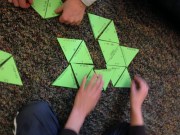
About a month ago I came across a free puzzle maker called Tarsia.  Tarsia is a program for PC users that allows the creation of different types of digital puzzles that you can print out. There’s a large database of math puzzles that are compatible with Tarsia here. A colleague and I have used them during our math station activities.  Students work in collaborative groups of 2-3 to complete the puzzles.  Last week I heard students having math conversations about whether a specific piece fits or not.  Hearing students confirm their reasoning for putting a piece in a particular place can be useful in seeing if a student is understanding a particular concept.  I feel like the puzzles have been especially beneficial in reinforcing many math concepts.  They are reusable for station work and could be used in conjunction with a student math journal piece.

Station Work

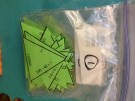
Keep in mind that I only use these types of puzzles for stations about once per week. Moderation is key with these types of puzzles.  I also found that cutting and bagging the puzzles in advance saves time.   In addition to the puzzles, I’m using math card games, technology tools, and self-directed learning activities for math groups that don’t directly meet with the teacher during guided math.  I’m looking forward to seeing how the puzzles continue to impact student engagement and learning in the classroom.

QR Codes and Math Stations

Providing feedback to students is important.   I find that the more specific the feedback is, the better.  Teachers use many ways to give feedback, whether that’s verbally or through written form.  Ideally, I’d like to be able to meet with every student in my class and offer them undivided individual feedback to improve understanding and enrich.  That’s not always possible so stations or workshop models become part of the classroom norm.  Math workshop models can improve opportunities to give 1:1 feedback.

During the past two weeks I’ve been using QR code activities (1) (2) for one of my math stations.  One of these activities can last 3-4 math sessions depending on the math concept being covered.  These types of stations involve questions that I’ve found through my PLN.  Some of the QR activities that are used involve scavenger hunts.  Students answer questions in groups or individually and check their answers by scanning the QR Code.  The QR code is unlike the actual teacher’s manual as student’s can’t immediately peek over to see what the answer is.

QRcode

Instead, students have to scan the code to check their answer.  Students then document and turn in a sheet that indicates whether the students answer was correct or what mistake happened.  I’m looking into creating feedback codes that help students with common errors  with particular problems.  Students are also asked to write in their math journals about problems that were incorrect.  I’m using  this site to create the codes as SMS messages.  If used correctly, QR code activities can increase student reflection opportunities and engagement.  For more information or practical ideas on how to use QR codes in the classroom check out Denise and Edutopia‘s resources.

On a side note, I’m looking forward to using the idea of clickable paper in the classroom at some point.


How do you use QR codes in the classroom?

Using Comics in Math Class

Comics

Comics/cartoons have been used to communicate important issues for many years.  Education has even been part of the comic movement.  Susan O’hanian has demonstrated with her website how cartoons can communicate and start important conversations.  I’ve tinkered with comics in my math classroom this year.

I believe that humor has a place in the classroom.   Comics can bring in a humor aspect, as well as practicality and motivation that can engage students.  My students are starting their algebra unit this week and I’ve been looking for new ways to introduce combining like terms and solving for unknown variables.  In the past I’ve used Hands-on-Equations and different types of narratives that explain how like terms can be combined.  After a lot of searching,  I ended up using pages 5 – 8 in this pdf to help introduce the concept this year.  Students responded well to the comic and I believe it helped them complete the activity in the document below.  I used one of the practice sheets as a model and the second sheet was completed and shared in student groups.

Combining Like Terms Activity

When I look back at some of my favorite K-12 teachers, many of them were able to connect and build rapport with students quickly and use humor appropriately.  I’m going to explore how to use  comics a bit more in my classroom over the next few weeks.  I may even have students create their own through comic creator apps on the iPad.

How do you use comics in the classroom?