Math Acceleration or Enrichment

Acceleration v Enrichment
Acceleration vs Enrichment

A while back I was asked a question about student acceleration and differentiation.  The question related to different types of acceleration opportunities for students that master math content before others. This question is often at the heart of differentiation for high achieving students.  I thought awhile about the question and started to brainstorm what opportunities truly exist or if acceleration is needed in those circumstances.   In an education setting acceleration is often associated with a curriculum that is moving faster or happening at a quicker pace than the norm.

In math at the elementary level, concepts are usually built upon one another and acceleration seems to be valued. Similar to a lattice fence, once one concept has been mastered, teachers often move the student to the next row/concept.  The goal is to continually move students in an upwards trajectory towards the next concept on the ladder.

expectations
Upward trajectory

When acceleration is the focus, students are asked to master and then move to the next numerical concept. For example, If student A has mastered 2.0A.A.1 they automatically move to the next concept, 2.0A.B.2.  Keep in mind that mastery is often defined by the author of the assessment.  Mastery could be correctly answering a few abstract problems in a row or answering 90% of the answers correctly.  In the author’s mind, the faster this process occurs over time the more the student learns.  This isn’t always the case and the perceived notion of learning might not actually be occurring. This is especially prevalent with online adaptive software programs. This type of philosophy often facilitates minimal understanding and can lead to problems down the road.  Also, students that are accelerated are often asked to answer questions more on an abstract level rather then explore mathematics constructively.  Creating a personal level of mathematical understanding is valuable.  Focusing in on only the abstract doesn’t always lead to a learning experience or a better understanding of math.

I believe acceleration has a place in the elementary classroom, but I don’t think that it should be the default.  Honestly, I feel like accelerating is easier than providing opportunities for enrichment. Instead of acceleration why not emphasize enrichment for students that have already demonstrated mastery? I think the word enrichment gets caught up in buzzword land, so here’s a formal definition:

Miram-Webster defines enrichment as the process that improves the usefulness or quality of (something) by adding something to it.

Enriching math instruction doesn’t necessarily mean that students quickly move from one concept to another, but instead it may focus on practical application and problem solving.  Developing strong problem solving skills enhances the usefulness of mathematics.  I find that students benefit when given opportunities to enrich their understanding of mathematics.  In addition, enrichment provides opportunities for students to practice relevant skills that become immediately useful.  Logical thinking, abstract reasoning, and problem solving can all be part of the enrichment process.  All of the skills that are practiced through enrichment activities can be used cumulatively throughout a math curriculum sequence.  The picture below is just one example.

enrichment
Enrichment

Students often need to have a foundational understanding of mathematics to be successful at the middle and high school levels. Logical thinking and abstract reasoning skills tend to contribute to the background knowledge for algebra and geometry concepts.  Problem solving is a skill that’s used throughout school and life.  Enrichment opportunities encourage students to use the math learned and apply it to practical situations.  It also enables students to solve problems using trial and error and find multiple solutions.  Perseverance skills are also practiced during math enrichment opportunities.  Instead of completely emphasizing the upward trajectory of concepts, students that experience enrichment opportunities develop skills laterally and may cement a more solid mathematical foundation in the process.  It may also enable students to see mathematics in a new light, not just a lattice of concepts placed in chronological order.  Feel free to review MathwireNRichMaths and Andrew Stadel’s Math Acts,  for a few different examples of how to incorporate math enrichment opportunities.

There isn’t really one right answer to the question found at the beginning of this post.  The solution includes a possible combination of acceleration and enrichment, but immediately leaping to acceleration might not be the best option.

How do you use math enrichment in the classroom?


National Governors Association Center for Best Practices & Council of Chief State School Officers. (2010). Common Core State Standards for Mathematics. Washington, DC: Authors

Enrichment. 2014. In Merriam-Webster.com.Retrieved July 21, 2014, from http://www.merriam-webster.com/dictionary/enrichment

photo credit: Filter Forge via photopin cc

Professional Development Conversations

1

Yesterday I was able to participate in a SAMRiCamp teacher workshop.  Similar to last year, DG58 hosted the event and it was well attended.  It’s great to see so many educators and administrators taking time out of their busy schedules to attend this professional development opportunity.  There were many sessions available and facilitated by educators and administrators in the area.  The sessions provided educators with a variety of options to choose from. For the most part, the facilitators of the sessions had organized presentations displayed on whiteboards that were shared through Google Drive. As usual, the entire conference was paperless.  Discussion generally followed the presentation with the audience sharing feedback with the group.  The majority of the sessions included a hefty dose of teacher conversation.

I find that this type of teacher development model is different than the norm.  This type of model can benefit educators in ways that weren’t possible a few decades ago.  My past teacher trainings generally consisted of specific workshops for teachers within a particular district.  The presenter spoke for the majority of the time with a handout and limited audience participation.  Instead of having one district provide training for their specific teachers, the SAMRiCamp teacher camp model encourages more of the conversation element with participants from multiple districts.  Different perspectives, programs and ideas can be heard when participants offer responses in the sessions.  Gathering teachers and administrators from the local area/state can reap benefits for all participants.

The conversation and collaborative part of this type of professional development is important. Including time to discuss, ask questions and share ideas can evolve into teacher reflection opportunities.  During these teacher-led conversations, teachers can experience affirmation and may also meet constructive feedback from others that they can bring back to their school.  Pushback, or asking deeper questions that lead to justifying a response can also play a role during these conversations.  Discussions can lead to deeper connections with other teachers outside of their district.  This action also provides opportunities for teachers to expand their personal learning networks.  Being able to candidly discuss matters related to education with other professionals can improve practices. Since many districts are represented, different instructional models and ideas can be brought to the table for discussion. Since educators are both introverts and extroverts, the discussion doesn’t necessarily have to always be verbal.  The conversations and questions could take the form of a shared Google Doc. I believe all teachers have something to share and getting comfortable enough to share can be a positive tipping point in the professional development conversation.  Taking the risk to share/present and receive feedback can benefit all stakeholders in the room.  At the same time, I think it’s important for teachers to be able to say that they don’t have all the answers. The unanswered questions can often help develop an atmosphere of brainstorming, which inturn helps the group.  Reflecting on past practices and sharing/learning from others can lead educators to change their practice for the better.  Feel free to review the #SAMRiCamp tag for a brief overview of what was discussed.


Bridging Procedural and Conceptual Understanding

Yesterday I was putting together a few math projects when a Tweet caught my eye. The Tweet below started a short conversation that I thought was interesting.

David’s Tweet had many responses.  Most responses revealed that educators tend to side with solving one problem ten different ways rather than having students solve ten similar problems.  I started to reflect on how teachers give assignments that ask students to complete repetitive problems that often reinforce procedural mathematical thinking.  I also started to think how in an effort to provide practice, teachers may focus on procedural aspects first and then move towards practical application.  I find this happens frequently with math concepts at the elementary level.  What I don’t find often is the viewpoint that practicing procedural aspects can be embedded in solving specific problems multiple ways.  This type of thinking reminds me of number collection boxes.

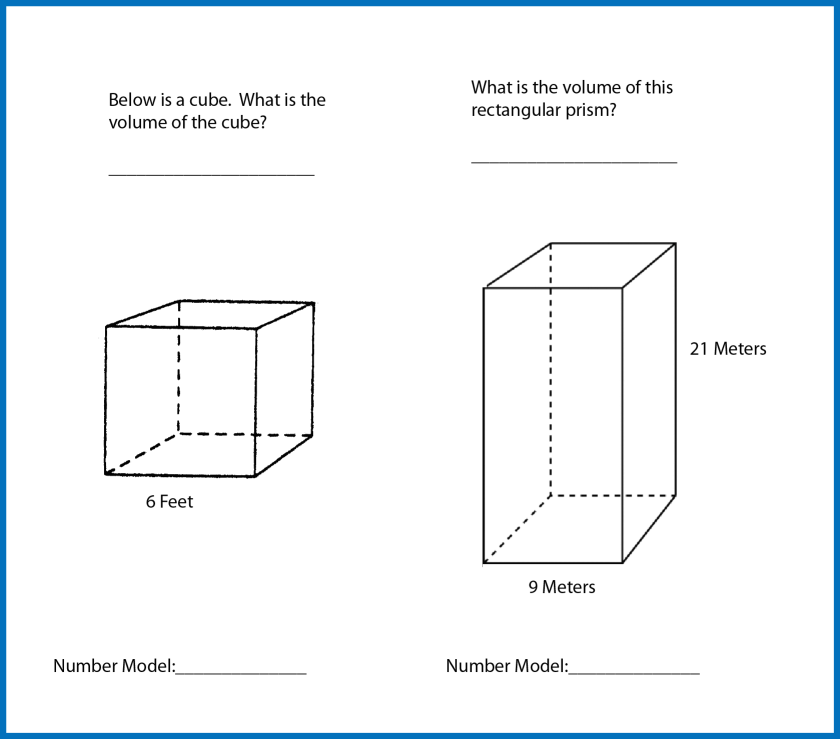
Regardless of the assignment I want to be able to give specific feedback.  A larger problem that involves multiple steps can provide opportunities for teachers to pinpoint where misconceptions are and give direct feedback.  This isn’t always possible with ten similar shorter problems.  Below is an example of a few problems that you may find in a fifth grade classroom.  I don’t condone using these types of problems as they are definitely utlized, but I think we need to ask what’s being assessed when students complete this type of problem?  Students are simply asked to find the volume and show a number model.  I appreciate how the problems ask students to show their number model, but these types of problems seem to measure procedural understanding.  Do students know the formula?  Yes, well then they can answer many of these problems, even 10 in a row.

Procedural


I think the above problems have a place in the classroom, but shouldn’t necessarily be the norm.  Usually these types of problems are found on homework sheets.  The problem below which was adapted from a recent fifth grade test is more challenging, but gives students opportunities to showcase their own mathematical understanding and persevere.  Some would say that these two problems are completely different.  I would agree, but similar concepts are being assessed.  They do look different and the second requires more skills to complete.  Students need to be able to use their procedural understanding and apply it to the situation.  Also, one key element that’s missing from the first problem is the student explanation.  Students are required to show their mathematical thinking in the second problem.  This is big shift and can reveal student misconceptions more clearly than the first problem.  I struggled with the decision, but eventually had students work in groups to complete the problem below.  Students were allowed to use any of the tools in the classroom to find a solution.

newadvanced


At first, all groups struggled with this problem.  Near the end of class all the groups presented their findings.  What’s interesting is that all the groups had different answers and ways in which they came to their conclusions.  I was able to offer opportunities for students to see and ask questions about different math strategies.  During the next class I was able to pull each group and give feedback.  This activity took a good amount of time to complete, but I feel like it was worth the commitment.

Through this experience and others I’m continuing to find that it takes a “bridge” to connect the procedural and application pieces.  At times I feel like there’s an assumption that if students are able to answer 10 similar procedural problems that they will be able to simply apply that knowledge in a multi-step problem.  This isn’t always the case and sometimes the bridge doesn’t fully form immediately.  Performance tasks, similar to the problem above can be one way in which teachers can help the transition from procedural understanding to practical application.  Being able to apply that knowledge to a math performance task can be a challenge for some students.  When teachers focus so much on the procedural, that’s the only context that students see and practice.  A blend between procedural and application needs to be established within the classroom.  I feel like activities like this help bridge this gap.


How do you bridge mechanical and conceptual understanding?