Addressing Local Math Misconceptions

mathconceptions

Over the past week I had time to disconnect a bit and spend time with family. I was able to stay with relatives in another state and spent most of the time catching up with people I haven’t seen in a while. It was a great time to refresh and reflect on the past year.  While relaxing one relative in particular asked me about this “new” math that’s in the schools now. I was asked why schools are changing how they teach math and why it needed to change. Specifically she spoke of the different strategies used to compute numbers.  I’m assuming she meant the extensive use of the number line and compatible numbers.  I defended the reasons for a more conceptual understanding of mathematics, especially at the elementary level. Many of the “new” strategies help build that understanding and enable students in developing a foundational understanding of numbers. The relative was receptive and asked more questions related to this topic. I felt like her understanding of the topic became clearer as we discussed the use of  multiple strategies utilized to teach computation. This was a small part of our longer conversation, but the topic had me thinking about how to provide opportunities to address misconceptions. In particular, I thought how my conversation could apply to addressing math misconceptions in schools.

I feel like one of the more important issues with student misconceptions stems from a lack of addressing them. They tend pile up and build over time. I vaguely remember having a math teacher that asked if his students had any questions. I remember looking around and wondering if I was the only one in the class that had multiple questions. Unfortunately I kept my hand down even though I was lost. The teacher then quickly surveyed the room and seeing that no one had their hands up, moved onto the next topic. I found that the less I asked questions that less comfortable I was with the current concept and the process continued until I finished the class. Looking back, I’m sure there were other opportunities to address my misconceptions and questions; I just don’t remember any of them at the time of this writing. I didn’t learn as much as I should from the class, but I started to understand that I needed additional opportunities to ask clarifying questions.

In addition to including many opportunities to address misconceptions, the classroom environment plays a pivotal role in having students feel comfortable in offering input.  The strategies below can be used in a variety of settings. I’ve had success with the strategies, although some have been more successful than others.

Classroom Math Conversations

Classroom conversations can be a powerful strategy in gaining a better understanding of students’ viewpoints. Using open-ended math question and having groups respond to the class can offer opportunities for a healthy math debate. For example, I’ve seen some teachers use Always, Sometimes, Never with great success. Math Talks can also be an avenue in which classroom conversations can develop. Through these conversations teachers can glean important information and possibly misconceptions that can be addressed later or at that time. These types of math conversations, accompanied with anchor charts can document the classroom’s learning journey.  The anchor charts can then be revisited as students construct their understanding.

Formative Assessments

These types of assessments can take different forms. Some teachers prefer to use exit cards, while others use a quiz model. Formative assessments can be used via technology means and some may take the form of a paper/pencil quiz. Regardless of the form, the student’s response can give teachers an indication of understanding. In order for the teacher to give feedback the question needs to be appropriate. Students need to be given the opportunity to explain their reasoning or steps involved in solving problems. If not, the problem is wrong/right, and the teacher is unaware of where the mishap is occurring. Using written or verbal feedback to address the misconception can lead to a more in-depth conversation at a later time. Some students may need the reinforced conversations while others may not. I believe most teachers understand their students and at what level to scaffold feedback.

Journaling

Similar to answering a question in a classroom student group, journaling can provide students a low-risk venue to showcase their understanding. Through a prompt, math journaling can allow students to explain their mathematical thinking and processes in a written form.  Students often become more aware of their growth as the year progresses.  I find that students might not know that they have a misconception until it’s brought to light.  It’s the you don’t know what you don’t know dilemma. The concept of math journaling can be used for teachers to write feedback to individual students and ask questions that give students opportunities to reflect on their writing and math process. Allowing a bit of extra time to confer with a student after their math journaling process can be beneficial as teachers may want to review specific concepts with students.


All of these strategies above seem to go well with a heavy dose of teacher feedback and student self-reflection.  Through reflection, students can help internalize and address the misconceptions.

How do you address misconceptions in the math classroom?
 

My School’s First Coding Club

Photo Dec 03, 8 19 15 AM

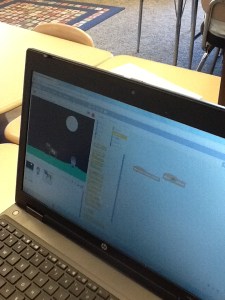
Last Wednesday concluded my elementary school’s first coding class. The class started in October and met once a week for one hour for a total of 11 sessions. Myself and two other classroom teachers led the sessions with 20 students in grades 3-5. Students learned about coding by creating a variety of projects within Scratch. Each session focused in on a specific skill. Students spent the last two sessions on a final project that showcased many of the skills that were acquired through the class. The final projects were submitted and reviewed by the instructors and parents.

The team has determined that another coding class will start up in January. Before that starts I want to reflect on the last class and a few things that have been learned in the process.

Student exploration is necessary

As coding topics were introduced I found that some students needed visual representations, while others were fine listening to the instructors. I found that all the students needed time to explore the Scratch programming language. Giving opportunities to explore the cause and effect of using different Scratch blocks enabled a better understanding of the sequence of a project. I can remember one project that asked students to use only 10 specific blocks to create a program. Through trial and error students evaluated whether what they were creating made sense. This low-risk activity also helped student hone in on what a particular coding phrases meant. Specifically, students started using “if” “forever” “change” “rotation” “x” and “y” more often.   This type of vocabulary helped set the stage for future sessions. I felt like the time spent completing this activity paid dividends later in the course.

Provide multiple resources

The class emphasized and primarily focused in on using the Scratch programming language. Giving context to some of the programs required using resources outside Scratch. At the beginning of the course students learned how computer programming requires direct instructions. Students completed an activity with partners that had them move around the classroom and complete procedures with simple direction scripts on notecards. Participants also explored the debugging process by learning about Grace Hopper and the moth found in a large computer.

The team also used a variety of books and resources to teach the class. Books from our local libraries, Twitter resources, and online forums provided many resources that helped supplement the class.

Provide guidelines

While exploration is important I believe the team found that having guidelines in place helped make expectations clearer. Students knew as soon as they entered the classroom that they needed to get their laptop and login to their Scratch account. Students were expected to create a specific program each time that the class met. Early in the class the team developed a checklist for students. The checklist gave students a visual representation of what was required and reminded students of the expectations. Students completed the checklist and then were able to move on to the next topic. Each student worked at a different pace so the checklist basically helped students see what steps needed to be performed to make their program complete. The last project included a guideline sheet that asked students to use all of their skills learned to create a capstone of their learning.

Screen Shot 2014-12-13 at 9.03.46 AM

Provide opportunities to extend

Before the class started one of my goals was to introduce students to a specific number of concepts. As the class progressed I was finding that some students were ready for additional concepts. Thankfully, my district’s programmer let our class borrow her Raspberry Pi. A number of students explored the different components of the circuit board. Some students started to learn the Python coding language. One of my students actually decided to complete their math research project on Raspberry Pi.

Photo Dec 03, 8 18 53 AM

Also, students that were part of the coding club were able to assist during the Hour of Code that my school had last week. Those students took the lead and helped introduce coding to students at all different levels.  At the end of the class the team sent out an email to all of the parents of the class indicating next steps that the students could take if they were to continue their coding journey. I felt like this was important as students became more enthusiastic and curious with the concept of creating content with coding.

Overall, this class was a rewarding experience and will help in planning future courses for my school.

Educanon and Formative Assessments

Educanon and Formative Assessments

The second grade classrooms at my school reviewed subtraction strategies last week. Students were subtracting numbers on a number line and becoming more confident in using regrouping strategies. Based on pre-assessment results I felt like some of the students would benefit from additional enrichment. While talking with a few colleagues I revisited Educanon. I first heard of Educanon from Mary and I briefly used it last year. So I dusted off my username and password and logged into my account again.

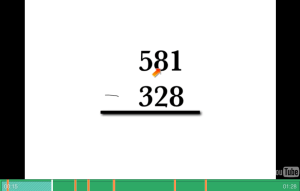
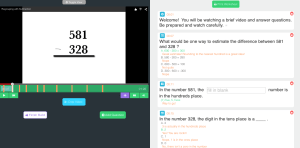
A while back I created a subtraction video using Explain Everything. I turned off the microphone function (my dog was barking when I created this) and just used the pointer and drawing functions. The video was only around two minutes in length, but had 10 questions. I added a variety of questions, including multiple choice, fill in the blank and checklists. The last question asked the students to use a whiteboard to find the difference between two numbers.

Screen Shot 2014-12-06 at 7.33.13 AM

During class students were placed in two different stations. One station was Educanon and the other was working with base-ten blocks to subtract multidigit numbers. The stations rotated after approximately 10-15 minutes. All students logged in and finished the Educanon within the time period.

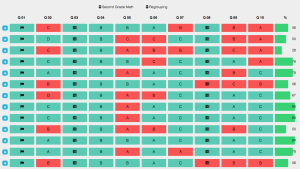
After class I was able to review the results. I felt like this data could be helpful for the teacher as well as the student.

Student answers

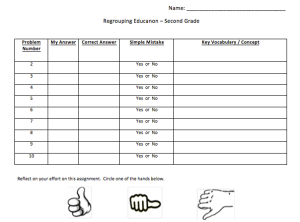
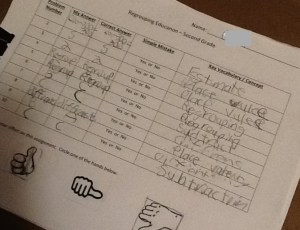
The next day I printed out the student results and compiled a reflection sheet.

Click for file
Click for file

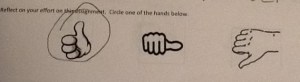
Each student’s answers were stapled to the back of the reflection sheet. As a class we reviewed each question together and students filled out their specific sheet. Out of all the categories on the sheet, I thought the “Key Vocabulary/Concept” section stood out. Students started to develop an understanding of what type of skills were being addressed from each question. This was also an opportunity to emphasize certain math vocabulary words. At the end of this reflection session, students circled their effort level on this formative assessment.

difference

Photo Dec 06, 7 18 45 AM

I thought this was a beneficial activity for a second grade classroom. Students are also starting to think more about their own mathematical thinking and learning. I’ll be using the data and student reflection in preparation for more challenging subtraction concepts later in the year.

Visual Fraction Models

fractionmodelstitle

Today students explored fractions using number and visual models. Students have been practicing how to add and subtract numbers for the past few weeks. Most of the students have an understanding of how to find common denominators and add or subtract problems.  Yesterday students answered word problems involving fraction computation.

What I’m noticing is that students are understanding and compiling their number models but aren’t as comfortable with visual representations. Being able to model fractions is important and a key ingredient in understanding fractional parts. As the class progressed I felt like there was a disconnect between fraction representation and computation. Eventually, the lack of conceptual math understanding impacts a student. I’ve found this to be especially clear with fractions.  So today’s class focused on showing both, the number model and visual representation. Students worked in groups on the page below.

Visual Fraction Models
Click for file

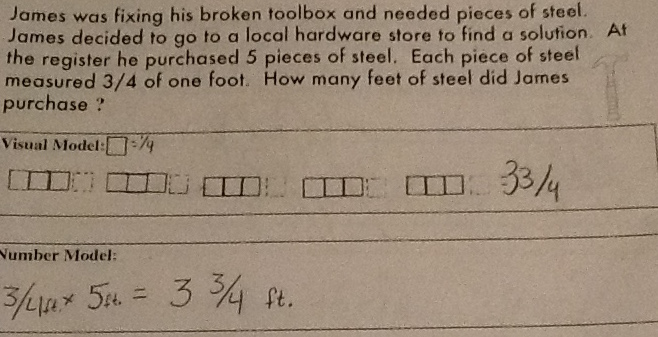
Students worked together on the two problems. There was a lot of struggle, especially with the visual model portion of problem two. I was tempted to lean in and help the students but I wanted them to use strategies and their partner to find a solution. I let the students work and even debate strategies with each other. Near the end of the class students presented their final number models and visual representations.

Photo Dec 02, 6 19 11 PM
This student turned a pentagon into 5 triangles. Each triangle represents 18 miles.

Photo Dec 02, 6 19 27 PM

I gave them feedback and asked questions in return. Two of the better examples are above. Tomorrow the class will be exploring visual fraction models via Thinking Blocks. Overall, I felt the productive struggle was worth their time and I hope that another layer of conceptual understanding is starting to cement.