Class Math Discussions

conversation-01-01
Making time for quality math discussions

A few years ago I remember my school district emphasizing the need to use more of a math workshop approach in the elementary classrooms. The school district even invited a math workshop specialist to present on all the different ways to set up groups and organize guided math.  Some of the teachers gleaned the information and used parts of the model in their own classroom.   The consensus was that some of the guided math approach was better than none at all.

As the years passed the idea of math workshop started to change. Teachers started to change the math instruction block to incorporate small group instruction. Whole group instruction still occurred, just in shorter bursts. The small groups consisted of around 5-6 students and rotated every 10 – 15 minutes.   The groups didn’t meet everyday – that’s almost impossible. I remember barely making it through two rotations 2-3 times per week. The organization involved seemed overwhelming, but doable. This workshop model was modified depending on how the teacher organized their math class. After a couple of years the district changed it’s focus to emphasize reading instruction. One small part of the reading instruction is designed for students to share their understanding with others. After hearing about this type of model I decided to merge this type of model within my math classroom.
conversation-01

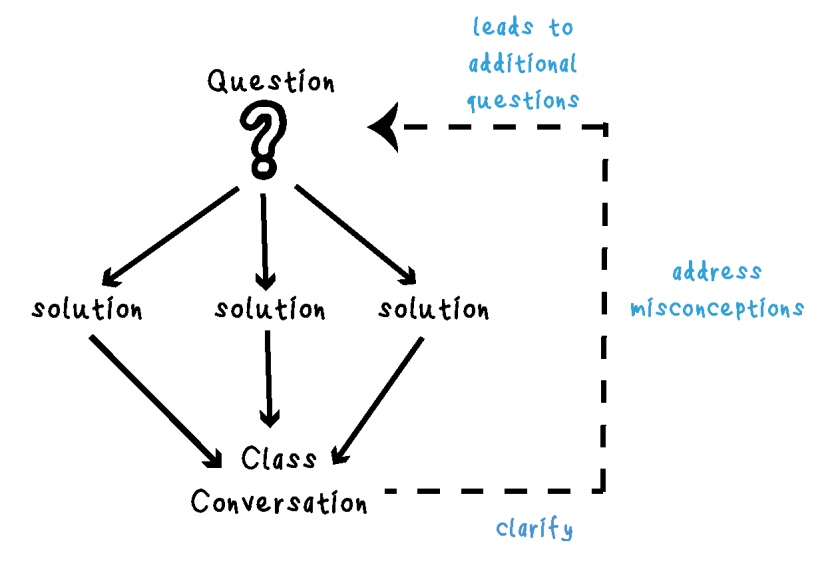
As the district changed its initiatives my math model also started to change. Instead of fully devoting time to small group math practice, I decided to incorporate a math discussion within the teacher group for a portion of the time. Half of the time in the small group was used to work on direct problems associated with a standard, while the other time was set aside to discuss the math concept in detail. Over time the conversation started to eat up a larger potion of my small group time. This discussion component ended up becoming more formal after I found the conversations started to impact students’ understanding of math.  The questions that I asked were often related to vocabulary or about a particular strategy that was used to find a solution. Students were given opportunities to answer the question and ask each other questions in the process. For the most part students were on task, but I’d have to reign in or rephrase responses as needed.  I also found myself planning questions to intentionally ask during the small group time. I had to use some type of timer system to rotate groups at the right time. Most of all I felt like students were able to offer their input in a low-risk environment and discuss math while receiving some type of feedback from everyone involved. Also, students were starting to use some of our more formal math conversations in their written explanations. What I’m finding is that I need to be more intentional in creating opportunities for these classroom conversations to happen. They seem to open up additional learning opportunities that were closed off before. I feel as though slowing down the pace and delving deeper into math concepts has brought about this opportunity

Side note: I’ve also used this strategy with a whole-class discussion.  Although it’s benefiting students I need to refine the logistics of using this strategy for the entire class.  Also, I’ve experimented with Math Talks this year – definitely something that I want to explore a bit more in the next few months.

 

Connecting the Math Curriculum

Connecting the Math Curriculum

A few months ago I informally asked a group of elementary students what they think of when they hear the word math. I heard many responses from the students.   First and second graders focused on the words adding, subtraction, shapes and money. Upper elementary students emphasized multiplication, division, money (again!) and fractions.   Often, the student responses were directly related to the last few units that were taught.

I find that the perspective of math changes as kids move grade levels. My own perspective of math has changed over time.  I used to dread talking about fractions when I was in middle school.  My perspective switched gears when I started to see the different uses of fractions outside of the classroom.  When I started to see fractions as less abstract, my notion that they were evil started to dissipate. Events similar to this affected me and my teaching style during my first few years of teaching.

My first teaching job out of college started in an empty fourth grade classroom. I was placed on a team with a two veteran teachers.  I remember being given a curriculum guide and told to teach math in specified units that were often separated into math concepts.  I don’t believe there’s anything specifically wrong with this, but wonder now if the idea could use some tweaking. This type of unit lesson planning lasted throughout the year. During those units, the lessons were directly related to a particular standard and didn’t deviate much from that path.   My team was extremely supportive, although we didn’t question the sequence or the curriculum.  Once students took the unit test, the class moved to the next unit of study, which was generally a different math strand. For example, fractions were out and division was in. This process was repeated throughout the school year without revisiting past strands. Of course there was review, but the units didn’t seem connected in any way. As students moved through the units they often had a challenging time applying skills taught earlier in the year. The gap between the content in the units seemed to widen as the year progressed.

I bring this up because it relates to a book that I’m reading.  Over the past month I’ve been participating in a math books study with some amazing educators. We’ve been discussing this book over GHO every other week. One of the passages that peaked my interest came from page. 74

“Structuring units – and – lessons within the units – around broad mathematical themes or approaches, rather than lists of specific skills, creates coherences that provides students with the foundational knowledge for more robust and meaningful learning of mathematics.”

As math educators plan units I feel as though the above is sometimes a missing component. Planning opportunities for students to discover how math concepts are connected can be a powerful learning tool. It also shows students that math is not defined as a checklist of singular concepts or “I can” statements.   As students switch their mathematical lenses, they see the connected aspects of math, as I read on page 76.

“When they teach the sequence of lessons that they have prepared as a team, the teachers will continually ask students to switch the lenses that they use – from looking at a situation algebraically to exploring how it connects with geometry that they have been studying.”

This year I’m more intentional in planning lessons and activities that connect math strands. I follow the curriculum, but in addition to that I’m finding that activities and lessons that blend math strands gives students more opportunities to cement their mathematical understanding. Problem-based learning projects often lend themselves well to these types of lessons. Even showing students the sequence of the curriculum can prove beneficial as students see where they are starting and the expected finish.  It also helps students to be able to view math beyond the abstract. That connectedness can bring a new appreciation and possibly a renewed math perspective.


photo credit: Hyperlink via photopin (license)

Better Student Reflections

B9uYDrUCIAADggL-01

This year I’ve attempted to incorporate more student reflection opportunities in math classes.  This reflection has taken on different forms.  Reflecting on math practices is evident through classroom conversations and through student math journals  I feel as though a heavy dose of student reflection can go a long way in having students build awareness of their strengths and areas that need bolstering.  My focus this year has been geared towards students reflecting on their unit assessments.  I want students to understand that reflecting on past performances and setting goals can help them improve going forward.  I don’t believe all elementary students come to this conclusion all on their own.

At the beginning of the year I analyzed all the different methods to promote student reflection opportunities.  The timing of student reflection matters. My classes generally have approximately 11 unit assessments throughout the year.  Having formal reflection points after the assessments provide a number of checkpoints along the way.  I decided to start by finding/creating student self-reflection templates.

My student reflection sheets have changed over time.  The evolution of what was created can be found below.

1.)

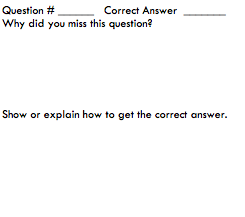
Students identified corrected answers and showed reasoning.

At the beginning of the year students were asked to find problems that were incorrect and delve deeper into the reasoning. Students had to seek out why a problem was incorrect and explain how to find a correct solution.  This offered little interaction between the student and teacher, although some students would come up to the teacher to get further clarification on specific concepts.

2.)

dfaf
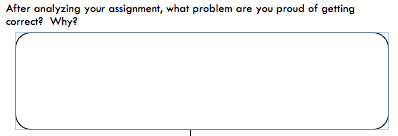
Positive elements

The above portion was added to the first and helped students focus on positive elements of their performance while still addressing areas of improvement.

3.)

Persevere and stay focused component

One major area that I thought needed strengthening was in the perseverance department.  The above section was added to help students find strategies that they could use when approaching a complex problem.

4.)

Analyzing specific math concepts

Around the third unit assessment I decided to merge a more standards-based grading approach.  I had students identify which problems were associated with certain math strands.  Students then analyzed those results to look at possibly setting a relative math goal.

5.)

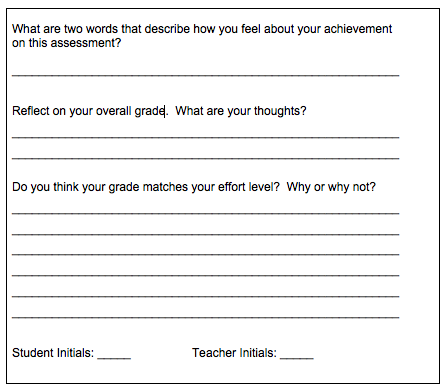
Written reflection and growth mindset

By this time students were becoming more reflective learners.  I liked what I was seeing and felt like students were benefiting from this reflection opportunity.  I added more pieces that emphasized having a growth mindset – e.g. connecting to achievement.  This was also the first time that I had students and teachers sign-off on the reflection.  I was able to have short discussions with the students about their assessment.

6.)

fdaf
Identifying areas of strength/concerns
arewq
Student goal setting piece

Around the fifth unit assessment I added a goal setting part to the reflection sheets.  I haven’t tweaked the reflection sheet much since then  feel the results are positive.  Students are not as infatuated with the letter grade, but more focused on specific concept areas of the test.

I’ve used this sheet for the last few unit assessments.  It’s in a Word format so feel free to edit it and make it your own.  There’ll never be a perfect student reflection sheet but this has worked well for my students.  Moreover, students are able to look back through their math journals and see their own growth over time.

Last week I passed back a graded unit assessment back to a group of fourth grade students.  Each student took a peek at their paper, looked over their problems and grabbed their math journals.  Students found a comfy place in the room to reflect on their results and set goals for the next unit.  After students finished the reflection they brought the sheet up to me to discuss the reflection and next steps.  We both signed-off on the reflection and the students move on to another activity.

This process of math reflection seems to help my students.  It does take up around 30-45 minutes or so, but I feel like it’s time well spent.

How do you use student reflection in the math classroom?


Connecting Math Games and Computation

title

I feel like the curriculum stars are in alignment. Many of my classes are exploring computation in some capacity. This rarely happens because of the scope and sequence of the curriculum at the elementary level. Computation is an interesting concept to explore in the classroom. I find students come to class with a variety of computation knowledge, although some of the background relates to procedures or tricks used to compute numbers. Other students have a conceptual understanding of the computation, but might be lacking in the procedural department. Either way, I find that students need more practice to become fluent with computing numbers. They also need to be able to distinguish and apply rules to problems e.g. signed numbers, fractions and order of operations.

Developing computational fluency can be found in a variety of forms, but as of late I’m finding games to be the most beneficial. Computation timed tests drive me nuts. I couldn’t stand that as a student and feel a bit embarrassed when they are assigneds. An alternative to this can be found using math games. Games provide low-risk opportunities for students to engage in math conversation and practice computation skills. This past week I was able to use one of these games with students in second and fourth grade.

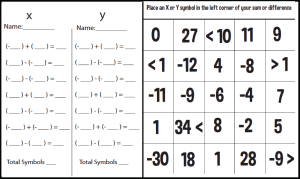
The game involves using dice and strategy and computation skills.  Students were given a game board and recording sheet. I pair the students using Michael‘s grouping spreadsheet and the students grab the sheet, dice and find a cozy place in the room. Students then roll the dice and fill in each line slot and match it with an answer on the game board. The game is over when all the slots have been filled. Click on the pictures to download a file of the game.

2nd Grad
2nd Grade – Adding / Subtracting Multi-Digit Numbers

I first used the above game with second grade and then decided to use the same format with a fourth grade class.

4th Grade – Adding / Subtracting Signed Numbers

Both games seem to serve their purpose.  Students are practicing their computation skills while using a variety of strategies to compute numbers. Students are also engaging in math conversations around computation and using vocabulary associated with computation.  In addition to the game sheet, some students decided to grab a whiteboard and complete their computation there before transferring it to the game sheet.  Hopefully these skills will develop into a deeper sense of computational fluency and cement as students progress through school.