Volume and Fixable Mistakes

Screen Shot 2018-02-24 at 10.13.44 PM.png

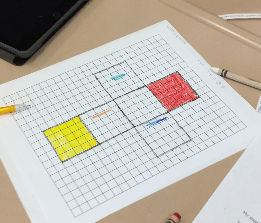
My fourth grade students have been exploring volume and area for the past few weeks. Lately, they’ve investigated different methods to find the volume of prisms, pyramids, cones, and cylinders. Through this process, they created their cities of volume and have been studying this topic extensively.  This fourth grade crew has made a lot of progress in finding the volume of objects when given the dimensions.  This particular unit of study is more focused on making spatial connections and using formulas to find volume.  Although the kids have been showing a better understanding, I’m observing very similar errors when I give checkpoints.


  • Using inappropriate units (squared vs. cubed)

Students need constant reminders to show appropriate units.  When I whiteout the unit line it’s interesting which students automatically write down the correct units and those that leave it blank.  Lately I’ve been bringing out the base-ten blocks to show the difference between linear measurements, area, and volume.  Students tend to not have any issues with telling the difference at that time, but when concentrating on formulas, the units are sometimes omitted.  I’m currently looking at different ways for students to show their understanding of the differences between square and cubic units.  I don’t want to heavily focus on this, but I’m noticing it as more of a student afterthought than something that they think of while answer a question.

  • Find the lengths of a side or the circumference with volume is given

Students seem to be efficient when trying to find the volume of prisms and cylinders.  When given the measurements of each side, students tend to perform the calculations correctly.  It’s a bit of a different story when students are given the volume and are asked to find other dimensions.  Some students rock this and do well, others not so much.  The class reviewed these types of problems by using a variable for the missing side or circumference.  We then created a few different steps that can be taken when tackling these types of problems.  I’d say the majority of issues with this specific problem came when students were given the volume of a cylinder or cone and needed to find the volume.  This is something that the class is still reviewing.

  • Remember that in r^2 actually means r * r and not r * 2

I’m going to chalk this up to not having enough practice with exponents.  At this level, students have used exponents, but more so to show Scientific notation.  When students hear “to the second power”, some hear that the word second and just multiply the radius by two.  Some students also problematically use the diameter and call it the radius.  Digging deeper into this issue has also revealed that some students aren’t using the Order of Operations to solve for volume.  Next week I’m planning on co-creating an anchor chart to address this.  Also, Pi Day (3/14/18)  is coming up soon and the class will definitely address the vocabulary and formulas associated with that soon.


These three issues have come up fairly consistently during the past week.  I’m looking forward to addressing them next week, but also having the students become more aware of what fixable mistakes exist so we can be more proactive. I’m also looking into having students create a culminating volume activity.  Putting that together is in my plans for tomorrow.


A simple mistake or something more?

Screen Shot 2018-02-18 at 1.19.07 PM.png

I’m grading tests this weekend.  My third grade group just finished up an assessment on fractions and multiplication.  It’s been about a 1-2 month journey full of investigations on this particular topic.  Many formative checkpoints were planned along the way and the unit assessment was scheduled for last week.

While reviewing the student work, I’ll sometimes write questions or direct students to a part of the question that would’ve made their answer more complete.  There are moments of pride and moments where simple mistakes drive me a bit crazy.  You see, there are only eight units with my new resource, so the assessments influence grade reporting quite significantly.

After grading the assessments, I have student analyze their results.  They comb through the test and look at how each question aligns with certain skills.  They also determine if a missed question was a fixable mistake.  I want students to be able to recognize when this occurs and fix them when they can.

Screen Shot 2018-02-18 at 1.27.14 PM
File

In my experience, 9/10 times students believe that the reason they missed a question was because it was a fixable mistake.  That’s not always the case.  There’s a certain amount of self-reflection and humility that’s involved in this process. Being able to be a bit more honest and communicating what a simple mistake is and what it isn’t might be in order before the next assessment.  So, what steps do students take if a missed questions isn’t a fixable mistake?  It’s one step in the right direction to admit that it isn’t fixable, but then what happens next?  Do students and teachers have plan for this, or do we move on to the next unit?

So, was it a simple mistake or something more?  This question comes up more often than not while I’m grading student work or reflecting back on a class conversation.  Some of the answers are more positive than others.  A simple calculation error can vastly impact an answer, but it may be a simple mistake and the student has a solid conceptual understanding of that skill.  But, a number model that doesn’t match the problem tells me that the student might not be certain about the operation that needs to be completed. Was the simple mistake putting the wrong operation sign in the number model?  I guess you could go down many different paths here.

The question type can influence how well and thorough a student responds. Some questions are quite poor in giving educators quality feedback to help inform instruction.  Right off the top of my head, multiple-choice and true/false questions fit that bill.  They sure are easy to grade by human or a machine.  Hooray!  But, they don’t give me quality feedback that I can use immediately.

This also has me wondering about the quality of the assessments that are given.  Measuring how proficient a student is on a particular concept doesn’t always have to come from standardized or unit assessment results. Classroom observations and formative checkpoints are beneficial and give teachers insights to what students are thinking. I want to make students’ math thinking visible.  Whether that’s using technology or not, making that thinking visible puts the teacher in a  better position. From what I observe, some of the best math task questions are open-ended and tend to have a written component where students are asked to explain their thinking.  The quality of the question and openness of the answer helps educators dig deeper into how and what students are thinking.  I think that’s why teachers are always looking out for better math tasks that help students demonstrate their understanding more accurately.

How do you help students determine if a mistake was simple or something more?

What about those SMPs?

Screen Shot 2018-02-11 at 10.00.39 AM

About a month ago my teaching team was asked by administration to map out our new sixth grade unit assessments.  By mapping, I mean that we had to review the questions on the tests and determine if the question was was multiple choice, short answer, essay or a performance assessment.  We then wrote what type of objective was present, the domain for learning, and the DOK level.

This mapping took a long time and the entire team was knee-deep in our teacher guides. It was a productive session, but we all needed some more caffeine afterwards.  While reviewing the assessments, we noticed how the guides emphasized the standards and the Standards for Mathematical Practices.  Both were given somewhat equal allocated text boxes in the guides.  Both seemed to be highly valued by the publisher and our district math coaches.  While the team was matching up questions and standards, I noticed that the SMPs weren’t getting any love.  They sat there unhighlighted and under appreciated. This had me internally asking questions about how teachers actually incorporate and communicate the SMPs.  So I went to visit the #Mtbos community and came across a Tweet by @cmmteach.

I completely understand that the standards are important, but what about the SMPs?  These practices are part of our lessons, but I’m wondering how teachers address that importance.  I asked a bunch of teachers this same question (I think they’re tired of me talking about it) and I generally get the same generic response.  That response generally is, “I know what they are and they are part of the lessons” or “I sometimes mention them when moments come up to use them.”  I see the SMPs briefly reviewed during math pd opportunities.  I also observe posters of the practices hanging in the classrooms around schools.  I even think there’s a Jedi one roaming the Internet as I’m writing this.  I wonder how often they’re referred to and what students think of them.  A few years ago I even had my students personalize the SMPs, but haven’t revisited them in as much detail since them.  Are they really engrained as part of the daily math lessons or do they need to be outright communicated.  Maybe there isn’t a right answer here.

I’m curious to how other educators communicate the SMPs.  What’s your favorite strategy or technique?

Reflection and Math Goals

Screen Shot 2018-02-03 at 10.31.44 AM.png

Two of my classes took assessments this week.  These are considered unit assessments and are related to math skills that the class has been working on over the past 1-2 months.  My fourth grade class just finished up a fraction unit, while fifth graders ended a unit on equations. I tend to grade the tests and then pass them back in the next day or two.  Seeing that it takes so much class time to give these tests (and the grading) I want students to be able to use these assessments.  By using them, I mean that students should be able to look at them with formative lens and purposefully reflect on the results.  Usually the assessment process looks like this:

Stage 1

  • Assessments are passed back to students
  • Students review their score and are excited or disappointed
  • Students try to figure out how everyone else did

Stage 2

  • Teacher reviews the assessment solutions with the class
  • Students ask questions about why or maybe how they can get additional credit
  • Students see where fixable mistakes exist

Stage 3

  • Students receive their math journals
  • Students fill out a reflection sheet looking at skill strengths and areas to improve
  • Students indicate the most memorable activity and why
  • The teacher and student meet and sign-off on the test analysis and reflection portion


Okay, so stages 1-3 have been happening in my classroom for the past seven or so years.  It’s become part of my classroom’s math routine.  I see benefits in having students reflect on their progress on assessments, but I also want students to look at an assessment beyond the grade itself.  I’ve blogged about this evolution before. I stopped putting actual letter grades on assessments because of this.  I also considered taking off the point totals as well, but ended up keeping them since it was on the grade report anyway.

I see value in the student reflection component.  I believe students feel empowered when they’re given more control, choice, and access in the classroom.  This year I’ve added my own stage 4.  I’ve added this for a couple different reasons.  One, I’ve noticed that students that don’t necessarily meet their own expectations are really hard on themselves.  They often react negatively on the reflection component and I don’t want students to feel worse after reflecting on their performance.  I want this to be a valuable experience and growth opportunity.  Two, my students have kept their math journal for multiple years.  Some of them are jam packed with notes, reflections, and foldables.  You’d be surprised at how much is in some of these journals.  One thing that students continually tell me is that they love going back in their journal and looking at what they completed over the past few years.  They see that their mathematical writing has changed as well as the concepts that they’ve encountered.  It’s similar to a math yearbook to many of my students.  My third reason is that I’ve always been interested in how students perceive themselves as math students.  Over the years, I’ve emphasized that creating an individual math identity is important. I emphasize this at my school’s back to school session. This math identity shouldn’t come from a parent, but instilled within.  Being able to see students for multiple years allows me more of an opportunity to do this.  Also,  I’m excited to share this at NCTM and learn with other educators about the goal setting and monitoring process. This has been an area of growth for me as I’m continually refining the student math reflection process.

So, here’s stage four:

Stage 4

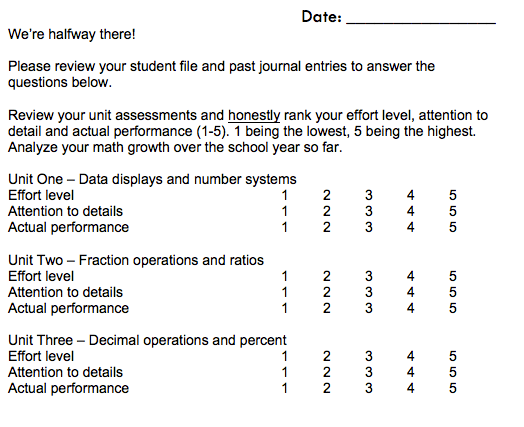
  • Students review and rate their perceived effort level and attention to detail
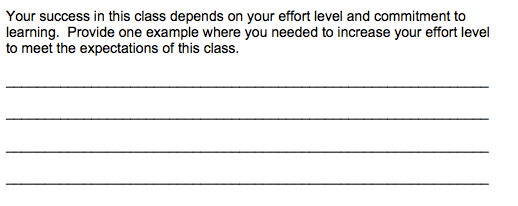
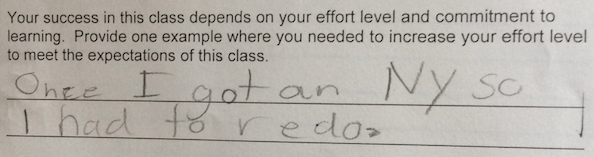
  • Students provide an example of where their effort level increased
  • Students create a math goal that will be achieved by the end of the year
  • Student indicate how they know that the goal will be met
  • The teacher and student sign-off on the reflection sheet


Screen Shot 2018-02-03 at 9.59.08 AM

Don’t get me wrong, this type of reflection is time consuming.  Whenever I discuss this process with other teachers I get quite a few questions about how to find the time.   Meeting 1:1 with kids to discuss their goal takes time and usually the other students are in stations or working on something independently. I can usually finish up meeting with the kids over 1-2 classes.  Instruction still occurs during this time, it’s just not a whole-group model.

Screen Shot 2018-02-03 at 10.02.01 AM.png

I’ve attempted many strategies to move kids away from comparing their score with others.  One strategy that seemed to work well was to have students go to stations and then I passed out the assessments.  I realized later that they just compared the results when they left the classroom.  I want to shift the paradigm to more of an individual growth model.  It’s a challenge.  Through the years, I believe progress has been made in this, but more needs to be done.

Screen Shot 2018-02-03 at 10.06.22 AM

The student math goals are interesting.  I had to have a brief mini lesson on the topic of math goal setting as many students wanted to initially make a goal of “getting everything right on the next test.”  I think many students were more interested in thinking of what their parents wanted and not necessarily a specific goal for themselves. Keep in mind these are 3-5th graders.  After a few different attempts, students started to make goals that were more skill focused.  Some students are now writing goals about “becoming better a dividing fractions”, “divide decimals accurately”, “become better at solving for x with one-step equations.”  While conferring with the kids I’m reminding them that the goals need to be measurable.

Screen Shot 2018-02-03 at 10.19.35 AMScreen Shot 2018-02-03 at 10.19.51 AMScreen Shot 2018-02-03 at 10.20.06 AMScreen Shot 2018-02-03 at 10.20.37 AM

After the assessment students review their math journals and monitor whether they’ve met their goal or not.  If not, they write down why or possibly change their goal.  I’ll then meet with the student and sign-off on the goal.  My next step is to involve parents in the goal and have a more frequent monitoring process.