The Last Five Days of School

Screen Shot 2018-05-25 at 7.27.52 PM

There’s about one week of school left before the end of the school year.  My school year ends on June 4th. Students know it, parents know it, and so do the teachers.  You can tell that school is coming to a close.  It’s in the air.   Teachers are starting to box up items and are planning their last few lessons of the school year.  The last class newsletters are being posted and student lockers are starting to empty.  The media specialist and library team is attempting to retrieve all of their books for inventory. Teachers that are retiring or leaving are giving away their resources and some teachers are moving classrooms.  The sound of tape closing up moving boxes echos around the school.   Multiple bulletin boards are being stripped down to reveal their natural cork board surfaces.  The classroom walls will soon be bare as teachers start thinking about the next school year.
Screen Shot 2018-05-25 at 7.29.47 PM.png

Yet, we have one week left. There’s been a lot of emphasis on the first five days of school, but in this post I’d like to address the last five days in one of my classes.

Monday is Memorial Day so students will begin the week on Tuesday.  Two of my classes will  be taking an assessment during the last week of school, which means that I can’t close out my grade book until the tests are graded.  Both classes have been exploring fractions and measurement and I don’t think the assessment will take longer than one period.  My class that isn’t taking a test is completing a scale factor project.

On Wednesday students will complete their last math journal reflection of the year. I’m in the midst of creating some questions for this and hope to finish it up by Monday.  Basically, I’m going to have the students analyze all of their assessments and SeeSaw account.  They’ll then reflect on the progress that they’ve made this year.  They’ll pinpoint a few strength areas and areas that could use some strengthening.  Since I loop with many of the classes I’d like to have the student create a summer goal that we can discuss when they return in August.  Students will bring home the tests that Wednesday to be signed and returned.

I plan on having Thursday be a research day for our math genius hour projects. Students have already created a questions and are currently in the research phase.  Some students are putting together their presentation while others are just beginning.  I don’t intend on having the students present his year as they’ll continue this project next school year.

Friday is designed as an end-of-year celebration.  Students will play different math games that we’ve used throughout the school year.  Some of the games are digital, while others involve cards and dice.  The last 10-15 minutes of class is used to fill out a class survey.  Again, I’ll be working on this over the weekend, but you can see something similar that I’ve used in the past here.  I say goodbye and tell the kids to have a great summer.  Some students are excited to get out to the bus and leave, while others want to talk about the year or what they’re doing this summer.

Field day is scheduled for Monday.  I generally don’t see the students much during field day.  I help out the different teams and at the end of the day all teachers have bus duty.  The fifth graders are “clapped-out” of the building and all the teachers wave goodbye as the busses leave.

Similar to other teachers, I have mixed feelings about the end of the school year.  It’s great to celebrate another year and the progress that’s been made.  But there’s also something different about coming back to your classroom that’s empty.   The clean up process begins and eventually teachers head home and another year is in the books.  I’m looking forward to recharging over the summer, but also have a few different work-related events.  Before you know it, I’ll be back to setup my classroom for another year.

Math Group Tasks

Screen Shot 2018-05-16 at 5.13.17 PM

My students have around two and a half weeks of school left.  Standardized testing has finished up and I’m planning out the end of May.  Each one of my math classes will be taking one more unit assessment before the end of May.  My fourth grade class has been exploring measurement conversions, computation, and graphing.  For the past week my students have been participating in group work where they’re given a task, anchor chart paper, (sometimes I split one sheet in half or quarters) and Expo markers.  Students work together to create a plan, create visual models, and report out the results.  Below is the structure that I’ve been following.

First, the teacher reviews the task with the entire class.  Students ask questions and clarification is given.  The tasks are often open-ended and require additional thought and reasoning beyond a yes/no answer.  Usually students need to construct a plan and present the best option.

Screen Shot 2018-05-16 at 5.13.04 PM.png

The teacher reviews the expectations.  Often I have the students show the steps needed to solve the problem, create a visual model, create a number model, and present their solution to the class.

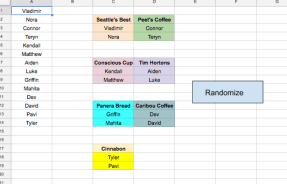
Students are then placed in groups randomly.  I’ve been using the randomizer script this year to create groups.  Using a visible random grouping strategy seems to help here.

Screen Shot 2018-05-15 at 9.16.21 PM

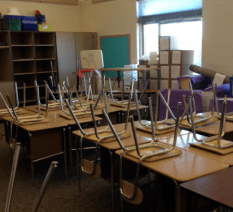
Students are assigned specific parts of the room to start the task.  Students are given some anchor chart paper and a bunch of markers.  Markers are used to put together a thorough response that’ll be shared with the class.  I set the Google countdown timer for 20-30 minutes and display it on the board.

I tend to listen to the discussion in each group and ask questions when needed.  I also try not to talk as much during this time.  Students create some type of rough draft on notebook paper before creating their chart.  When finished, the charts have visual models, number models, and are often messy.  I have no problem with that.  Math is and can be messy.  Students often scratch out number models that didn’t work or change units when needed.  They assign each other roles and determine the sequence for their presentation.  The presentations are no more than five minutes and includes a verbal explanation of how they found a solution.


This slideshow requires JavaScript.

After the alarms sounds students then present their findings to the class.  Part of the criteria is that all students are required to help when presenting to their peers.  Students are then given time to ask questions.  Each group presents and I hang up the charts all over the room.  I then model and review the answer with the students.  By then the class is just about finished and we’re on to the next lesson.

I’m finding that these types of  group activities to be great opportunities for students.  The collaboration and conversations that occur during these events are sometimes undervalued.  Students seem to be empowered to find the solution for themselves.  I provide scaffolding when needed, but I tend to let the students struggle through and find the best solution.  I find students using math vocabulary and critical thinking about the answer as they create number models and visual representations.  I’m hoping to include more of these opportunities in my planning for next school year.

Connecting and Extending Math Strategies

Screen Shot 2018-05-10 at 3.14.34 PM.png


This post has been marinating for a few weeks. I started thinking about it before NCTM and afterwards found it just as valuable.  In Late April my third grade students were exploring fractions.  This third grade group had experiences putting together and taking apart fractions earlier in the year.  They also used number lines to multiply a unit fraction by a whole number.  Students have slowly and steadily improved their confidence in being able to use fractions when completing application problems.  That’s when I came across a problem that seemed to stretch the fraction strategies that they’ve been using.

Screen Shot 2018-05-10 at 12.57.35 PM

I displayed this problem on the whiteboard.  I gave the students some time to digest the task and asked them what their first step would be.  A few students wanted to dive right in and use repeated addition to find the solution.  They thought this might be the most efficient method and what’s available in their strategy toolbox.   Other students thought that there might be a better strategy.  One students had an idea to possibly use an area model for this problem.  Curious looks came across the classroom as this particular student spoke up a bit more.  She mentioned that using a partial-products strategy could be helpful in a situation like this.  Some students agreed, while others were shaking their heads in disagreement.  For the most part, the class is very familiar with partial-products so the area model wouldn’t be a stretch.  Students also had an understanding that multiplication might be one way to tackle this problem.

I gave students time to discuss in their groups the different ways to solve the problem.  There was a lot of disagreement happening during this time.  I wanted to stop the whole class because of the noise, but the math conversations were actually really good. Students were vocal about using an area model, while some students said that they could find the answer by using a traditional method.  More students seemed confused, as this isn’t really a method that students have used with decimals.  I gave the class time to independently try out their strategy and find a solution.  Students worked on this for around five minutes.  Pictures were drawn, number lines constructed, and repeated addition was in full swing.  Some students had a correct solution, but I didn’t give an affirmation (which is crazy tough not to do).  I asked students to show a number model and most generated (5 * $1.13) + $1.39 = ?  I displayed the different strategies on the document camera.  I then asked the class if it’d be possible to use fractions to find a solution for this?  Just then, a group of students raised their hands.  They said that the 1.13 could be represented by 1 13/100 while 1.39 is equivalent for 1 39/100.  A collective whispering sound came across the classroom.  Then a bunch of hands came up from all over the room.  The class went through this strategy to find a solution.  Our number model changed a bit.

Screen Shot 2018-05-10 at 1.23.54 PM.png

The class then took the number model and used an area model.

Screen Shot 2018-05-10 at 1.28.58 PM.png

The students then added the 1  39/100 to the 5 65/100 to get 6  104/100.    Students then said that the answer is 7 and 4 hundredths.  Another students chimed in that the answer can’t just be written as a decimal and that it’s $7.04.  Students were satisfied with this method and asked if they could use it in the future.  I asked them why not?  A couple students said that they didn’t see fractions in the problem.  They saw decimals and that automatically changed the approach to a more “decimal-friendly” computation strategy. A few students replied that they didn’t think they could use it because it wasn’t taught.   Ouch.

After the class I pondered that response and thought about what is explicitly taught and what we expect students to explore and construct on their own.  Do we truly give students opportunities to discover mathematics in a way in which they can bridge strategies?  Not one student verbally called out to using a decimal to fraction conversion for this problem.  This has me wondering how explicit teachers are in empowering students to bridge strategies and concepts.  Are they given that freedom?  For example, are fraction strategies only used when students see fractions?  Is the substitution method only used when students see 1-step equations?   I believe it depends on the situation and background information also plays a role here. Having a deeper conceptual understanding of fractions and decimals might have led students to look at how the last strategy might be helpful.  Also, while an area model might be helpful now, the strategy will most likely change as a student’s math journey progresses.  Multiple strategies are beneficial for any learner, but this lesson has me asking more questions.  It was a terrific lesson and I know students were making connections.  That’s an #EduWin in my book. Next week the third grade class will be investigating angles.

Side note:  I finally submitted by components for board certification this week.  It’s a huge relief to send the files off, but now it’s a waiting game as I won’t get the scores back until December.