Evaluating Summative Assessments

Screen Shot 2018-12-29 at 9.46.26 AM

This past week has been a great opportunity to reflect and plan out the new year.  I’m writing this as I sip my coffee on a chilly day in the midwest.  As I contemplate my plans I’m reminded of always to “keep the end in mind” as I think of how instruction eventually leads to a summative assessment.  I usually see the following procedure used for math instruction:

Introduction–> Formative Assessment –> Reflection –> Summative –> Reporting

Summative assessments have changed over the years.  One major factor that determines how these look at the K-5 level is based on the district resource that’s used.  There are so many math publishing companies that push their resources to districts and the unit tests generally accompany them.   There are formative assessments that teachers use, but they’re often used depending on teacher preference. Grade level teams often plan out the formative assessments, although it’s up to the individual teacher to use them.  The summative assessments are another story.  These are set in stone and given at specific intervals throughout the school year.

The summative assessments in some K-5 classes take a long time to complete.  The upper elementary classes take a lot more time than the lower.  The accelerated classes can take 1-3 instructional days to complete one summative assessment. Usually there’s another day reviewing the assessment afterwards. The unit assessments often include written component and an open response section.  Each math class is allocated around 60 minutes for math and students are given (not always though) as much time as they need to complete the assessment.  These summative assessments are solely used to communicate how well students are performing compared to the standards and that’s put on the report cards.  As schools move more towards standards-based grading the reliance of the summative assessments may increase. Middle and high school might manage this time differently as final exams and tests become more of a priority.  I wonder how this summative assessment time could be better managed moving forward.

As far as I can see, there a couple options to consider.

  • Prioritize the standards within a math unit and adjust the summative
  • Rely more on class quizzes and emphasize the summative less
  • Create new summative assessments that better reflect the standards
  • Continue without changing anything

There are consequences depending on what’s picked and I’m sure other options exist that I can’t think of right now.  Prioritizing standards will inevitably leave out some standards and students won’t be exposed to certain skills/concepts as frequently.  Relying on quizzes for grades has me wondering how many attempts are given before students are actually assessed.  This can be a challenge as some students might be exposed to a concept three times, while another might have seven.  Is one student better prepared for the summative than the other?  Creating new summative assessments might be a good option if time is available to do so.  I’ve heard multiple times that teachers aren’t trained to write assessments, but I find that there input to be very valuable in the process.

I don’t believe there’s one right solution to this issue, but it’s worth contemplating a few different ideas.  I’m interested in hearing how others manage the summative assessment process.

Continuing the Math Writing Process

Screen Shot 2018-12-15 at 7.07.33 AM.png

As some of you might already know, one of my goals this year is to find strategies to help my students write better mathematical explanations. My students have been making progress towards that goal.  I see glimpses here and there where students are putting together more concrete statements and transitioning them into coherent explanations.  It’s good news – and making progress helps the students see that growth is happening.  We all need that boost every once in a while – or even more than that. Last week, students were asked to fill out a rubric and evaluate their own mathematical writing.  I then went over and highlighted my responses in a different color.

I passed those papers back early last week and the class had a conversation about the difference between my scores and theirs.  It was a productive conversation and I believe the kids left with a better understanding of what the categories in the rubric mean.  For the next couple days the class reviewed measurement concepts and place value.

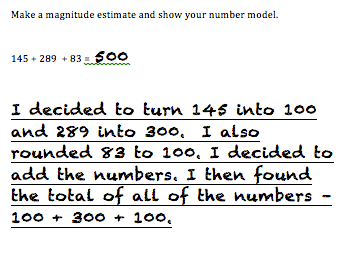
The next stage of this mathematical writing process was for students to evaluate the writing of another student.  I’m finding myself using more retrieval practice strategies for this particular process and critiquing others writing multiple times has helped (at least I believe) them become better at recognizing rubric elements in their own writing.  I also want to give students multiples opportunities that are spread out with assessing and self-assessing strategies.  I tried this before earlier with some success, but this was also before students created the writing rubric that we’re using now.  Students read the prompt on magnitude estimates, read over what the writer created and filled out the rubric.

Screen Shot 2018-12-15 at 6.58.11 AM.png

The students carefully read through the prompt and then throughly read through the response.  During this time the classroom was so quiet.  Some students used highlighters while others were very critical with the pencil.  I even had a few students ask the writer about their response on the paper – future teacher maybe?

Near the end of the class I reviewed the responses and the students voted on where they thought this writing would fit on the rubric.  I’d say around 50-60% of the students were on target with all the rubric selections.  This improvement is telling and I’m excited to see growth in this area.

Next week I’m planning on introducing a different math writing prompt.  This will be their second attempt and will be used as a formative checkpoint.  The class will then continue this journey after winter break.

  • Shoutout to the MAA site and people for helping me thinking of additional ideas for this math writing process

Math Explanations

Screen Shot 2018-12-08 at 6.49.34 AM.png

This year I’ve been working with a group of 20-25 second grade math students.  I see them daily for about 20-30 minutes.  This group has been exploring a number of math concepts related to computation, place value and measurement.  At the beginning of each unit this group is given a pre-assessment and the class investigates a number of concepts for approximately a month.  During that month that class puts together and takes apart numbers, uses math tools, reflects on our math experiences and sharpens  different computation strategies.  The unit concludes with a post-assessment.  The class then reviews the assessment, looks for trends and analyzes possible errors before moving onto the next unit of study.

Every unit assessment has some type of open response which asks students to explain their mathematical thinking.  The performance on these questions has been rough. This isn’t a new experience and I wrote about this a while back here.  Students seem to have trouble creating complete math statements that answer the open response question.  Students have noticed this trend too.  Earlier in the week I ended up having a class discussion about math statements and written responses.  Through our discussion I also realized this is something that I need to learn more about.  This opportunity also had me wondering about past assignments and how often kids are really asked to explain their mathematical writing in written form.

To me, this issue looked like a professional need as well as a student need.  I looked online for additional resources related to helping students identify quality mathematical writing.  I found a few rubrics, but they were very generic and included words like “high-quality” or “fully understands the topic” that I think are valued, but not necessarily quantifiable.  So the class had another brief discussion about what math explanations should look like.  We came up with a list of what should be included:

  • Math vocabulary
  • Restating the question
  • Number models

A draft rubric was built and students completed a pre-assessment using the new expectations.  After writing a mathematical response to an estimation problem earlier in the week, students circled where they felt they were in relation to the expectation.

Screen Shot 2018-12-08 at 6.49.03 AM.png

Screen Shot 2018-12-08 at 6.49.19 AM.png

Screen Shot 2018-12-08 at 6.49.46 AM.png

I then went through the student responses and added my own thoughts in blue. Next week I’ll be passing these back to my students. This was the first time using this particular rubric and there may be changes to this as the year progresses.  I still need to hone in on helping students recognize what “restating the question” means as I think that’s a bit fuzzy.

The good news is that we’re making progress and students are becoming more aware of their mathematical writing skills.  I’m looking forward to seeing how this evolves over time.  I’ll also be sharing this with my second grade team before winter break.