Spaced Retrieval Practice

Screen Shot 2019-04-25 at 6.41.25 PM

There’s around one month of school left and it feels like the home stretch.  The next month is full of changes.  The weather changes from chilly temps to sunny days (at least in the Chicago burbs), class lists and sections are starting to take form, driving to/from school with the windows down is the norm, and planning for that final month is in full swing.  The majority of my math classes just finished a unit assessment and there’s one unit remaining.  So often I find that students perceive the end of a math unit to “close out” the learning on a particular skill set.  I observe that this idea often gets pushed out as grade deadlines approach.

As my classes start a new unit I’m pausing to reflect on how my practice has changed.  Last year I read How to Make it Stick and I intentionally planned to use more retrieval practices. This year I’ve incorporated more review opportunities through online formative quizzes and by trying to make implicit connections to past learning.  I’ve often asked students how today’s objective connects to this week’s learning.

While digging through my resource materials early this year I found optional mid-year and cumulative assessments. Generally, I find that there’s not enough time to complete all of the assignments/tasks in the resource so these particular tests aren’t used frequently.  This year I decided to use them to help with spaced retrieval practice.  Instead of using a mid-year and cumulative assessment directly following a unit I decided to space out these assignments and take off the grading emphasis.  These types of assignments take multiple days to complete and I often have students work with partners to reflect on their progress.  So far I’ve seen positive progress as students this year are referring back to past skills more quickly and bridging the connections on a frequent basis.  I’m looking forward to using a similar strategy next year.
Classifying Polygons

Screen Shot 2019-04-12 at 6.59.00 PM.png

One of my classes is in the middle of a unit on geometry and measurement.  They’ve identified shapes before, such as rectangles, squares, triangles and hexagons.  Earlier in the year they found the area and volume of shapes involving rectangles, squares and triangles.  The current unit investigates how polygons (specifically triangles and quadrilaterals) are similar and the study of shapes progress as students create hierarchies.

  • CCSS.MATH.CONTENT.5.G.B.3
    Understand that attributes belonging to a category of two-dimensional figures also belong to all subcategories of that category. For example, all rectangles have four right angles and squares are rectangles, so all squares have four right angles.


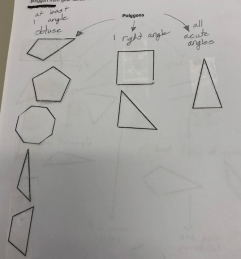
In order to dig deeper into the above standards the students starts the classification process.  This was fairly new for most of the students.  I explained what classification meant and gave a few examples related to the characteristics of triangles and quadrilaterals.  Students were given a sheet of quadrilaterals to cut out and classify.  The next question I was asked was related to how each shape should be categorized.  The class reviewed different vocabulary words associated with polygons and then I left the students create their own categories.

Screen Shot 2019-04-12 at 6.58.38 PM.png
This student decided to split up the shapes into three categories.  3-sides, 4-sides and 4+.

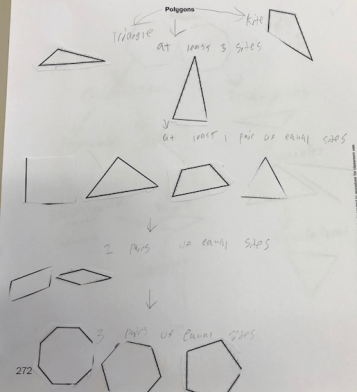
After discussing equal side lengths and parallel sides two of my students created the classifications related to those terms.

Screen Shot 2019-04-12 at 6.58.48 PM

Screen Shot 2019-04-12 at 6.59.08 PM.png

Almost every student had a different way to organize their shapes.  Students went to different tables and observed how their peers classified the shapes and then the class discussed similarities.  Next week students will classify the shapes with a hierarchy chart.  I’m looking forward to seeing what they create.