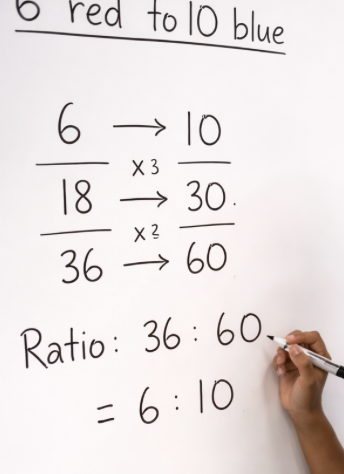
This year I have been thinking deeply about how to better use whiteboards in the classroom. I have contemplated what it means to create a classroom where students are truly doing the thinking. In my 6th grade math classroom, Building Thinking Classroom (BTC) strategies have pushed me to see math instruction differently. I’ve observered that success is not about how quickly students get to the answer or how closely they follow my method modeled during direct instruction. It is about giving students meaningful opportunities to reason, collaborate, and make their thinking visible. The more I lean into student math tasks at the whiteboards, the more I see that productive struggle, discussion, and student voice are not obstacles to learning. They are the learning.
One moment that really changed my thinking happened during a BTC ratios task earlier this year. Students were working at the whiteboards and one group solved the problem in a way I did not directly teach. My teacher instinct was to step in, but instead I asked the group to explain their thinking. As they talked I saw that their reasoning was strong, even though their approach looked more extensive than mine. That moment reminded me that my role is not always to give students the quickest method, but to slow down, listen, and learn how they are making sense of the math. I have become much more intentional about when to step in. I carefully decide when to let student thinking lead. That is where real reasoning, confidence, and math stamina start to grow.
For the last month or so I’ve been trying a new strategy during consolidation. Today, after students finished working at the whiteboards, I brought everyone back to their seats for our discussion. Instead of having students explain only their own board, I asked individual students to read and interpret what other groups had written from their seat. This small shift created a powerful opportunity. Students had to look carefully at work provided by another team. They needed to make sense of their thinking and had to consider whether the ideas were communicated clearly. It also gave the original writers a chance to see whether their written thinking matched what they intended to say. Sometimes the original team would comment or rephrase their thinking during this time so it is more clear. As a class, students began comparing and contrasting strategies, asking questions, and noticing details they missed while communicating their solving process. The conversation felt richer because it was not just about presenting answers. It was about making thinking visible and understandable to others.
That is the direction I want my classroom to keep moving. I want students to see math as a place where their ideas matter. It is a place where different strategies can be worth exploring. It is also where discussion helps everyone learn more deeply. BTC has strengthened my belief that the teacher does not always need to be the first voice in the room or the keeper of strategies. Sometimes the most important work I can do is create the conditions for students to notice, explain, revise, and connect ideas together. When that happens, the classroom looks a little messier and louder from the outside. However, the thinking is stronger and the reasoning is deeper.

 Educational Aspirations