Last week at this time, I was in Renton, WA attending the Building Thinking Classrooms (BTC) conference and enjoying the scenic Pacific Northwest as a backdrop. I was fortunate to attend with colleagues from my district and the conversation in sessions and over lunch sparked ideas about how to take what we’ve learned back to the classroom.
After using BTC strategies for the past few years, I was especially drawn to sessions that focused on how to organize the boards for efficient time use and studentc-centered management of learning behaviors throughout the BTC process. Below are a few of many takeaways from the event.
Brian Durocher shared an idea that stood out—using student or family submitted photos over the summer as math prompts. Students analyze these personal images for mathematical concepts, either individually or in groups. It’s a powerful way to build routines, connect learning to students’ lives, and set expectations early on.

Jared Sliger offered insight into what strong and weak BTC task launches look like. His example involved thin slicing systems of equations across whiteboard quadrants, progressively revealing answers to promote deeper thinking. He also emphasized storytelling as a key component of effective launches.

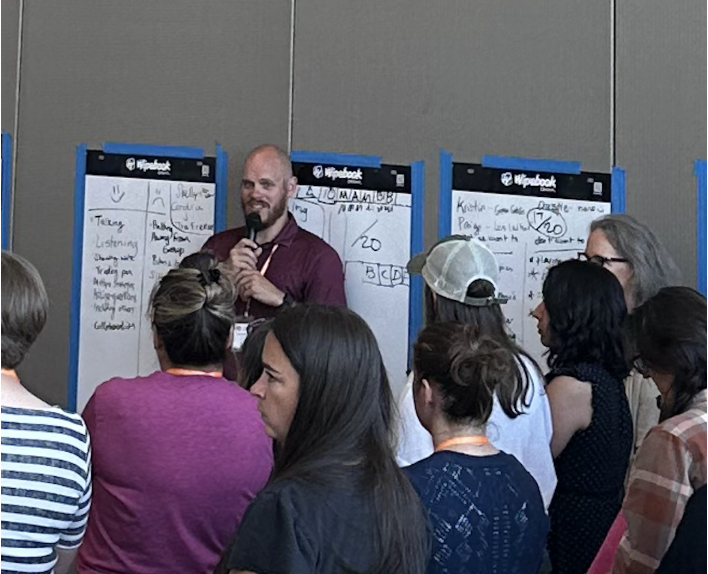
Another theme that emerged was about setting clear expectations. Chase Orton and Aleda Klassen led a session on rubrics and first-day BTC tasks where students role-play through an activity to co-create class norms. I’m seriously considering adapting this for my first day in August.

Nicholas Stevener’s session on grading board work gave me a lot to think about. His system allows students to earn participation points based on group behaviors—sharing the marker, working in triangles, etc.—with opportunities for teachers to adjust scores based on observation. It’s a structured way to encourage self-advocacy and accountability, though I’m still considering the logistics of implementing it.
Now comes the challenge of deciding what’s realistic to bring back and what’s truly worth the time. With limited hours in the school day, I want to be purposeful in choosing tools and strategies that support stronger norms, meaningful tasks, and greater student ownership. It was more than nice to learn in a scenic location, be in the presence of passionate educators, and bounce ideas off of colleagues. Now comes the application phase – let’s get to work.
 Educational Aspirations