Shaving Cream and Math

Image by:  Salvatore


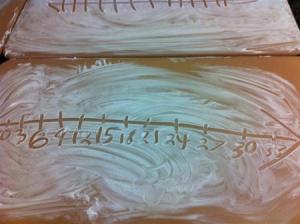
I’m always trying to find new ways to make math interesting and relevant. Generally, the more interested the students are in the instruction, the more willing they are to apply their learning.  This past week I used one common household item to teach my elementary math class about number lines.  I’m not the only teacher who has used this strategy in the classroom, but I’ve found encouraging results by doing so, that’s why I’m sharing.  I’ve provided a few pictures for those (like me) who need a visual representation before putting a strategy into practice.

Procedure

1.)  Have all the students clear their desks.  There shouldn’t be anything on the desks, including pencils, water bottles, etc.  During this time students get a little anxious in wondering what’s going to happen next.

2.)  The teacher takes out one or two bottles of shaving cream.   I used Babaso, available at the Dollar Tree.  This works much better than some of the more expensive shaving creams.

3.)  The teacher asks the students to predict how the class will be using the shaving cream to learn about math.  You might get some interesting responses with that question.  This may also gains student interest.

4.)  Go over the ground rules.  Everyone should roll up their sleeves, don’t fling the shaving cream at anyone in the class, don’t touch the shaving cream until directed, no one gets out of their seat, etc.

5.)  Go to each desk and spray a bit of shaving cream (4-5 seconds) in the middle of each desk.

6.)  Tell the students that they will be given a few minutes to “play” with the shaving cream.  Ask the students to make different types of polygons, rays, lines, etc. with the shaving cream.

7.)  The teacher models a few number lines on the whiteboard.  Students are asked to create their own number lines.  Ask the students to create multiple number lines.  Once a student creates a number line, the teacher reviews the work (could be a great opportunity to take a picture), gives the student a bit more shaving cream and then looks for another finished project.

8.)  At the end of this project there are a lot of sticky fingers.  The teacher hands out wet wipes or wet paper towels to the students.  The students clean their own desk and hands.

9.)  Before the students leave class, or sometime in the near future, the teacher asks the students to create three additional number lines (addition, subtraction, multiplication) on paper and turn their work into the teacher.

More Examples:

Shaving Cream and Math Ideas

Greenfield Exempt Schools

Mrs. Clayton’s Class Blog – Using Shaving Cream

Disclaimer (unfortunate but necessary) : The thoughts and opinions expressed in these pages are my own, and not necessarily the opinions of my employers.

Characteristics of a Teacher

                                                                                                                                                                                                                    Image by Nuttakit


Early in my teaching career I had an administrator ask me an interesting question:

What characteristics do you value in a potential teacher?

This question was asked before interviewing a few candidates for an upper elementary grade level teaching position. From what I remember, my response primarily consisted of the candidate being able to follow the district’s protocols, the ability to create lesson plans, and handle classroom management.  Looking back now, my answers originated from what I learned during my undergraduate experience.  If I was going to answer the question now, my answer would be vastly different.

Three Characteristics:

1.)  Communication

The teacher should have solid communication skills.  These skills are important, not only for instruction delivery, but also in communicating expectations to the community.  Teachers need to be able to use technology to deliver updates and keep parents in the loop to what is happening in the classroom.  Often, non-communication may be perceived as not caring.  Trouble can brew from unbalanced expectations from the teacher or parent.

2.)  Collaboration

Working together with limited resources happens frequently in the education sector. Having the ability to collaboratively work within a grade level team, as well as a school team benefits an entire school.  Teachers who embrace the idea that not only are the students in their class valued, but the entire school is full of learners and all stakeholders are responsible for the students.

3.)  Focus on Student Learning

Teachers need to be able to understand their role in the student learning process.  Teachers play many roles in the classroom, but student learning should be the focal point.  Student achievement data, in a variety of forms can be helpful in driving instruction decisions.  Teachers who are able to analyze student data to make instructional decisions are extremely valuable.  Curriculum is only as good as the teacher who is utilizing the resource.  To meet students’ needs teachers need to be able to identify students’ academic learning needs and address how to utilize resources to meet the needs of each student in the classroom.  In order to ensure that students are learning at high levels, teachers need to be able to access practical professional development opportunities to improve their craft, therefore increasing student learning.


This is by no means an exhaustive list, but just a few key components that I find valuable.  21st century teachers need to be able to have a variety of skills that enable students to learn at optimal levels.

Differentiated Instruction

Image by Luigi Diamanti

As an educator, part of my job is to meet students’ academic needs.  Every educator, at one time or another, asks the question – how can I meet the needs of all the students that enter my classroom?  That’s a tough questions to answer, with multiple answers, depending on your philosophy of education.  To start, you need to understand the current skill level of your students.  You might want to give some type of pre-assessment to determine what type of skills that the students possess. A lot of vital data can be extracted by analyzing student assessment data.  Student assessment data can often drive school-wide instructional decisions.  Once assessment data has been collected and analyzed, you can begin to start to differentiate and individualize instruction.  Differentiated instruction is an educational buzz word that has been around for quite some time now.  What does it actually mean and isn’t it subjective?  Here are a few definitions:


“Differentiated instruction is a teaching theory based on the premise that instructional approaches should vary and be adapted in relation to individual and diverse students in classrooms” – Carol Anne Tomlinson

Differentiating instruction ….”Maximize(s) each student’s growth by recognizing that students have different ways of learning, different interests, and different ways of responding to instruction”  – Diane Ravitch

“Rather than simply teaching to the middle by providing a single avenue for learning for all students in a class, teachers using differentiated instruction match tasks, activities, and assessments with their students’ interests, abilities, and learning preferences” Jennipher Willoughby


Throughout this post, I’m going to show one way to differentiate instruction in the classroom. Specifically, via a flexible grouping strategy.

After utilizing a pre-assessment, or some type of formative assessment, you can use the results to begin to group the students based on skill level.  Generally, different “flexible” groups are created based on the skill level of each student. Each group will work towards achieving or mastering specific skills related to the curriculum.  For example, one group might work on basic computation strategies related to practical application problems, another might practice critical thinking skills, and another group may complete enrichment projects related to statistics.  What each group works on should focus on improving students’ skills.  Student groups are fluid and can change throughout the school year as additional student data is collected.  Individuals in each group will set their own goals through a goal setting process.  By engaging in goal setting, students are given the opportunity to gain responsibility for their own learning.  Shifting some of the responsibility to the student gives ownership, therefore assisting in intrinsically motivating a student to achieve their goal.

This is only one form of differentiated instruction.  I’ve provided a list of resources on differentiated instruction below.

Disclaimer (unfortunate but necessary) : The thoughts and opinions expressed in these pages are my own, and not necessarily the opinions of my employers.

The Real Number Line

Image by Winnond

Approximately two weeks have passed since the new school year has started and I’m finding that the traditional number line (that many teachers have become accustomed to) needs an upgrade.  My math students are benefiting from the number line, but true understanding of numbers doesn’t come from a number line alone.  For the past seven years I’ve used a “typical” number line from -10 to 100 in my classroom.

Don’t get me wrong … the number line is helpful in teaching many number sense concepts.  In my opinion, the number line offers students a visual/spatial representation of the number system.  I  believe many numeracy concepts are built from understanding the system of numbers.  What is often missed, or not necessarily taught, while utilizing the number line are numbers that don’t fit the category of being whole.  For example, I generally don’t see pi or irrational numbers being part of a number line.


Recently I found a “Real Number Line” poster.  I was fortunate enough to find this poster and have utilized it to teach elementary students about the number system. I think it’s important to communicate that square roots, fractions, percentages, mixed numbers, etc.  should be included on a number line.

I actually created a practical follow up activity in response to this post here.

Instead of purchasing a poster, you could have the students create their own.  A few examples are found below:

4/25/12

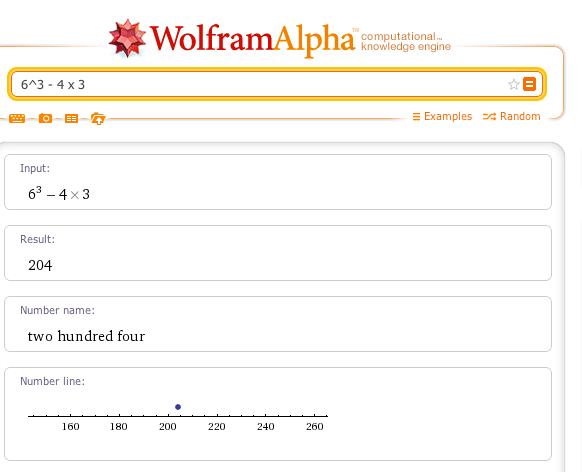
I believe that Wolfram Alpha does an excellent job of emphasize the importance of a number line in the answer it provides.  The answer can be represented on a number line.  See the example below.

8/14/12

I’ve been reading How the Brain Learns Mathematics by David Sousa.

David emphasis the importance of the mental number line.  All humans have number sense.  For example:  studies indicate that the brain can decide that 60 is larger than 12, but it takes the brain a longer time to distinguish that 76 is less than 79.  It seems that when the digits are closer in value the response time of the human increased.  Visualizing many different forms of number lines would be beneficial and assist in developing better number sense skills at a young age.

 I thought this quote was beneficial:

“The increasing compression of numbers on our mental number line makes it more difficult to distinguish the larger of a pair of numbers as their value gets greater.  As a result the speed and accuracy with which we carry out calculations decrease as the numbers get larger”

 – David Sousa