Wanted: Math Skills for Discounts

             Image by:  A. Balaraman


I recently came across “Number Crunching Coupon Calculating Champ” on a Facebook page.  The screenshot image is found below.  I plan on incorporating this page into my math instruction next week.  According to the website, if I completed the problem correctly I would receive a certain percentage off of my next purchase.  So … completing a math problem on the Internet = a percentage discount?  I don’t recall ever reading a promotion like this before.  Regardless of the motivation behind the company sponsoring the ad, I thought this type of math application could benefit my classroom.

I didn’t fill out the form, but I thought that this type of problem could possibly supplement my instruction.  There are many ways to teach discounts, but real life examples bring awareness that math is everywhere.

There are many different ways to solve this type of problem.  I may have the students work in collaborative groups to find the answer.   All of the different mathematical operations will be useful to practice.  Overall, I feel as though this type of problem will give students an opportunity to utilize their mathematical knowledge in a practical way.


My students enjoyed working out the problem above, although it is quite intense for an elementary student. The picture below might assist in starting a discussion about percent increases and the processes involved in finding the answer.

What is the percent increase from 7 to 10?

Fundamental Place Value

Image by:  D. Castillo

After analyzing a recent math assessment, I asked a group of middle school teachers in another state what particular math topic they would recommend elementary teachers strengthen.  I thought that the middle school teachers could offer valuable input regarding how the elementary schools are preparing students for middle school. After a quick discussion, each middle school teacher (all five of them) decided that place value is a fundamental concept that precedes many other high-level math concepts. After listening to the discussion, I started to think of when place value is actually taught.  According to the math Common Core, an entire math strand is dedicated to place value / base 10 concepts.  In fact the word place value is found 42 times in the Common Core Standards for Mathematics.  Obviously, place value is important, but how do teachers introduce and expand on the topic?  First of all, teachers can use visuals,such as a place value chart.

Ideas and links regarding teaching place value can be found below.

  • Place value can start before first grade – counting and identifying specific values
  • Students can be given the opportunity to utilize base-ten blocks and explore how the pieces are interchangeable
  • Place value can be viewed as a decimal or fraction
  • Use coins to show another way to view place value
  • Tactual place value activities
  • Online games or activities
  • Use a number line to show how place value plays a role in how large or small numbers become.

Reflection Journals in Math Class?

Image by:  Samana

In the past, I’ve used reflection journals for language arts assignments.  Allowing students to reflect via journaling was one way that I could informally assess whether students were making connections to the literature.  After utilizing the idea of journaling for my language arts class, I thought that it might be useful to integrate this strategy with math.  Before starting this adventure I decided to complete some homework on the idea of math journaling.   In the past I’ve used standard reflection sheets.  While collecting ideas, I also looked for math journal writing prompts and rubrics 1 2 3 .  I found many ideas and strategies for math journaling here and at Monica’s website. If you’re unsure of how to introduce the topic of math journaling, this Word example may help.  If you’re curious of where to start, I’ve found that this site provides terrific examples.  So, after researching a few options I decided to label all of my journals and prepare for uncharted territory.

After giving a unit assessment, I gave my first math writing prompt:

  • How do you feel about your performance on the last unit assessment?  
  • What type of math concepts do you find interesting?  Why?

Students were also asked to include a picture with their response.  Why a picture?  I thought that allowing students to draw a picture may portray how they feel regarding their performance.  Some students decided to draw more of a picture, while others decided to write more with words.  Allowing this type of flexibility gave students an opportunity to communicate their response to the writing prompts differently.  The students then turned in their journals and I wrote a short response to each individual response.  I feel as though the students really enjoy the fact that I personalize my response to each student. I also feel as though this builds a positive classroom environment, as each student is shown that their opinion is valued.  The journals can also be used during parent teacher conferences, although it might be a good idea to disclose this to the students before they write.

What happend?

After completing a plus/delta chart, students thoroughly agreed that the math journals enabled them to reflect on how they are doing in the class.  Some students even communicated that the journals were a way to set specific math goals.  Currently, I give students an opportunity to complete a journal entry approximately every two weeks.  A byproduct of using the journals may also lead to personal goal setting and more academic involvement from the student.

What’s next?

I would like to incorporate the idea of utilizing specific math vocabulary in the journals. Not only should the math journals be used for reflection, but they can also be used as another opportunity to practice mathematical concepts.  As an elementary school teacher, I think it’s important for students to have a solid understanding of math vocabulary at a young age.  Having consistent definitions is also important. Certain math vocabulary words that are utilized in first grade will accompany a student throughout their entire life.  For example: multiply, divide, sum, fraction, etc.  Overall, I feel that students will become better at understanding math vocabulary and reflect on their learning through the math journals.  The journals will be used consistenly, so students will observe the progress that they have personally achieved throughout the year.

Geometry Birds

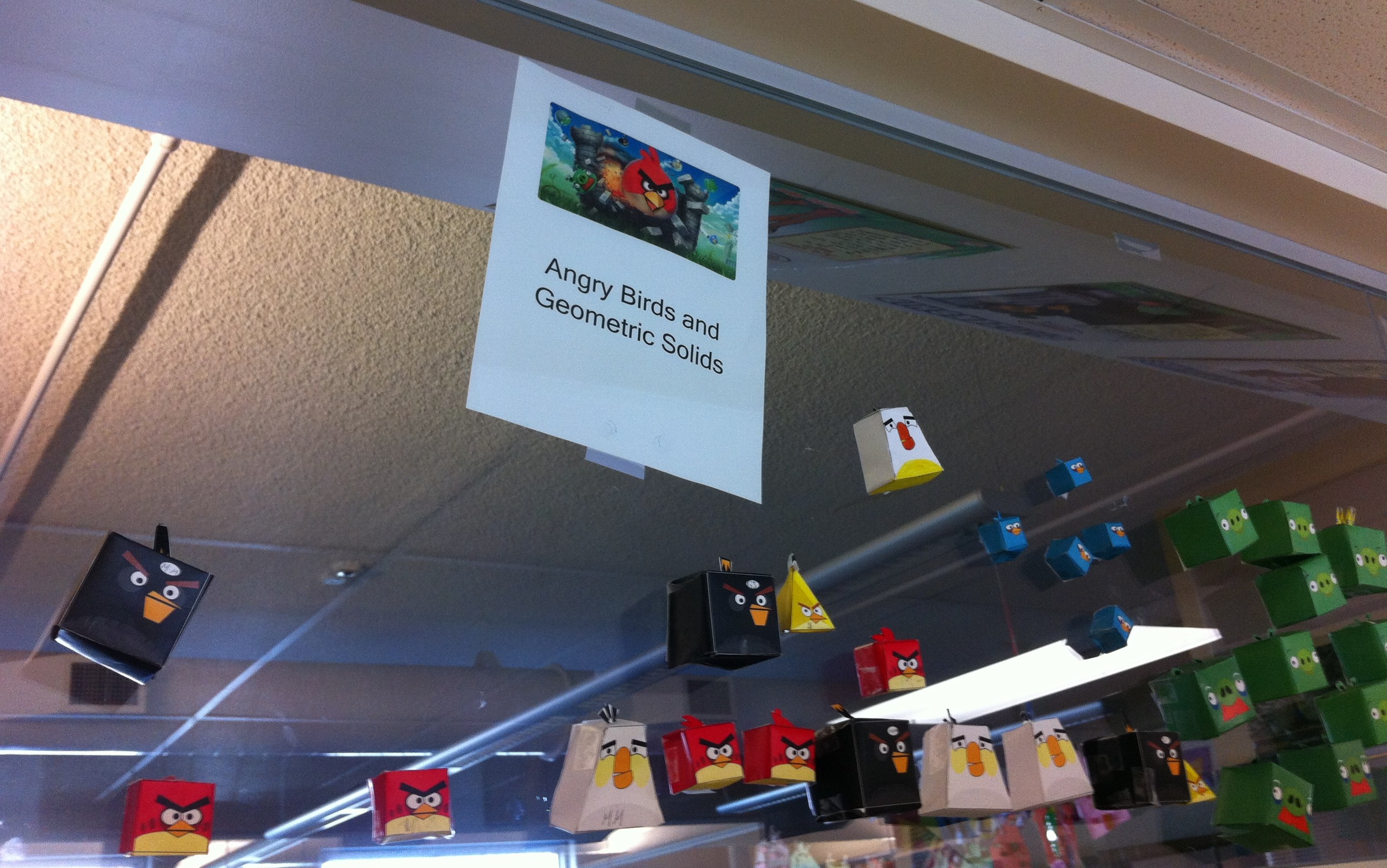
Most teachers would agree that making math relevant and engaging is important. Utilizing student interest in a math lesson can turn a good lesson into a great lesson. Moreover, the lesson will be memorable for the student – even after the assessment. An example of this type of lesson can be found here. Over the past year I’ve seen many Twitter posts (and publication articles) regarding how to use Angry Birds in the classroom. I understand that this game can be used for a physics discussion, but since I teach at the elementary level, I often skimmed those types of posts and looked for some type of way to integrate this extremely popular game into my classroom.

Even at the elementary level, students are intrigued and can tell me all about the game itself, from strategy to cheat codes.  I feel that part of my job is to engage students in meaningful learning.  Last weekend I came across a blog that led to this site that shows how Angry Birds can be used to teach geometry concepts at the elementary level.  The site even had colorful PDFs that I could print to make this activity realistic.  I utilized this activity for my third grade class.

Here are the steps:

1.)  I printed out the PDFs and had my students create all of the different geometric solids. Here are the pdfs (1) (2).

2.)  I showed students different types of solids.  I also brought out the manipulatives found below.

3.)  I then reviewed the following vocabulary words:  vertices, faces, edges, and surface area.

4.)  Students were given an opportunity to pick the net of one particular bird.  Here’s an example:

5.)  Students used scissors and glue sticks to build their particular bird.

6.)  Once finished, students were asked to fill out an exit card regarding the amount of edges, vertices, and faces of the particular bird that they created.

7.)  The birds were then posted in the classroom.  The pictures are below.