2012 in Review – Statistics

2012 Statistics
2012 Statistics

After reading a few “2012 end of the year review” blog posts, I decided to write my own. This blog started out as a math lesson bank and has evolved into a reflection / feedback tool for the #elemchat and #mathchat communities.

Educational Aspirations, the title for this blog hopes to communicate the importance of creating a culture of continuous learning.  Throughout 2012, I’ve utilized my PLN to implement lesson ideas / strategies in my own classroom.  Blogging has enabled me to reflect on my own practice and receive feedback on thoughts related to education. In an effort to be more organized and concise,  I’m going divide this blog post into a few statistical lists.

Most Visited Blog Pages:

1.  Educational Aspirations Homepage (7,853 visits)

2.  The Real Number Line (4,947 visits)

3.  Geometry Birds (1,815 visits)

4.  Goal Setting for Students (1,044 visits)

Top Views by Country

1.  United States

2.  United Kingdom

3.  Canada

Most Popular Tags:

1.  Education

2.  Math

3.  Elementary Teaching

2012 Referrers

1.  Google Search “number line” “the real number line” “educational aspirations”

2.  Pinterest

3.  Twitter

Outbound Clicks

1.  Angry Birds Templates (652 clicks)

2.  NRICH Enriching Mathematics (302 clicks)

3.  Elevated Math (195 clicks)


Picture Credit:  R. Krishnan

Utilizing Teachers’ Strengths to Improve Schools

Utilizing Teachers' Strengths

Utilizing Teachers’ Strengths

During this holiday season I’m reflecting on the topic of school leadership.  School improvement often begins with a vision, but without teacher input or ownership, the vision may become undervalued.  It takes commitment and collaboration from all stakeholders to improve a systematic school organization.  This collaboration requires staff to trust the leadership within a school.  Principals have opportunities to build trust with their staff by ensuring that they don’t underutilize talents within their own school.  Teachers often have skills that aren’t necessarily visible during an introductory handshake.  Every teacher has strengths that they can bring to the bale, although some of the strengths may be challenging to distinguish.  Some of these positive skills could include:  rapport with parents, technology integration, planning with teaching teams, leading through mentoring,  goal setting with students, small group instruction, facilitating guided groups, etc.)

Coordinating Strengths

Teachers that are underutilized often disengage when asked to be part of school leadership decisions.  I believe that the majority of teachers unconditionally care and want the best for their students.  Unfortunately, teacher underutilization may encourage complacency and a lack of voice during school leadership decisions.  At this point, some teachers find professional development elsewhere, or possibly, employment elsewhere. Retaining effective teachers through utilization of teachers’ strengths is possible. I believe that teachers that feel utilized and valued often have ownership and participate more in school decisions. Teacher ownership helps schools become communities of collaboration.

How do educational leaders utilize teachers’ strengths and encourage teacher leadership?

One way to encourage teachers to utilize their strengths is to use inventories.  Just as teachers survey their students to learn more about them, principals have a unique opportunity to understand their staff better by surveying them.  Being aware of a teacher’s strength will enable a principal to coordinate personell to best meet the needs of a school.  Administrators can create a survey using Google Docs or use a template that best meets their needs.  Surveying staff members can be a proactive step in understanding individual perspectives and skill sets.  Using teacher inventories can lead to staff investment opportunities for school administrators.

What methods do you use to to encourage teacher leadership?

Photo Credit:  D. Castillo & J. Creationz

The Marshmallow Challenge in the Elementary Classroom

Using Food to Learn
Creating Structures with Collaboration

Approximately two months ago I noticed a Twitter post about something called the Marshmallow Challenge.  The tweet led me to this TED video.  Many of the examples indicated that the challenge could be used with adults as well as students.  The official Marshmallow Challenge website offers many useful instructions and tips for facilitators.  I decided to use the challenge with a fourth grade classroom.  The session, from start to finish, took approximately 45 minutes.  The standard 18 minute time limit to work on the project was perfect for my classroom.  Of course the focus of this project emphasizes teamwork, but I decided to add a few measurement standards. For example, the students were required to measure the length of each pasta stick used and find the volume of the marshmallow (as a cylinder).  The total height of the structure was also measured.  Here are a few pictures from the event:

This slideshow requires JavaScript.

The class had a debriefing session after the event.  During this discussion, students revealed their strategy.  Here were some of the questions that were discussed.

  • What will the base of the structure look like?
  • Will we use all of the materials?
  • What are our roles?
  • How will we work as a team?
  • How does working as a team help us succeed?
  • Will we wait to put the marshmallow on top at the very end or test it throughout the project?
  • Should we write out a plan in advance?
  • How should we work together?
  • What are other groups doing?

Overall, this learning experience gave students an opportunity to use critical thinking in a collaborative setting.   I’m planning on having students complete a plus/delta chart and complete an entry in their math journals next week.  

*Picture credit: Stoon

Measurement and Mini Golf

Measurement Project
Measurement Project

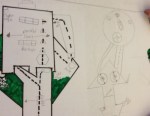
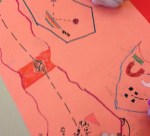
Approximately a week ago I was paging through my math curriculum. Through a pre-assessment I found that students were in need of a review on angle classification and measuring skills.  The curriculum lessons offered a number of worksheets and angle measuring drills.  Although these lessons seemed beneficial, I felt the need to create a more memorable learning experience for my math students.   At this point, I decided to search for measurement projects. While following #mathchat, I came across this Edgalaxy site.  The project seemed to match many of the objectives that needed strengthening in my class.  I changed up the directions and modified some specifics in order to best meet the needs of my students.

So … a week has passed and almost all of the projects are complete.  I listed the project steps below.  Feel free to use any of the ideas below in your own classroom.

1.  Had out the direction sheet.  Here is a Word template (via Google Docs) for your use.

Directions in WRD

2.  Review many of the different vocabulary words associated with the project: acute, obtuse, right, parallel, perpendicular, trapezoid, etc.

image_8

3.  Show possible examples.  I tend to show just a few examples as I don’t want to give them a mini golf course to copy.

4.  Group the students into pairs.  If you prefer, this project could be implemented as a collaborative group activity.

5.  Students choose their construction paper color (11″ x 20″)

6.  Students draft their course in pencil (on grid paper).  The draft gets approved by the teacher and then is transfered to scale on construction paper.

Sample

7.  Students present their final projects to the class.