
Web-Based Math Differentiation in Elementary Schools

Different Learning Paths for Different Students

It’s apparent that student achievement data, in many different forms (formative, standardized, norm-referenced, common assessments, etc.) is becoming increasingly valued by administrators and teachers alike.   Teacher PLC teams analyze this data to become more aware of strengths/concerns and differentiate their instruction accordingly.   Instead of whole group instruction, teachers are beginning, or already using guided groups to meet the diverse academic needs of their classroom.

Once needs are identified, teachers put together plans to address the needs in the classroom. Generally, teachers utilize guided reading/math groups, small groups, resource specialists, to meet the needs of individual students, whether the needs are remedial or for enrichment purposes.  One of the goals is to meet the need with some type of teacher support or intervention; although this is not always possible with time constraints and limited staffing.  Have time to be able to individualize instruction is vital for any teacher.  At times, time and staffing limit the amount of differentiation that can occur.  Teachers continue to look for ways to supplement their instruction for differentiation in and outside of their classroom.  Which leads me to this question …

What free online tools can be used to supplement math differentiation in and outside of the classroom?

Note:  All of the tools below are aligned to the Common Core Standards and can be accessed at school or home.  I’m not suggesting that these tools replace school interventions, but they may be helpful if used appropriately.  Click the pictures to enlarge.

MobyMax 

MobyMax is an adaptive online curriculum provider that creates individual education plans for students.  Student take a pre-assessment that seems to be fairly accurate (at least in my opinion).  The pre-assessment determines where to start instruction and helps students practice skills that they haven’t yet mastered.  Student data is collected on every lesson and problem that is completed, so progress monitoring is quite painless.  Mobymax also has an app for easy access.
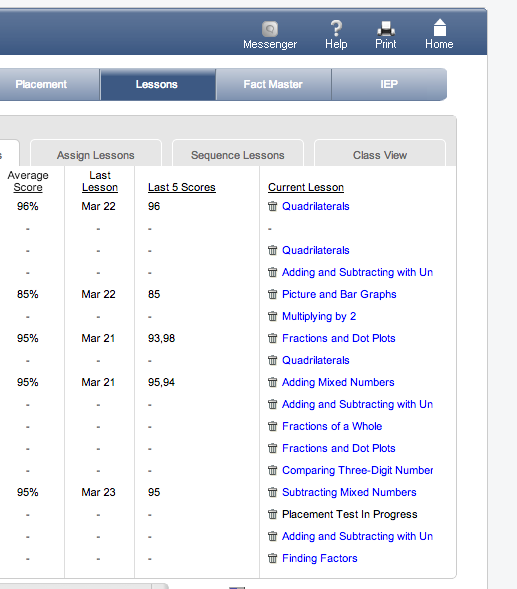
MobyMax - You can assign specific concepts for differentiation
MobyMax – You can assign specific concepts for differentiation

Scootpad

Scootpad is another adaptive curriculum provider that enables teachers to assign specific CCSS concepts to individual students.  Teachers determine the mastery level and they are able to keep track of individual student progress.  As of right now, there aren’t any lessons associated with the questions.
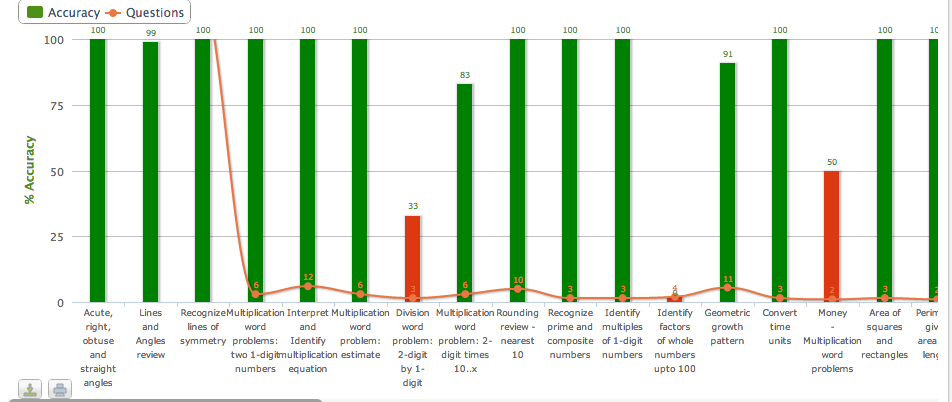
Scootpad - You can analyze performance on specific concepts
Scootpad – You can analyze performance on specific concepts

TenMarks

TenMarks is used to introduce or reinforce teaching in the classroom.  Students are able to review online lessons and are asked questions related to the topic.  Teachers are able to track student progress over time with TenMarks.

TenMarks - Allows lessons to be interactive with feedback
TenMarks – Lessons are interactive with feedback

XtraMath

Xtramath is designed to help students improve their math computation fluency.  This isn’t a program that’s for everyone.  I’ve found that students who need practice with multiplication/division tables benefit from this web-based intervention.  The program is very user-friendly and has a progress monitoring component which seems beneficial.
XtraMath - Students practice math computation facts
XtraMath – Students practice math computation facts

Photo credit: weesen via photopin cc


What tools do you use to differentiate instruction in/out of the classroom?

Letting Students Decide

You Decide

Last week I decided to introduce one of my math classes with a complex algebra problem. The problem had multiple solutions and a variety of different ways to achieve the answers.  I grouped the students and they began to discuss methods to solve the problem. Each group was given an iPad, whiteboard and marker to get started.  After approximately ten minutes I had group coming up to me asking if they were on the right track.  I asked the students to decide on what path to take to solve this problem. The students waited for additional instruction but I decided to say no more. Often, students are looking for affirmation or some type of hint.  I told the students to rely on their math skills to validate why they think their solution is best. The students went back to their group and continued to work and validate their reasoning.  Students continued to have questions and I decided to answer those questions with questions that pointed students in the right direction. By facilitating and guiding I felt as though students were taking more ownership of their own learning.  After approximately thirty minutes student groups presented their answers to the class.  The majority of groups indicated that they hit multiple roadblocks, but eventually achieved some sort of success in finding a solution to the problem.  After listening to the presentations I concluded that the students took another step this year towards becoming responsible learners in the classroom.  Moreover, I found myself reflecting on what was communicated to the students during the process.

The words you decide can be powerful.  In a classroom setting, the words can enable students to make decisions that impact their learning.  Students need to be able to take ownership of their own decisions and what a teacher communicates can benefit or limit learning in the classroom. I’d like to move my students beyond the stereotypical systematic focus of finding the one right answer.  Mathematical understanding might not permeate when students feel that finding the answer is the only goal.  Giving students opportunities to make decision within a safe environment prepares them to own their own learning and become more accountable in the classroom.

What strategies do you use to encourage student ownership?

Photo Credit:  S. Miles

Student Groups and Debates

Student Group Dynamics

Teachers often have students work in groups to solve problems.  Educators may recite that “two heads are better than one” or something of that sort when talking about the power of effective collaboration.   I’ve seen firsthand how student grouping can impact decision making and student learning.  How a group interacts will often influence outcomes.  Positive interactions between group members often spurs a team to meet their goals.  I believe most teachers encourage positive talk during group activities and many set up a norm/expectation list for behavior. Learning is often stretched when students are encouraged to explain their answers to others.

What happens when a student explains an answer and the other party isn’t receptive?  Or, what happens when students disagree on an answer or how to solve a problem?  This is bound to happen from time to time, but I don’t think this is necessarily a negative.  Students should be able to stay on topic and analyze their own argument without expressing frustration towards the idea (not people) that they disagree with.  Disagreement may conjure anger if not carefully managed.  This requires clear expectations and modeling by the teacher. Easier said than done?  Yes.  Often “I agree” statements can overshadow academic misunderstandings, while students just follow what the leader is saying in the group.  I’m aware that some classrooms encourage debate and I think that in some cases that benefits the classroom.  I should also note that having a classroom/group debate depends on the problem and is purely situational.

Students, no matter what their age, need to be able to communicate their ideas in order to meet goals.  It’s perfectly fine for students to disagree with the group.  How that disagreement is communicated and received charts the course for the group.  Individual insights hold value and each contribute to the overall goal of the group.  Students need to be able to disagree respectfully, but understand that the team is working towards the same goal.  Students that have this mindset are able to offer differing opinions, but innovate as a team.

Having a balance is key.  Groups should work together but also be open to differing ideas. Disagreement often forces other students to justify their positions.  Justifying provides opportunities for students to analyze their own argument, which gives the teacher a better understanding of a student’s understanding of a particular topic/concept.

I think this also plays a role in how adult teams operate as well (see Ringelmann).  I’m going to end this post with a quote from James Surowiecki, the author of The Wisdom of Crowds.

“The wisdom of crowds comes not from the consensus decision of the group, but from the aggregation of the ideas/thoughts/decisions of each individual in the group.”


Picture Credit:  S. Miles

Math Debates in Elementary Classrooms

Learning through Conversations

Over the past few months I’ve dedicated a good amount of time to to having math conversations. These math conversations occur when the class is unsure of how to solve a problem or when disagreement ensues over what particular strategy should be used to tackle a problem.  The math conversations (or debates) allow students the freedom to openly discuss logical reasoning when solving particular problems.   These conversations can be sparked by the daily math objective or follow another student’s response to a question.  It’s not necessarily planned in my teacher planner as “math conversation” in yellow highlighter, but I do make time for these talks as I feel that they bring value and encourage student ownership.  The conversations also give insight to whether students grasp concepts and are able to articulate their responses accordingly.  Mathematical misconceptions can also be identified during this time.

During these conversations I have manipulatives, chart paper, whiteboards, iPads and computers nearby to assist in the discovery process.  I emphasize that there’s a certain protocol that’s used when we have these discussions.  Students are expected to be respectful and listen to the comments of their classmates.  To make sure the class is on task I decide to have a specific time limit dedicated to these math conversations.  Some days the conversation lasts 5 minutes, other days they may take upwards to 15-20 minutes.  When applicable, I might use an anchor chart to display the progress that we’ve made in answering the questions.  I should also mention that sometimes we don’t find an answer to the question.  Here are a few questions (from students) that have started math conversations this year:

  • Why is regrouping necessary? (2nd grade)
  • What can’t we divide by zero? (3rd grade)
  • Why are parentheses used in math? (3rd grade)
  • Why do we need a decimal point? (1st grade)
  • When do we need to round numbers? (2nd grade)
  • Why is a number to the negative exponent have 1 as the numerator? (5th grade)
  • Why do you have to balance an equation? (5th grade)
  • How does the partial products multiplication strategy work? (3rd grade)
  • Why do you inverse the second fraction when dividing fractions? (5th grade)
  • Why is area squared and volume cubed? (4th grade)

Above is just a sampling of a few of the math conversations that we’ve had.  Afterwards, students write in their journals about their experience finding the solution to the problem.

Of course this takes additional time in class, but I believe it’s time well spent.  The Common Core Standards  focus on depth of mathematical understanding, rather than breadth.  This allows opportunities to have these conversations that I feel are beneficial.  They also emphasize the standards of practice below.

  • CCSS.Math.Practice.MP1 – Making sense of problems and persevere in solving them.
  • CCSS.Math.Practice.MP3 – Construct viable arguments and critique the reasoning of others

Photo Credit:  Basketman


Do you have math conversations in your class?

Standardize This

Bubble Test?

Education reform continues to make headlines as US student achievement is compared to the achievement of other countries.  An overall increasing focus on standardized assessments has been at the forefront of many of these reform discussions.  Teachers and school districts often get caught in the middle of these types of discussions   From what I’ve observed, what seems to agitate some educators is the notion that one high-stakes standardized assessment can validate/invalidate the success of a school year.  Even though educators have been critical of this notion, federal, state, and local school boards continue to look at standardized assessments as the go-to for quality control/accountability purposes.  I truly feel as though these boards have good intentions, but I would like to encourage them to look at alternative ways to measure school achievement.

I don’t know a teacher that doesn’t believe in accountability.  Teachers inherently feel a sense of accountability for their students.  The way that accountability is being measured and the consequences that occur if growth isn’t met is what’s causing concern.  Critics emphasis that only focusing on standardized test scores encourage teaching to the test, massive amounts of test prep and unfortunately cheating.  I’m not downgrading the value of standardized assessments as I believe a limited amount are beneficial in providing valuable feedback that can inform instructional decisions.  Appropriately utilizing student assessment results may prove beneficial for a teacher or school, but using that data outside of its context to manipulate accusations can cause problems.

Proactive Steps …

By now most educators have realized that student achievement data is starting to make up an increasing portion (20% + ) of one’s evaluation.  In some cases one VAM assessment could be used to measure student growth and impact employment decisions.  Instead of using one standardized assessment to determining teacher effectiveness, administrators should enable teachers to show student learning through a variety of means. This is a difficult task to tackle as administrators are also being assessed on standardized assessment results.  While one assessment shows a singular brush stroke of learning, the picture becomes much clearer when multiple data points are used.  Even NWEA, the makers of the MAP assessment encourage school leaders to use multiple data points (not just MAP) to measure student growth.  Regardless, some districts are already using singular assessments for evaluation/employment purposes.  I’m advocating that principal’s take a closer look at multiple student achievement data points instead of relying on one growth indicator.

How …

Formative assessments, student projects, presentations, and pbl activities can show learning at varying levels.  This collection of student data can not only help inform instructional decisions, but show evidence of student learning.  Digital portfolios are making a splash in education and I’m hoping that more districts start using them in conjunction with standardized assessments to provide evidence of student learning.  Showcasing student learning through a variety of formative assessment tools gives more meaning to the learning that’s happening. If communicated appropriately, state and local schoolboards will take notice and become more interested in multiple data points to determine effectivenessss, rather than a singular one.

photo credit: CliffMuller via photopin cc