Feedback Opportunities

feedback-01

Last week I took part in a Twitter conversation about student feedback. The discussion evolved into why direct feedback is often more efficient than vague “good job” teacher responses. Most of us agreed that feedback and exploration is often the cornerstone in having students recognize misconceptions and build mathematical understanding. That feedback is so essential and is a vital ingredient in the learning process.  The conversation had me thinking of the different feedback opportunities that exist in and out of the classroom.

Everyone receives feedback. In a school setting that feedback can come in the form of a supervisor, team, students and so many others.  Beyond this, I receive feedback when I forget to shut my car door or leave the lights on. A loud beep blasts out of the speaker and I need to go back and fix the problem. When creating a document and I forget to save before exiting I receive a “do you want to save” message. Absolutely I want to save, and the feedback (or reminder) gives me an opportunity to do so. I could give other examples but the point is that feedback comes in forms that might not be associated with classroom use.

I feel as though giving students feedback is intentionally setting the stage for student improvement. What happens if the student doesn’t utilize that feedback?  What good is the feedback if it sits on the paper? I feel like this happens more often than I would like to admit.

Giving students multiple opportunities to utilize feedback can lead to action.  That action may lead students to make changes in how they approach problems and concepts.  Although the teacher is one of the main feedback systems, it shouldn’t and isn’t the only option. While thinking of feedback, I started to brainstorm some possible feedback systems that can aid in the learning process.  I can picture these systems being used to give feedback after some type of formative assessment or instruction.


Teacher – The teacher is one of the best feedback tools in the classroom. Fielding student questions, clarifying  and anticipating next steps all play a role in how a teacher responds with feedback. Teachers all around the world offer feedback, so much that it becomes part of their daily lives.  The feedback from teachers can be observed in written or verbal form.

Students – Peer editing and group work can be powerful. Of course, modeling and front loading needs to occur before this becomes an amazing tool. When students discuss answers with each other it opens up a door for feedback. Students can explain their reasoning and be critical friends in the process. Group work provides opportunities for students to become better at explaining their mathematical thinking and processes. Hearing how other students explain their thinking can lead students to an explanation that might not have been perceived before.

Math Classroom Conversations – Math class conversations can be beneficial to all involved.  This also takes modeling before becoming a positive aspect of the classroom experience.  Asking open-ended math questions and having students respond can lead students to ask additional questions.  Feedback can be provided during this entire process while students construct understandings. Classroom conversations often involve some type of whole group question, group response and feedback.

Games – Math games can provide students with a low-risk opportunity to practice skills and show their understanding. I find that when students use math games they engage socially, think strategically and practice skills in the process. Board, card, dice and app games all provide feedback in different ways. Feedback is given in how the other students react to each other, how the answer is revealed and in the scoring element. Math games open up a door of possibilities and adds some competitiveness. Apps have helped revolutionize this idea. Kahoot and Socrative have gaming elements that provide students with additional feedback that can be used to inform instructional decisions.

Adaptive Software – No, this shouldn’t be the only method of feedback. Keeping that in mind, the feedback given through adaptive software can be be helpful to a point. Regardless of the adapted score or level, this type of feedback might not be tailored to the individual student.  Although adaptive apps/software is a field that’s improving (as tech startups hire education professionals), this type of feedback isn’t as accurate as some of the other methods above.


How do you give feedback opportunities in the classroom?


Higher-Level Math Tasks

A few days ago I started reading Principles to Actions Ensuring Mathematical Success For All as part of a book study. As I was reading in preparation for our first session I came across a few ideas worth highlighting. Pages 18 and 19 discuss the four levels of cognitive demand in math classes.   Along with expectations, these demands are often revealed in tasks or assignments that students are asked to complete.

The book describes lower-level demands as tasks related to memorization and procedures without connections. Memorizing rules/formulas and following procedures is often related to lower-level demands. Students often understand what’s expected when lower-level demands are required. Generally one answer or procedure is evident with this type of task. Worksheets that have students practice rote computation skills without words could fall into the lower-level demand category. Higher-level demands are procedures with connections and often require considerable cognitive effort to achieve. Anxiety is often a part of higher-level demands, although this may be because students don’t see these types of tasks as often.

After reading this page and looking at the different examples I started to reflect on how elementary math classrooms are organized. Math practice is needed, but students should also be given time to explore, discuss and make connections in a low-risk environment. I find more lower-level demands in math classrooms than higher-level, but an ideal ratio is challenging to ascertain.

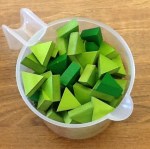
So after reading pages 1-35 I decided to use an example of a higher-level demand activity with a fifth grade classroom. This particular class is learning about fraction multiplication and division. Students have learned in the past to multiply the numerators and denominators to arrive at a solution. To delve a bit deeper in their understanding I decided to use and adapt one of the tasks in the book. I first grouped the students into teams and gave each team 12 triangular blocks and a whiteboard marker.

Photo Jan 22, 9 45 43 AM

Students were asked to show a visual model of 1/6 of 1/2. Some students knew the answer already but seemed unsure of how to show the answer visually. Many of the groups weren’t quite sure on how to approach the construction of the fractions. They understood the abstract and procedural but had a challenging time visualizing the fractions.

After seeing the students struggle a bit I’m glad that I decided to have them work in pairs. Students started to build models of 1/2 using the 12 triangles. Some of the groups came to a conclusion that two different sets of six triangles shows half. Then from there students started to think of what’s 1/6 of the 1/2. Students took out 1/6 but then debated on the value. Some groups said that the answer was 1/6 while others were confident that it was 1/12. Eventually the students decided that 1/12 was the correct solution.


I went around the classroom and took some pictures of the different creations. Not everyone created the same type of model. This was a great opportunity to highlight some of the different models that arrived at the same solution.


This slideshow requires JavaScript.

Afterwards, I thought that offering exactly 12 triangles helped but limited the choices for a visual model. The student models were somewhat similar as a result of the level of scaffolding. As students reflected on their actions in this activity I heard some interesting conversations. Students were aware of the procedure to multiply fractions less than one, but started to visualize the model through this activity. I thought this might be one way to introduce fraction multiplication at the fourth grade level.  I also thought that this activity was well worth the time and I’m looking at incorporating additional high-level cognitive demand activities in the future.

Student Shape Books

TITLE

Last week I introduced one second grade class to Christopher’s Which Shape Doesn’t Belong book.  After hearing about its success on Twitter I decided to use it with one of my classrooms. After downloading the pdf I displayed the images in front of the class and asked the students to think of which shape didn’t belong. Just about everyone in the class raised their hands. Students overwhelmingly decided that the unfilled shape didn’t belong. Students were ready for the next page of shapes when I saw a hand raise from the back of the classroom. That particular student said that wasn’t the only answer. Quite a bit of the class raised their eyebrows and their voices in saying that the unfilled shape was the answer. The student raising his hand said that the triangle doesn’t belong because it only has three vertices. Other students started to raise their hands with additional solutions. Through this process students started to find more solutions.  The student input became contagious. I would sum up what happened during the next 10 minutes here. Words like vertex, diagonal, side, symmetry, and angles were starting to be part of our class conversation.  I also was able to identify misconceptions and ask questions to think about their responses.  This led to more student responses and questions.  This conversation wasn’t planned but I felt like it was worth the time and fit in perfectly with my geometry unit.  I was going to move to the second page of the book when our class ran out of time.

So the next day the class started the day off with page two of the book. Again, students found different solutions and the class continued the conversation. After a brief amount of time I introduced a shape book activity.

Click for pdf
Click for pdf book

For this activity students were asked to create a personal shape book similar to Christopher’s book. In addition to creating a which shape book, students were asked to include particular shapes in their book.

3D_Shape_Activity

Screen Shot 2015-01-18 at 7.13.46 PM

Students were given guidance on the first page. I explained the directions, what was expected for the assignment and answered a few questions. I included a formative assessment on the last page of the booklet.  Students worked diligently in creating the initial parts of their books for the rest of the class. Most of the time was spent on the reasoning pages.  The gallery below will show some of our progress from last week.


This slideshow requires JavaScript.

I’m planning on having students share their books with the class next week.


Operations and Mazes

In a few weeks my fifth grade students will start their pre-algebra unit. Before delving into the unit students often need a reminder on how to use the order of operations with fractions and decimals. Half of today’s class was dedicated to reinforcing number sense and computation skills. At some point students will need to be able to use these skills along with maneuvering variables on both sides of an equation. I find that some students struggle with pre-algebra if they don’t have sound number sense skills.   So today I ended up using an Illuminations operations activity.

Click for file
Click for file

I passed out the above sheet to each student then reviewed the directions. Students were paired and asked to find a spot in the room to work. Students were asked to hide their calculators and estimate one path that will lead to the largest number. Each group came up with their own path.

Trial and Error

Students were then asked to use a calculator to find the path that ends with the largest number. It was interesting to listen in on the student conversations. Here are a few of the statements that I picked up:


“If you divide the number it will decrease”

“Not really, if you divide less than one the number will increase”

“If you divide by a really small number than our number will skyrocket”

“But we can’t multiply by a number less than one”

“But we can multiply by a large number”

“Let’s just work with the multiplication and division paths, those will make the number jump”

“Let’s work sideways instead of making a path straight down.  Gives us more opportunities to increase”

While listening to the students I decided to not intervene. It was insightful to hear how the different strategies were planned and executed. There were some student arguments and stonewalling.  Eventually students had to defend their reasoning as groups needed to find a solution. Near the end of class students presented their final paths and the class calculated the total. Students soon started to realize that their answer would differ depending on if they followed the order of operations. This changed many of the answers as some groups completed each operation individually. In the end students all decided on one pathway to find the largest number. Students then informally reflected on this activity through a class conversation.

Solutions

Before sending the students on to their next class I mentioned to them the Pick-a-Path game website. The interactive component has more options and might be a decent supplemental activity.  I’m hoping to see that a few students took the initiative to check out the site tonight. It might even be part of a classroom discussion tomorrow.

Sample Size and Reliability

Sample Size and Reliability

Monday was my school’s first day back from break. The students had two weeks off and many students and teachers are still getting back into school mode.  The teacher coffee machine was is still working overtime.  The first day tends to ease students back into the concepts taught back in mid-December. One of the better ways to transition is to debrief with the students about their break. This is also an opportunity for students to make connections and reconnect with their peers.

After debriefing with the students about their break one of my classes delved a bit deeper into a data analysis unit. This class studied different types of graphs back in December. We explored stem-and-leaf plots, bar graphs, pie graphs and even took a look at box plots. One of the objectives of the lesson on Monday was to explore the relationship between sample size and the reliability of the results.

This lesson was actually adapted from a fifth grade Everyday Math lesson. Before class I decided to use different colored unifix cubs to represent candy colors. I’d prefer to use regular candy but we have so many allergies and a wellness policy that nixes the use of candy in the classroom. Anyway, I took 100 unifix cubes and split them up into 50 being chocolate, 30 cherry, 10 lime and 10 orange. I didn’t tell the students how many cubes there were or the color allocation.

Unifix Cubes
Setup before class


Before digging into the manipulatives the class discussed why using sampling was important. Students discovered how sampling is much less time-consuming compared to surveying all people/objects. We then discussed how much of a sample is appropriate. Students were all over the place with their estimates. Throughout the conversation I was attempting to sett the stage for students to make some connections and find clarity on the concept through this activity.

Students were placed in groups of two for this activity. Each partner randomly chose five unifix cubes.

Random Sample

The groups then combined their cubes and documented their total. About 80/100 cubes were taken after all the students documented their total. Each group reported out their findings. Some groups had almost all chocolate while other groups had zero orange or lime. It was interesting to see how the students reacted as other groups reported out their results. It seemed like they wanted to question their own results.  Students were then asked to make a prediction of the actual results based on the sampling.  The class then combined the results of the groups and shared the results.

I brought the students to the back table in the classroom and dumped the cube container. We counted each color to see how accurate our class sample was to the actual result. Students then compared their group results to the class and then to the actual results.

sample
Better than what I expected


I then gave the students an opportunity to reflect on the comparison as a class. Some groups were very close to the actual percentage while others were way off.  I explained that this is part of the sampling process.   Students were then asked to journal about their experience and the class will explore this topic in more detail later in the week.