Grading Practices

2016-09-02 07.13.38

School started about two months ago.  Since then so much has happened and the first trimester is closing upon the school.  Report cards are starting to creep up on teachers and the very busy month of November is knocking.  My school has parent/teacher conferences as well as a bunch of professional development sessions planned for the turkey month.

While thinking back about the last two months there’s a lot that comes to mind.  Specifically, I made a change in my grading policy.  I wrote about that here. I decided to move from a point-based system to something that better resembled a standards-based approach.  It’s definitely not 100% standards-based, but it’s moving towards that model.

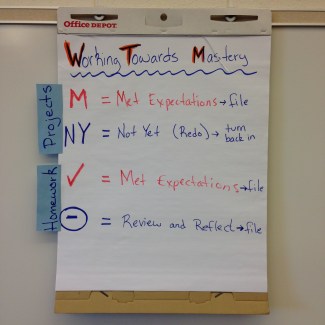
Basically, students complete a quiz or project and receive it back with my feedback.   Students either get a M or NY.  If they receive a M they file away the papers.  A NY means that the students are required to redo/change the assignment so that they meet the expectations on the second attempt.  I keep the score on the second attempt.  It’s not a perfect system, but I believe this policy is making positive ground.  My reflections on the first two months of using this are below.

1.)  Students are much less anxious about the quizzes and projects.  Maybe knowing that they get another opportunity allows them to take a risk or try a new strategy that they otherwise wouldn’t have considered.

2.)  I’ve become more precise in what I expect students to complete.  Part of this is due to wanting to make sure that a boat load of students don’t have to redo the assignment because of unclear directions.  I’ve been using a “criteria for success” indicator on each project.  This eliminates the points aspect, but also gives students an opportunity to evaluate their own progress on the assignment before turning it in.

3.)  Students are a bit more assertive in looking at their own misconceptions/simple mistakes when they look at a NY that’s returned to them.  Some students ask for additional help or resources before completing the assignment a second time.  Students aren’t allowed to redo the assignment at home so some have used technology tools in the classroom to research the skill before making a second attempt.

4.)  When I first started using the M/NY criteria I found that time was an issue.  It still is although it’s managed a bit better with some clear expectations upfront.  Students that receive a NY have to redo the assignment before the end of that unit.  Some students finish it on the day I return the sheet, while others wait until close to the last minute. I don’t accept the assignment after the unit is over.

5.)  It’s not perfect.  I don’t think any grading policy is perfect.  It takes students more time to complete assignments, especially if they have to take it twice.  There’s also more feedback involved, which takes additional time.  Also, this policy is in place for assignments, but not necessarily tests.  What happens to students that take more than twice to achieve mastery?  Good question and I haven’t answered that yet.  The district still requires letter grades at the upper elementary level.  My district current doesn’t use standards-based grading, but at some point it may move towards that model.  I’m already seeing positive strides in my own classroom and a slight change in how students view assignments.  It’s more of a focus on moving towards the mastery of a concept vs. look at my points.  We’re making positive progress.

Angle Relationships

screen-shot-2016-10-19-at-4-57-26-pm

My fourth graders are just about finished with their unit on geometry and measurement.  They classified angles earlier in the week and are now looking at angle relationships.  This is one of my favorite topics to teach as it involves logic and an understanding of basic geometry.  I’m finding that students are becoming better at measuring angles using a protractor.  Using Angle Tangle has helped in that process. They’re able to identify and measure acute and obtuse angles comfortably.  Reflex angles still give them issues, although this is improving as students are able to subtract an acute or obtuse angle from 360 to find the measurement.

Students then moved on to angle relationship skills. When asked to find the missing angle in a triangle they immediately started to look for their protractor.  Students wanted to find the actual measurement without looking at what types of relationships actually exist and if a protractor is needed.  So on Tuesday the class reviewed interior angles.  Students found through patterns that they could split a convex polygon into triangles and find the sum of angles.  This was eye-opening for some students and you could tell that they were relieved in seeing that they wouldn’t have to measure all of the interior angles.

One of the assignments called students to create  polygon and find the sum of angles without actually measuring each interior angle.  Some students were stumped while others students looked at how a triangle’s sum can aid in finding the sum of other polygons.  The student projects turned out well, although some had to redo them as the drawing actually started to get in the way of creating triangles.  This is one of the better projects.

screen-shot-2016-10-19-at-4-57-35-pm


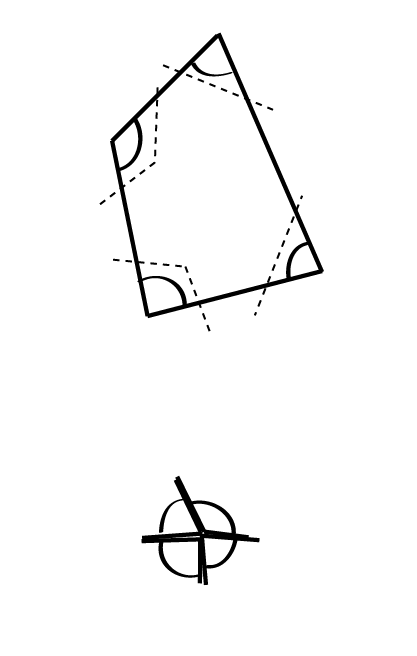
I could tell that students needed a bit more practice with using angle relationships to their advantage.  On Thursday I asked students to create a qudrilateral using a straightedge.  Students drew arcs to indicate the angles on each vertex.  The quadrilaterals were cut out and the sides of the shape were torn off.  Students lined up the sides and the class had a brief discussion on what they noticed.

polygonaction-01.png

Right away, some students noticed that the arcs didn’t line up.  They also noticed that the four corners actually created a circle. Some even said that the total was 360 degrees. Students checked their work by using a compass to add all of the angles together.  Their prediction rang true.  This was a winning moment as I could tell that students were starting to grasp this concept better.  I gave each student some tape and they tapped together their circle to their folder.  I’m hoping it stays on their folder and in their memory banks.

photo-oct-18-1-19-18-pm


What’s My Rule?

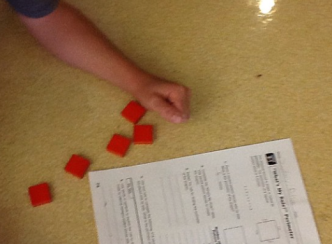
My third grade class ended their unit on data analysis and computation last week.  We’re now onto our next adventure of exploring patterns and number rules.  This last week the class started to identify number patterns.  The class observed how they could develop rules to find the perimeter of connected squares.  This was a bit of a challenge because students had to combine two different operations to find the actual rule.

Screen Shot 2014-10-11 at 7.54.13 AM
What’s the perimeter for three connected squares?

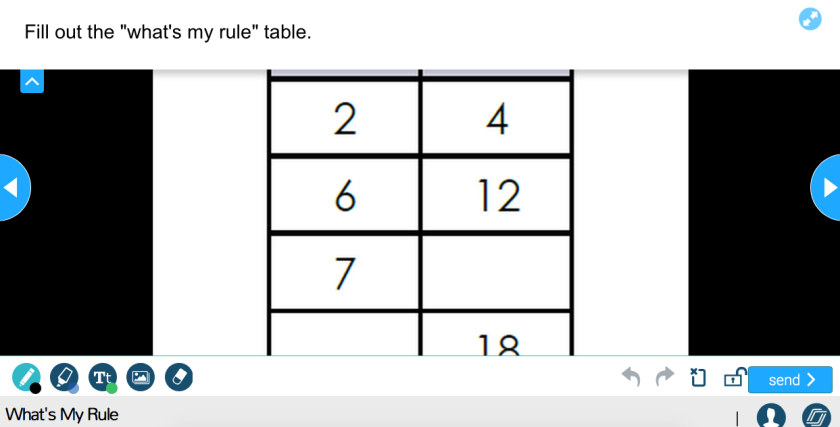
We used this activity that I discussed a bit more in detail last year.  They looked for consistency and investigated with trial-and-error what the “rule” might be.  The class used a Nearpod presentation to see how a function machine transforms numbers.

screen-shot-2016-10-09-at-12-49-18-pm
Click for presentation

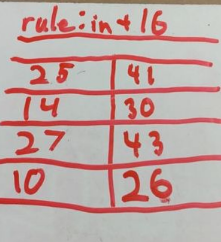
Eventually the class moved towards creating their own rules using dice and a whiteboard.  It was during this time period that students started to dig a bit deeper into how rules impact a table.

screen-shot-2016-10-09-at-10-51-31-am

One issue came up with the consistency of the numbers on the “in” side of the table.  A few students were confused with the idea that numbers didn’t necessarily have to be in order on the “in” side of the table.  A few examples helped address the issue but I thought it was interesting as most students are so used to a specific 1:1 scale.  I wonder if this is something that’s emphasized more at the second grade level and it just continues with our third graders.

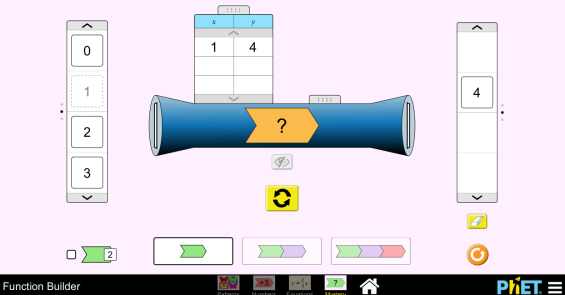
Later in the week I brought out a digital function machine.  The kids had a great time placing numbers in and watching at they transformed into something different.

screen-shot-2016-10-09-at-10-53-59-am


I highly recommend the PheT simulations. Feel free to check out other simulations that they’ve developed.  Next week the class will be working on creating and identifying true or false number sentences.