Math Bell Ringers

My school officially opens up for students in about three weeks.  Teachers can enter in about a week or so since the floors are being waxed and cleaned.  Like many educators during this time of the year, I’m starting to plan out what my first few days are going to look like.  I had a chance to review my schedule and it looks like I’ll be teaching math to students in grades K-5 next year. Right now, all of my materials are in about 30 boxes in my new classroom.  I had to relocate over the summer because of enrollment and extra sections.

As I was looking over the #TMC17 and #MTBoS tags this weekend I started to notice other teachers are also persevering through the planning process.  I also had a chance to catch up on a few blogs yesterday. Reading other peoples’ reflections ignited my own reflection process and I started putting together this post.  One part of my school day that I’m planning out relates to my advanced math class bell ringers. For me, bell ringers have been an ever-changing process from year to year.  A bell ringer is what my students complete during the first 10 minutes of class.  I have a 60 minutes math block for my 3-5th grade classes.  I tend to have students come into my class at different times because of band, orchestra, or other circumstances.  Usually I get all of the students in my class within the first five minutes.  Some students are waiting outside my door at the exact time the math block starts, while others are not.  When students come into the classroom they follow the flow chart and take a look at the agenda that I have projected on the whiteboard.

I tend to use bell ringers to review math concepts that were taught earlier in the week.  I used to use brain teasers and different math games, but they weren’t exactly related to what was being taught.  Each grade level (3-5) uses a different type of ringer and some work better than others.  I’ve been looking at more quality ringers over the summer.  The first 5-10 minutes of class is so valuable and I want to make sure the ringer has students thinking about math in ways that benefit them.  Here’s what I have planned so far:

Third Grade –

I’m going to use Estimation180 as my bell ringer.  Students will come into the classroom, follow the flow chart, open their folder and begin working on the daily E180.  Last year my third grade class was able to make it to around 140 days.  This was something that my kids enjoyed and it was a low-risk activity that had them engaged from the start.  While students look at the day they filled out something similar to this sheet. This year, I’m thinking of having students complete open number lines for some of the days.  It might take a little bit more time, but I’m thinking it’ll be worth it as the year progresses.

Fourth Grade –

My fourth graders have been using Scholastic’s Dynamath for the past few years.  It’s been a great extension for some students, but not all.  I generally assign specific pages and then we review them as a class. I’m still in the process of looking for additional ways to use this bell ringer time more effectively.  I was thinking of possibly using VisualPatterns.  Maybe one pattern per week or something like that.

Fifth Grade –

Last year my fifth grade students used Math Magazine for their bell ringer.  Similar to Dynamath, Math Magazine is designed to reinforce skills taught and also extends into areas that aren’t as familiar.  The publisher designed this particular magazine for middle school math students, but it works well with my math class. At times, students needed to look up different skills to complete this magazine.  I’m thinking of having students use SERP’s AlgebrabyExample.  I started using it last year for a couple months.  I love the variety of problems and that students have to find and correct mistakes.   It also helps that it’s free, unlike the Scholastic resources. This is much different than what students are accustomed to doing in math class.  I’m thinking that students can complete one page per week.  What’s nice is that I can match the skills with a topic that the class is currently exploring.


I’m sure I’ll refine this before school starts, but it’s a start.  What do you use for math bell ringers?

SaveSaveSaveSave

SaveSave

Math Intuition

Screen Shot 2017-07-18 at 3.52.50 PM.png

Over the past two days I’ve been reading and rereading chapter 8-9 in my summer book study. Chapter eight discusses how mathematicians connect ideas.  From what I see in classrooms, this connection of ideas is often directed by the teacher and involves some type of classroom discussion that helps students construct understanding.  Intentionally setting aside time to have math discussions and connect ideas from students is worthwhile.  The prime example of Debbie (the teacher) allowing time for Gunther (student) to put the calendar in the shape of a clock was especially a memorable portion of this chapter.  That opportunity wouldn’t have occurred if the teacher didn’t take the initiative to intentionally plan to use manipulatives to have students construct their own understanding through a math discussion.  Having these student math discussions gives educators feedback in whether students are attempting to make/create connections and whether their overgeneralizing. Creating opportunities for student to make these connections is important.

Chapter nine emphasizes the need for mathematicians to use intuition. I appreciate how the chapter indicates that math is often perceived as a very logical content area.  It’s truly not, but the perception still exists.  Tracy states in the chapter that she’s come to see “mathematics as a creative art that operatives within a logical structure.”  I had to reread this a couple times to let it sink in. I’ve heard it over and over again that someone is “not a math person.”  What I find interesting about this is that mathematical intuition is developed.  Since it’s developed over time it can change.  I tend to tackle this issue quite a bit and address it at the beginning of the school year during Open House. Providing students with opportunities to develop this personal intuition can be a game changer.  It’s up to the teacher and school to create memorable experiences for students to develop math intuition. That’s a responsibility that each teacher takes up when they open their classroom doors. By increasing their math intuition, students may also increase their math confidence. Educators need to carefully think about the different math experiences that we provide for our students.  Those meaningful experiences aren’t always found in general textbooks.

After reading these two chapters, I started to think of what perceived/real barriers stop teachers from intentionally creating these opportunities.

I think sometimes teachers feel as though they’re required to follow word-for-word the scope-and-sequence that’s provided by a district.  This can be the case when a newly adopted text is revealed and teachers are highly encouraged to follow it to a tee.  Some texts even tell teachers what to exactly say, what questions to ask, and predicted student responses.  I’ve been though many different math text rollouts and this occasionally happens.  I see it more at the elementary level though. Having common assessments with a specific timeline that everyone needs to follow can also provide pressure for teachers to fall in line with a particular lesson sequence.  Deviating from that sequence may cause issues. I find that there’s a balance between what a district curriculum office deems “non-negotiable” and room for academic freedom within a sequence.  I’ve been told in the past that a district text is a resource, but for new teachers it may be more than that.  There can be a lot of anxiety, especially if certain parts of your instruction model have to follow a pre-determined sequence and is used for evaluation purposes.

Teachers need to feel comfortable in giving themselves permission to use their own intuition.  That may be easier said than done and it depends on your circumstance.  Despite good intentions, a published text won’t meet the needs of all of your students. I believe that’s why open source resources are frequently shared within the online teacher community. Supplementing or modifying lessons/questions with resources that match the learning needs of your students happens on a daily basis.  Dan’s Ted talk hits on that point.

I believe educators have permission to do this while still meeting a strict scope-and-sequence.  Teacher confidence also plays a role with how willing someone is to try resources outside of the textbook.  Elementary math teachers need to feel empowered to be able to use resources accordingly without feeling as though it’s going to be detrimental in their evaluation.  I think that sometimes teachers don’t exercise their academic freedom to the highest potential because it’s perceived as going against a district’s plan.  Having math coaches available and supportive administration is also important in changing this perception

The work that we do is important.  Creating mathematical intuition happens through repeated experiences.

Photo Jul 18, 3 25 46 PM.jpg
p. 212

Sometimes those experiences are beyond the textbook/worksheet and educators have the ability to make them meaningful.  I’ll be keeping this in mind as I prepare for the new school year.

Look Who’s Talking

Screen Shot 2017-07-06 at 12.50.29 PM

I’ve been able to check off a few books on my summer reading list.  I’m now in the process of reading one book in particular.  It’s been a slow process through this book, but worthwhile as I’m actually thinking of how this applies to my practice.  That takes time. Yesterday, I was on a reading tear and made it through chapter seven.  This is where I ended up paying most of my attention. The chapter is related to asking questions in the math classroom.

In the eyes of most students, questions are often given to them, not something that they get to ask other students or even the teacher.  The ratio of questions they’re required to answer far outweighs what they ask.  I’m not arguing that there’s something wrong with that ratio, but Tracy and others in this chapter make a case to why educators should allow more opportunities for students to ask, wonder, and notice.  I think there’s value in providing these opportunities, although the management involved in that process seems challenging at times.  While reading, I came across a terrific quote by Christopher.

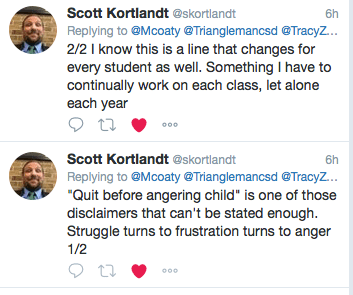
One of the bigger issues is the last highlighted sentence: “Quit before angering child.”  When I read this I actually laughed out loud and then started to realize how often this happens in the classroom.  Ideally, all students would be willing to make a claim, be receptive to what others have to say and then change their claim accordingly.  Some students are much more willing to engage in this type of math dialogue, while others would rather not.  There are different activities and procedures that can help move students towards being more receptive to asking questions during claim dialogues.  Notice and Wonder, 101questions, problem posing, riffing off problems and independent study options can help students ask more questions and encourage them to be a bit more curious.  That curiosity can spur students to ask more questions.  All of those are great resources, but there’s an important piece that needs to be put in place beforehand.  I believe Scott makes a great point.

Screen Shot 2017-07-06 at 12.28.43 PM

Each child has their own tolerance for struggle.  That struggle can turn into frustration quicker for some more than others.  This happens with children and adults. I think most educators have been in situations where a student makes a claim and then retracts it after its been shown that their response wasn’t quite right.  That student then disengages and it’s challenging to get them to be assertive afterwards.  How can this be avoided or is it possible to avoid these types of situations?  I don’t know the exact answer to this, but understanding the level in which a student can struggle without frustration is important.  Struggle is part of what happens in any math class. That productive struggle is what’s often needed before students construct their own mathematical understanding.

Enabling students with tools and models can help in these struggling situations.  I’ve also seen this struggle occur during whole class guided math conversations. Some students shut down when they are called out by another student.  They think that disagreement means that they’re being challenged or attacked. That’s not the intention, but it may be perceived that way by other students. It may be helpful to model what appropriate math dialogue looks like.  After the modeling, practicing that type of math claim dialogue and providing opportunities for questions can help smooth out the process.

I also believe some students are not used to making a claim in a verbal format.  Students are definitely used to talking.  Ask any teacher.  Also, they’re probably familiar with providing reasons why they agree/disagree on paper, but communicating it in a verbal format can cause some issues. Providing these students with sentence starters, using technology that can be shared with the class, or using other appropriate means can help students engage respectfully in a productive math dialogue.

I’ll be keeping these ideas in mind during my planning process.