Whiteboards and Math

Screen Shot 2017-09-28 at 7.06.31 PM.png

Over the summer I changed classrooms.  It was a lengthy process, but great, as I was able to reorganize my classroom.  I moved into a smaller room with less cabinet space.  To boot, the room also didn’t have any carpet.  Starting with a blank slate caused some anxiety at first, but it also gave me time to think of different design ideas.

Over the summer I received many great ideas from my pln about classroom design.  I knew I wanted to add additional group stations and lay out the space so kids could utilize all the different locations within the classroom.  I’m not an HGTV expert by any means, but I thought that some changes in my design might be helpful.  During August, I ran across a few Tweets from TMC about vertical non-permanent surfaces.  It even has it’s own tag – #vnps.  Interested, I researched this a bit and found some great news.  My summer book study and the TMC crowd both confirmed that these seemed to help students.  Thankfully, I ran across a Tweet about getting whiteboard from Home Depot.

I went over to Home Depot a couple days later and bought two 2 x 5 boards.  I wasn’t really sure where I’d place them. Over the next few days I started unboxing my materials and started planning out student learning places.  I put in a work order to hang up the vertical whiteboards and they were installed a couple days early.  Maintenance drilled the boards into the wall and I was a happy camper.

Screen Shot 2017-09-28 at 6.54.29 PM.png

I labeled the stations the next day.  I explained that the whiteboards were used so students could brainstorm and show their thinking.  Immediately, students were excited to use these new shiny boards.  The quality was decent and they easily erased.  It was interesting how quickly students picked up their Expos markers and got to work.  Some use them solo while other students like to use them in groups.

Screen Shot 2017-09-28 at 6.54.21 PM.png

My only gripe is that I wish they had a magnetic component.  Some students want to hang up their papers on the board and show their work on the board.  I’m still looking into options to what I can use to attach the work to the board without buying some magnetic paint.  Still checking out alternative ideas.  I’m looking forward to seeing how students use these surfaces throughout the year.

SaveSave

Cracking the Code

Screen Shot 2017-09-21 at 9.14.31 PM.png

My third grade students explored different addition and subtraction algorithms this week.  It’s been a challenge.  In the past, students used number lines to add or subtract by the highest place value first and then slowly move towards the lowest.  Moving towards a  standard algorithm has been a process this week.  Students started by using the partial-sums method.  This was similar to what they were used to and mimicked the number line models.  Students seemed fairly comfortable in using this method.  The column addition method was next on the docket.

Many students come into my classroom already knowing how to use this method.  It’s often referred to as the traditional/standard addition algorithm.  Students complete the steps and out comes an answer.  Does it make mathematical sense to my third graders?  In some cases the answer is no. So, in an effort to bring a bit more meaning to why it works I decided to use a code activity to reinforce the idea of base-ten and place value.

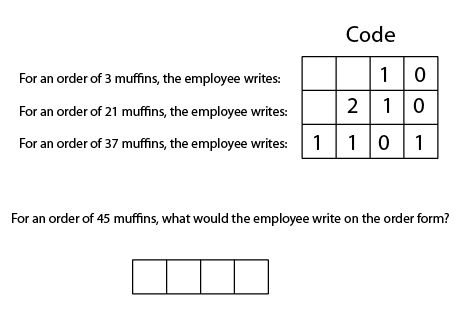
Cracking the muffin code is an activity found in the Everyday Day math curriculum. A quick Google search will also bring up many different threads related to this activity.  I’ll be paraphrasing the lesson throughout the post.  Basically, students are given a scenario where they’re in charge of a muffin market.  At the market the muffins are packed into boxes.  The boxes only hold a certain amount of muffins.  When someone asks for muffins, an employee fills out an order form.  That order form contains a code.  The largest box needs to be filled first and the employee needs to send boxes that are full. Here’s an example that I paraphrased from class:

Screen Shot 2017-09-21 at 8.49.18 PM

I had students work in groups to figure out the code.  I gave them around 10 minutes and at the end of time a few groups were fairly confident with their answer.  We discussed the code and students started to notice a pattern.  They used trial-and-error to figure out which column matched the box size.

Screen Shot 2017-09-21 at 8.59.12 PM.png

There was a lot of excitement in the air as students solved the puzzle. Afterwards, students connected this to the idea to place value for the next problem.  This puzzle was designed differently. Now, students were asked to pack boxes of granola bars. The packages hold 100, 10, or 1 bars.  The employee uses a coding system.  Here’s another example:

Screen Shot 2017-09-21 at 9.04.30 PM

Almost immediately, students were able to see that the first column was designed to package one bar.  The second was for ten, and the third, one hundred.  I gave time for students to look at the similarities and differences between the granola and muffin codes.  Students were then asked if the base-ten system was similar to the granola code.  Students nodded their heads and I even had a student say that when we regroup numbersit’s like adding another package.  Another student stated that sometimes not all the numbers fit in a package so we have to find another place for them.  Students were making connections to how the base-ten number system works and why regrouping is sometimes necessary.

This was an eye-opening experience for some students as they started to look at the place value positions as bins or containers.  This lesson had students talking about how place value can be perceived as “containers” or “boxes” for numbers.  Each box needs to be filled to it’s capacity until a new one can be used.   I’ll be referring to this activity throughout the year as it seemed to help students make connections when exploring the base-ten system.

Afterwards, students used the column addition algorithm with a bit more confidence.  Next week we’ll be discussing multidigit subtraction.


Volume and Missing Blocks

Screen Shot 2017-09-12 at 9.10.54 PM.png

On Monday my fourth grade crew worked on tasks related to perimeter and area.  Today they discussed volume. The volume discussion began when I brought out a large container filled with water.  I asked the students what they thought volume was.  Was it the amount of substance contained in an object or the space inside of the object?  It was interesting to hear their perspective.  I wrote down their thinking on the whiteboard. Some students were positive that volume measured how many cm cubes that could fit into the cylinder.  Another student stated that there wasn’t anymore volume left because the water took up the space.  I then took the same cylinder and dumped the water out.  Another student mentioned that you didn’t need to use cubes to fill up the cylinder.  You could’ve used sand instead to measure the volume.  Throughout this class conversation I thought students were testing their understanding of volume and not just regulating it to filling up objects with cubes. The class then made a math journal entry and created a t-chart of examples and non-examples of volume.

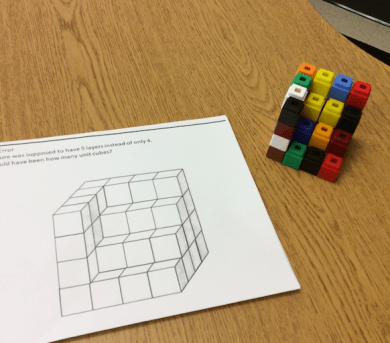
Afterwards, students went back to their table groups to discuss volume and I used Steve’s image from the tweet below.

I asked students to think about the shape and how many cubes might need to be added to create another layer.  Students were confused at first, but then gradually came around to thinking about how to add another layer.

Screen Shot 2017-09-12 at 9.10.43 PM

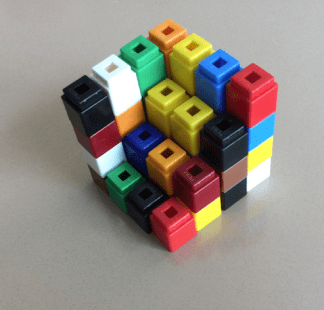
Some students wanted to add a layer on top, but then realized that making that top layer would mess up the stair sequence.  Eventually, after some major perseverance, I asked students to create a model.

Screen Shot 2017-09-12 at 9.10.50 PM.png

That model proved helpful as students could see and start thinking about how many blocks could be added to the bottom.  I noticed that students started to think of arrays and how helpful they were in creating another layer.

Screen Shot 2017-09-12 at 9.10.54 PM.png

At that point class ended.  We’ll be discussing this problem again tomorrow.  I’m looking forward to seeing what the students discover, their solutions, and what strategy they end up using.

Triad of Responsibility

Screen Shot 2017-09-03 at 8.00.30 AM

My students finished their seventh day on Friday.  The students and I are in the midst of a timely three-day weekend.  For the most part, I’d say that students and teachers are starting to get into their school routines.  There have been a few bumps in the road (there always are), but the school, teachers and students are making progress and we’re off to a great start.

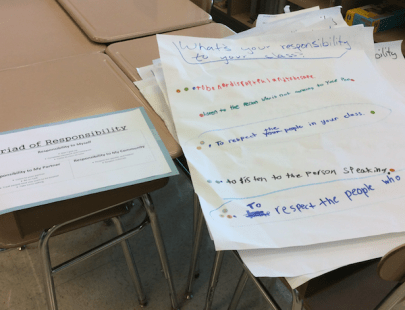
This past week started off with discussions about expectations and routines for all stakeholders. Staff emails and student assemblies reinforced these expectations for teachers and students.  Early in the week I had the opportunity to have a class conversation about responsibility.  This stemmed from Caitlyn’s blog post and her experience with the NYC Math Lab.  Students were placed in groups and given a marker and anchor chart paper.  Each group was expected to create a list of at least five statements related to what ______ sounds/looks like.

  • What is  your responsibility to your class?
  • What is your responsibility to your partner?
  • What is your responsibility to yourself?

I gave each group around 10 minutes to discuss and write down their thoughts.  It took a while for the groups to decide on what to write, but they eventually came to somewhat of a consensus and documented their answers.

After the ten minutes, I brought the class back together and hung up the anchor charts around the room.  Students were given two stickers and asked to visit an anchor chart that wasn’t their own and place their stickers next to two statement that they thought were the most important.  Students were then given an additional two stickers to place on the remaining anchor chart.  Basically, students weren’t allowed to vote for their own anchor chart.  Afterwards, the class met as a group and analyzed the two most important (as surveyed by the students) statements.  Those statements were used to create the responsibility expectations for the classroom.

Screen Shot 2017-09-03 at 8.00.46 AM.png

I used this activity with three of my classes and compiled the results. I thought it was a decent activity and it had students thinking about their responsibility.

Screen Shot 2017-09-03 at 8.00.56 AM.png

Looking back, I probably could have took a math angle to this activity and ask students to think of how each responsibility applies to them as a a mathematician. Maybe next year.  : ) I’ll be referring to the “triad of responsibility” as the year progresses.