Fraction Progress

Screen Shot 2017-11-18 at 5.16.43 PM.png

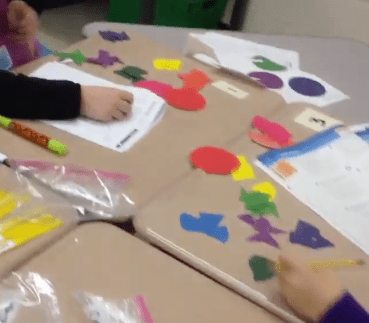
My third grade students have been exploring fractions.  For the past month, students have been delving deeper and constructing a better understanding of fractions. Last week, students cut out fraction area circles and matched them to find equivalent fraction pairs.
Screen Shot 2017-11-18 at 4.05.19 PM.png

For the most part, students were able to match the fractions to observe equivalency.  Afterwards, students discussed how to find equivalent fractions through different means.  Some students made the connection between doubling the numerator and denominator, while others noticed that they could divide to find an equivalent fraction.

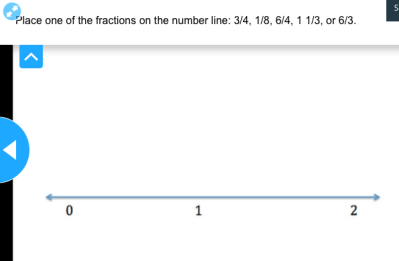
Early this week, students started to place fractions on number lines.  They used the whiteboard and a Nearpod activity to become more accurate when identifying and labeling fractions on a  line.
Screen Shot 2017-11-18 at 4.19.31 PM


It was interesting to see how students showcased their understanding as the number line increased from 0-1 to 0-2, and beyond.  Giving an option for students to decide which number to use seemed to encourage them to take a risk with showing their understanding.

On Wednesday, students started a fraction task related to computation.  Students were asked to color each fraction bar, cut them out and organize the fraction pieces to complete given number sentences.  Students had to rearrange the fraction pieces and found that there were leftover pieces, which makes this a more challenging task.  You can find more information about this activity here.

This task took around a day to complete.  Students struggled at first and they used a lot of trial-and-error.  Students compared the fractions bars and switch the pieces around quite a bit before taping down the sum.  A few students needed a second attempt to complete this.

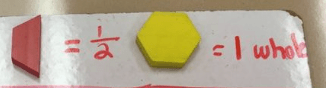
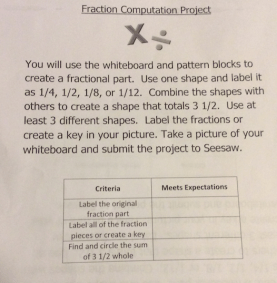
On Friday, students used polygon blocks to show their understanding of fractions.  Using polygon blocks, students were asked to take one block and label that as 1/4, 1/2, 1/8, or 1/12.  They then combined at least three different blocks to find a sum of 3 1/2.
Screen Shot 2017-11-18 at 4.56.15 PM.png

Students used whiteboards and geometry blocks to combine the fraction pieces.  I observed students using different strategies to combine and then take away blocks to find the sum of 3 1/2.

Next week, students will investigate the relationship between fractions and decimals.


Area and Volume Skills

Photo Nov 07, 1 44 56 PM

My fourth grade students finished up a unit on volume about a month ago.  This past week I gave the same group a cumulative assessment on the first two units.  After grading the assessment I started to notice trends.  Many students had issues with converting square units to cubic units.  Students also mislabeled units related to measurement.

This is my first year using a new version of a district-adopoted math resource.  This year’s scope-and-sequence had students encountering area first and then volume was discussed in a completely separate part of the unit.  I believe that isolation made students think that problems in the different sections were either 1) related to area or 2) related to volume.  The assessments that I graded indicated that students needed some bolstering in applying area and volume.  Combining them would be a bonus.

Early this week I came across Graham’s Tweet about test questions.

I clicked on the article and found some amazing questions.  I definitely geeked out after trying out a few. These types of  questions made me think beyond one math skill or idea and I thought it would move students in that direction too.  I decided to use the area question with my students.

You see, in the past students have been given the length, width, and height, and then asked to use a formula (often given to them) to find the volume.   In this case, students were given the area and had to use that to find the side lengths.  This type of task in Graham’s Tweet was definitely different problem for them.

I gave each student a copy of the sheet and had them work on it individually for about 10 minutes.  Students initially thought of adding all the area sides together, but then they realized that adding them wouldn’t help in the process.  I redirected students to look at what the question is asking.  There were a few minutes of frusturation as students were looking for ways to find the length, width, and height.

Students were then put in groups to work out the problem.  Eventually, students started to think of factors as they started to investigate numbers that  work for the length.  Some went the route of using a factor rainbow, while others used a trial-and-error method.

Screen Shot 2017-11-10 at 7.55.59 PM.png

More frustration ensued, but students still moved forward.  A few groups were confident that they had a solution.  I briefly looked over all the responses and saw that no one had the correct answer, but I pokerfaced it and had the students work it out at home.  That evening some of the students tackled the problem and came back with a solution.  I was impressed with the perseverance and also how these students applied their understanding of area to find volume.

Conjectures and Math Arguments with Fourth Graders

Screen Shot 2017-11-02 at 5.55.44 PM.png

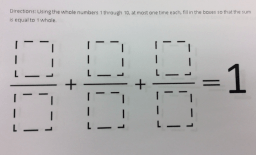
My fourth grade class just started a unit on division and fractions. Students started out the unit by observing the relationship between fractions and division. This was a realization for some students as they perceived fractions as an isolated topic, separate from the division operation.  From there, students moved to adding and subtracting fractions. The class completed an Open Middle problem on Wednesday.

Screen Shot 2017-11-02 at 5.47.00 PM.png

Last year, students were introduced to this computation skill and many were comfortable transitioning that skill to more complex fractions.  I’d say the majority of my students completed problems using a common denominator strategy.  Very few used a visual model.  For the most part, students were able to find solutions to the computation problems.

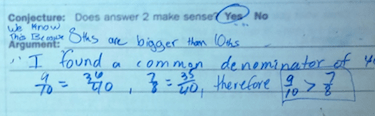
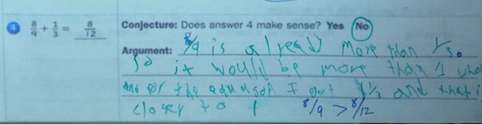
The next day, students experienced the idea of using mathematical reasoning to create conjectures.  This was brand new for the students and I recently read about how to use conjectures in class from Tracy Zager’s book.  The class discussed very simple conjectures, claims, and arguments.  After about ten minutes, a student mentioned that someone is being a “math lawyer” when they go through the conjecture, claim, and argument process.  I think the whole class laughed at that response, but agreed.  I then helped model a few different conjectures and clarified the definition.  Students then worked in table groups to role-play how to defend their claims.

Screen Shot 2017-11-02 at 5.42.20 PM

Near the end of class, I was able to have students work on a page related to fractions and conjectures.  Each table group 1) looked at a specific fraction computation problem 2) each student added their own view point of whether they agreed or disagreed 3) the groups came to a consensus and wrote their argument to prove their case 4) students wrote their arguments on the whiteboard.

Screen Shot 2017-11-02 at 5.43.30 PM

I was impressed with how students started to improve the clarity of their mathematical writing during this process.  This is an area of growth for all of my classes.  Writing in math class doesn’t happen as often as I’d like.  I’m hoping to complete more conjecture, claim and argument activities as the year progresses.