Student Self-Reflection and Common Math Errors

Screen Shot 2018-09-22 at 2.31.17 PM

My fourth grade students took their first unit assessment of the year last Wednesday.  This is the first class to take an assessment this school year.  The unit took around four weeks and explored topics such as area, volume, number sentences, and a few different pre-algebra skills.  This year I’ve been approaching student reflection and unit assessments differently.

Students were given their study guide during the first couple days of the first unit.  The study guide included questions that covered topics that would be taught throughout the unit.  At first students were confused about how to complete items that we haven’t covered yet.  Eventually students became more comfortable with the new study guide procedure as we explored topics and they completed the study guide as the unit progressed.  There were a couple of students that lost their study guides, but they were able to print it off from my school website.  I reviewed the study guide with the class the day before the test.  It took around 10-15 minutes to review, instead of around 40-50, which has been the norm in the past.

After students finished the study guide the class reviewed the skills that were going to be assessed.  Students informally rated where they were at in relation to the skill.  I decided to move in this direction as I’m finding that reflection on achievement or perceived achievement doesn’t always have to happen after the assessment.

Students took the test and I passed back the results the next day.  Like in past years, I have my students fill out a test reflection and goal setting page.  This page is placed in their math journals and I review it with each student.  I decided to use Pam’s idea on lagging homework/coding and add this to my student reflections.  Last year my students used a reflection sheet that indicated problems that were correct or incorrect and they developed goals based on what they perceived as strengths and improvement areas.  This year I’m attempting to go deeper and have students look at not only correct/incorrect, but also at error analysis.

So I handed back the tests and displayed an image on the whiteboard.

mathcoding -01.png

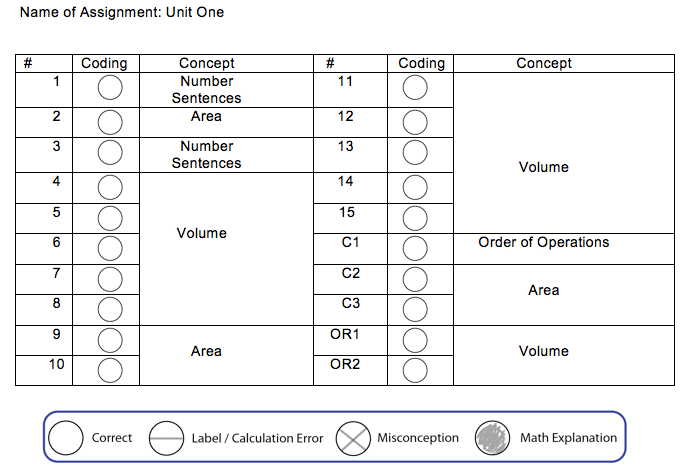
I told the students that we’d be using coding in math today.  I reviewed the different symbols and what they represented with a test that was already graded.  Each question would be given a code of correct, label / calculation error, misconception, or math explanation. I gave multiples examples of what these might look like on an assessment.   I spent the bulk of my time introducing this tool to the misconception symbol (or as some students say the “X-Men” symbol) to the students.  After a decent amount of time discussing what that looks like, students had a good feel for why they might use the math explanation symbol.

I then passed out the sheet to the students.
Screen Shot 2018-09-22 at 2.07.02 PM.png

Students went through their individual test and coded each question based on the key.  At first many students wanted to use the label/ calculation error code for wrong answers, but then they stopped and really looked at why their answer didn’t meet the expectation. In some cases, yes, it was a label issue.  Other times it was an insufficient math explanation.  Most of the students were actually looking at their test through  different lens.  Some were still fixated on the grade and points, but I could see a shift in perception for others.  That’s an #eduwin in my book.

This slideshow requires JavaScript.

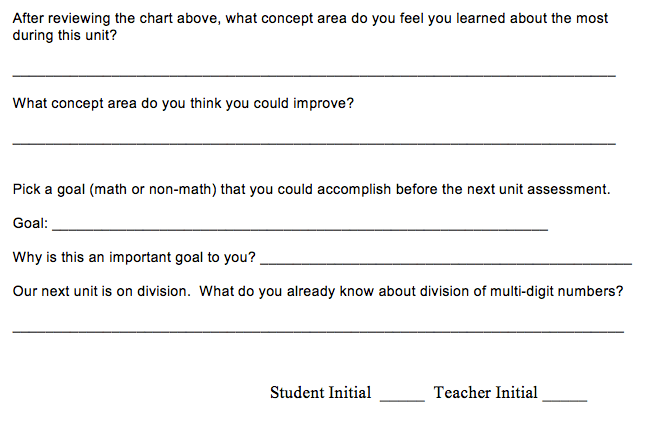
After students filled out the top portion of the reflection sheet they moved to the rest of the sheet.
Screen Shot 2018-09-22 at 2.11.02 PM.png

Students filled out the remaining part of the reflection sheet.  They then brought up their test and math journal to review the entry.  At this time I discussed the students’ reflection and perception of their math journey and I made a few suggestions in preparation for the next unit.

At some point I’d like create an “If This Than That” type of process for students as they code their results.  For example, If a student is finding that their math explanations need improvement then they can ________________ .  This type of growth focus might also help students see themselves as more owners of their learning.  I’m looking forward to using this same process with my third and fifth grade classes next week.

Third Grade Math Confidence

Screen Shot 2018-09-15 at 3.06.58 PM

My third grade students have been working on rounding and estimating this week.  It’s been a challenge as these concepts are fairly new to the entire class.  We’ve only been in school for only three weeks but I feel like we’re in stride now.  Kids and teachers both are in a routines and tests are already on the schedule.

Back to rounding and estimating.   So students have been struggling a bit with these two concepts as we head towards using the standard algorithm. With that struggle comes a shake in math confidence.  Students needed to be reminded of our class expectation of “lean into the struggle” many times during the past week.  It’s interesting how a student’s math confidence changes throughout a unit, or even throughout the year.  This third grade class in particular is working on becoming more aware of their math performance compared to what’s expected.  In order to reach that goal, I dug back into my files and found a simple, yet powerful tool that might help students on this awareness math journey.

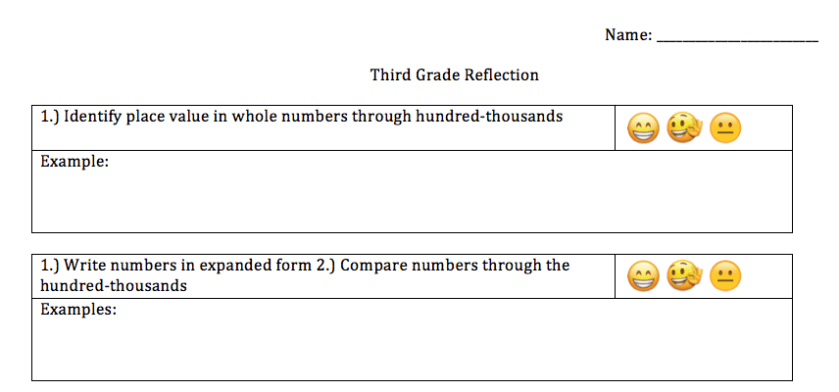
Screen Shot 2018-09-15 at 2.50.55 PM.png

Basically, students first read the top row goal. They were then given a die to create an example of the goal.  During this process students circled one of the emoji symbols to indicate their confidence level.  The extremely giddy emoji indicates that they could teach another student how to complete the goal.  The OK smiley means that you’re fairly confident, but feel like you might not be able to answer a similar question in a different context.  The straight line emoji means that you’re confidence is lacking and you might need some extra help.  This paper wasn’t graded and that was communicated to the students.

Regardless of the emoji that is circled, students are required to attempt each goal.  Some students were very elaborate with explaining their thinking, while others tried to make their answer as concise as possible.  After completing this students submitted their work to an online portfolio system so parents can also observe progress that’s been made.  So far it’s been a success.  I’d like to use this simple tool for the rest of the first unit and possibly the next.  It takes time, but as usual in education, the teacher has to decide whether it’s worth that time or not.  In my case, the student reflection has meaning and it’s directly tied to the goals of the class.  I’m looking forward to seeing how these responses change over time. Feel free to click here for a copy of the sheet if you’d like one.

Volume and Group Tasks

2examples-01.png

My fourth grade students have been exploring measurement and geometry during the past week.  They started out by learning about perimeter, area, and are now in the midst of discussing volume.  Students are working on a project where they’re building rectangular prism models and constructing cities.  They document the dimensions, cut out the rectangular prism that matches the measurements and places it on a map.

The groups have been working diligently over the past days.  What I found interesting on Friday were the student conversations.  As I peered over each group I eavesdropped on what was being said.  Students are in groups of 2-3 and there’s plenty of conversation happening.  Students are recognizing that the length, width and height all impact the volume of a rectangular prism.  Mistakes are also happening.  That’s a good thing.  Students have had to use multiple grid sheets because they either cut out the faces too large or too small.  They just grab another grid sheet and start over again.  Their perseverance and being able to “lean into the struggle” is evident and I made sure to remind them of that.  Students were even getting creative in adding sunroofs and open decks with their prisms.

Projects like this take time, but they’re often worthwhile in helping students build conceptual understanding.  I’m looking forward to adding a question component for the groups on Monday.  The questions will relate to cubic units and how the volume is found when combining multiple rectangular prisms.

I believe that this activity helps students apply volume formulas.  I want students to come away with a better understanding of why the formula V = b*h is used and have them feel more confident in being able to see geometry/measurement relationships.

After this activity students will take a brief formative checkpoint where they’ll be answering questions similar to the below image.  This is also how students will be assessed in a couple weeks.

3dcomboshape

The projects should be finished by the end of the next week.  I’m looking forward to seeing how the cities finish up and the student reflections that follow.