White Fragility and Perspectives

Screen Shot 2019-07-26 at 1.22.24 PM

This summer I’ve had the chance to read a few books on my list. Now with just a few weeks left before school starts I’m left with an opportunity to reflect on what I’ve read and am looking forward to applying what I gleaned from the pages.  Two books in particular have peeked my interest related to white fragility and awareness:  White Fragility by Robin DiAngelo and This is Not a Test by José Luis Vilson.  My local library was able to find a copy of each through their interlibrary loan system.

To start I’ll talk about White Fragility.  This book was eye-opening and powerful (also has an amazing discussion guide for educators).  Kudos to Sonja for giving the recommendation. To be honest, I’ve had my own fair share of “equity” type of pd trainings and whenever the discussion of race is brought up the room gets very quiet. I hear statements like “I treat all students the same” or “I don’t see color.”  The author discusses these specific phrases among others and why people get defensive. White privilege exists. White people might squirm in their seats and censor their language carefully during discussions that creep towards equity and racism.  The book discusses why white people feel uncomfortable while discussing racism.  The historical perspective detained was thought-provoking and brought me an awareness piece that I haven’t encountered before.  One particular quote that stood out is below.

“I repeat:  stopping our racist patterns must be more important than convincing others that we don’t have them.” White Fragility p. 129

Many equity trainings often start with “getting to know you” activities.  These are generally designed so that participants feel comfortable discussing racism and their perspective.  An enormous time is set aside for this.  The author suggests that this isn’t because participants don’t feel physically safe, but it’s more because they want to convince others in the room that they certainly aren’t racist.  Being willing to discuss the important issue of systematic racism means being able to accept our own white fragility and the role that plays in often hindering these important conversations from moving forward.  Also need to keep in mind white consensus and how quickly people are at defending each other when being asked to reflect on actions.

The second book that I read was called This is Not a Test by José Luis Vilson.  I enjoyed reading about his experience growing up in NYC and how he went from being a computer science major to moving into teaching.  I enjoyed how José discusses his life and how he landed on being a teacher.  The end of the second part and the third resonated.  I appreciate how the author illustrates how teachers can have a voice in the current system that often perpetuates the status quo. José also addresses power structures and the different dynamics involved with standardized testing and teacher shaming.  I thought this quote was interesting:

“Educators have to get involved in planning curriculum and pedagogy.  We also have to believe in ourselves as powerful change agents or else we perpetuate the same power structures we say we’re against.” This is Not a Test p. 108

This hit home.  Teachers need to get involved in the curriculum and instruction development and rollout.  It’s challenging for me and it’s most likely due to my own white fragility, but educators need to be vocal and address systematic policies or pedagogy that might not be as inclusive as needed.  Same goes with resources.  Say no to historical simulations involving slavery, the holocaust and a myriad of other painful scenarios.  Be culturally aware that situations involving escaping from ______ might not be a good options.  Having the students recreate objects of hate such at the confederate flag shouldn’t exist.  Speak up.  If we’re silent than that inaction continues to kick the can down the road.  This should also apply to specialized advanced programs in schools.  Take a peek at the demographics and look at how they compare to the overall population. One concept that the book emphasizes is that intent isn’t enough. – the idea of intent vs. impact.  People need to take the initiative while also understanding that teachers are in a position that isn’t always recognized as a place where decisions are made.  Teachers have a voice and using it is important.

Both of these books have given me an opportunity to think about my perspective and privilege.  I’m kicking myself because I should’ve read these earlier.  Realizing how you’re raised, perception of what’s defined as racism, the history behind white supremacy, systematic pieces related to education, availability to access, status, and why it’s so hard to discuss racism all play a role in how you can make an impact moving forward. Both books have reinforced the idea that intent isn’t enough. I’m becoming more aware of my thoughts on white privilege and am still learning.  As I look at my school calendar I’m looking forward to seeing and possibly sharing how these two books have impacted my perspective with others.


Building Awareness and Knowledge

Screen Shot 2019-07-14 at 1.46.19 PM.png

During the past couple weeks I’ve created a brief routine of reading in the mornings. Sitting out on the deck, reading a book and slowly drinking my coffee has been time well spent.  I’m taking advantage now since this won’t be happening once school starts in about a month. One of the books is related to culturally responsive teaching and the other I’m just starting to dig into is about white fragility.  Both books are somewhat similar and I’ve been able to spend a decent amount of time reflecting on systematic education practices.

One particular takeaway in chapter four of CRT was related to building awareness and knowledge before making judgements. The author makes the case that teachers should widen their interpretation aperture when interacting with students. Aperture refers to the amount of light that is allowed in and out while taking pictures. Aperture is used instead of lens in this context. Widening that interpretation aperture takes time and a process is involved. The paraphrased process below is from the Mindful Reflection Protocol by Dray and Wisneski.


1.) The author discusses replaying student and teacher interactions in your mind.  That replay involves describing what’s seen. It can be challenging to replay conflicting interactions, but keep in mind that the replay is neutral – it’s stating the facts.

2.) Make assumptions and attempt to interpret the behaviors.  Teachers have to make so many decisions everyday and generally the interpretation falls into two categories:  intentional or non-intentional – positive or negative.  Behavior interpretation has the potential to be a sticky situation as it depends on the aperture of the teacher.

3.) The author suggests to offer alternative explanations.  What would a child behave in ____ way.  Do cultural norms or beliefs play a role in why the behavior happened?  How are directives given at home?  After reviewing the assumptions a couple times it’s time to check the explanation.  Explain the observation with other teachers.

4.) Hear from their perspective and check your explanation.  It might be helpful to go outside of your team to discuss this to receive alternative perspectives.  Here’s where it takes an extra effort to research and build more of an awareness of cross-cultural knowledge.  Trainings and PD can play a role with this.

5.) Make a plan of how to address similar behaviors and continue to review when you might be overgeneralizing situations.


Next week I’ll be reading about how to recognize common triggers and look at building learning partnership.  I’m also going to to be diving into chapter two of White Fragility.


Reflections on 2018-19

Screen Shot 2019-07-06 at 11.19.39 AM.png

It has been about a month since school let out and I’ve been enjoying the summer so far.  I’ve been reading, working on the lawn, painting and took a vacation.  During the last month I decided to focus my time on things not related to school work.  This balance of time tends to give me a better perspective when I do come back to working on items related to school.  Now I’m starting to see school supplies (already!) in stores and am looking back at how the school year went last year.  Every year I attempt to gather information about my students and how they perceived the school year as a whole.  I give a survey and use that information moving forward for the next year.  I decided to wait a bit over the summer to look over the results.

Back in June I gave a survey to all of my students in 3-5th grade.  The survey was related to instruction models and preferences.  This year I intentionally varied my models throughout the year and didn’t stick with one particular tool for activities.  I started off the survey with a brief question about their favorite math topic this year.

Screen Shot 2019-07-06 at 10.37.43 AM

Before giving the survey I went into detail about each topic.  The purple is measurement and I’m not sure why it didn’t show up with my advanced table Gform add-on. The next question was related to why they felt this was their favorite topic. Here are a few responses:

Screen Shot 2019-07-06 at 10.42.59 AM

Next time I’m going to put a minimum character limit to extract more information.

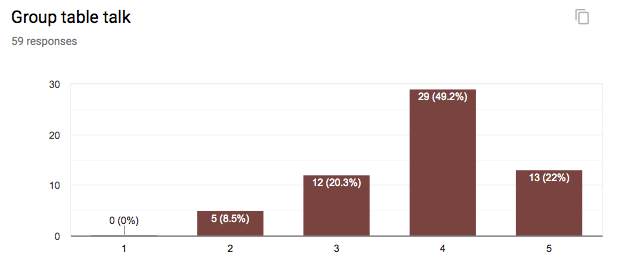
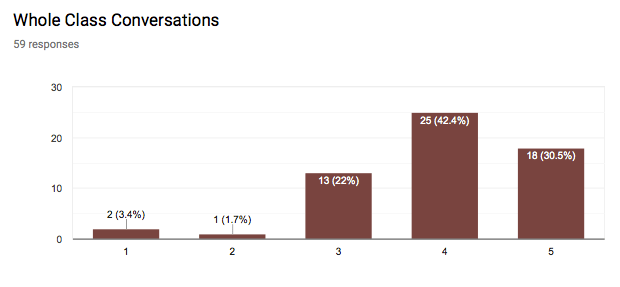
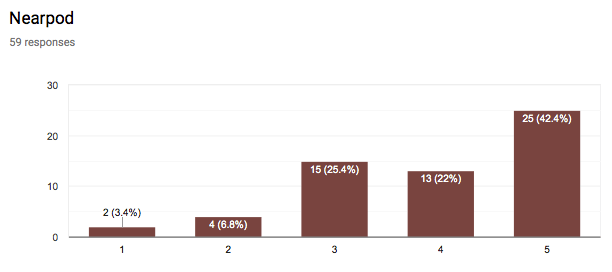
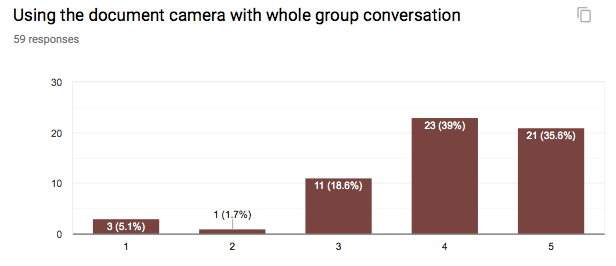
The next section, which was the largest, was related to instruction models/activities. Students rated them (1-5) 1 being the least effective for learning and 5 being the most.  A brief explanation of the items is in each caption.

Screen Shot 2019-07-06 at 10.46.13 AM.png
Teacher gives prompt and students discuss as a group and share out responses to the class

Screen Shot 2019-07-06 at 10.47.52 AM.png
Used for retrieval practice – students used this individually and in groups of two

Screen Shot 2019-07-06 at 10.49.14 AM.png
Similar to Kahoot, but more self-paced – used to reinforce concepts

Screen Shot 2019-07-06 at 10.50.37 AM.png
Similar to Number Talks – prompt is displayed and class discusses concept

Screen Shot 2019-07-06 at 10.52.40 AM
Used  for notation on slides and showing student’s work to the entire class

Screen Shot 2019-07-06 at 10.54.14 AM.png
Used K-5 math for whole class or independent exploration of math concepts

Screen Shot 2019-07-06 at 10.55.55 AM.png
Students are digitally randomized into groups and then they work on a particular task with that partner.  Students report out their responses afterwards.

Screen Shot 2019-07-06 at 10.57.10 AM.png
I display work (sometimes student work) on the document camera and the class discusses strategies


I had 59 students take the survey, but I have 65 + students in 3-5th grade.  Some of them were out for other activities during the time the survey took place.  Something to consider … some of these activities were used more frequently so students had a larger sample size.  Overall though, it seems students enjoyed most of the tools/activities for learning about mathematics.  I think it should be mentioned that there’s a difference between a tool and strategy and I might be blending the lines a bit in this post.

category-01.png

The tools in the box were used independently or with a partner.  They also required some type of technology (iPad, Chromebook), while the other four didn’t.  I think having a blend between the tools/strategies is helpful and students aren’t dependent on using one medium to show their learning.  I’m looking forward to diving more into this data as the summer progresses.