We Got This – Part 1

This summer I’m reading through We Got This by Conelius Minor. I’ve heard of the book and another teacher at my school raved about out last year. Based on the preview it looks like it falls in similar lines with two of the books that I read last year: This is Not a Test and White Fragility. I feel like understanding your own bias and privilege are the beginning steps in making actionable change. I’m continuing to read more to find out where I can make lasting impact.

The book is part of an optional study for the summer that was made available by my administrator. With all that has transpired over the last few months (George Floyd’s death, protests, awareness of inequalities … ) the district has taken a stance that equity should be a focus. How that turns out is anyone’s guess right now, but I believe we’re making strides in the right direction. The study group will be reading a couple chapters and then meeting over Zoom throughout the summer. Last week the group initially met to discuss the logistics and decided to read two chapters and meet every two weeks.

I kept my highlighter handy as I went through the first two chapters. I highlighted certain statements that resonated and kept them at limit to focus on particular pieces. I’m writing here to preserve my current thoughts.

Chapter 1

“The true masterminds – the real enemies – in this dystopia are the business-as-usual attitudes ..” p. 10

Over time I’ve realized the business-as-usual tendencies are often rooted in resistance to change. As an organization become larger balancing efficiency with what’s best for students tends to drive decisions at a school level. Being open to modifying or scrapping an idea for something else can be a challenge, especially when the originators of the system are not willing to budge or have been given a directive to stay the course.

“When we are inflexible in our naming, we become inflexible in our thinking” p. 10

Despite our best efforts, fixed labeling is evident in schools. Gifted, resource, special ed, striving, low, high, average, EL, kiddos (okay I threw this in there), are all labels. Once a label is fixed it’s trying to remove it from our fixed perspective. Being more flexible with categorizing can help evolve our viewpoint. Students are changing, growing and developing their own academic identities through experiences at home and school. Why should teachers affix a label that’s attached to a student as the individual learning process evolves.

Chapter 2

“Teaching without this kind of engagement is not teaching at all. It is colonization.” p. 28

The text before this statement mentions the importance of relationships that are grounded in a shared vision and collaboration. The word that bounced off of the page was colonization. When I hear the word I think of establishing control. Is that what school is for? I would assume if you ask teachers, many of them would say that having a classroom community is essential in creating an environment for optional learning. This quote reinforces how important it is to allow (I kind of cringe when writing that word as it assumes that it’s my decision) students to be empowered to be part of a community of learners.

“... Racism, sexism, ableism, and classism are systems”

“The hard part of knowing that oppression lives in systems too is understanding that systems don’t change just because we identify them; they change because we disrupt them.” p. 31

Understanding that racism is a system and not necessarily an act can take time to digest. Being aware that oppression exists within systems takes a critical eye in looking beyond business-as-usual tendencies. Identifying what/how a school culture silences, excludes and/or oppresses students is the first step. Then we move towards the disruption process.


Feedback During eLearning

I’m a couple weeks into summer and have had time to thin about the last couple months of the school year. After analyzing it a bit, I’ve come to the conclusion that feedback was one of the major challenges during eLearning.

Feedback in an actual classroom is much different compared to feedback during eLearning. I should say emergency eLearning because the plans were thrown together with very limited transition time. It’s much different when you’re able to sit and talk with a student about misconceptions. In person feedback is more effective as you can use non-verbals, see reactions, have students explain their reasoning, and make multiple attempts within a short period of time. The biggest difference is in how quickly students are able to use the feedback while in person. In the digital realm, I found myself giving feedback and a student using it much later in the day or sometimes multiple days later. Some students would respond quickly and others wouldn’t even see it for days. Part of this was due to the platform that we were using. I found that the effectiveness of the feedback was a tipping point when introducing new content and students were still having a challenging time applying the skills. Students that understood the concept and/or had help from a parent at home were able to move on and those that didn’t had trouble keeping up.

Soon after moving to eLearning I ended up developing a draft key to help with the feedback. This was made more as of a communication method to tell students that I received their work and if corrections were needed. SeeSaw allowed me to write in the comment section and that’s where I put the feedback. I wrote about some of this earlier in the year here.

√ Meets expectations
∆ Try again (and then I added feedback)

I mainly used these as they’re shortcut keys on my computer and I could quickly type them into the comment field. If a student received less than 100% they’d get a ∆. Over time my feedback turned into questions or I referred students back to the directions.

Some of the question/comment stems are below.

  • The directions state …
  • Have you considered …
  • Can you explain why you …
  • Is volume measured in …
  • How does your work show …
  • Check what I circled …
  • It looks like ____ might be missing
  • Why did you use ____ operation
  • Why did you round …

Obviously the written feedback depends on the task. Many of the tasks came out of our district’s adopted resource, but others were Google Form or from Desmos. Another factor to consider is how receptive students are to the feedback. Most students were receptive and resubmitted with a “I forgot/ I didn’t see that / That makes sense now / Thanks! / I’ll remember that next time …” Other students would say, “It’s right, I checked it / I didn’t forget anything.” In those cases I’d kindly remind them to check again or notate on the student response where additional information is needed. There were times where I gave audio feedback and that worked for a few of the students. Some students would respond to this immediately, while I had to remind others to review the feedback and resubmit.

As we inch closer to the new year I’m looking at modifying this system. Teachers and students might (as of 6/20) be in the classroom to start the year with masks and there’s a possibility that some of the instruction will be online.

So far this summer has been full of non-school reading and yard work. It’s great to recharge and get outside. While doing this I’m keeping in mind what needs to be done when we return in August.

Reflecting on the 19-20 School Year

School officially ended on Monday. It didn’t feel like a typical end of the school year as teachers said goodbye via Zoom and then shut off their computers for a little while. It’s now time to reflect, drink my coffee slowly, work on a few house projects and take some time for self care.

Before leaving for the summer I asked students to fill out a Desmos survey that I found online. It was originally created by Rachael Degnan and I edited it to reflect my students’ situation. The survey asked students about eLearning, their effort and a number of other questions related to this school year. I was able to get 44 responses in total. I’ll post the slide question and observations in the captions.

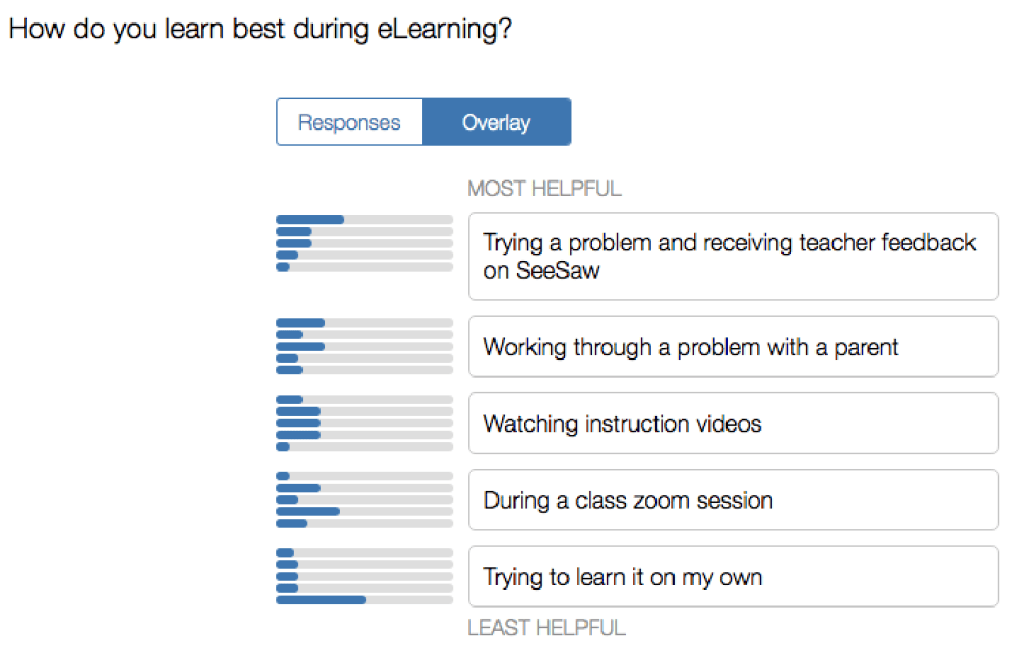
The first question asked students about elearning and instruction. In my case students primarily use the SeeSaw platform. Teachers were expected to post daily assignments in SeeSaw for students to complete. The assignments were posted by 9 am and Zoom sessions were scheduled throughout the week – some by the homeroom teacher and others by specialists. Sometimes the Zoom session related to the daily assignments other times that wasn’t the case. It was up to the teacher to decide what to assign and how to use the time during the Zoom sessions.

Most teacher assignments included some type of instruction (possibly pre-closure) or during a Zoom session/teacher instruction video. The most helpful, according to the students was trying a problem and then getting sometime of feedback from the teacher. I’d say approximately 60-70% of the assignments required a student to review the teacher feedback and make a second attempt. Some students required additional attempts. If students were still having difficulty after multiple attempts the teacher would sometimes create a brief instruction video or screencast to help.

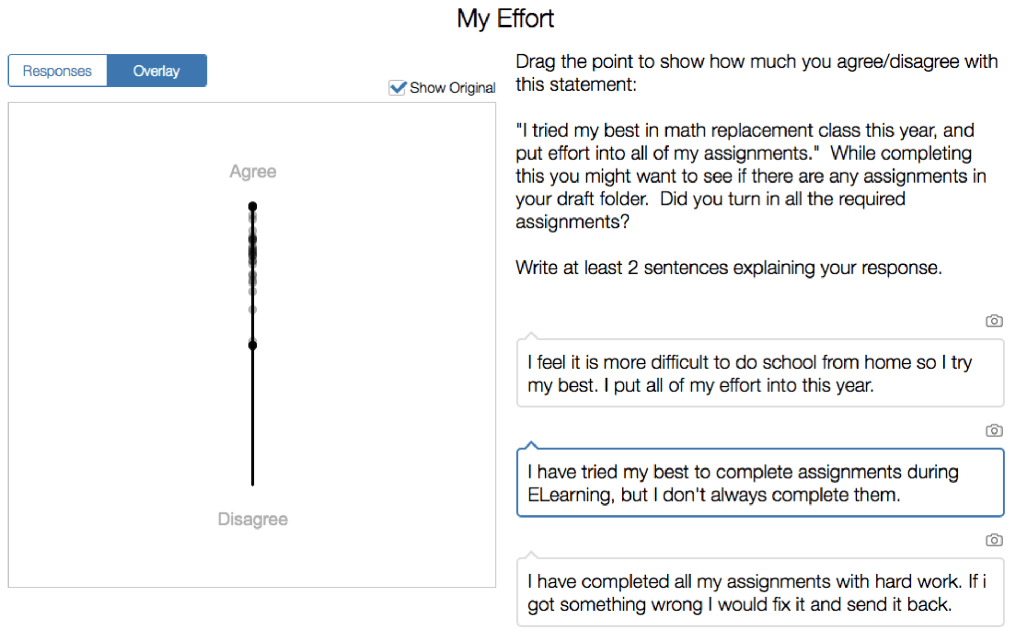
The second question related to effort. Most students felt as though they tended to put in a good amount of effort during class. I think if I excluded it to just eLearning the results might be slightly skewed lower. Some students mentioned in the comments that they didn’t try as hard during eLearning because there wasn’t as much work expected. That’s true because the work required decreased during emergency eLearning.

Students tended to skew more positive on the improvement as a student/learner compared to the personal level. This was given to students in grades 3-5 so that’s also something to keep in mind when analyzing the results. Many students related to personal growth to making new friend and helping others in need. I saw responses like this in the student explanations. I thought that was interesting as it wasn’t something that the class discussed much in detail.

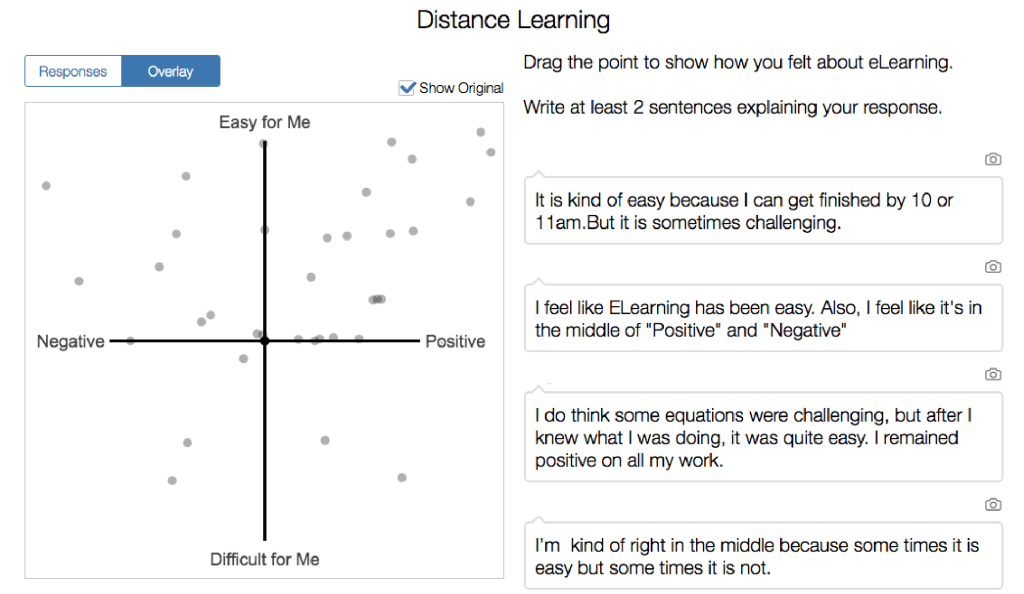
This question had responses across the entire grid. Students generally completed the math work in the morning after a homeroom class Zoom session. If a students was having trouble with a concept it was challenging to address it without seeing the student work first. I think this was tough for some students as they were able to ask for help from a parent and others were not. Some students mentioned in the comments that they couldn’t work through problems with a partner or group and that negatively impacted how they felt about eLearning. Other students were nervous and weren’t quite sure how to work their question so they gave up or left question fields blank.

A couple things stood out to me with this question. Most of the students liked completing tasks at their own pace. This doesn’t happen as much as I’d like it to in the regular classroom as schedules often limit timing. Many students mentioned they learn best in-person. This isn’t surprising and highlights the importance of being able to see a student, their work, non-verbals and use those to connect and give feedback. I believe students missed those connections.

The top vote was “getting good grades” and part of me feels sad about this. I try to devalue points/grades as much as possible and focus on the math journey instead. There’s quite a bit of pressure for these students to do well. I was glad to see maintaining friendships and building new friendships to be in the upper half of the priority list. I loop with most of my students so it’ll be interesting to see how students react when I show them this data in the fall.

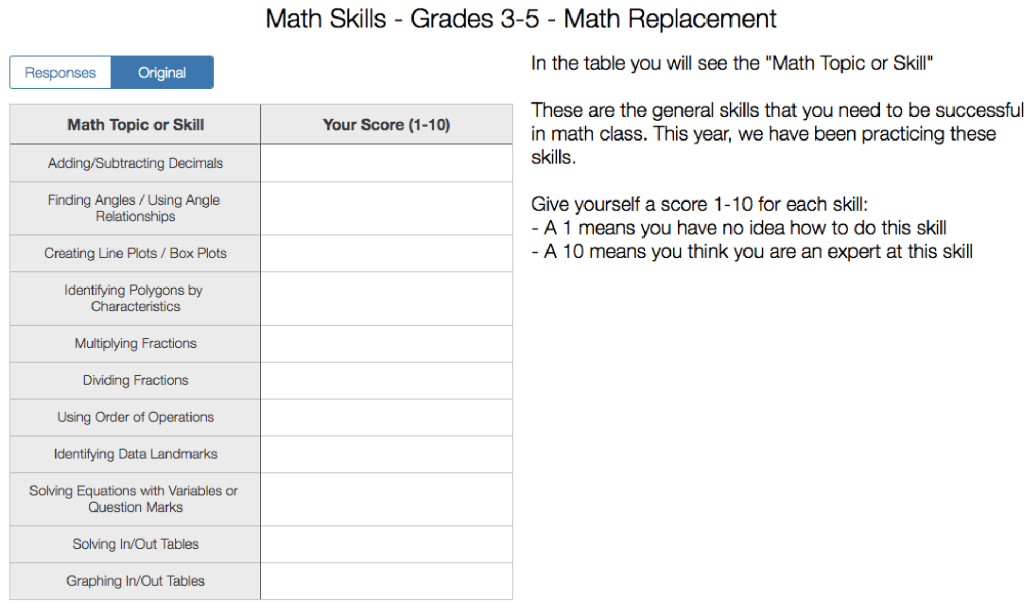
Each student filled this out and I was pleasantly surprised with the results. Most students gave themselves between 5-10. Concepts that haven’t been discussed as much were in the 5 range. Again, I’ll be reviewing this with the students that I loop with in the fall.

I was initially teetering on whether to give this feedback survey. I’m glad I decided to try it out and will be parsing out more details as I dig into the data a bit more over the summer.

Now, summer officially begins.