Lately I’ve been thinking about how to help my sixth graders make stronger connections between their work habits and their math learning. Assessments provide one opportunity to have that conversation, but I want students thinking about their preparation well before a test is handed back, not the night before. How are they using class time? What happens when they get stuck? When they review, are they trying problems themselves or following along with answers that already make sense?
These are some of the questions behind an updated reflection sheet I’ve put together for our Unit 1 ratios assessment. I’ve shared different approaches to student reflections over the years. I still see value in giving students time to look back, identify strengths, and set goals. This version builds on that work by asking students to connect specific evidence from their assessment to the choices they made while learning. My hope is that the reflection becomes something they can use as we move into the next unit and something I can use for upcoming parent/teacher conferences..
Work ethic is part of this conversation. I want students to understand what consistent effort looks like in math: attempting a problem, explaining their thinking, revisiting an error, making up missed learning, and asking for help. Those habits take practice. Telling a sixth grader to “study more” leaves quite a bit for them to figure out. Most sixth graders are still grasping what it means to study for a test. The sheet has four sections, each designed to make that process a little more concrete.
Review each problem
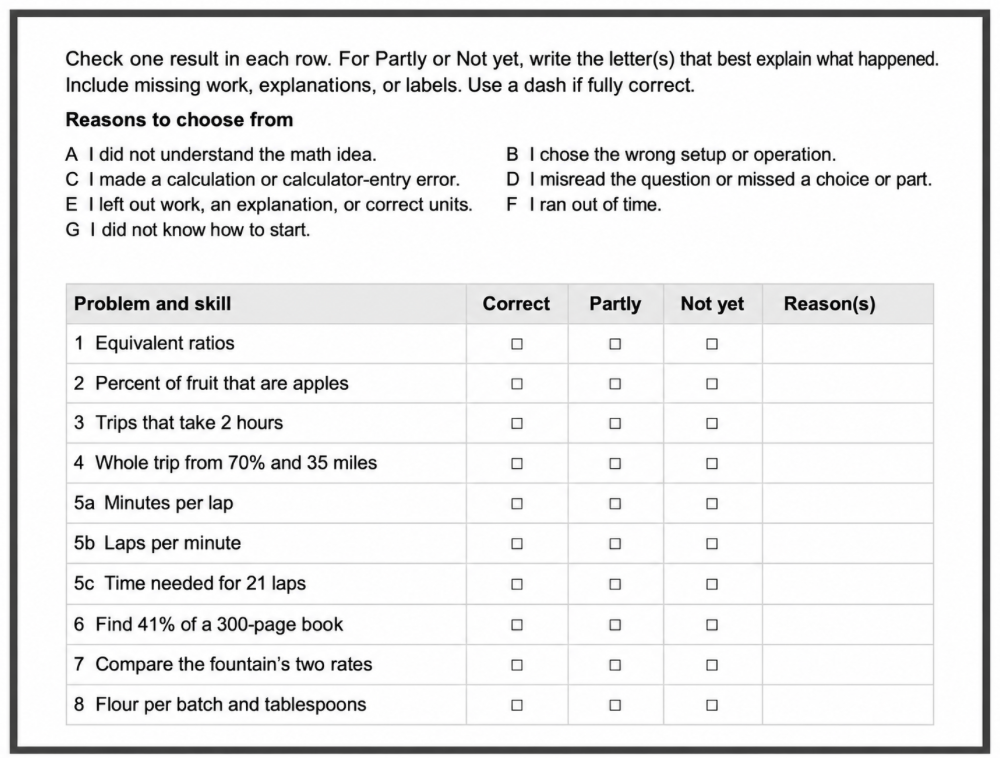
The first section asks students to look at their graded assessment one problem at a time. They identify whether their work was correct, partially correct, or not yet correct. Each row includes the skill being assessed, such as equivalent ratios, minutes per lap, or finding a whole when a percentage is known. Including the skill matters to me and hopefully to the student. A problem number helps students locate their work, but the description helps them identify what they understand. A student might recognize that finding minutes per lap went well while finding laps per minute was more challenging. That gives us somewhere specific to begin a conversation. Ask any sixth grade teacher, getting started with student reflection can be challenging.
For problems that were partially correct or not yet correct, students select reasons that explain what happened. The options include misunderstanding the math idea, choosing an incorrect setup, making a calculation error, misreading a question, leaving out an explanation or units, running out of time, and not knowing how to start. I’m hoping these choices help students move beyond describing every error as a “silly mistake.” There is a difference between entering a calculation incorrectly and not understanding which quantities to compare. Those situations call for different next steps.
The categories also give students language they can use when asking for help. “I don’t understand ratios” is a starting point. “I can complete the table, but I don’t know which rate the question is asking for” gives both of us more information. I’ll need to model this process. Students may need help distinguishing a calculation error from an error in their setup. Looking closely at their written work together should make those conversations more useful.
Learn from the evidence
The second section asks students to identify a strength and connect it to a particular problem. I wanted to make room for this before asking them to revisit something challenging. Students should be able to recognize what is working. Maybe they organized a ratio table clearly, included units that helped them interpret an answer, or used a second strategy to check their reasoning. Naming that strength gives them something they can use again.
Next, students choose one problem to revisit and explain what they would change and why. The “why” is an important part of this prompt. Writing a corrected answer tells me less than explaining how they would change their approach. For example, a student might explain that they found minutes per lap when the question asked for laps per minute. Their next step could involve labeling the quantities before calculating and checking whether the resulting units answer the question.
Students who answered everything correctly still have thinking to do. We’ve all had students say there’s no need to reflect if they receive 100%. The sheet asks them to explain how they checked a challenging problem. I want reflection to be useful for those students too. They can examine the decisions that made their work successful and consider whether they could explain those decisions to someone else.
Connect preparation to results
This is the section I especially wanted to develop. Students record how many days they studied and approximately how much time they spent preparing. They then check what they actually did. The choices include completing assignments such as CYU and Delta Math, using the study guide tool, solving problems without looking at answers, checking and redoing mistakes, and asking for help or explaining their thinking.
There are also options for reading notes or answers only, not preparing outside class, and not making up assignments after an absence. I want students to be honest here. If they feel they need to select the answers that sound best, the reflection won’t give either of us much useful information. I’ll need to communicate that their responses are a starting point for planning.
The amount of time matters, but I’m also interested in how that time was used. A student might spend a substantial amount of time reading through worked examples and still have difficulty starting a problem independently. That student has put in effort. Our conversation can focus on adjusting the preparation so that some of it involves attempting problems, checking the work, and trying again.
Assignment completion deserves a closer look too. Completing all the practice is a useful habit. Returning to a misunderstanding after receiving feedback is another habit that students may need support developing. Students also indicate whether their result was better than expected, about what they expected, or lower than expected. This creates an opportunity to compare how prepared they felt with what their work showed.
A lower-than-expected result might lead us to examine how they checked their understanding before the test. A better-than-expected result might help a student recognize that a preparation strategy was worth continuing. Neither response tells the whole story on its own, but both can open a productive conversation.
I also want to be careful about the conclusions the students draw. A test score doesn’t measure a student’s work ethic. Striving students can work hard and still need a different explanation, additional practice, or support with a particular concept. The reflection should help us identify those needs.
Set a goal for the next unit
The final section asks students to name a preparation habit they will keep or change. My hope is that the earlier sections make this goal more specific. “Try harder” is difficult to follow through on because it doesn’t describe an action. A goal such as “After checking my CYU, I’ll redo a missed problem without looking at the answer” gives the student something they can actually do.
Other students might focus on spreading their preparation across several days, making up work after an absence, or bringing a question to class when they cannot explain a solution. I included the option to keep a habit because reflection should also help students recognize effective choices. Sometimes the next step is to continue a routine that is helping.
The sheet ends by asking students what they want their teacher to know or help them with. I see this as an important opening for self-advocacy. This is a topic that my entire 6th grade team is trying to instill within our students. Students may know they are confused without knowing how to bring it up during a lesson. A written response gives them another way to start that conversation.A student might explain that they understand a solution when someone demonstrates it but struggle to begin independently. Another might need help deciding which assignments to revisit after being absent. Those responses can help me plan a brief check-in or identify a need that wasn’t obvious from the assessment alone.
Making time to return to it
Moving forward, I plan to use a version of this reflection after assessments and revisit the goals during the following unit. That follow-up will matter. I want students to have an opportunity to try their plan, notice whether it is helping, and make an adjustment before the next assessment.
The responses should also help me reflect on my own teaching. If several students identify the same conceptual difficulty, I need to consider what we should revisit. If students are spending time preparing but relying mostly on reading answers, I need to make effective preparation more visible in class. This is another revision in how I approach student reflection. I’ll likely make changes as I see how students respond and which prompts lead to useful conversations.
For now, I want students to leave the reflection with a clearer understanding of their work and a manageable next step. Being able to identify a strength, explain a difficulty, adjust a habit, and ask for support is something they can practice throughout the year. I’m hoping this sheet helps give those conversations a more consistent place in our math classroom. You can find a pdf of the reflections sheet below.


