Mindframes and Teaching

Screen Shot 2015-11-07 at 9.27.27 PM

This last Thursday I was fortunate enough to attend a conference around the topic of visible learning in schools. The conference had so much information.  I had to filter and compartmentalize the discussions and presentation.  One of the discussions revolved around John Hattie’s effect size and how schools can make learning visible in classrooms. The last day was dedicated to organizing a school plan that’ll be carried out through the remainder of the school year.

One of the more memorable pieces of the conference were the discussions that happened between the school teams.  My school sent a team of four teachers and two administrators to this particular conference. Discussing our views on teaching and learning was a powerful experience. Many members of the team don’t regularly work with one another, so meeting to discuss these issues brought about other views as we’re all in different roles . Not everyone thinks the same and each member of the team was willing to hear out different perspectives. As a team, we agreed that our school has some great initiatives happening right now. That affirmation was great to hear, but at the same time, we felt that there are steps we need to make to become better. In order to put these initiatives in place the school has to communicate the importance and reasoning behind these proposed changes.

This brought up another discussion about how change will not happen unless stakeholders are truly committed to the cause. Even if they’re committed, the initiative doesn’t reach its full potential unless the organization and individuals have mindsets that are aligned with the initiative. This type of thinking falls in line with Hattie’s Mindframes for Teaching. Teachers have beliefs that impact their teaching. That belief often stems from a self-developed mindframe. Understanding your own mindframe can help stakeholders better define their own role.  The mindframes are explained in the video below.

All of these mindframes are discussed in Hattie’s Visible Learning book.

Early in September my school was introduced to the idea of teacher mindframes. A staff meeting was designed to have educators analyze Hattie’s mindframes and reflect on their own. We plan on revisiting this topic throughout the school year. Understanding deep-seeded beliefs about our role in education can help bring awareness to how we think.  I believe that thinking impacts instructional decisions that influence student learning.

Computation and a Growth Mindset

growth
Encouraging growth

This past week my third grade class started to use multiplication and division strategies to solve world problems.  They’ve used arrays before and are now applying their understanding of multiplication and division.  That practical application can be a challenge for some and I feel like it’s partially because students aren’t yet fluent with their facts. In an effort to collect a bit more data on what particular facts students were struggling with I gave the class a short 17 question Kahoot! quiz. The quiz was related to multiplication and division facts.

Screen Shot 2015-10-17 at 12.48.51 PM
Click picture for actual quiz

In the past I’ve used Kahoot to review concepts and skills in a game-based format.  I’d estimate that the majority of Kahoot quizzes have a limited amount of time and points are scored.  This is fine and I’m not against using this format, but it didn’t work for my purpose.  I wanted students to take their time and diligently pick an answer.  So, each student grabbed an iPad and completed the quiz on Wednesday.  It took about five minutes or so and students reflected on how they thought they did on the quiz.  The class then reviewed multiplications strategies and connected how multiplication and division are connected.  The homework for that evening also reinforced some of the computation strategies that we’ve been practicing in class.

The next day students were given the same Kahoot quiz.  The question order was changed and students were allowed to take as much time as needed.  I printed out both the first and second quiz results for the students to see the difference between the scores.  Students glued both sheets in their math journal and were asked to respond to the journal prompt below.

“Was there a difference between your first and second scores?  If so, why do you think the results changed?”

Some of the responses are below.

This slideshow requires JavaScript.

As you can see, some of the students are connecting the idea that improvement, effort, and growth is important.  I’d say this is a move in the right direction.  This year my school is emphasizing the idea of Dweck’s growth mindset.  Teachers are encouraged to use terms like persevere, not yet, and effort fairly frequently.  Students are hearing this type of speak and even being asked by administrators questions related to having a growth mindset.  By doing this activity I feel like students are starting to internalize that effective effort helps produce better results.  Instead of just talking about growth mindset and the benefits, students need to be able to make a meaningful connection between effort and achievement. I feel like preaching that effort alone will reap success isn’t the whole story.  I feel like students need to be able to document their journey and internalize the connections. I’m hoping to continue to use these types types of reflection activities throughout the year.

Students and E-portfolios

Student E-porfolios
Digital Portfolios

Last week my math students wrote in their math journals about their experience in math class so far.  Their entries were fascinating and many students documented their learning that took place since the beginning of the school year.  Some students drew pictures and wrote lengthy paragraphs indicating skills learned.  At the end of the class the journals were put back in their designated place in the classroom.  I looked over the journals and made comments.  Afterwards, I starting to think about what happens to these types of journals after they’re sent home at the end of the year.

What happens after a student receives back their classwork? The work is often presented in a number of ways: hanging up the assignment, placing it on bulletin boards, showcasing it around the school, or sending it home for refrigerator placement.  I’m not sure what happens after the assignment heads home. Optimistically, I assume that they’re kept forever, but most likely the assignment moves towards a recycling bin at some point.

I’m finding that the work that students complete is becoming increasingly digital. Regardless of how the work is created, it’s often captured and presented in a digital form. Student work that’s completed and presented digitally lives on.  Not only does it live on, but it can be seen by people outside of the school, state, or even nation.  For example, students might use base-ten blocks to show their understanding of how to add numbers together.  The end product, although it may be a physical representation, has an opportunity to be captured digitally and communicated to stakeholders.  Some school districts are finding that they can help showcase student understanding through digital means.

I’ve found that some of these same school districts have moved towards a student e-portfolio model.  This is much more prevalent at the middle and high school level, but exists in small pockets at the elementary level. In some cases, students have access to their own e-portfolio and they submit their work digitally. Over the past couple of years I’ve seen elementary teachers use Weebly, Google, Seesaw, and Showbie to have students submit their work digitally.  In turn, student receive feedback and document their learning experiences in the process.

A few teachers in my school are currently using Seesaw to have students’ submit their assignments.  Teachers need to approve the submissions and parents are notified that items are located in their child’s portfolio.  Teachers and parents can provide feedback to the students.  Students can even take that feedback and resubmit their projects as needed.

Silicon Valley has also paid close attention to how this is playing out. Learning management systems (LMS) are starting to become more of the norm as students and teachers become more familiar with how they work. As districts become more familiar with LMS, questions about student privacy and data collection should be addressed. Having an online student portfolio gives teachers, students, and parents opportunities to be transparent in communicating what’s happening in class. This type of student work evidence goes far beyond a classroom newsletter.  Being able to submit assignments and receive feedback digitally encourages learning beyond the school walls.  Submitting projects digitally also allows teachers to give feedback a bit differently.  Instead of writing feedback on papers, teachers can record comments verbally or record a brief video with examples.  Although I prefer to give feedback 1:1 in person, giving feedback digitally has its advantages. Ideally, the student e-portfolio would follow the student throughout a school district.

Back to my students’ math journals … so the next day I had students submit their work to their e-portfolios.  Through this action, students were taking their physical work and making a digital copy.  Parents were able to immediately check out their child’s work and make comments.  Some parents made comments, while others just view the work.  I’m not looking for interaction on everything submitted, but I feel like having that opportunity to communicate and the transparency involved is important.  It also can help initiate the “how was school” talk that happens when children come home from school.  Through the years the physical journals may stay intact, but the digital copy will always be accessible.  Having access to past entries can help students see the growth that they’ve experienced during their journey.

How do your students document their learning journey?

Putting it all Together

Building solid roots of retention

Last week I had the opportunity to finish up a book study on how the brain learns mathematics.  During our last GHO the crew discussed the implications and takeaways from the book.  We had instances of affirmation and some of the research had us look at our instruction through a different lens.  In my mind this was perfect timing as school is just around the bend or has even started for some. The last chapter in the book discusses the need to connect brain research and how educators teach mathematics.  Moving forward there are few different questions I want to consider while planning.


Is the lesson memory compatible?

Basically, are the number of items in a lesson objective too much, too little, or just right?  At some point I feel like all students need transitions.  Being aware of when to transition comes with teacher experience, but breaking up that time block dedicated to math instruction is important.  After the transition students’ working memory has an opportunity to refresh.  I couldn’t stand 60 minutes lectures when I was younger and still can’t today.  The brain needs time to move items into it’s working memory.

Does the lesson have some type of cognitive opening?

According to Sousa’s research, the degree of retention is highest during the first 10-20 minutes. New material should be taught after students’ are focused on the lesson. The opening of the lesson should provide students with opportunities to see new information and correct examples.  I feel like many teachers ask questions about the new topic to get student input and to make curricular connections.  This isn’t always the best option because students may reference incorrect information or examples and students will most likely remember that.  Instead the lessons should emphasize correct information in some type of mini-lesson format.  This was a bit surprising for me because I can’t count the amount of lessons that I’ve started by using some type of KWL activity.

Does the lesson have some type of cognitive closure?

Sousa also concludes the teachers should initiate some type of cognitive closure. This can take on many different forms.  During closure students participate in mentally rehearsing and finding meaning of the topic discussed in class.  There’s a difference between review and closure.  I’ve always put the two words in the same realm.  When teachers review they’re doing most of the work.  Closure is designed so that students do the majority of the work.  Closure doesn’t necessarily have to happen at the end of class.  Procedural closure can be used to transition from one activity to another, while terminal closure ties the day’s learning together.

How can I incorporate more writing in math class?

I’ve used math reflection journals before and I think there’s so much potential in having students write about their math experiences. Sousa believes that incorporating writing in math can be an effective way for students to make meaning of what they’re learning. Foldables and Interactive Notebooks have been the rage for the past few years but I’ve always questioned their effectiveness.  Students shouldn’t be rewriting the textbook or journal.  Students should use their own thoughts and vocabulary in their writing. Students are making sense and connections to the math concepts by writing about them. By writing down their math experiences, students are participating in elaborate rehearsal of newly learned concepts.  In addition, the writing can be used to show individual student growth over time.


Moving forward I think all of these questions have me thinking about how lessons are planned. I fell like all of them play a role in how well students retain information. All in all, I think there’s a balance in how teachers plan their individual lessons.  Retaining information is important, but students should also be given the opportunity to explore and build  a conceptual understanding of topics.  Retaining those experiences are pivotal throughout the year as concepts are built upon one another.  Being aware of how the brain learns math can help in that planning process.  I feel like being more intentional and using a critical eye in how I organize my class benefits how my students understand math.  To me this process of planning is more of a journey and not necessarily a solution.

Developing Multidigit Number Sense

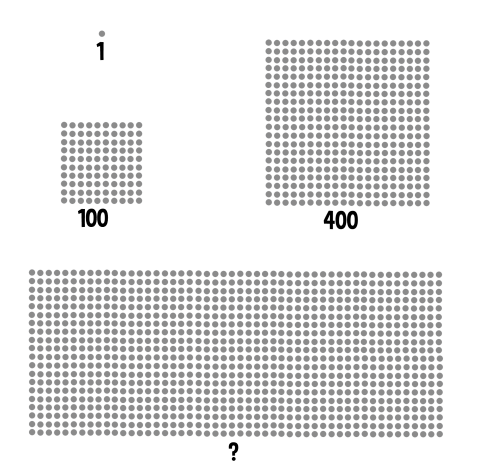
Cn you find a reasonable solution for the question mark?
                         Find a reasonable solution for the question mark

Lately I’ve been reading David Sousa’s book and have come across some interesting (at least to me) observations.  Humans have an innate ability to subitize.  That subitizing can lead to estimation and through appropriate practices this leads to bettering number sense skills.

After speaking with a few middle school teachers this summer I’m finding that one area that tends to need strengthening is found in the overarching umbrella of math skills: number sense.  Without adequate number sense skills, students flounder when asked to complete higher level math concepts.  Year after year I find some students have a decent understanding of procedures, but fall apart when it comes to explaining their reasoning for completing particular math problems.  Students are able to identify and repeat processes (usually copying the teacher), but not understand why they’re using that strategy.  I find this particularly a concern when students don’t question the reasonableness of an answer.  In my mind, I think finding a reasonable answer or estimation shows a form of number sense.  This isn’t always the case, but I tend to find it when students blindly follow only a set of procedures. I believe that this can lead to more problems down the line.

This is especially a problem with larger numbers. Researchers Carmel Diezmann and Lyn English found that the activities below seem to help students develop multidigit number sense.  All of these activities can be used at the elementary or middle school levels.  The headings in bold are found in David’s book and highlighted in Diezmann and English’s research.  My narrative is below each heading.


Reading Large Numbers

Placing an emphasis on place value when reading large numbers is important.  Being able to identify and see the value of each digit can help students read large numbers more accurately.  I find that students in kindergarten and even first grade start to combine place values when speaking of large numbers (e.g. one hundred million thousands).  Giving students opportunities to take apart these large number by digit value can help reduce this issue.  I find comparing standard and written forms of numbers can also help students start to recognize the place value of large numbers.

Develop Physical Examples of Large Numbers

Visually observing 100 and 1,000 dots can show students the physical difference between large numbers. There’s so much math literature that can help with this. 100 Angry Ants, Really Big Numbers and How Much is a Million can be used with manipulatives to show examples of large numbers. If you teach in an elementary school, I recommend adding these books to your math library. Using unifix cubes, base-ten blocks, or replicas can also be used to show a physical example of large numbers.  Having the physical example can benefits students as they start to question if their solution to abstract problems are reasonable.  A number line with 1:1 correspondent is also one way to showcase large numbers.

Appreciating Large Numbers in Money

Kids tend to like to talk about money.  Showing how $1 compares to 100 $1 bills can show students a visual scale between the amounts.  Visual representations of money in dollar and coin forms can lend itself to having students become more aware of how place value impacts the value.  A problem that tends to always get students curious relates to how much money will fit in a briefcase.  Will $10,000 in $5 bills fit in a 20″ x 18″ briefcase?  These types of questions can have students start visualizing money and the reasonable of their answers.

Appreciating Large Number in Distance

Maps can be useful here.  I remember having students use Google Maps to calculate the distance from one particular destination to another.  Also looking at the distance from one continent to another, or even from Earth to another planet.  I find that a good amount of scaffolding is needed to help students experience large numbers in distance/measurement.  Comparing skyscrapers to distances can also play a role with this as well. If you stacked one Willis Tower on top of another, how many would it take to reach the moon?


They’re many ways to have students observe and interact with large numbers.  I’d like to add appreciating distance in relation to time to the the list.  Time can also be used highlight and compare large numbers. I’m thinking of the dates in history and the Science involved in evolution. Many of these activities can be interdisciplinary as connections between curriculum content exist. Digital and physical forms play a role in having students conceptualize an understanding of large numbers.  Students should be given opportunities to recognize large numbers in a  variety of contexts.  By doing so, I believe students should be able to better question whether their answers are reasonable or not.

By the way, the answer to the top image is 1,000 dots.

Questioning the Gradual Release of Responsibility Model

gradual responsibility

When I first started teaching I was told from one of my professors to grab Harry and Rosemary Wong’s book and use it as a guide.  The guidance in the book was direct and seemed to be working during my first year of teaching.  I still refer back so some of the pages from time to time.  For the most part my class of fourth graders fell in line with the expectations that I set, which were from the book.  My administrator at that time suggested I use a gradual release of responsibility model with my students.  This “I do, we do, you do” model was heavily emphasized.  Basically, I was instructed to start my lessons with a guided whole class instruction, move to groups or partners, and then have students work on assignments independently.  Student input was limited when I used this model and I didn’t really see a problem with that at the beginning of my career.  As the year passed I found that extrinsic motivation was keeping most students on task.  The pressure of getting high grades and outside rewards moved students in being compliant. As I gained experience my instructional strategies changed .

As the years passed I started to let students make a few decisions in the classroom.  I offered students a chance to sit where they wanted at the beginning of the year.  Students also had options in what projects to complete.  This happened rarely, but I found that the choice opened up a new realm of student responsibility.  When students had a choice they often performed better and with more enthusiasm.  The reward for accomplishing a task started to become more intrinsic.  From there I surveyed students and included plus/delta charts throughout the units that I taught.  The more students offered input and felt like their voice was being heard, the more active they became in their own learning experiences.  Now that students were offering input I gave them opportunities to reflect on their learning and had them set goals.  Last school year students participated in genius hour.  I was truly amazed at the projects that were created by the students and the passion that I could visibly see as students presented their projects.  Students happily took advantage of these opportunities.  Students were asked to think about their own thinking, which was a new experience for students.

This opened up a new realm of possibilities for students as I felt they were realizing teaching wasn’t being done to them.  Instead, students started to realize that they were an intricate part of their own learning.

All this is good, but this type of thinking didn’t happen until the last third of the school years.  I scaffolded the gradual release of responsibility model until I felt confident to let the students take on more responsibility.  My confidence in students was conservative and I didn’t take the risk in allowing them to take control until later in the school year.  I’d like to change this next school year.  Allowing students to be responsible early in the school year can lead to dividends throughout the school year.  One book that has influenced me in this thinking has been Paul Solarz’s book.  Students should be given the opportunity to take the lead and be empowered in the classroom. One strategy that Paul highlights is his “give me 5” technique.  I’d like to start this early in the school year.  I’ve also questioned my own thinking regarding how students should be expected to proceed with a gradual release of responsibility philosophy.

I still adhere to the philosophy although I’d like to tweak my perception of it.  Instead of providing constant scaffolding to release responsibility, I’d like to start off the school year with student empowerment opportunities.  Waiting too long to give students responsibility can be costly.  Giving students opportunities to lead with support and guidance from the teacher can lead to positive results. I’m assuming there will be times where students will speak out of turn or take advantage of the empowerment opportunities, but I’ll take that risk.  With direct teacher support and feedback, I feel like students will become better at taking responsibility for their own actions.  There is a risk, but I feel there’s so much potential in empowering students to become part of their own learning experiences.

Connecting the Math Curriculum

Connecting the Math Curriculum

A few months ago I informally asked a group of elementary students what they think of when they hear the word math. I heard many responses from the students.   First and second graders focused on the words adding, subtraction, shapes and money. Upper elementary students emphasized multiplication, division, money (again!) and fractions.   Often, the student responses were directly related to the last few units that were taught.

I find that the perspective of math changes as kids move grade levels. My own perspective of math has changed over time.  I used to dread talking about fractions when I was in middle school.  My perspective switched gears when I started to see the different uses of fractions outside of the classroom.  When I started to see fractions as less abstract, my notion that they were evil started to dissipate. Events similar to this affected me and my teaching style during my first few years of teaching.

My first teaching job out of college started in an empty fourth grade classroom. I was placed on a team with a two veteran teachers.  I remember being given a curriculum guide and told to teach math in specified units that were often separated into math concepts.  I don’t believe there’s anything specifically wrong with this, but wonder now if the idea could use some tweaking. This type of unit lesson planning lasted throughout the year. During those units, the lessons were directly related to a particular standard and didn’t deviate much from that path.   My team was extremely supportive, although we didn’t question the sequence or the curriculum.  Once students took the unit test, the class moved to the next unit of study, which was generally a different math strand. For example, fractions were out and division was in. This process was repeated throughout the school year without revisiting past strands. Of course there was review, but the units didn’t seem connected in any way. As students moved through the units they often had a challenging time applying skills taught earlier in the year. The gap between the content in the units seemed to widen as the year progressed.

I bring this up because it relates to a book that I’m reading.  Over the past month I’ve been participating in a math books study with some amazing educators. We’ve been discussing this book over GHO every other week. One of the passages that peaked my interest came from page. 74

“Structuring units – and – lessons within the units – around broad mathematical themes or approaches, rather than lists of specific skills, creates coherences that provides students with the foundational knowledge for more robust and meaningful learning of mathematics.”

As math educators plan units I feel as though the above is sometimes a missing component. Planning opportunities for students to discover how math concepts are connected can be a powerful learning tool. It also shows students that math is not defined as a checklist of singular concepts or “I can” statements.   As students switch their mathematical lenses, they see the connected aspects of math, as I read on page 76.

“When they teach the sequence of lessons that they have prepared as a team, the teachers will continually ask students to switch the lenses that they use – from looking at a situation algebraically to exploring how it connects with geometry that they have been studying.”

This year I’m more intentional in planning lessons and activities that connect math strands. I follow the curriculum, but in addition to that I’m finding that activities and lessons that blend math strands gives students more opportunities to cement their mathematical understanding. Problem-based learning projects often lend themselves well to these types of lessons. Even showing students the sequence of the curriculum can prove beneficial as students see where they are starting and the expected finish.  It also helps students to be able to view math beyond the abstract. That connectedness can bring a new appreciation and possibly a renewed math perspective.


photo credit: Hyperlink via photopin (license)

Higher-Level Math Tasks

A few days ago I started reading Principles to Actions Ensuring Mathematical Success For All as part of a book study. As I was reading in preparation for our first session I came across a few ideas worth highlighting. Pages 18 and 19 discuss the four levels of cognitive demand in math classes.   Along with expectations, these demands are often revealed in tasks or assignments that students are asked to complete.

The book describes lower-level demands as tasks related to memorization and procedures without connections. Memorizing rules/formulas and following procedures is often related to lower-level demands. Students often understand what’s expected when lower-level demands are required. Generally one answer or procedure is evident with this type of task. Worksheets that have students practice rote computation skills without words could fall into the lower-level demand category. Higher-level demands are procedures with connections and often require considerable cognitive effort to achieve. Anxiety is often a part of higher-level demands, although this may be because students don’t see these types of tasks as often.

After reading this page and looking at the different examples I started to reflect on how elementary math classrooms are organized. Math practice is needed, but students should also be given time to explore, discuss and make connections in a low-risk environment. I find more lower-level demands in math classrooms than higher-level, but an ideal ratio is challenging to ascertain.

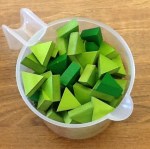
So after reading pages 1-35 I decided to use an example of a higher-level demand activity with a fifth grade classroom. This particular class is learning about fraction multiplication and division. Students have learned in the past to multiply the numerators and denominators to arrive at a solution. To delve a bit deeper in their understanding I decided to use and adapt one of the tasks in the book. I first grouped the students into teams and gave each team 12 triangular blocks and a whiteboard marker.

Photo Jan 22, 9 45 43 AM

Students were asked to show a visual model of 1/6 of 1/2. Some students knew the answer already but seemed unsure of how to show the answer visually. Many of the groups weren’t quite sure on how to approach the construction of the fractions. They understood the abstract and procedural but had a challenging time visualizing the fractions.

After seeing the students struggle a bit I’m glad that I decided to have them work in pairs. Students started to build models of 1/2 using the 12 triangles. Some of the groups came to a conclusion that two different sets of six triangles shows half. Then from there students started to think of what’s 1/6 of the 1/2. Students took out 1/6 but then debated on the value. Some groups said that the answer was 1/6 while others were confident that it was 1/12. Eventually the students decided that 1/12 was the correct solution.


I went around the classroom and took some pictures of the different creations. Not everyone created the same type of model. This was a great opportunity to highlight some of the different models that arrived at the same solution.


This slideshow requires JavaScript.

Afterwards, I thought that offering exactly 12 triangles helped but limited the choices for a visual model. The student models were somewhat similar as a result of the level of scaffolding. As students reflected on their actions in this activity I heard some interesting conversations. Students were aware of the procedure to multiply fractions less than one, but started to visualize the model through this activity. I thought this might be one way to introduce fraction multiplication at the fourth grade level.  I also thought that this activity was well worth the time and I’m looking at incorporating additional high-level cognitive demand activities in the future.

Addressing Local Math Misconceptions

mathconceptions

Over the past week I had time to disconnect a bit and spend time with family. I was able to stay with relatives in another state and spent most of the time catching up with people I haven’t seen in a while. It was a great time to refresh and reflect on the past year.  While relaxing one relative in particular asked me about this “new” math that’s in the schools now. I was asked why schools are changing how they teach math and why it needed to change. Specifically she spoke of the different strategies used to compute numbers.  I’m assuming she meant the extensive use of the number line and compatible numbers.  I defended the reasons for a more conceptual understanding of mathematics, especially at the elementary level. Many of the “new” strategies help build that understanding and enable students in developing a foundational understanding of numbers. The relative was receptive and asked more questions related to this topic. I felt like her understanding of the topic became clearer as we discussed the use of  multiple strategies utilized to teach computation. This was a small part of our longer conversation, but the topic had me thinking about how to provide opportunities to address misconceptions. In particular, I thought how my conversation could apply to addressing math misconceptions in schools.

I feel like one of the more important issues with student misconceptions stems from a lack of addressing them. They tend pile up and build over time. I vaguely remember having a math teacher that asked if his students had any questions. I remember looking around and wondering if I was the only one in the class that had multiple questions. Unfortunately I kept my hand down even though I was lost. The teacher then quickly surveyed the room and seeing that no one had their hands up, moved onto the next topic. I found that the less I asked questions that less comfortable I was with the current concept and the process continued until I finished the class. Looking back, I’m sure there were other opportunities to address my misconceptions and questions; I just don’t remember any of them at the time of this writing. I didn’t learn as much as I should from the class, but I started to understand that I needed additional opportunities to ask clarifying questions.

In addition to including many opportunities to address misconceptions, the classroom environment plays a pivotal role in having students feel comfortable in offering input.  The strategies below can be used in a variety of settings. I’ve had success with the strategies, although some have been more successful than others.

Classroom Math Conversations

Classroom conversations can be a powerful strategy in gaining a better understanding of students’ viewpoints. Using open-ended math question and having groups respond to the class can offer opportunities for a healthy math debate. For example, I’ve seen some teachers use Always, Sometimes, Never with great success. Math Talks can also be an avenue in which classroom conversations can develop. Through these conversations teachers can glean important information and possibly misconceptions that can be addressed later or at that time. These types of math conversations, accompanied with anchor charts can document the classroom’s learning journey.  The anchor charts can then be revisited as students construct their understanding.

Formative Assessments

These types of assessments can take different forms. Some teachers prefer to use exit cards, while others use a quiz model. Formative assessments can be used via technology means and some may take the form of a paper/pencil quiz. Regardless of the form, the student’s response can give teachers an indication of understanding. In order for the teacher to give feedback the question needs to be appropriate. Students need to be given the opportunity to explain their reasoning or steps involved in solving problems. If not, the problem is wrong/right, and the teacher is unaware of where the mishap is occurring. Using written or verbal feedback to address the misconception can lead to a more in-depth conversation at a later time. Some students may need the reinforced conversations while others may not. I believe most teachers understand their students and at what level to scaffold feedback.

Journaling

Similar to answering a question in a classroom student group, journaling can provide students a low-risk venue to showcase their understanding. Through a prompt, math journaling can allow students to explain their mathematical thinking and processes in a written form.  Students often become more aware of their growth as the year progresses.  I find that students might not know that they have a misconception until it’s brought to light.  It’s the you don’t know what you don’t know dilemma. The concept of math journaling can be used for teachers to write feedback to individual students and ask questions that give students opportunities to reflect on their writing and math process. Allowing a bit of extra time to confer with a student after their math journaling process can be beneficial as teachers may want to review specific concepts with students.


All of these strategies above seem to go well with a heavy dose of teacher feedback and student self-reflection.  Through reflection, students can help internalize and address the misconceptions.

How do you address misconceptions in the math classroom?


Planning Better Learning Experiences

Photo Mar 25, 9 36 35 AM


Spring break is now here and many schools are still bustling.  There’s not as much student laughter inside the school, but the parking lot is still busy.  A fresh batch of snow has covered the local area and vehicle tire tracks have carved their way into the teacher section of the school parking lot.  Many of the teachers inside and those at home are planning for the last few remaining months of the school year.  My plan book for each class is now starting to fill up.  Regardless of how I plan, student understanding of a particular concept doesn’t always align with my 3-inch plan book squares.  Specific curriculum and lessons can be planned to a tee, but it doesn’t guarantee an ideal learning experience for the students. This break has given me time to think of how educators plan their instruction.

Before break I was able to have a conversation with my classes about learning.  We discussed metacognition and analyzed how we learn best.  The class had a conversation about what math concepts will be introduced in April.  The conversation transitioned to what math activities are on the schedule for the months of April and May.

While discussing this I emphasized the words learning experiences instead of referring to the objectives that were posted to the board.  I find that students can easily see written objectives on the board.  Writing the objectives on the board is required, but I don’t believe many students actually internalize the meaning or they need more information to do so.  The objectives may say something specific and some benefit from reviewing them, but I want students to be able to understand that they are participating in intentional learning experiences that will give them opportunities to question, make connections, and become better math communicators.

Many of my students and parents are aware of the implications of the PARCC assessments and CCSS.  Common Core aligned material is everywhere.  Marketing and advertisers are consistently promoting the newest aligned Common Core material.  Many districts are in the process or have already purchased content that matches the CCSS and PARCC.  Regardless of what district adopted curriculum is purchased, learning experiences that meet students’ needs should be high on the priority list.  My colleagues and I are finding that there are many ways to follow the CCSS and still create engaging student learning experiences and activities.  This year I’ve modified and used different learning tasks that were created by members of my PLN.  Fawn, Dan, Julie and the MTBOS community have been generous in sharing their thoughts and resources.  These experiences don’t have to be scripted word-for-word (like the first curriculum that I was given) and many supplement the curriculum that the district provides. These student learning experiences are what will create beneficial memories that students can use going forward.  In addition, they will drive students to ask questions, make connections and develop math reasoning skills that will help them in the future.