iPad Apps for Math Intervention

IPad Apps for Math Intervention

Over the past few months I’ve been experimenting with guided math strategies in my classroom. One station in my classroom has been dubbed as the technology table. This table has been primarily used to differentiate  instruction to improve students’ understanding of mathematical concepts.  I’ve been using the tech table for the past few months with great success. There are five iPad apps that are used at this table.  Unlike many math apps that offer only demo versions, I’ve found the below apps to be useful in the classroom.


5 Dice

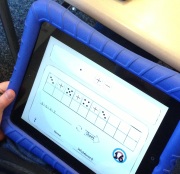
This app is the newest addition to my iPads for intervention list.  This app emphasizes order of operations for upper elementary and middle school students.  The game encourages students to use multiple dice to find the “target” number.  A whiteboard is built into the game for students to work out problem.  Progress reports can be emailed to the teacher for formative assessment data.

photo (1)

Splash Math – Grade 3

This app is used to differentiate math instruction and assigned practice.  What I like so much about this app is the variety of concepts that I’m able to individualize.  For example, if a student needs additional work on the concept of time, then I can setup the app to only give questions related to time. Questions first appear simple, but then become more challenging as questions are answered correctly.  If you prefer, Splash Math will send you a weekly update indicating the progress of each student.


Math Blaster Hyper Blast 

This app is used to improve computation fluency.  This interactive app has a quick tutorial to teach students how to move the main character through a variety of mazes.  Students control a space vehicle that inevitably encounters an octopus type of creature.  Students must answer computation (addition, subtraction, multiplication, or division) questions to defeat the boss.


Factor Samurai

Factor Samurai is an app geared towards emphasizing the concepts of prime and composite numbers.  Basically, numbers fly into the air and the student is expected to slice the composite numbers with their fingers.  If it’s a prime number, then the student leaves the number alone.  Some composite numbers can be sliced multiple times.


ScootPad

ScootPad can be used to individualize practice in your classroom.  I’m able to assign specific students certain Common Core objectives to practice. After a student completes an assigned section, they are allowed to see all of the correct answers.  Scootpad will also send the teacher a statistical report of the progress made by individual students.  I’d also like to note that Scootpad can also be used on a PC or MAC.


Honorable Mentions: 

 Math 7

 Sail Through Math

 Divisibility Dash

Equivalent Fractions

Rocket Math

update:  02/03/13

I’ve been asked by a number of people what apps I would recommend to an elementary teacher.  I decided to create a quick chart to help.

Elementary Apps


So, what math iPad apps do you use in your classroom?

Still Exploring Guided Math

Still Putting the Pieces Together

I recently participated in an afternoon professional development session led by Laney Sammons.  The session focused on how to implement guided math.  I’m still understanding the guided math process, as you can tell by the picture above.  I wouldn’t consider myself an expert in guided math, but I’m starting to use a few strategies that Laney discussed today.

A few takeaways from today …

  • Guided math can be similar to guided reading
  • Math games can be used in stations
  • Groups should consist of no more than six students
  • Groups can be used for informal assessments
  • There isn’t a “one size fits all” model for guided math

After the session I decided to explore guided math a bit further.  The links below have been vetted and may help shed additional light on guided math in an elementary setting.

Feel free to share any links or blog posts that you find relevant in the comments section.  Thanks!

* Picture credit to Janoon28

The Value of Self-Correction and Student Ownership


This year I’m continuing to find that student ownership plays a critical role in the learning process.  Students often become more responsible for their own learning when they are given additional opportunities to show their learning.  I’m finding that part of the key to increasing student responsibility depends on how it’s communicated by the teacher.  Students can’t be expected to own their learning without any guidance.  The gradual release of student responsibility can benefit the overal climate and achievement of a classroom.  In the past, I’ve used student journaling, plus/delta, surveys, choice boards, self-selected research projects, and other strategies to promote student ownership.  This past week I introduced another strategy that involves self-correction.  Here are the steps:

1.)  Students complete an assignment in collaborative groups or independently.

2.)  Students finish the assignment and self-correct using the Teacher’s Manual.  This can also be applied to digital progress monitoring tools.

3.)  Students independently use markers to indicate wrong/right answers.  If needed, students will write in correct answers.

4.)  Students utilize their math journals to reflect on the assignment and their feelings about the topic and achievement.

5.)  Student turn in their paper and journal to the teacher

6.)  Optional:  Students use multiple journal entries for individual goal setting

It might seem simple, but I’ve had terrific results from using this strategy.  Overall, I feel as though the students benefit from practices like this.  The self-correcting / journal process took modeling and practice at first, but the benefits are starting to become apparent.

Number Line Concepts

Image by:   D. Rizzuti


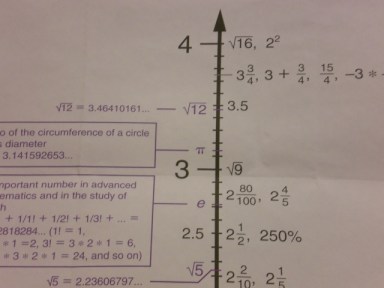
Lately, I’ve been having conversations with colleagues regarding how to communicate number line concepts in the classroom.  Specifically, I’ve been giving examples of how understanding number lines may lead to a more stable mathematical foundation. In the past, my class has created various products related to the number line.  My original inspiration came from this number line below.

The project in this post emphasizes the idea that percents, fractions, mixed numbers, and decimals are all related  This basic understanding helps develop number sense skills.  Here are the generic steps for this project:

  • Students cut out percents, decimals, percents, and fractions out of the template
  • Students draw a number line on a piece of construction paper
  • Students glue/tape each number on the number line

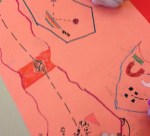
Here are a few sample photos (click to enlarge):

The project seems simple, right?  Well … it took about 20 minutes for the cutting, coloring, and gluing.  I then facilitated a classroom discussion after the number lines were presented.  The math curiosity (I really like that term) and discussion that followed the project seemed beneficial.  It’s truly amazing to see what type of concepts can be discussed when observing the number line through a variety of lenses.  Our conversations touched on the concepts of absolute value, positive/negative numbers, fractions and mixed number conversions, addition of negative numbers, and place value.  In fact, the math conversation lasted 30+ minutes.  Having these types of “math chats’ with third graders was a phenomenal learning experience.  All of the concepts discussed will be introduced later in their academic career, and hopefully I gave my students a quick preview to what is to come.

Estimation Challenge

Image by:  Akeeris


Over the past few years, I’ve been working on ways to utilize technology to improve student learning.  Understanding what objectives are being assessed helps me plan on what technology will be used and in what capacity it will be used.  One of the second units in my class emphasizes the importance of estimation.  The fifth grade Chicago Everyday Math curriculum asks the students to do the following:

Notice that the question says “location given by your teacher”.  Instead of giving all the students a specific destination, I decided to have the students pick an establishment (Culvers, Kohls, local park, school, etc.) in the town that they reside.   In the past, I’ve found that student choice can be a motivator for students. The destination had to be within 15 miles of the school.  The students were grouped in triads and were given a computer to complete this task.  Students were asked the following:

  • What is your destination?
  • About how many miles is it from your school to your destination?
  • About how many steps will it take to reach your destination? (they used the conversion in the journal above)
  • How long would it take you to reach your destination?
  • What breaks would you take during your walk to your destination?
  • If you left at 8:00 AM on Monday, when would you arrive at your destination?

The students were also given the Google Maps website to start their estimation challenge.  Most students were able to navigate Google Maps and find the “get directions” tab and enter in the school address.  The groups were able to find the establishment address fairly quickly, although some groups needed prompting.  The student groups needed to find out what route to take to their destination.  Some routes were quicker than others, but involved a lot of stopping at cross walks.  Other routes were scenic, but took longer.  Each group decided which route to take and found the Google Maps distance to the destination.  Here is a sample of what the students were looking at:

Some of the groups extracted the “Google Maps time” to answer the questions. Other groups thought that it seemed odd that it would take a specific amount of time for everyone to reach the destination at the same time.  One of my students remarked that not all people will take 2 hours and 56 minutes to reach the destination. I thought this was a prime opportunity to bring in the topic of ratios and proportions. One of the groups decided to time themselves walking 10 feet and then find out how long it would take to walk an entire mile at that pace.  I was impressed with the groups that went beyond the artificial time given by Google Maps.  Even more, the topic of ratios and proportions is typically introduced next school year.

Near the end of the project, the students presented their answers to the class.  Each group chose a different location and I could tell that their answers were well thought out.  Overall, the skills utilized in this project are applicable outside of the classroom and I feel that the students were fully engaged and met the objectives for the lesson. This is one of the projects that I’m planning on using next year.  This is my second Google Maps activity, my first lesson can be found here.

So You’ve Been to a Common Core Training?


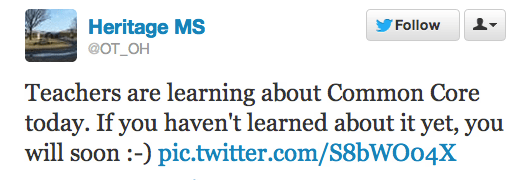
The words above seem true.  If you work in education, you most likely have heard about the math Common Core Standards.  Many educators have been given instructions and maybe even have had the fortunate experience of attending a PD session on the Common Core.  According to WAT, approximately 70% of teachers have received some type of Common Core training.  Maybe your district now has a Common Core “aligned” curriculum or manipulatives that will be utilized in the classroom that emphasize the main points of the Core?  Regardless of your situation, the content that you teach may be impacted by the Common Core Standards.  Many educators/administrators are asking questions about the Common Core and seeking answers on their own.  Common Core PD sessions have allowed teachers opportunities to ask questions and receive clarification on what is expected.  Here are a few statistics:

If you are like many educators, then you’ve been trolling to find additional information about the Core and resources that will enhance your instructional practice.  I’ve created a list below that may help us (as we are all in this together) unravel the Common Core and the changes that it will elicit over the next few years.  The links below aren’t listed in any prioritized order, but they are categorized to help you (and me) find and use the information quickly.  I have many of these sites already bookmarked, as I receive questions on the Common Core and it’s far reaching impact.

Blog Posts:

General Info on the Common Core:

Livebinders / Digital Newspapers:

Testing Questions / PAARC / Behind the Scenes:

“Aligned” to the Common Core

Image by:  Felixico


Now more than ever it seems that educational leaders are being encouraged to align their curriculum to the Common Core. Currently, 45 states and 3 territories have signed the Common Core initiative.  National tests are now being developed to evaluate how well students understand the math and reading Common Core standards.  Seeing that the majority of the United States supports the Core, new “Common Core Aligned” products seem to be popping up everywhere. Workshops, seminars, webinars, and PD sessions are dedicated to communicating how the Common Core standards impact curriculum.  In general, I believe that the workshops mostly benefit teachers. I also believe that the Core will give opportunities for educators to positively change the way that they deliver math and reading instruction. What I’m concerned about though is how the “aligned” resources are being utilized.  I in no way endorse/oppose the products below, but the images & links contribute to the notion of how publishers (McGraw Hill, ASCD, Pearson, etc.) are marketing Common Core resources to educators and administrators.

I’m finding that teachers are being pressured into purchasing these “aligned” materials to prepare their students for the upcoming accountability testing.  I’m not against the Common Core materials being produced or used in the classroom.  I’ve actually read many “aligned” resources and have found them most beneficial.  To be honest, most educators that I know have already viewed a number of the Common Core materials.

Don’t get me wrong, educators should be aware of the new standards and adjust their instruction accordingly.  The over reliance on “aligned” published materials can cause teachers to take less risks as they focus only on items located in specific published books.  In these cases differentiation may occur less as the teacher uses whole group Common Core instructional techniques to cover specific content that’s found on future standardized assessments.  I view the “aligned” resources as important and another tool in an educators tool belt.

“Aligned” materials and other supplemental materials should not be viewed as a magic bullet in raising test scores or in teaching in general.  Instead of impulsively purchasing “aligned” materials, school districts around the country should collaborate with each other to share resources that will benefit all stakeholders involved.  I believe some states are attempting to use this model and I applaud their efforts.

Utilizing teaching strategies that work for educators and their students instill an appreciation for learning and give students an opportunity to show their learning in new settings.  Using solid pedagogy along with supplemental resources allows teachers to differentiate their instruction to meet the needs of all students.

Differentiated Instruction

Image by:  Grant Cochrane


Lately, I’ve spending time preparing for the 2012 – 2013 school year.  Last week I had a conversation with a teacher in another district about student achievement data, specifically MAP data.  We discussed similarities/differences in general student achievement data.  The achievement data inside a typical elementary classroom can range significantly.

This data along with teacher input can bring awareness to academic strengths and concerns.  Educators are responsible for teaching all students regardless of prior knowledge.  I think most stakeholders would agree that prior academic background knowledge vastly impacts instruction and pacing.  What happens if that prior knowledge is missing, partial or incorrect?

All students in a classroom should have the opportunity to experience success.  That success depends on the environment and instruction that occurs throughout the school year.  What do teachers proactively do to meet the needs of all students in their classroom?  Treating all students to the same instruction, same assignments, assigning same goals, same homework, same _____ doesn’t help all students meet their potential. I’ve found that differentiating my instruction is one way to meet the diverse needs of students.   What does differentiation look like in the classroom?  “Differentiated Instruction is matching instruction to meet the needs of individual learners ” –FCRR.  I’ve included strategies with links for more information on differentiated instruction below.

The links below have been helpful in writing this post.

Gifted Differentiation  GT Webinar  Instruction for Gifted Learners  Flexing Differentiation Ideas for Teaching

Unlock the Number Line

Image by:  Tratong


It’s becoming more evident that the Common Core initiative is running at full throttle. Keeping that in mind, I’m now finding myself exploring different methods to introduce fundamental math concepts and create lessons that emphasize number sense skills. These number sense skills are especially needed at a young age and often influence how students perceive / achieve in math later in their academic career.

Having students explain their mathematical thinking is a big focus next school year.  By asking appropriate questions, teachers are able to analyze and give feedback in real-time to best meet the academic needs of each student.  After researching math strategies and participating in a variety of CCSS workshops this summer, I’ve concluded (at least partially) that the number line can be utilized for many math objectives at the elementary level.

Teachers that model the mathematical problem-solving process find that it’s beneficial. The visualization of a numer line can be useful, whether it involves the concepts of measurement (elapsed time), percents (finding discounts), algebra (inequalities) or fractions (computation).  A number line can be useful in solving problems related to any of the above concepts.  If the idea of utilizing a number line to solve math is introduced via classroom instruction, it may be beneficial to give examples of how it’s used outside school as well.


So.. how did you use a number line today?

Math Shortcut or Conceptual Understanding?

Image by:  Renjith


There are “tricks” or “shortcut” techniques that many teachers have in their tool belt when it comes to teaching mathematics.  These techniques are often memorized by students to be used later on some type of assignment.  I’m not saying that these types of techniques are good or bad, but often students come away with little conceptual mathematical understanding of the concept being taught via the shortcut. Click on the picture below for more information on conceptual understanding.

© 2007 – 2012 Regents of the University of California

Without that understanding, students are not necessarily being prepared to apply the concepts later in middle school/high school.  A very small sample of the short cut techniques I’m referring to are below.


PEMDAS – order of operations

King Henry Died Drinking Chocolate Milk – Metric System

FOIL Method – Algebra

Negative Multiplied by a Negative = Positive

Gallon Guy/Gal = Capacity


Students generally remember the shortcuts and utilize them on assignments/tests.  Is that a bad thing?  I can almost hear math teachers around the world grumble.   If the students truly have a conceptual understanding of the concept then why not use these techniques?  Many of these types of shortcuts are used at the late elementary level. When students understand the technique – such as King Henry .. but don’t understand the concept (differences between the units of measurement and in what context they can be applied) then students/teachers run into problems.  Students are expected to be able to apply the concepts in multiple situations. Middle school teachers are then are held responsible to deepen the mathematical understanding of the concepts behind the techniques that were briefly utilized at the elementary level.  This topic has been on my mind lately, and finally made it’s way into this post based on this post.  Elementary teachers, as most teachers do,  attempt to use innovative and engaging methods to produce excitement related to learning and school. That motivation is often contagious and beneficial.  Whether teachers use these techniques or not (obviously, it’s up to you!) students should understand the concepts before memorizing nifty sayings that don’t really relate to the concept itself.  I’m not blaming teachers for using these techniques to engage students, but ensuring that students have a mastery of the concepts should be near the top of the priority list.