Multiple Technology Devices or 1:1?

Penguin Multiplication

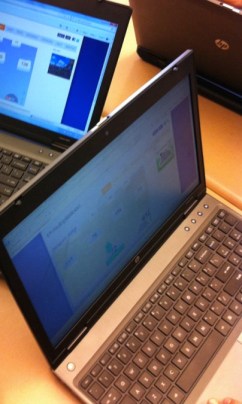
It’s becoming increasingly evident that technology continues to change the education landscape.  The landscape now consists of a variety of technology tools that teachers can use to facilitate the learning process.  If you look around the field of education you’re most likely going to find more schools that are going 1:1 with iPads (1 2 3) or Chromebooks (1 2 3).  I’ve even heard of schools that are using Kindles or tablets to replace textbooks. It can be challenging to decide what type of technology to order for your school district.  Should you go 1:1 or allow funding for multiple devices in the classroom?  I’m hoping to provide a different perspective on that topic through this post.

I’ve used iPads in the classroom and appreciate the many useful characteristics that they bring to the learning environment.  Students are often engaged while utilizing iPads and the user-friendly interface allows little transition time.  I’ve used iPads for individual math interventions, small group instruction, whole class problem solving activities, and math research.  The fast startup time, battery life, and enormous app selection makes iPads a contendor.  Regardless of all of the positives, I’m still looking for ways to create projects on the Ipad. I believe the iPad is primarily still considered a media consumption device first and a creating tool second.  Maybe this will change in the future?  For project creation involving increased keyboard volume, Flash, precision beyond fingers, and faster processing speeds a laptop/netbook might be a better choice.

Laptops/Netbooks bring additional processing power that an iPad may lack.  Recently my students created a podcast project that could only be completed on a computer.  The iPad has many podcasting apps, but all that I tried lacked the additional features that were needed.  Netbooks also provide opportunities to use open source education software.  This is often not possible with iPads.  From my experience, netbooks often fall short in battery life and startup times, although this is improving.

A document camera brings value to my classroom.  Everyday I use a document camera to display student work and model examples.  My document camera is connected to an LCD projector which displays images on a whiteboard.  Displaying work on the whiteboard and being able to use markers to make corrections or highlight exemplary work is extremely beneficial.  I don’t think I could go a day without using the document camera.

Of course there are many different ways to use technology in a math class.  Relying on only one option (like 1:1) without even considering computers may limit the opportunities for student learning and exposure.  Multiple devices, like iPads, netbooks, laptops, document cameras, tablets, Kindles, and ____ all have different uses.  Understanding how to utlize the technology at the right time is important.  Preparing our classrooms with multiple devices allows students the opportunity to pick the right tool for the project.  I believe we should model, but then give students the responsibility to decide what technology tool to use to complete the task.

What do you think?

Teaching Algebra Through a Different Lens

medium_6794460197


I recently taught a lesson on pan-balance equations.  In my curriculum pan-balances are taught as a precursor to more in-depth pre-algebra.   My students seemed to understand simple pan-balances and found that the balances (like an equation) needs to be balanced to work.  The majority of students had no problem with questions (like these) involving oranges, apples, paperclips, etc.

Day Two

During the next lesson I introduced the idea of variables with equations, like 2x + 4 = 18. Students seemed to understand, but less than the first lesson.  I brought everyone up to the classroom whiteboard and practiced many problems with the students.  The students who understood always seemed to raise their hands, while students who didn’t completely grasp the concepts tried to blend in with the carpet.  Students became less interested in what I was teaching when I started writing equations on the whiteboard.  Unfortunately, I felt like I was losing a battle here.  The more the students seemed to not understand, the more I felt the need for direct instruction.  Near the end of the lesson around half of the students seemed confident to proceed to the next algebra lesson – solving for x on both sides of the equation.

I had to change something.

Day Three

During the next day I decided to change up my instructional approach.  I remembered back to when I first learned algebra and the confusion that I used to experience.  My school memories of algebra started and ended by watching a chalkboard and overhead projector, as my teacher wrote and erased equations on the board.  This was the only way to learn algebra, or so I thought back then.  Using my experience  I decided to change the instructional medium.

I started my next algebra lesson with a quick review of pan-balances.  Students seemed to gain confidence as we had a conversation about the importance of using algebra in careers outside of the classroom.  We watched a quick BrainPop video on algebra and it’s uses.  Instead of using the whiteboard again, I decided to take out the iPads.  I already downloaded an app called Hands-On Equations a few weeks ago.  The students were quickly motivated and I modeled how to use the app under the document camera.

Hands-on-Equations

The class and I went through a few problems together until I thought they were ready to proceed.  I allowed the students 20 minutes to explore the app and lessons. The students were expected to complete at least three lessons and reflect on their experiences in their math journal.   What was interesting was that the students immediately took control of their own learning and utilized the app at their own pace.

Payoff

After approximately 20 minutes, I asked the students to write in their journal how they felt about their journey with pre-algebra.  The majority of responses were positive …

“I now understand why we use algebra”

“I never thought algebra could be so much fun”

“Having a picture of the balances helps me understand the concepts better.”

The Takeaway …

After hearing their responses and reflecting on the outcomes, I’m becoming more motivated to vary instruction to better meet the needs of my students.  Varying the instructional approach can give students multiple opportunities to grasp concepts that can be particularly challenging.  Your students may benefit from a bit of instructional change from time to time.


photo credit: ajaxofsalamis via photopin cc