Class and Learning Expectations

Screen Shot 2018-08-27 at 7.02.15 PM.png

Today marks my school’s fourth day of school.  I’m starting to notice that students and teachers are starting to get used to routines again.  Students are getting used to backpacks and teachers are getting back into doubling up on coffee in the morning.  So much energy has been used in getting classrooms ready and activities planned for kids.  Individual classrooms are in the midst of continuing to introduce and reinforce school and class expectations.  Every year classrooms use different activities related to creating classroom expectations.  Generally, individual classrooms take input from students and create a few different norms for a class.

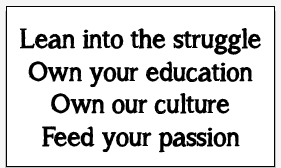
I’ve used similar strategies over the past few years to help co-create expectations for my classroom.  This year I decided to call an audible and try a different strategy.  I tend to loop with many of the same students so they generally feel like the expectations carry over from year to year.  This year I outlined four expectations that I feel like match the classroom.  I actually borrowed a few of these (she has many more) from Jessica’s fantastic post.

  • Lean into the struggle
  • Own your education
  • Own our culture
  • Feed your passion

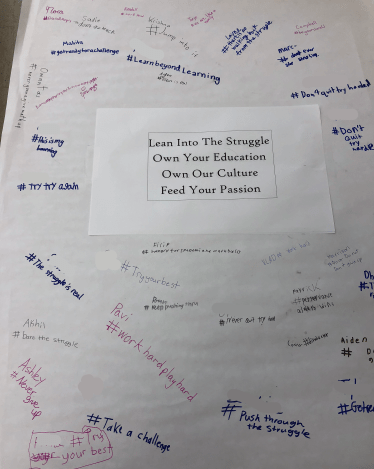
I believe all four of these expectations are important.  While introducing these expectations I gave a number of examples of how they can be applied in the classroom setting.  I then had the students get into groups and discuss what each statement means to them.  We had a brief classroom discussion about the expectations and the community that we’re in the midst of building.  Students were then asked to think of a hashtag that matched one of the expectations.

Screen Shot 2018-08-27 at 6.50.42 PM.png

The hashtag is intended to have the students internalize that particular statement. Students signed their first name and then placed the tag underneath it.  This is what it ended up looking like by the time we finished.

Screen Shot 2018-08-27 at 6.59.03 PM

I’ve already referenced the expectations at least a few times a day since last Thursday.  I’m looking forward to seeing how students internalize this moving forward.

Math Exposure Isn’t Enough

A few months ago I remember sitting in a meeting where teachers were discussing students and their math placements.  The conversation revolved around the topic of whether students should change math placements for the next school year.  For example, should a student stay in a homeroom math class or be part of an accelerated class?  How will we provide additional math support for particular students?  These types of questions tend to occur throughout the school year, but action for the next year often takes place near the end of the school year.

The decision to change placements is based on a variety of factors, but many schools/districts narrow down their criteria using standardized assessment data.  That data is often in the form of achievement, cognitive, and/or even aptitude tests.  Each district that I’ve been in has had a different process to determine subject placements.  This placement process becomes even more apparent as students travel from elementary to middle or middle to high school. Students’ birthdates, norm-referenced test scores, and percentages often take center stage during these decisions.  Sometimes the conversation evolves into whether students would be able to transfer the skills to a more rigorous math program than the one that they’re currently attending.  The conversations are usually productive and emphasize how to best meet the needs of students.

The topic of exposure is often brought up when making these types of math placement decisions.  A quick Google search will bring up one of the definitions – “introduce someone to a subject or area of knowledge.” I have heard on more than one occasion the following paraphrased statements/ideas:

  • If students haven’t been exposed to the content then they won’t be prepared
  • Those students weren’t exposed to above grade level work so they won’t be ready for that class
  •  The reason the student scored at the ___%ile was because he/she was exposed to that skill before the test
  • If they’re not exposed to this class then they won’t take higher-level classes in high school

I feel like these types of phrases are thrown around lightly and in a way that doesn’t hit at a bigger issue  Being exposed to content doesn’t necessarily equate to applying it in different situations.  Showing a students how to complete a specific skill/process doesn’t mean that they fully understand a particular concept.  Students might understand a process, but are limited during the application stage.  Also, educators need to keep in mind whether an above grade level curriculum is developmentally appropriate for students.


I believe the bigger issue here is equity.

  • Are all students receiving high-quality math instruction?
  •  Do the tasks and math routines allow students opportunities to explore mathematics and build solid understandings?  
  • Do students need enrichment opportunities instead of acceleration?
  • Will being exposed to a new curriculum/topic/grade-level be the panacea to move students to a higher math placement?  Is that even a goal?  

So many questions are above and I’ll admit that I don’t have a solid solution for them.  I think we have to go back to what a school/district values. I do know that I want students to be curious about math and dive into its complexities.  Classrooms should develop a culture where taking mathematical risks is the norm.   High-quality math instruction takes investment from a school and district.  Ensuring that this instruction is occurring and support is provided is also important.  Mathematical tasks that encourage students to observe, create, and apply their understanding beats limited exposure any day. Exposure is the first step and it doesn’t end there.

Community Building and Content

I think it’s safe to say that I’m slowly transitioning into school mode.  It’s inevitable and happens every year, but the month of August seems to fly by as a new school year approaches.  Over the past few weeks I’ve bought items for my classroom and have started some planning here and there.  Next week I’m planning on dropping by my room and start the unpacking process (I changed classrooms).  That is unless HGTV decides to makeover my classroom over the weekend.  So right now I’m drinking coffee and being a bit reflective.  I’ve opened up my planbook and am starting to ink in the first couple days.  While doing this a few questions have crossed my mind.

Will students be receptive to the beginning of the year tasks/activities? Are the activities related to my content area and does that matter?  Will the activities be remembered one day, five days, or even five months from now?  How will the activities impact the rest of the year and how will students remember them?

Many students get excited about new tasks or activities.  I find this happens quite frequently at the elementary level. The beginning of the year often yields plenty of classroom community building activities.  These may or may not be associated with the content that’s taught.  The emphasis is on building a positive classroom environment and often helps set the stage for the rest of the school year.  During this time students often work in groups and there’s generally a reflective piece near the end where a consensus is made.  Sometimes the classes develop norms and touch on the idea of growth mindset.  Usually these activities end after the first few days of school.  As the community building time ends students know what’s going to happen next.

Screen Shot 2018-08-10 at 9.58.50 AM
Should this be the process?

A shift is approaching and then it comes.  Kids know this and so do the adults.  All of a sudden homework starts being assigned and lesson sequences arrive.  It’s no longer “community building time” and we’re now in (insert your content area) time.  It’s often expected that the norms that were established and community building will last throughout the year.  It’s been established, right?

Not so much.  I find that teachers have to revisit the community building, norms and other themes periodically – not just after a long break. Otherwise those themes become like the posters on classroom walls – ignored after a certain amount of time. Students are used to playing the game of school.  Having novel beginning of the year activities and building a classroom community aren’t mutually exclusive.  Students and teachers are often reminded that the culture of the classroom is always evolving.

There’s often a perception that teachers need to dive into curriculum as fast as possible.  This is often perpetuated with scope-and-sequence guidelines and expectations.  Why not blend the community building activities and your content area?  That’s why I’m a fan of having math as part of the community building process.  Blending in content and community building can happen and I think it helps the sudden transition that sometimes becomes apparent.  I think also revisiting some of these community building activities throughout the year can give perspective and remind everyone of the importance.

Back to School Night

My school’s Back to School night (also known as Curriculum Night) is in a few weeks. Usually this presentation creeps up on me and I end up tweaking last year’s slides for this annual night.  This year I’m trying to be a bit more productive and get my plan started before the school year begins.  It also helps that @druinok has a great #MTBoSBlaugust initiative this month so I can actual address this now!  Better now than later, as once school starts it gets a bit hectic with time management.

I generally have about 30 minutes with parents during Back to School night.  My time occurs before the principal has an annual address.  I usually have around 30-40 parents come into my classroom to hear about what the class is all about and they also sign-up for conferences.  It’s usually a rush to get a preferred time.  You’d think that we’d move to an online system, but not yet. I try to pack my room with adult-sized chairs, but there’s usually quite a few that are standing. Parents sign-up for parent/teacher conferences during this time so it’s usually a packed room.  I loop with almost all of my student for three years, so some parents sign-up for conferences because they already have an idea of the policies and procedures and head out.  Newer parents often stay to hear about the class.  I also mention earlier in the year that the Back to School Night presentation is on my website.

I start off the presentation with introductions.  I usually say this is my ___ year in the district and tell everyone to hold onto the questions until the end.   Every year someone still asks questions around the second slide.  Go figure :-).  We go through an agenda to give everyone a heads-up to what’s coming.   I review the materials that are needed for the course.

Screen Shot 2018-08-01 at 7.58.33 PM.png

These supplies generally last for a few years.  Each item gets a whole lot of use throughout the year.  The first one to go is the accordion file as students put in their homework, quizzes and sometimes even their journals in there.  I have a roll of duct tape  on hand for the accordion files that don’t hold up.  The “pro” compasses are the best and I try to get a hold of them when I find them on clearance.

The next few slides discuss the different classroom routines, tasks, and resources that will be used for the year.

Screen Shot 2018-08-01 at 8.20.12 PM

I discuss how the adopted-text that we use spirals and there’s a large emphasis on problem solving / application.  I also indicate the different resources and activities that take place during certain grade levels.  I usually have an example that I can refer to but I have to keep it to a minimum because of time.  I usually get some curious eyes when I bring up the Stock Market Game, Estimation180 and AlgebraByExample.  Around 5 – 10 minutes is spent on this particular slide.  It’d be amazing if I could have the parents actually participate in one or two the activities. Maybe during a math night at some point?

The next slide communicates the homework policy.  Basically, I state that it’s not part of the overall grade, but expect to see it come home around 2-3 times a week.  Over the years I’ve reduced the amount of homework that I generally give.  I find that the students that actually need the practice don’t complete it and I’m eventually chasing down those that don’t turn it in.  It adds some unneeded anxiety for just about every party involved.  I’m actually even thinking of dropping this down to 1-2 times.  I’m still internally debating this issue even as I write this post.  I then discuss the grading scale which is 50% tests and 50% quizzes.  I also mention how students are able to retake certain assignments.

I then mention how to access the school math resources.  I point the parents to the school website and how to access the student portfolios on SeeSaw.

At this point I have around 5 – 10 minutes left and then answer questions.

Screen Shot 2018-08-01 at 8.38.18 PM.png

I have a list of FAQ questions and  mostly relate to how parents can contact me.  I mention that the study guides will be available on my website.  This is new this year and something I’m encouraged to try after reading Make it Stick. I try to end the time on an important point.

I use Fawn’s slide and go through her points.  I generally follow the same plan for the past few years.  You can find more information about how I use this here.

Screen Shot 2018-08-01 at 8.41.38 PM.png

I feel like ending on this slide is powerful.  I want to ensure students create their own math identity in my classroom.  There’s some resistance to this (especially # 1) but I feel like parents are receptive to the idea as they see their children develop perseverance skills and develop self-confidence.

My time is generally up after this last slide.  I remind parents that they should sign-up for a conference before leaving.  I usually walk with a few parents down to the auditorium where the principal gives her address.  I’m looking forward to this night seeing that I feel better prepared now.  🙂

Study Guide Issues

Screen Shot 2018-07-22 at 9.01.21 PM.png

This past week I started working on my school website.  It’s a journey every year, but this year is a bit different since my district adopted a new math text and quite a few of my links need to change.  In the past I’ve posted homework, a few math strand practice sections, and class newsletters to my website.  I’ve decided to change a few things up for the 18-19 school year.  I’m nixing the homework section and adding a study guide piece.  The reason I’m adding a study guide section is because I’m not thrilled with how it’s currently being used.

Study guides have been a sticky issue for me over the years.  There are so many different ways that they’re used.  My class tends to give and review a study guide a day before the unit assessment.  Each teacher in my school uses them slightly differently, but the process usually follows this sequence:

1.) Students use class time to complete the study guide

2.) Study guide is reviewed by the class and teacher

3.) Students correct their answers and feedback is provided

3.) Students use the study guide to prepare for the test

It seems that most teachers use some version of a study guide or review before an assessment.  Some teachers use games, while others go the paper and pencil route.  I think it truly depends on the teacher and their students.  This study guide process works well for many students, but I think it needs some tweaks and to a certain extent, improvements.  This summer I’ve been reading Make it Stick and it affirms some of what I’m seeing when it comes to memory retrieval.  Teachers want students to be able to retain what’s experienced in the class and giving a study guide with only that night to prepare isn’t as helpful as other strategies.  I’m starting to become more critical when it comes to questioning study guide practices. I sent out a Tweet indicating my concerns.

Here are my issues:

  • Students aren’t being given enough time to process what’s being discussed on the study guide
  • Students aren’t benefiting from enough retrieval practices
  • Students solely rely on the study guide to review for the test
  • Students might not be engaged or they decide to copy the answers from their partner
  • Students aren’t aware of how to study (this could be a whole different blog post)
  • Students aren’t experiencing enough reviews throughout the unit
  • The questions on the study guide are very similar to the actual test

I’m aware that some of these issues will occur regardless of the policies or procedures that are put in place.  I’d like to specifically address the blue issues in this post.

  • Students aren’t being given enough time to process what’s being discussed on the study guide 

In order to give students more time to process the study guide I’ve decided to give the packet in advance.  This requires more planning on my part (let the uploading and copying process begin!).  I’m planning on posting the study guides on my school website and giving students a paper copy at the beginning of the unit.  Students will have 4-5 weeks to finish up the study guide before the assessment.  In addition, this will help students preview the learning, as Mary pointed out.  It’s likely that some students will lose the sheet as they’ll need to hold on to it for about a month.  That’s why I’m deciding to post the study guides.  I’m also planning on having students code their work with a few self-monitoring strategies. I really like the completed, mistake, misconception, and correct coding.  Occasionally the class will review concepts discussed on the study guide so that the class won’t have to wait until the last day before receiving feedback.

Giving students more opportunities to experience math has its benefits.  Being more  intentional in how retrieval practices look is important.  I currently have specific exit cards and review checkpoints that are used for particular units.  I’m planning on creating more and placing them strategically throughout the units.  I’d like to give students multiple opportunities to address standards and receive feedback.

  • Students aren’t experiencing enough reviews throughout the unit

Moving forward, I think students need to have the opportunity to review topics as the unit progress.  The text my district uses has reviews, but the students need more opportunities to address skills that are taught at the very beginning, middle, and end of the unit.  Like David said, I’m planning on adding deliberate interleaving of concepts to the study guide.  That may add additional questions to the packet, but I think it’s worthwhile.  I also need to keep in mind that students will have around a month to work on the packet.

  • The questions on the study guide are very similar to the actual test

I’m conflicted with this.  I think students should be aware of what skills are on the test and the format shouldn’t be a surprise.  Being unfamiliar with the questions or format can cause anxiety.  There’s already enough anxiety surrounding testing.  I think sometimes giving questions that are too similar can cause students to be overconfident.  I think there’s a balance, I just haven’t found it yet.  I’m placing this bullet point in the ‘to be continued’ section.

From here, I’m currently updating my school site to include study guide materials.  It’ll take a shift in expectations as I loop with many of my students and they’re not used to that process.  Change is inevitable and I believe being aware and making a shift will benefit students. I’m looking forward to seeing how this process plays out and will write a post about it at some point.


SaveSave

More Accurate Self-Reflections

Screen Shot 2018-07-17 at 5.07.41 PM

Improving how students reflect on their math progress has been one of my goals during the past few years.  It’s a topic that I’ve been trying to incorporate more in the classroom. That reflection piece in my classroom has changed quite a bit since starting this journey.

Last year students would take an assessment, review their scores and then fill out a reflection sheet.  Students filled out the reflection sheet the best that they could.  The students and I would review the test and reflection sheet to determine the next steps.  Some reflections were spectacular and had a lot of insight, others didn’t. Most of the time the next steps included items like studying more before the test, reviewing a certain concept in more detail, practicing specific skills, or dedicating more time to the subject.  I’ll admit that too many of the nexts steps were vague and wouldn’t match the SMART criteria.  I was glad students were creating goals and following through.  Refinement was needed, but I appreciated that students were lifting up more responsibility for creating their math identities. The students did a fine job following up with the next steps, although this was inconsistently implemented.  I’d check-in on goals during the next reflection time.

While reading Make it Stick (I’m on the second renewal from the library), I found something that I’d like to keep in mind for the new year.  In chapter five the authors discuss the Dunning-Kruger effect.  Research has shown that people (students) sometimes overestimate their own competence.  They “… fail to sense a mismatch between their performance and what is desirable, [and] see no need to improve.”  As I continued reading I found that lower-performing students were the most “out of touch” in gauging how well they were doing compared to the standard.  After reading this I started to think about how students accurately reflect on their math progress.

Students are often asked to compare their work to the criteria for success.  The points/letter on the top of graded work is generally perceived in black and white.  Students either view themselves as doing great or poor.  There’s nothing in the middle.  I rarely have a student that says they had an average test.  This becomes even more evident when students complete the reflection and goal setting sheets.  I’ve had a number of instances where students can’t come up with a goal for themselves.  Through probing questions I’m generally able to help students create a goal that is worthwhile, but this doesn’t always happen.  I believe math confidence and adopted math identities play a role here.  The perception is stuck on the score and it’s challenging to move beyond that number.  Maybe it’s because students aren’t as familiar in gauging how they’re performing compared to the standard? I’ve used different methods to encourage students to look at skills compared to points and this has helped, albeit the success using the table has been inconsistent.

Screen Shot 2018-07-17 at 5.24.03 PM.png

The authors of book discussed an experiment where poor performers improved their judgement over time.  These students received training specifically on the test concepts before the assessment. That time spent improved their self-reflections and they were more in-line with reality.  Basically, the students are better able to show sound judgement during self-reflection if they understand the concepts.  Accurate self-reflection becomes an uphill battle if they don’t.

Moving forward I’d like to spend more time discussing error-analysis and misconceptions with the class.  When students are aware of how these specifically exist then they’re better able to analyze their performance.  Pre-loading that meta-cognition piece is something I want students to keep in mind during the self-reflection process.  I think it will deter students from making statements like “I don’t know what goal to make” or “I need to work on everything.”  These types of statements are disheartening.  I think having exemplars might help instead of just diving in and asking students to reflect.  Having a clearer direction and possibly having a reflection time that occurs more frequently could also help.  Math isn’t always perceived as a subject where students are asked to create some type of narrative and connect to the text/content. I find that students rise to the challenge when I give them an opportunities to do so.  I believe that giving students opportunities to analyze, reflect, and set goals for themselves will empower them to create more accurate math identities.

Embracing Difficulties

Screen Shot 2018-07-10 at 4.35.20 PM.png

I just finished up chapter four in Making it Stick.  Parts of the chapter involve the topic of challenge and how it impacts memory.  Looking back at my K-12 experience, what I remember is often associated to how I felt during the experience.  The best experiences for me required an extensive amount of effort and perseverance that eventually led to a productive outcome.  Some of the more challenging experiences were also memorable.  I learned from both those positive and negative outcomes. It’s interesting that the experiences that I remember were either positive or negative.  I don’t have many so-so memories during school – they don’t stand out.

Chapter four emphasizes how difficulty can help students retain information for longer periods of time.  I’m going to interchange the terms difficulty and challenge for this post. Challenge triggers retrieval processes and encourages students to make connections to find a solution.  This is often termed “desirable difficulties” by the Bjorks.  Chapter four discusses the importance of generative learning.  Basically, generative learning places students in a situation where they solve problems without being explicit taught how to solve them.  Students are required to make connections and generate answers without repeating a process that was clearly taught by a teacher.  The responsibility is on the students to generate a solution.  When I first read this I wasn’t exactly sure about this idea.  I work with mostly elementary math students and some want to know exactly what and how to complete a task.  If they’re unsure students might say “you never taught us ______.” It takes a shift in mindset to take a risk and generate solutions based on prior knowledge.  In the end students might be absolutely right or wrong, but they took a risk and came up with a solution.  Praising the effort involved and reflecting on the journey is important.   When coming across open-ended tasks students need to understand that learning is a journey and challenge is part of that process.

Next year I’m planning on incorporating more opportunities for students to participate in generative learning.  I believe it first starts with creating an environment where students aren’t “spoon-fed the solution” and they have to think critically about the situation.  I find that students are more likely to check their answer for reasonableness with tasks like this.  That environment should encourage students to speak up, offer their ideas, use trial-and-error, make connections, and become aware that learning is a journey.  This culture and mindset takes time to build, but the dividends it pays throughout the year benefits all involved.

I’m staring to to take a look at next years plans. Currently there’s one task for each unit that’s designed for generative learning.  Sometimes I have students work on these tasks in groups, while other times it’s independent work.  These types of tasks are often open-ended and may have multiple solutions.  They also involve a hefty time commitment and can reach multiple math standards within one tasks.  Over the summer I’m planning on finding additional ideas using MARS and Illustrative Mathematics resources.

Next steps: At the end of each task I’d like to have a class conversation about the task.  Have a regular reflection component can bring additional connections.  I’m planning on continuing to have students journal about these experiences throughout the year.  I’m also hoping that these types of tasks translate into students being more willing to take additional ownership for creating and monitoring their math identities.

Learning and Making it Stick

Screen Shot 2018-06-29 at 4.48.49 PM.png

I’ve been reading Make it Stick during the past few weeks.  It’s been a great summer read and it helps that a few people from the #ICTMChat crew has been reading as well.  Reading as a group adds an accountability piece that I think is needed – especially over the summer.

So far I’ve read the first couple chapters.  I’m finding a few gems and ideas that are great to reflect on before school starts back up in August.  I think the first chapter comes out swinging.  It hooked me from the start. I’m also hoping that writing about these first few chapters will help me remember them by the time school starts back up.  The authors suggest that the ways that people traditionally study aren’t the best methods.  What we’re told about learning is misunderstood. Multiple research studies to show that cramming or re-reading text multiples times is often a prescribed method to study.  It may work well short-term, but not long-term.  We now know that reading content repeatedly in a short amount of time isn’t effective.

Chapter two discussed retrieval practices.  One example that I thought was interesting involved using testing as a tool for learning.  I was brought up in an education system where a test signified the end – the end to a unit or end to a bunch of concepts that were studied together.  A grade was plopped on the top of the test and that was that. Once the test was given it was up-and-onward to the next unit.  Researchers found that giving multiple tests (low-risk) with a high cognitive demand helped students perform better on a final exam.  I put the emphasis on low-risk and high cognitive demand.  If the assessments have consequences attached than students might not be as willing to perform.  If tests are too easy or hard, then students might not take the tasks as serious. I see this as a balance.  The words formative assessments come to mind when thinking about low-risk tests with high cognitive demand. Most educators give these types of assessments throughout their courses.  This isn’t new and is often brought up during during teacher evaluation process. Repeated retrieval through the use of these formative assessments or self-quizzing techniques can produce better outcomes.  I see this repeated retrieval taking the form of study guides, formative assessments, exit cards, and even group tasks. While planning out the new school year, I’m thinking of being more intentional in picking spots within a unit to insert self-quizzing and formative assessment opportunities.

The third chapter brought some head-nodding.  Variety is the spice of life – or so they say.  It seems it’s the same in the classroom.  Massed practice of repeating or re-reading the same thing over and over again produces results that don’t last.  Cramming is often the go-to before a big test.  I’ve used it before and I’m assuming you have as well. You might retain something, but it’s generally gone before too long.  I’m into the learning that lasts.  I want what’s being introduced in September to still be swirling in students’ heads in March.  One of the practices that the author highlights revolves around the notion of spaced and interleaved practice.  Spacing out practice sessions gives students time to process new learning while making connections. Interleaved practice is similar to spiraling assignments where students need to recall different processes and find (often informally) the relevancy in how they’re connected.  Varied practice is something I find often at the elementary level. Concepts are introduced and practiced, but not necessarily mastered before moving on to the next sequence. The example of Coach Dooley and his practice regiment was interesting.  Coaches often have their players working on a variety of skills throughout the week. They need to review playbooks, look at tape, work on fundamentals, practice individual skills and practice team skills. Having a schedule in place to address all of these is helpful and the improvements are often slow and steady. According to the research, this type of learning is better for long-term acquisition.  The same can be applied to the education world.

Practice and repetition is an important part of the learning process.  I think this book has me thinking more critically about why practice is emphasized so much.  The research involved makes compelling points.  Students should be given time to practice and process their math experiences. Teachers want students to move beyond memorization and have them apply their learning in different contexts.  Students need to discriminate what the problem is asking and delve into their toolbox to pick the right way to approach the task. Being more aware of interleaving, spacing, and variability practices can help teachers be more intentional in how students practice skills.  Adding a student reflection component to a practice session also helps bridge connections.

I’m actually enjoying the approach of taking my time and reading this over the summer. This post was designed to as a medium to reflect on what I’ve been reading.  I’m looking forward to checking out chapter four over the next week or so.

Moving Away from the Gifted Math Label

Screen Shot 2018-06-18 at 8.46.22 AM.png

I’ve been paging through Jo Boaler’s Mathematical Mindsets lately.  I’m finding a few takeaways as I’ve been reading sections over the past few days.  My school has embraced some of the ideas in the book and we’ve been taking small steps each year.  One idea I found interesting relates to gifted students.  Page 94 discusses the “myth of mathematically gifted child.”  I feel like that statement is ripe with controversy as many are for or against the idea.  Most parents, teachers, and students have at some point in their life been told or shown their math identity.  Then that math identity may or may not be adopted and confirmed by the student. That communication can come from a teacher, parent, or somebody else.  Sometimes it comes from a single teacher or constant grades on assessments/assignments. Usually it’s developed early in life and continues with that individual.  People often can’t shake the generalization that they’re “good” or “terrible” at math.  I hear this at parent/teacher conferences, at school meetings and on EduTwitter.  Of course this is a generalization, but I find that this math stigma has lasting consequences.

I believe that the same stigma has the potential to occur with the “gifted” label.   I find that this can happen as early as the elementary level or even before then.  In an effort to address the needs of all students sometimes elementary schools group students by perceived math ability – emphasis on perceived. This often takes students and places them in different math classes during instructional blocks.  Students are moved to these different levels based on standardized test scores, classroom tests, teacher recommendations, or some other data that the team feels is necessary.  The groups can be fluid and change every unit, but sometimes they don’t. In some instances, school also have advanced math classes for students in upper elementary.  These classes might have a gifted label associated with them.   Although they’re labeled “gifted math” the roster doesn’t match the label.  The classroom rosters are often based on a criteria.  Sometimes the criteria is heavily weighted towards one single test-score cutoff, accounting for 40 or more percent.

Many questions come up regarding the actual percentage for students that are identified as gifted.  Most gifted specialists tend to agree that the amount is less than 10%.  Yet, these classes that are labeled as gifted tend to have 1/4 or even 1/3 of the total grade level population.  These classes may be accelerated, but not necessarily be meeting the needs of all the students that are identified.  Moreover, moving students to and from these classes can prove difficult as social/emotional consequences play out.  Often these classes aren’t as fluid and the roster doesn’t change as much since the students are accelerated from day one.

When shopping for school districts I sometimes find that parents are looking for whether schools have gifted classes for their child.  Schools might communicate on their website or through brochures that they have “gifted” classes, but in reality they’re accelerated subject-oriented classes.  Gifted students have academic and social/emotional needs and funding isn’t always available for this need.  It’s up to the local districts to create a system to meet the needs for these students.  I’m assuming positive intentions for the schools and districts in this scenario. In an effort to please the community and potential registrations, districts might used the term gifted to mean that the needs for high-achieveing students will be met.  Also, students that participate in these classes are artificially given the gifted label and they adopt the identity.  For some students they thrive in the class and it’s just what they need.  For others, it’s the opposite. Students struggle and feel contempt for math as they attempt to live up to the label of the class.  Having this happen at the elementary level sets the stage for a student’s math identity into middle school and beyond.

Labeling a class as gifted has consequences.  I want students to be able to create and maintain their own math identities.  Creating engaging math experiences for students with a heavy does of individual reflection can help students decide for themselves how they feel about math.  Regardless of their assigned math identity, I’m hoping my math class provides an appreciation, curiosity, and enthusiasm for mathematics.

Class Survey Results – 2018

Screen Shot 2018-06-13 at 2.24.51 PM.png

School officially ended around a week ago and I’m starting to look back at the year.  During the last few days of school I gave students a survey.  I’ve used end-of-the-year surveys before, but this year I wanted to get the students’ perspectives on lesson structure and math interactions.

The reason I went in that direction because I noticed some trends while recording myself teaching. These recording were taking place because video recording were required for a certification that I’m pursuing. I went with the volume approach and decided to record three days a week for the first couple months of school so students would feel more comfortable around the camera.  At first, students would wave, make faces, dab and do all sorts of unrelated math actions around the camera.  That died down once students started to see that the camera wasn’t leaving.

After reviewing many different recordings (this took what seemed like forever), I started to notice trends related to how I was designing and implementing lessons and tasks.  This was a humbling experience.

I noticed that students were doing more independent work that I’d like to admit. There’s nothing wrong with independent work, but I wanted students to engage in math conversations with one another more frequently.  My lessons weren’t generally designed to have these math conversations occur regularly.  I used quite a bit of whole-group math conversations to spur mathematical thinking.  Although that seemed to be a good use of time, I noticed that not everyone was engaged.  There were students that hung out in the background and didn’t engage unless called upon.  I found through this experience that I was spending too much time on certain instructional elements and not enough on others.  I want the time that students spend in my classroom to be valuable and useful.  So I decided to start varying my strategies more often.  Short story: lesson design and pacing is undervalued.

So I made a few changes related to how often students work together.  The class created norms associated with how students should be working with one another.  I decided to increase that amount of “collaboration” so that each class had more of the time dedicated to working with other students.  I used visible-grouping strategies so students could see that groups were randomly chosen and all ideas are valued.  During this partner/group time students were completing math tasks, short-term assignments, long-term projects, Scholastic magazines, Desmos, Nearpod, and Kahoot! activities.   I noticed that students were having better math conversations at a more frequent pace.  While students were in groups I walked around and asked questions to help ignite or guide the discussion.  This slight shift seemed to play dividends as the year progressed.  Students became more confident with their math communication skills and the quality of those conversations increased over time.

Here are the survey results that came out during the first week of June.

Screen Shot 2018-06-13 at 1.05.41 PM.png

Not quite sure about the 2s and 3s.  I reviewed what the term “appropriate” meant and how it applied to their personal learning before students answered the question.   I think that some students prefer to work independently, while others thrive during group work.  I have to take this into consideration while reviewing these results.  Also, some students might be rating the actual work that is being done during these two scenarios.

Screen Shot 2018-06-13 at 1.06.01 PM.png

I was pleasantly surprised to see these results.  I tried to focus on giving students multiple ways to show their mathematical thinking.  Looking back, I used whole-group and independent math routines, projects, journal pages, individual tasks, math reflection journals, and  math class discussions throughout the year.  I was hoping to give students multiple opportunities to learn about math.  I believe students enjoyed some of the structures more than others, but having a variety of them gave them opportunities to see math from different perspectives.

The last survey question is below.

Screen Shot 2018-06-13 at 2.10.10 PM.png

This has been an issue that I’ve been tackling for years.  There are not simple answers for this. Students often view math as a speed game.  The quicker they are, the better.  I believe students see and are experiencing mixed messages when it comes to their math journey.  Fortunately, I get to loop with students and they get the message that math is a journey and there’ll be challenges and wins along the way.  Now what they do with that message differs.  When students perceive math as a journey, they develop a deeper understanding of the concepts that are introduced in class.  There’s also less anxiety related to speed and algorithms.  I’m going to keep this in mind while planning out what messages are being sent to students and the community next year.