Homework and Learning

Homework

Homework has been a contentious subject in the field of education.  Many people in education have been/are willing to talk about the subject; see examples 1, 2, 3.  Beyond the annual science fair and occasional project, homework in elementary school is generally used to practice or reinforce skills learned in school.  Reinforcing skills through application is important, although the homework that is often assigned at the elementary level tends to be worksheet based.  I’ve found this to be especially evident in math classes.  Beneficial math homework has value and can extend the learning experience.  I’ve observed some amazing educators assign math homework that stretches their students’ thinking.  I believe that this type of homework isn’t the norm, although I wish it was.  At times, I’ve seen math homework being used as a motivator, but there are definitely myths related to homework. Some teachers use homework as part of a student’s grade.  This can be problematic, as the environment outside of school can play a role in whether the homework is done and if it’s actually accurate.

Adam @agholman wrote a Tweet that seemed to be spot-on when talking about grades.  I connected the Tweet below with the idea of homework and motivation.

“But they won’t do it if it’s not for a grade” – This tells me way more about your motivation than your students’

As soon as I read the Tweet I started asking questions …

  • So in theory, one way that educators can encourage students to complete homework is to assign it with point values attached?
  • If a reduction in a grade is based on incomplete homework, does the grade really reflect mastery?

I believe that rewarding/punishing students for doing/not doing their homework can limit motivational tendencies in and outside of the classroom.  Can a teacher truly validate that a student should receive a “C” instead of a “B” because of homework issues?

Now … for some students homework fulfills its purpose.  Students practice and may receive help, but through the practice they are improving in their understanding of certain concepts. This can be beneficial.  As educators already know, this is not the case for all students.  Students that don’t complete the homework on time or turn it in may need some type of intervention in the form of extra help or possible enrichment, depending on the student.

Grading homework in itself can be a form of feedback, but purposeful direct feedback can help students understand concepts more clearly.  Unfortunately, many students don’t look beyond the grade on their paper for feedback.  There isn’t an easy answer for this problem, but I believe moving towards standards based grading practices may help in this situation.  An emphasis on formative assessment practices and feedback may also provide value.  Written feedback with a self-reflection component can be especially valuable in enabling students to become more responsible for their own learning.

My Takeaways:

  • Homework may benefit some students, but definitely not all
  • Grading homework doesn’t necessarily increase motivation or accurately reflect understanding
  • If you’re required to assign homework, assign meaningful and relevant homework
  • Direct feedback (not the actual grade) on formative assessments/homework continues to play an ever important role in the learning process

photo credit: bgilliard via photopin cc

Releasing Control

In a matter of weeks schools will be opening in my state and across the nation.  Most students and teachers are anticipating a smooth start to a new school year.   For me, this summer has been full of opportunities to hone in my teaching practice and expand my PLN.  Reading Teach Like a Pirate and attending Playdatedg58 were two opportunities that stretched my thinking in preparation for a new school year.  This post is based on what I’ve learned through these events/activities.

1. Teachers have control (for the most part) and can take risks in the classroom

The experiences that I highlighted above have brought insight to the idea of teacher control in/out of the classroom.  Teachers  often have more control in their classroom than many educators would like to admit.  Besides the curriculum given to the teachers by administration, how much input do teachers have in how their classroom is constructed/run?  Speaking from an elementary teaching perspective, teachers have quite a few opportunities to modify their classroom environment.  Middle and high school may be a bit different as more than one teacher is in one classroom throughout a day.

The concept of instructional academic freedom often gives teachers the ability to teach how they feel best engages students in the learning process.  Of course this depends on how academic freedom is interpreted.  The book Teach Like a Pirate has reminded me that educators can take risks in their classroom.  Trying out a new teaching strategy can bring fruitful results.  Creating lessons that with unique hooks can engage students in new and exciting ways.  Students are more likely to retain and apply knowledge when their learning experiences are memorable.  Moving outside of general lesson plans that are often created by publishing companies, gives teachers the ability to differentiate lessons based on students’ needs. Engaging lessons might include lots of conversations, noise, excitement, wonder, curiosity, disarray … but also learning.  This may not always the norm in your building or school but I feel that action is needed to move beyond standardizing all schools, classrooms and students.

Now, I understand that not all teachers feel this way.  Some are in organizations that mandate specific teaching protocols that may limit teacher academic freedom in the classroom.  Also, some teachers may feel that they are unable to take these types of risks in the classroom because of expectations from administration.   If you find yourself in a situation where taking a teaching risk isn’t the norm, feel free to speak with your administration about the benefits of your idea.  Within reason, most administrators will support the enthusiasm and ideas that a teacher brings to the table.

2.  Give the control back to the students

Many of the teachers that I met at Playdatedg58 seemed to feel comfortable creating engaging learning opportunities for their students. I’ve found that most teachers want students to become intrinsically motivated to do their best. That motivation is vital in enabling student ownership in the classroom.  I’ve found that materialistic motivators to be less than stellar in developing student ownership.   Moving beyond materialistic rewards also communicates that some of the satisfaction gained from learning and accomplishing tasks is internal.

I remember being a student and rarely having input in classroom decisions.  It was informally communicated that the teacher was in control of what/how I learned, resulting in close to zero student ownership.  The near 100% teacher direct instruction didn’t help my situation. Fortunately this changed for the better as I progressed through elementary school.  I believe that giving students the opportunity to make decisions in the classroom is important.  It also communicates that the teacher has created an environment where there is trust between the students and teacher.  Creating that climate of trust is essential for student ownership.

How do educators create an environment where students feel comfortable and are encouraged to take ownership of their own learning?

Keep in mind that this list is designed for elementary students, but I’m sure it could apply to other grade levels.

Students are given opportunities to  …

  • Make classroom decisions – rubrics, what problems/assignments to complete
  • Set expectations – set rules for class
  • Set goals – analyze their performance, set personal goals, monitor progress along way
  • Give/offer feedback – use plus/delta, quality tools, reflect and offer input regarding learning
  • Publish their writing – use blogging platforms to publish/scan in digital works
  • Use social media – Tweet , Vine, Instagram, Twitpic throughout day/week/month
  • Participate in Student jobs – electrician, technician, paper passer, etc.
  • Journal – reflect on progress made and respond to written feedback by teacher
  • Setup the classroom – help in arranging classroom setup
  • Respectfully debate – participate in conversations about most effective way to solve ______.

I believe that a classroom is a community of learners.  To accomplish some of the tasks above teachers need to be able to step back and give students opportunities to take control/ownership. Many new teachers that I’ve encountered feel that if they allow students opportunities to express themselves they won’t be able to regain control and that will negatively impact their evaluations. I’m sure many educators have heard the sarcastic phrase “don’t smile till January” or something like that.  I’ve found that giving students opportunities to control their learning also benefits the entire classroom community.  Giving up some control in the classroom means that educators are willing to take a risk and create a classroom environment that enables students to take responsibility for their own decisions.

Playdates in Education

Connected Through Playdates
Connected Educators

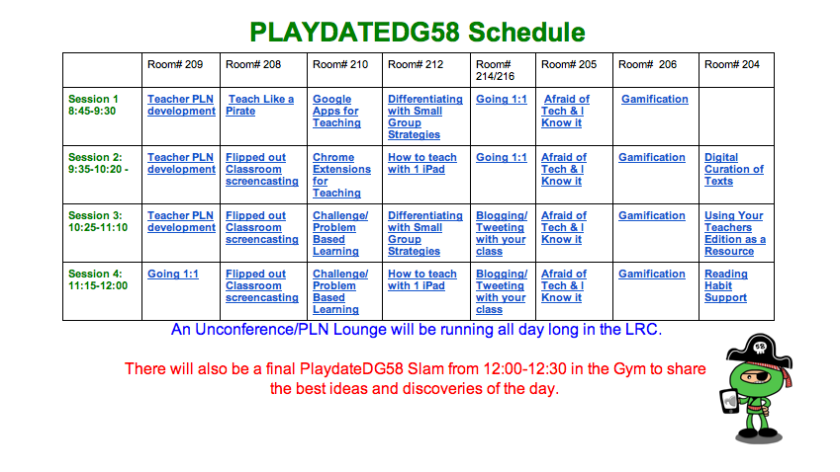
Yesterday I participated in Playdatedg58, a new (at least to me) type of professional development/workshop for interested educators, administrators and technology integration specialists. Playdate stands for People Learning Asking Y: Digital Age Teacher Exploration.  This type of conference was different than many that I’ve attended in the past.  There were no sponsors, booths, fees, or paper involved in this conference.  This is the first conference that I’ve attended that seemed to be paperless.  Most of the conference was organized by District 58 teachers and specialists.  According to the Playdate site, only a handful of Playdate conferences have occurred in the past.   I don’t believe this event  would have been possible without teacher and administration support.  Based on what I saw, it seemed that the District 58 leadership enthusiastically embraced the idea of having a summer workshop and I believe the superintendent was even in attendance.  Overall, I believe around 200 attendees were present from all over the state of Illinois.  Many of the participants were from neighboring school districts.  I appreciate that the workshop leaders allowed other educators from neighboring school districts to join in on the learning.  Unfortunately this isn’t always the case with structured professional development. The schedule was from 8:00 – 12:30 and I attached a screen shot below.  Each session had a link that was attached to a live GoogleDoc that anyone could edit.  What’s great is that these links will be available so that attendees, or anyone, can access and utilize the information for next school year.  Feel free to click the image to be directed to the appropriate link.

Playdate

Playdates seem to emphasize the notion that professional development doesn’t need to be contained locally.  It’s becoming increasingly evident that local school district professional development is changing.  Teachers with a variety of talents are seeking out their own professional development through social media and other means.  Twitter has allowed opportunities for teachers to connect with other people in the education community.  In fact, that is how I was informed on this particular Playdate.  Educators and administrators are beginning to notice that learning opportunities exist through our PLNs and some of the best professional development can occur outside of our district walls.  Moreover, I was able to meet members of my PLN face to face and make additional connections with people across the state.  Making these connections also amplifies the professional learning opportunities that teachers are able to access.  I hope that other school districts are able to find opportunities for their staff to participate in similar Playdate models in the future.

photo credit: br1dotcom via photopin cc

Math Autobiography

Math Autobiographies

The start of the school year is coming up quickly.   Very soon schools across the country will be bustling with staff, students and parents.  I’m not setting up my classroom until mid August so I’ve prepped materials all this week.  During the past few weeks my RSS feed (R.I.P. Google Reader, hello Feedly) has been filling up with passionate posts related to goal setting. These posts have allowed me time to reflect on my classroom and put together a few initiatives for the fall.  One of my goals revolves around the concept of math reflections.

I’m always advocating for interdisciplinary units of study in the classroom, so incorporating student reflections is one way that I integrate math and language arts.  Even at the elementary level, student reflections have so much potential.  In fact, I worked with a group of first grade students last year on reflecting on our learning experiences near the end of the year.  As an introduction we started by talking about the words “My Mathematical Journey” that’s displayed on the outside of my classroom door.  We called it our “scrapbooking” time, as most of their parents had some form of a scrapbook and the idea connected to reflections.

My upper elementary classes already use math journals, but we haven’t delved into math autobiographies … yet.  Ideally, I’d like to have students create an autobiography of their mathematical journey so far.  While the journey hasn’t been long, it’s still worthwhile to discuss and reflect upon.   While researching a few options I came across these sites:


  • John Burk’s post – This post gives some practical questions to ask students when discussing students’ math experiences.  I actually started at this site and branched out to the sites below.
  • Algebra 1 Blog – This blog contains essay prompts with student replies.  This is a prime site if you’re looking for student examples, as there’s over 100 sample responses.
  • Math Autobiography Slideshare – I was thinking that this example might be one way to construct a math autobiography.  Adding pictures, narration, etc. might be a decent way to present a student’s math journey.  I found that this Prezi is also another method that could be used in the elementary classroom.

There are a lot of resources and examples available on the topic of math autobiographies. Most are geared towards middle school and beyond, most likely because of the writing component involved.  So, I’m going to use a few ideas from the above links to adapt the autobiography assignment for my students.

To start, I’m going to give my students a digital camera.  Why?  Similar to Matt Gomez, I believe the digital camera can be an amazing tech tool in the classroom.   Students will take pictures of themselves in different poses:  with math manipulatives, books, the classroom, etc.  I’ll print out the authentic pictures (hopefully in color) and students will write captions under each picture.  Students will place their own pictures and captions in their own math journal in chronological order.  I believe the photos can all be glued into each student’s math journal.  As the year progresses the students might want to add more photos and captions to extend their math autobiography.

In a few months I’m hoping to write a another blog post showing the results of this idea.

photo credit: This Year’s Love via photopin cc

Gamification in the Math Classroom

With some assistance from ISTE13, it seems that the concept of gamification is becoming more associated with education.  I was #notatiste this year, but I heard that the keynote by Jane McGonigal was well received.  The idea of gaming in education, specifically the use of technology to facilitate gamification continues to build momentum.

The concept of gamification is described by Wikipedia as game-thinking in non-game contexts.  The idea is continuing to make an impact as companies and now schools are implementing the underlying concepts of gaming in the workplace/school.  I find more and more that gaming is becoming mainstream, from purchasing points to Fitbit badges.

To be honest, when I first heard of the idea of gamification I thought that this idea has a place in the classroom.  I then thought of how much time students (and teachers) spend on games and what role motivation plays in those games.  Many iPhone/iPad games give multiple, sometimes endless opportunities to successfully pass a level.  Think of games like Angry Birds, Doodle Jump, Words with Friends for general examples.  If a user fails at a level, they use the electronic feedback (e.g. not hitting the right board in Angry Brids) to make another attempt.  I know that that is a generic example but also reinforces the point that feedback is important.  Although I feel urged to mention that electronic feedback isn’t always effective … think of Game Genie.

Recognition, competition, and collaboration all have the potential to contribute to learning in the classroom.  I think most teachers use forms of gaming in their classroom, but they don’t necessarily refer to it as gamification.  Many web-based companies continue to interweave the idea of games and learning.  Khan Academy, Scootpad, Class Dojo, and MobyMax are just a few that use points or badges as a partial motivation tool.  Many iPad educational games are also adding to the gaming party.  SplashMath, a math game used with my second graders uses points that can be used to build an aquarium with exotic fish.  Where was this when I was a student?! Teachers often use games to engage students in the classroom.  I do believe though that staff should always be aware of what learning outcomes the games address to also validate why they are being played.  For some, the idea of playing games is related to entertainment, not learning.  Why can’t it be both?  Personally, I find that board, card, math contests, and dice games to be effective in helping students retain and apply mathematical practices in the classroom.  Not only do they encourage students to collaborate and use social skills, but I find them to be useful during guided math groups.  A debrief after the game also allows time to reflect on strategies and reinforce mathematical processes.

The focus now seems to be placed on technological uses of gamification in the classroom.  One of my goals this next year is to incorporate additional gaming opportunities in the math classroom.  I’m still in the process of researching and finding additional resources related to math gamification. If you’re in a similar boat, Trever Reeh’s page on math gamification is a good place to start gathering a few ideas.  I believe gamification in the math classroom has its place, but finding a balance between different teaching strategies is important.  How do you use games or similar activities in the math classroom?

4 Ways to Encourage Student Self-Reflection in Math Class

Math teachers have a variety of tools that can enhance the learning process.  Technology, math manipulatives and problem-based learning activities can all play an important role in a math classroom.  Regardless of the tools or strategies, one of the most powerful motivators that I’ve utilized over the past few years deals with the concept of reflection.  Adults often learn by experiencing events and reflecting on them later.  Generally the reflection lets us make better or more informed decisions in the future.  Many educators blog, which I believe is one form of reflection.  Allowing students opportunities to reflect on their math learning experiences, including celebrations and mistakes can be time that is well spent.  A sense of ownership develops when students begin to understand that their success isn’t only dependent on the teacher or tools within the classroom, but on themselves as well.  Reflection is especially powerful after making mistakes.  By reflecting on math mistakes, whether they are procedural, formula issues, or simple errors, students become aware that mistakes are part of the learning process and shouldn’t be on the taboo list.  How do we give students opportunities to reflect in math? Here are four possible ideas:

  • Math Journals – This is a great way to gauge a student’s understanding of particular math concepts.  I’m continuing to find that students are using their math journals to communicate their conceived strengths and personal concerns.  Students are asked to reflect on their learning experiences in the journal through various journal prompts.  I check the journals periodically and am able to provide feedback to individual students.
  • Student Led Math Conferences – Throughout the year I have personal math conferences with the students.  Students bring their formative assessments to the conference and the student reflects on their progress.  We work together to find areas that need strengthening and write a personal goal related to specific academic concepts.  Students may decide to bring their math journal to their math conference.
  • Class Anchor Charts or Plus/Delta Chart – After a formative assessment or test the class may have a discussion about what problems on the assignment caused concerns.  We then reflect on the processes used to find the answer and have a thorough discussion about the mathematical process.
  • Blogging – Student blogs allow time to reflect on their mathematical process.  Students can blog about how they solved a particular problem and what steps were needed.  I find that blog explanations are especially useful when explaining solutions to problem-based learning activities.  It’s also a stellar documentation tool.   Keep in mind that the blogs may be public and not all students want to wave their mistakes in the air.

photo credit: doctor paradox via photopin cc

How do you encourage student reflections in math class?

A Sharing Culture

photo credit: overgraeme via photopin cc

Teachers Aren’t Meant to be Islands


The ISTE 13 conference in San Antonio is now over.  I wasn’t able to attend this year, although I was amazed with the amount of digital sharing that occured during the conference.  I was able to follow the #iste13 hashtag which provided me with links that were directly associated with conference keynotes, slides, sessions, speaker notes, videos, pictures and a multitude of useful information.  This type of generous sharing should happen in education more frequently.

I’m now reflecting on how schools and teachers share resources with each other.  I’ve experienced sharing through social media and have a variety of experiences sharing ideas/resources in schools.  When comparing schools and social media PLNs, I find differences in the volume and quality of sharing that occurs. I’ve observed teachers that actively share resources with their PLN through social media, but not so much in their school and vice versa.  There may be reasons behind this that are directly associated with how many people are in your PLN compared to the amount of staff in your school.  Regardless, the amount of sharing within a school truly depends on the culture.  Some teachers are very private with their resources and ideas, while others will freely handout their resources to anyone who asks. I believe the reasoning can be partially tracked down to who completes the work and a fear that their resource wouldn’t be used correctly.

Current teacher evaluation systems that include VAM may also play a role. VAM scores seem to be making a splash and are unintentionally causing teacher competition. One byproduct of competition is often isolation, which causes a decrease in sharing as teachers are numerically pinned against each other.  This culture negatively impacts teachers, students and the community.  I believe teachers aren’t meant to work in isolation. One of my newest PLN members, Victoria Olson said, “…we are not intended to be islands, yet many of us are.”  I believe that quote is spot on and applies to educators everywhere.

How do education leaders encourage sharing and collaboration?

I believe every staff member has something that they can share, regardless of their position in a school.  Sharing often brings opportunities to innovate as one idea is built upon another. Sharing also empowers teachers to find additional resources and possible teaching strategies that may help their class.  This sharing may strengthen the trust between teachers and school teams.  It may also encourage teachers to begin to direct their own learning, as Dean Shareski says in his post.  Teacher and administration sharing sessions can benefit many stakeholders and can lead to brainstorming opportunities.  This is not a top-down approach and isn’t necessarily consistently embraced, but it can yield positive results.  Administrators should encourage sharing with colleagues (like this) and incorporate staff sharing moments during scheduled meetings. Sharing shouldn’t be seen as being narcissistic. George Couros expands on this idea in his post.  Sharing your ideas/strengths also validates that we’re all learners attempting to improve our practice.  Having a dialogue about the sharing is essential in the process and may improve teaching practices.   No matter who you are, or what experience you have, there’s always a way to become better at your craft.  Starting off the school year by sharing ideas/resources can help build a solid foundation that encourages additional sharing.   What should be shared?  This depends on the school and leadership.  Here’s a rough idea list:

  • Workshops
  • Conferences
  • Education Journals
  • Education related books
  • Blogs
  • Experiences over the summer
  • RSS feeds
  • Colleagues
  • Teachers

I have respect for administrators that share what they’ve learned when they were teachers.  I believe that sharing these experiences and resources have potential to build a positive rapport between administrators and teachers.  This modeling may help motivate others to share as well. When sharing becomes the norm, administrators can encourage teachers to participate and even lead professional development sessions with their staff.   This type of professional development has many benefits.

How do you promote collaboration and sharing with your staff?

Better teaching practices

photo credit: Krissy.Venosdale via photopin cc

I remember reading a tweet a while back that mentioned that teachers should be using best teaching strategies in the classroom.  I absolutely agree with the tweet.  Best teaching practices should be something that school districts strive for, although I think the term ‘best practice’ often falls into the edubabble category and is used incorrectly at times.  I’ve listened to the phrase being used in appropriate circumstances and I’ve heard it used primarily as a trump card to end education conversations.  Regardless, the phrase is often utilized to convey that a particular research-based strategy will better your classroom.

Many educators have read the popular book called Classroom Instruction That Works.  The book suggest that teachers use specific “high-yield” teaching strategies in the classroom.  I’ve known educators who term the strategies as best practice since they’ve been researched and suggested by leaders in the field of education.  After the book was published school districts started to use these strategies more frequently.  I say frequently because I believe that some schools were already using the strategies before the book was published.  Unfortunately, some schools were using the strategies as a form of a checklist, expecting to see the strategies in most/all classrooms.  Morzano, one of the authors of the book, cautions that  “A school or district that uses a narrow list of instructional, management, or assessment strategies will fall into the trap of assuming that all strategies must be used in every classroom.”  I believe that many of the strategies are beneficial, but they shouldn’t be used as a checklist.

School leaders should look at incorporating better teaching practices in schools.  Often school improvement plans are put in place to improve (better) a school in a certain area.  Using the word ‘better practices’ communicates that there’s room for growth and innovation.  All schools, administrators and teachers can become better at what they do.  I believe that growth mindset should also apply to teaching practices.  Moving from entire whole group instruction to differentiated instruction could be one way to move towards showcasing better teaching practices in the classroom.  Empowering teachers and providing them with strategies to improve is essential, regardless if the strategies are termed best practice or not.  Innovative educators have strategies or ideas that they use on a daily basis that might not yet be termed or published as best practices.  Let’s move beyond the term and encourage better teaching practices in our schools.

Student Self-Reflections

Reflection
photo credit: karola riegler photography via photopin cc

Over the past few years my teaching practice has evolved.  Growth in the teaching profession often occurs through experience and professional development.  As continuous learners, teachers generally hone in on their craft over time.  I believe reflecting on teaching experiences plays a role in the professional growth of an educator.

  • How often are teachers able to reflect on their craft?

I’d hope that it would be more often than not at all.  Personally, reflecting on past experiences can lead to better decision making and goal setting in the future.  They’re many ways in which educators can reflect.  Off the top of my head I can think of:  after a professional development session, reading or commenting on a blog post, participating in an education twitter chat, attending workshops, and many more.

  • If educators feel that reflecting on experiences is important, why not give students opportunities to reflect on their progress?

Absolutely.  One way in which reflection has been beneficial in my classroom is actually rooted in the formative assessment process.  Local formative assessments give quality information that can be used to drive instruction in the classroom, while other data (standardized assessments) are used for district/state/nation purposes.  Formative assessment data not only serves the teacher, but it also informs students of areas of strengths and concerns.  Last year I decided to have my students use a reflection journal to analyze their own achievement levels in class.  Students reviewed their formative assessments, usually in the form of exit cards, and wrote a short paragraph regarding how they performed.  I asked the students to write a few sentences related to how close they are in understanding the concepts observed on the exit card.  Every so often, generally after a grading period, students were guided to setting individual goals for themselves. These goals were based on the journal entries and learning experiences throughout the grading period.  This process required modeling during the introduction phase, but after two grading periods the students were ready to complete this independently.

I vaguely remember using journals during my K-12 experience.  The teachers that assigned the journal entries rarely wrote any comments back to me.  This peeved me as a student and I’m over it still does as an educator.  Therefore, I make a conscious attempt to review all the student reflection journals and write short individualized comments to the students.  The comments show the students that their teacher is aware and cares about their progress.  This action is especially important to students that might not be as assertive in class or might be embarrassed to state how they truly feel.  I place an emphasis on the student created goal. Student goals are highlighted  as I will often share them with the parents to ensure that we’re all working towards the same end goal.

I also find that the student reflection journals show student growth on a personal level.  When growth is evident, students often gain confidence in setting new goals.  Reflecting on progress made can be a tremendous opportunity to set goals.  These goals can empower students to own their learning.

Side note:

 Reflections can take on many different forms.  Incorporating various prompts throughout the entire school year also communicates to the students that goals don’t have to be directly associated with scores.  In the past I’ve used field trips, current events, literature, and problem based learning activities for reflection journal prompts.  

* Feel free to visit Helen Barret’s reflection for learning site for more information on this topic.

Risk and Professional Development

Teacher Professional Development
Is this your teacher professional development?

I recently found some time to reconnect with a few teachers that I haven’t talked to in a while.  A group of us were able to meet up and discuss our lives during the past school year.  As the conversation extended beyond pleasantries a few common themes emerged:  high-stakes testing, new teacher/administration evaluations and district professional development (PD).  The last topic took up most of the time and reminded me of how important it is to connect with fellow educators.

Some stories about PD were positive and some negative.  I listened to a few less than stellar stories of districts that dictate all PD needs. These top-down, one-size-fits-all PD sessions help certain staff members, but not all.   One of the teachers at our table insisted that school districts need to be able to differentiate their PD opportunities .  Just as teachers differentiate for their students, districts should also differentiate their PD for their staff.  I’m encouraged to hear that other educators like Ellen (@sneakyfritz) have similar thoughts about PD being more aligned to teachers’ needs.  Teachers learn at different paces and have a variety of strengths, therefore different opportunities should exist for them.  I find that the second model in the image below is used frequently in some districts.

photo credit: superkimbo via photopin cc

Another teacher in our group thought that educators should be able to choose their own PD sessions, even if they’re located out of the district.  By not mentioning PD opportunities outside of the district (Edcamp, Twitter chats, conferences, workshops, MOOCS) teachers’ professional growth can be limited. Administrators that aren’t connected may not be aware of the PD options that are available online and outside of their school.  Discouraging teachers or omitting opportunities outside of the district also infers that a district doesn’t trust the professional judgement of its teachers.  Obviously, not all districts are like this.  I believe that teacher ownership plays a role in increasing the effectiveness of PD.  This terrific post by Dean (shareski) sheds some light on some of the important issues of PD and teacher ownership.

When teachers share what they’ve learned with each other the district often benefits.  I applaud districts that encourage teachers to be part of the PD process by having them lead district training sessions, similar to an edcamp model.  That seems like one way to encourage teacher ownership and solidify a mutual trust between teachers and administration

Screen Shot 2013-06-17 at 8.15.20 PM

Sometimes the one-size-fits-all model of traditional PD is mandatory, as regulated by the state.  I’ve found that districts that have total control (top-down) of the PD often informally discourage sharing and innovation.  Not all sessions have to be this way. Districts can encourage teachers to grow professionally by taking a risk and trusting their teachers to pick and choose the PD that meets their specific needs.  Districts should advocate for their employees to attend the most effective PD sessions.  Many of the teachers in our discussion stated that some of their best professional development came from outside of their school district boundaries.

Another teacher in our group stated that many educators are already taking ownership of their professional growth through a Personal Learning Network (PLN).  In many cases, they take ownership because the district might not providing opportunities for the growth that they need.  Regardless of a districts financial situation, many beneficial PD opportunities exist and are found through Twitter and other social networking sites.  These sites are generally free to join.  It’s truly unfortunate that some districts decide to rely on traditional PD and expect it to dramatically change teachers’ skills.  By omitting the use of technology for PD opportunities, districts are actually limiting their effectiveness and devaluing the educators that are already utilizing these outlets for PD.

Despite the lackluster view on the process of PD in some locations, the group that I sat with agreed that there’s good news.  The good news is that teachers aren’t depending on school districts to provide adequate PD.  They’re seeking out their own PD and bringing back innovative ideas to the classroom.  Teachers can bring these ideas to other connected educators around the world.  Teachers are connecting with other educators across the world through Twitter and other social media avenues.  This connection has many benefits.  Being a connected educator often gives teachers opportunities to learn more from other educators and bring back practical ideas to the classroom.  These teachers are using ideas found through their PLN to better their students’ learning experiences.  Often times they are enhancing their students’ learning experience without the district even knowing.  Districts need to be able to identify and celebrate theses succeses. I’m optimistic that school districts will adapt their current PD practices.   My optimism is rooted in the fact school districts  are listening to the staff and increasingly adopting non-traditional PD approaches to meet the professional needs of their teachers. These teachers are taking risks to better their own classroom/school and I believe school districts have the opportunity to do the same.  I’m going to end this post with a Tweet that assisted in inspiring this post:

Screen Shot 2013-06-17 at 8.12.45 PM

photo credit: mikecogh via photopincc