Overemphasizing Standardized Test Data and Possible Solutions

Standardized Tests and Formative Assessments
Assessment Data

Assessment Data …. If you’re within listening distance of a classroom you’ve probably heard the words.  The words can hold positive as well as negative connotations. Two different types of data are often used in the classroom – summative and formative.  I think this picture helps show the difference between the two.  If used appropriately, formative assessment data (exit card, common assessment, observation, journal, data binder, etc.) can be used to improve student learning.  Many teachers that I’ve met through Twitter utilize formative or local assessments to maximize student learning. I believe that it’s possible to use student achievement data to identify specific strengths/concerns as well as assist teachers in developing interventions (remediation/enrichment) for students.

At times the word is also associated with standardized test scores and accountability. Those words combined might make a few teachers cringe and organizers protest. A school district’s standardized test scores may make news headlines and influence school improvement plans.  The emphasis on standardized testing has caused teachers to allocate more time for test prep.  Some districts begin the test prep process in January, or before, when the test actually occurs in March. That test prep time takes away time from many non-test related subject areas.

I’ve been told that the Common Core will change the standardized testing landscape. I can’t predict the future, but I believe standardized test scores will continue to dominate local and national headlines. It’s been well documented that there’s an overemphasis on standardized test scores in public schools in America.  The emphasis on test scores impacts teacher instruction and will soon influence teacher evaluations.  Is this a good thing?

I’m not advocating for or against standardized assessments, but I believe formative assessments should drive academic differentiation decisions in the classroom. Even though the overemphasis on standardized test scores seems to be the norm, I’m optimistic. Why?  Many influential education leaders are starting to notice the impact of standardized testing on students, teachers, communities, and administrators.  The leaders below are speaking out on the impacts of standardized testing.  Feel free to follow the courageous people below.

  • Joshua Star @mcpssuper is the superintendent of MCPS, a large, diverse, and high performing district in Maryland. He has concerns over the validity of standardized tests and has asked for a moratorium on standardized testing.
  • Diane Ravitch @dianeravitch, is Research Professor of Education at New York University, wrote a blog post about the inequalities of standardized testing here.
  • Larry Ferlazzo @larryferlazzo, an ESL teacher in California, wrote a blog post comparing the difference between being data-informed and data-driven.

2012 in Review – Statistics

2012 Statistics
2012 Statistics

After reading a few “2012 end of the year review” blog posts, I decided to write my own. This blog started out as a math lesson bank and has evolved into a reflection / feedback tool for the #elemchat and #mathchat communities.

Educational Aspirations, the title for this blog hopes to communicate the importance of creating a culture of continuous learning.  Throughout 2012, I’ve utilized my PLN to implement lesson ideas / strategies in my own classroom.  Blogging has enabled me to reflect on my own practice and receive feedback on thoughts related to education. In an effort to be more organized and concise,  I’m going divide this blog post into a few statistical lists.

Most Visited Blog Pages:

1.  Educational Aspirations Homepage (7,853 visits)

2.  The Real Number Line (4,947 visits)

3.  Geometry Birds (1,815 visits)

4.  Goal Setting for Students (1,044 visits)

Top Views by Country

1.  United States

2.  United Kingdom

3.  Canada

Most Popular Tags:

1.  Education

2.  Math

3.  Elementary Teaching

2012 Referrers

1.  Google Search “number line” “the real number line” “educational aspirations”

2.  Pinterest

3.  Twitter

Outbound Clicks

1.  Angry Birds Templates (652 clicks)

2.  NRICH Enriching Mathematics (302 clicks)

3.  Elevated Math (195 clicks)


Picture Credit:  R. Krishnan

Utilizing Teachers’ Strengths to Improve Schools

Utilizing Teachers' Strengths

Utilizing Teachers’ Strengths

During this holiday season I’m reflecting on the topic of school leadership.  School improvement often begins with a vision, but without teacher input or ownership, the vision may become undervalued.  It takes commitment and collaboration from all stakeholders to improve a systematic school organization.  This collaboration requires staff to trust the leadership within a school.  Principals have opportunities to build trust with their staff by ensuring that they don’t underutilize talents within their own school.  Teachers often have skills that aren’t necessarily visible during an introductory handshake.  Every teacher has strengths that they can bring to the bale, although some of the strengths may be challenging to distinguish.  Some of these positive skills could include:  rapport with parents, technology integration, planning with teaching teams, leading through mentoring,  goal setting with students, small group instruction, facilitating guided groups, etc.)

Coordinating Strengths

Teachers that are underutilized often disengage when asked to be part of school leadership decisions.  I believe that the majority of teachers unconditionally care and want the best for their students.  Unfortunately, teacher underutilization may encourage complacency and a lack of voice during school leadership decisions.  At this point, some teachers find professional development elsewhere, or possibly, employment elsewhere. Retaining effective teachers through utilization of teachers’ strengths is possible. I believe that teachers that feel utilized and valued often have ownership and participate more in school decisions. Teacher ownership helps schools become communities of collaboration.

How do educational leaders utilize teachers’ strengths and encourage teacher leadership?

One way to encourage teachers to utilize their strengths is to use inventories.  Just as teachers survey their students to learn more about them, principals have a unique opportunity to understand their staff better by surveying them.  Being aware of a teacher’s strength will enable a principal to coordinate personell to best meet the needs of a school.  Administrators can create a survey using Google Docs or use a template that best meets their needs.  Surveying staff members can be a proactive step in understanding individual perspectives and skill sets.  Using teacher inventories can lead to staff investment opportunities for school administrators.

What methods do you use to to encourage teacher leadership?

Photo Credit:  D. Castillo & J. Creationz

The Marshmallow Challenge in the Elementary Classroom

Using Food to Learn
Creating Structures with Collaboration

Approximately two months ago I noticed a Twitter post about something called the Marshmallow Challenge.  The tweet led me to this TED video.  Many of the examples indicated that the challenge could be used with adults as well as students.  The official Marshmallow Challenge website offers many useful instructions and tips for facilitators.  I decided to use the challenge with a fourth grade classroom.  The session, from start to finish, took approximately 45 minutes.  The standard 18 minute time limit to work on the project was perfect for my classroom.  Of course the focus of this project emphasizes teamwork, but I decided to add a few measurement standards. For example, the students were required to measure the length of each pasta stick used and find the volume of the marshmallow (as a cylinder).  The total height of the structure was also measured.  Here are a few pictures from the event:

This slideshow requires JavaScript.

The class had a debriefing session after the event.  During this discussion, students revealed their strategy.  Here were some of the questions that were discussed.

  • What will the base of the structure look like?
  • Will we use all of the materials?
  • What are our roles?
  • How will we work as a team?
  • How does working as a team help us succeed?
  • Will we wait to put the marshmallow on top at the very end or test it throughout the project?
  • Should we write out a plan in advance?
  • How should we work together?
  • What are other groups doing?

Overall, this learning experience gave students an opportunity to use critical thinking in a collaborative setting.   I’m planning on having students complete a plus/delta chart and complete an entry in their math journals next week.  

*Picture credit: Stoon

Measurement and Mini Golf

Measurement Project
Measurement Project

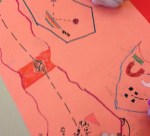
Approximately a week ago I was paging through my math curriculum. Through a pre-assessment I found that students were in need of a review on angle classification and measuring skills.  The curriculum lessons offered a number of worksheets and angle measuring drills.  Although these lessons seemed beneficial, I felt the need to create a more memorable learning experience for my math students.   At this point, I decided to search for measurement projects. While following #mathchat, I came across this Edgalaxy site.  The project seemed to match many of the objectives that needed strengthening in my class.  I changed up the directions and modified some specifics in order to best meet the needs of my students.

So … a week has passed and almost all of the projects are complete.  I listed the project steps below.  Feel free to use any of the ideas below in your own classroom.

1.  Had out the direction sheet.  Here is a Word template (via Google Docs) for your use.

Directions in WRD

2.  Review many of the different vocabulary words associated with the project: acute, obtuse, right, parallel, perpendicular, trapezoid, etc.

image_8

3.  Show possible examples.  I tend to show just a few examples as I don’t want to give them a mini golf course to copy.

4.  Group the students into pairs.  If you prefer, this project could be implemented as a collaborative group activity.

5.  Students choose their construction paper color (11″ x 20″)

6.  Students draft their course in pencil (on grid paper).  The draft gets approved by the teacher and then is transfered to scale on construction paper.

Sample

7.  Students present their final projects to the class.

iPad Apps for Math Intervention

IPad Apps for Math Intervention

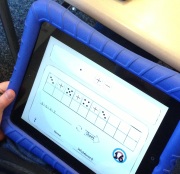
Over the past few months I’ve been experimenting with guided math strategies in my classroom. One station in my classroom has been dubbed as the technology table. This table has been primarily used to differentiate  instruction to improve students’ understanding of mathematical concepts.  I’ve been using the tech table for the past few months with great success. There are five iPad apps that are used at this table.  Unlike many math apps that offer only demo versions, I’ve found the below apps to be useful in the classroom.


5 Dice

This app is the newest addition to my iPads for intervention list.  This app emphasizes order of operations for upper elementary and middle school students.  The game encourages students to use multiple dice to find the “target” number.  A whiteboard is built into the game for students to work out problem.  Progress reports can be emailed to the teacher for formative assessment data.

photo (1)

Splash Math – Grade 3

This app is used to differentiate math instruction and assigned practice.  What I like so much about this app is the variety of concepts that I’m able to individualize.  For example, if a student needs additional work on the concept of time, then I can setup the app to only give questions related to time. Questions first appear simple, but then become more challenging as questions are answered correctly.  If you prefer, Splash Math will send you a weekly update indicating the progress of each student.


Math Blaster Hyper Blast 

This app is used to improve computation fluency.  This interactive app has a quick tutorial to teach students how to move the main character through a variety of mazes.  Students control a space vehicle that inevitably encounters an octopus type of creature.  Students must answer computation (addition, subtraction, multiplication, or division) questions to defeat the boss.


Factor Samurai

Factor Samurai is an app geared towards emphasizing the concepts of prime and composite numbers.  Basically, numbers fly into the air and the student is expected to slice the composite numbers with their fingers.  If it’s a prime number, then the student leaves the number alone.  Some composite numbers can be sliced multiple times.


ScootPad

ScootPad can be used to individualize practice in your classroom.  I’m able to assign specific students certain Common Core objectives to practice. After a student completes an assigned section, they are allowed to see all of the correct answers.  Scootpad will also send the teacher a statistical report of the progress made by individual students.  I’d also like to note that Scootpad can also be used on a PC or MAC.


Honorable Mentions: 

 Math 7

 Sail Through Math

 Divisibility Dash

Equivalent Fractions

Rocket Math

update:  02/03/13

I’ve been asked by a number of people what apps I would recommend to an elementary teacher.  I decided to create a quick chart to help.

Elementary Apps


So, what math iPad apps do you use in your classroom?

Still Exploring Guided Math

Still Putting the Pieces Together

I recently participated in an afternoon professional development session led by Laney Sammons.  The session focused on how to implement guided math.  I’m still understanding the guided math process, as you can tell by the picture above.  I wouldn’t consider myself an expert in guided math, but I’m starting to use a few strategies that Laney discussed today.

A few takeaways from today …

  • Guided math can be similar to guided reading
  • Math games can be used in stations
  • Groups should consist of no more than six students
  • Groups can be used for informal assessments
  • There isn’t a “one size fits all” model for guided math

After the session I decided to explore guided math a bit further.  The links below have been vetted and may help shed additional light on guided math in an elementary setting.

Feel free to share any links or blog posts that you find relevant in the comments section.  Thanks!

* Picture credit to Janoon28

Recruiting, Developing, and Retaining Effective Teachers

Does the above picture remind you of a teacher professional development session?


According to the US Department of Education, states that receive Race to the Top money are asked to advance reforms around four specific areas.  One of the specific areas revolves around recruiting, developing, rewarding, and retaining effective teachers and principals.

Recruiting, developing, and retaining effective teachers can be problematic.  In some states, 1 in 5 teachers leave the profession within the first five years.  As Forbes suggests, training new teachers costs school districts a significant amount of money. This link provides graphs and documentation that points to the dire situation.

Recruitment begins by having an effective professional development (PD) program. Developing effective teachers starts with having an exceptional PD program that gives accurate support and feedback to all stakeholders. Often, teachers will seek out PD opportunities outside of their school district because there is a lack of targeted PD support from their employer.

One size fits all PD support continues to be on the endangered list, as the approach shows that it’s not effective in promoting permanent change.  Having a self-selected PD growth model can encourage ownership and lead to best practices. When possible (I hope often) educational administrators need to release a bit of the control in the professional development department.  Teachers are professionals, and most understand where they need additional support.

How can the current PD model change to better reflect teachers’ needs?

Here are a few ideas that involve PLNs:

Teachmeet:  The first TeachMeet occurred in Scotland in 2005 and has been spurred through learning networds enabled by Twitter and Facebook.Teachers at TeachMeet  meet at local schools or establishments to inspire each other with interesting and useful ideas, develop and maintain a network of partners in teaching and learning, and share ideas and strategies to use in the classroom and beyond.  One teacher characterized TeachMeet as professional development unplugged.  Teachmeet can also lead to e-learning opportunities.

Twitter & Facebook:  Twitter and Facebook have become resources that teachers visit to gain insight into best practices and methods to integrate technology and learning. Educational Twitter chats also offer opportunities for teachers to engage in meaningful conversations with other professionals across the world through various hashtags.

Survey & Implement:  Administrators may use teacher survey data to tailor multiple PD opportunities for educators.  Notice that I said multiple.  Giving teachers choices often encourages ownership and higher probabilities that the PD sessions will have lasting value.  Teachers should have an opportunity to select from various sessions to maximize their PD.  After the sessions, surveys should also be used to document the effectiveness of the sessions.

How would you change teacher PD?

* Picture credits (2) to Renjith Krishnan

The Value of Self-Correction and Student Ownership


This year I’m continuing to find that student ownership plays a critical role in the learning process.  Students often become more responsible for their own learning when they are given additional opportunities to show their learning.  I’m finding that part of the key to increasing student responsibility depends on how it’s communicated by the teacher.  Students can’t be expected to own their learning without any guidance.  The gradual release of student responsibility can benefit the overal climate and achievement of a classroom.  In the past, I’ve used student journaling, plus/delta, surveys, choice boards, self-selected research projects, and other strategies to promote student ownership.  This past week I introduced another strategy that involves self-correction.  Here are the steps:

1.)  Students complete an assignment in collaborative groups or independently.

2.)  Students finish the assignment and self-correct using the Teacher’s Manual.  This can also be applied to digital progress monitoring tools.

3.)  Students independently use markers to indicate wrong/right answers.  If needed, students will write in correct answers.

4.)  Students utilize their math journals to reflect on the assignment and their feelings about the topic and achievement.

5.)  Student turn in their paper and journal to the teacher

6.)  Optional:  Students use multiple journal entries for individual goal setting

It might seem simple, but I’ve had terrific results from using this strategy.  Overall, I feel as though the students benefit from practices like this.  The self-correcting / journal process took modeling and practice at first, but the benefits are starting to become apparent.

Number Line Concepts

Image by:   D. Rizzuti


Lately, I’ve been having conversations with colleagues regarding how to communicate number line concepts in the classroom.  Specifically, I’ve been giving examples of how understanding number lines may lead to a more stable mathematical foundation. In the past, my class has created various products related to the number line.  My original inspiration came from this number line below.

The project in this post emphasizes the idea that percents, fractions, mixed numbers, and decimals are all related  This basic understanding helps develop number sense skills.  Here are the generic steps for this project:

  • Students cut out percents, decimals, percents, and fractions out of the template
  • Students draw a number line on a piece of construction paper
  • Students glue/tape each number on the number line

Here are a few sample photos (click to enlarge):

The project seems simple, right?  Well … it took about 20 minutes for the cutting, coloring, and gluing.  I then facilitated a classroom discussion after the number lines were presented.  The math curiosity (I really like that term) and discussion that followed the project seemed beneficial.  It’s truly amazing to see what type of concepts can be discussed when observing the number line through a variety of lenses.  Our conversations touched on the concepts of absolute value, positive/negative numbers, fractions and mixed number conversions, addition of negative numbers, and place value.  In fact, the math conversation lasted 30+ minutes.  Having these types of “math chats’ with third graders was a phenomenal learning experience.  All of the concepts discussed will be introduced later in their academic career, and hopefully I gave my students a quick preview to what is to come.