Student Content Creators – Haiku Deck

Using Haiku Deck in Math
Creating Student Presentations in Math Class

This year I’m using more student created math projects in the classroom.  Over the past two months my class has had two of these types of projects and both projects were well received.   I’m finding that these projects are enabling student to create original digital content.  Not only is the content being created by students, but that content is being shared with the world. The assignments align with CCSS and the eight mathematical practices.  I’m finding that student content creation, whether digital or not, can be utilized to assist in measuring student understanding.  I believe that these projects are providing yet another way for students to express and construct a product of their own, while showing mastery of certain math objectives.  Since the products are digital, they’ll always be available for students to reflect on and share with others.

Our newest project revolves around using the app Haiku Deck.  I first found out about it through my amazing PLN and started experimenting with the app.  I ended up creating a brief Haiku Deck (see deck below) that communicates the current topics of study in my math class. What’s great is that I’m able to update the deck from my iPad without logging in and changing my website manually.  Anyway, I saw the potential that this app had so I decided to use it with my students.
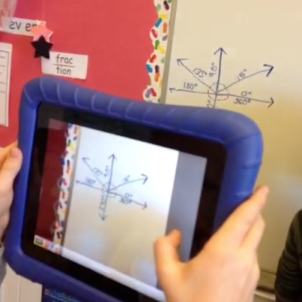
For the project, students were given a list of different math objectives for the unit and asked to become “experts” in a certain area.  Students were given an opportunity to pick a particular topic and asked to create an instructional presentation on that particular objective.  The project was definitely open to interpretation, so I offered a rubric to clarify expectations. Students were expected to create an essential question, brainstorm, collaborate with others, use the peer-review process, and present their projects to the class.

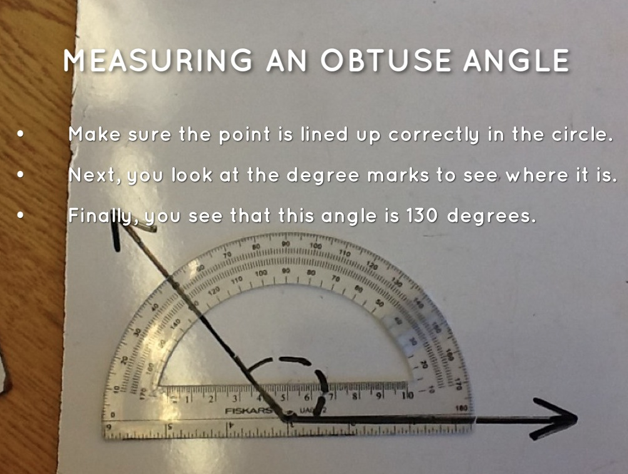
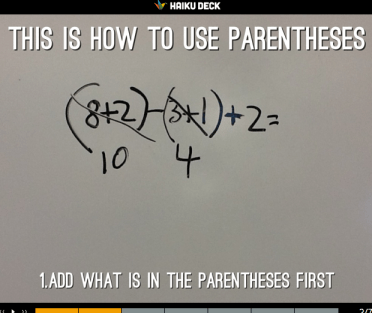
Once the students receive the rubric they begin collecting classroom pictures to import into their presentation.  Students often gravitate towards taking pictures of different math manipulatives that match their presentation topic.  Whiteboards and dry erase markers are also used during this process. The pictures are then imported into the presentations and text is added.
Using HaikuDeck
Using HaikuDeck

Slides are formatted accordingly and a peer edit session ensues before students turn in their projects to Showbie.  Afterwards, students complete a reflection sheet that documents their  journey during the learning process.  This Haiku creation process took my class around two hours to complete over a two-week time period.  Feel free to click here or here to see some sample presentations.  You’ll find a few example screen shots below.
Using Parentheses

Screen Shot 2013-10-27 at 10.54.42 AM

Student content creators is a blog post series.  Click on the links that follow to find additional posts related to how EducreationsInstacollageHaiku Deck, Playback and Prezi can be used in the classroom.

Visual Patterns

#mtbos post three
Patterns and Algebra

My third #MTBoS post is about the visual pattern resource, visualpatterns.org.  Generally, patterns (numerical and object-based) are some of the first concepts taught to introduce algebra and number characteristics.   Initially, patterns may seem simple, but they often allow opportunities to enrich and extend instruction into more challenging concepts

My third grade class has been studying patterns and rules during the past two weeks.  One of the activities that we used can be found here.   We’re using math tasks to uncover different type of numerical patterns.   I’ve had the opportunity to visit this site multiple times during the algebra unit.  One of my classes tackled the problem below last week.

Visual Patterns

The students loved that this problem was created by a sixth grade student.  I think this added to their motivation and bonus! … also had them thinking of how they could create their own problems.  The students were given whiteboards and worked with a partner to find the fourth pattern. During that time I asked questions that helped guide the students towards a solution.  With enough time, most groups were able to find a solution.  The class then had a discussion on how the solution was derived.  Then came the fun part …  the partners decided to answer “How many lego pieces are in step 43”?  Student groups then presented their answers to the class.

At some point I’d like to have my students create and submit their own patterns to visualpatterns.org.

Geometry Explorations

Compass
Geometry Explorations               #mtbos post two

My fourth grade class is now studying geometry.  Geometry at the elementary level allows opportunities for students to get out of their seats and learn while using their compass and protractor.  Last week my students dusted off their protractor and compass in preparation for the geometry unit.  Throughout the years I’ve added different geometry explorations to this unit.  Some of the activities in this post have been modified from the curriculum and others I’ve created or borrowed from some amazing teachers.  I’m going to highlight four specific geometry explorations that I find valuable.


1.

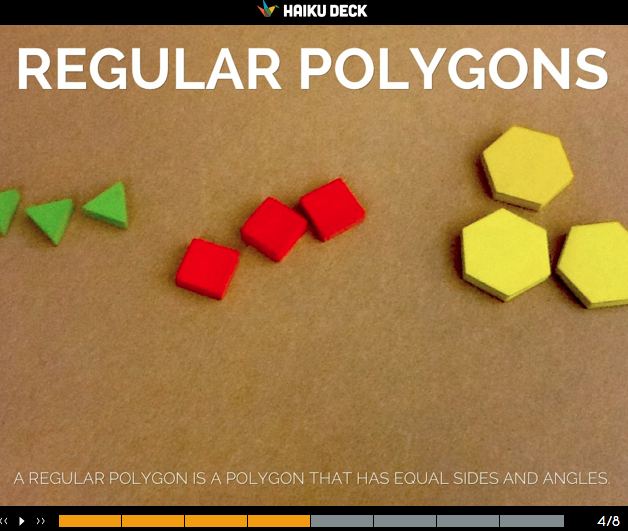
Students are given different types of polygons and asked to find interior angle measurements.   I tend to group the students and have them work collaboratively to find a solution.  Students can use any method to find a solution.  I find that some groups use a protractor, while others find the measurement of the triangle and use it to find the interior angles of other regular polygons. Near the end of the session the class creates an anchor chart that shows similarities/differences between the polygon shapes and their sum of measures.

Polygons

Polygon Angles

2.

I pass out a notecard/piece of paper to each student.  Students are asked to make an arc on each corner of the sheet.  The arcs don’t have to be the same size.  The arcs are cut out and put together to form a circle.  Essentially, students use a rectangle and turn the rectangle into a circle and both have the same interior angle measurements. Students are then asked what conclusions can be made by completing this activity.

Circle

3.

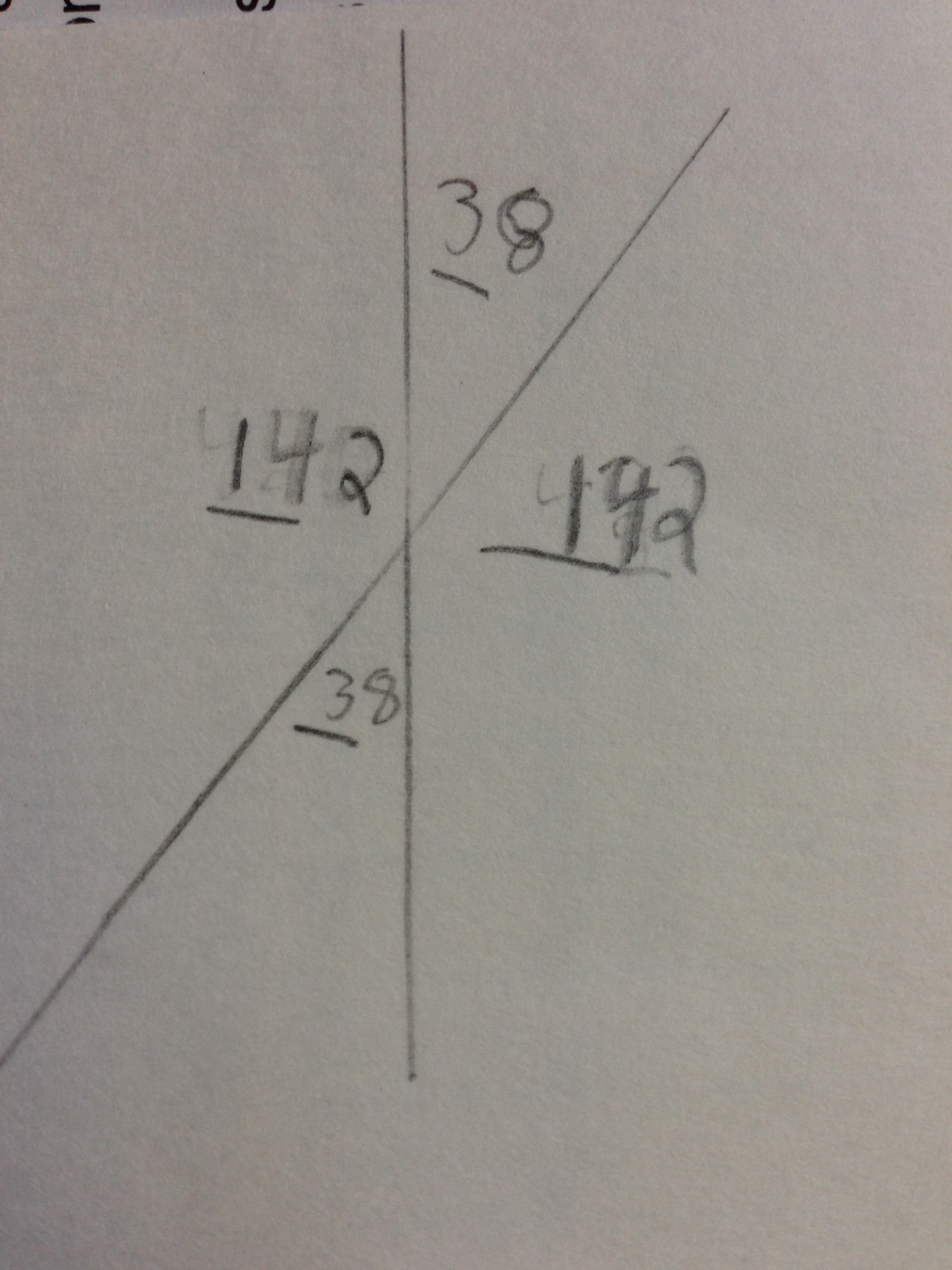
I generally use this activity before teaching about adjacent and vertical angles.  Students are asked to draw and label two intersecting lines.  This should be review, but most students haven’t been using angles in math class for about eight months.  Once the angles have been created, students measure each angle.  Students are then asked what they notice about the measures of the angles?  Do they notice any similarities?  This is a great opportunity to fill out an anchor chart indicating what angles are close in measurement.

IMG_2352

4.

After all the above activities take place I give students a quick formative assessment.  It looks like this:

Finding Angle Z

Students are asked to find and explain the reasoning for the measurement of angle Z.

Overall, these exploration activities allow opportunities for students to engage in math in unique ways.  Math manipulative and explorations often open doors that ignite interest in many students.

The Math Struggle

I’ve been using different math prompts for the past few years.  I usually introduce the prompts and give students time to work in a group to find a solution.  Students often work together, struggle, and eventually come to a solution.  It’s expected for students to document their journey in solving the problem in the prompt.  Last week I gave this prompt to one of my upper elementary classes:

math task

When I first introduced the problem the students had a million questions.  The questions were mostly related to what operations to use and hoping that I’d give away a few hints.  I want the students to succeed, but I also want them to become more responsible for their own learning.  I answered the questions related to the directions, but intentionally didn’t give away any information regarding what procedures/operations to use.  The students were then divided into groups and given 20 minutes to find a solution and present the answers to the class.  The next 10 minutes or so were challenging.  Challenging may be an understatement.  The students struggled, period.  They had a tough time knowing where to start after finding how many dollars fit in a ream. The less I spoke the more the students seemed to flounder.  Students began to look at each other and within to find a solution.  After the initial 10 minutes, the groups began to click.  Students started to find that their solutions were working. The students were beginning to make progress. The students were pumped and I tried to hide my own excitement for them as some groups were still struggling.  Groups were gaining momentum and near the 20 minute mark most groups were finished or partially finished.

The students then presented their journey in problem solving and the process used to find the solution.  Each group solved the problem (or came close to solving the problem) in a different way, but all the groups learned from each other during the presentations.

Following the presentations, the class had a discussion related to the math prompt.  The groups reflected on how challenging it was to persevere through the struggle of not knowing how to solve a problem.  I’m glad that the students were able to experience the struggle.  Moreover,  I’m glad that some of the students were able to use math problem solving strategies and look within and to each other to persist.

Exploring Number Rules

Number Rules and Perimeter

This week I introduced function machines to one of my primary classes. The activity yesterday revolved around the concept of number patterns and perimeter.  Student groups were given a pile of square geometry blocks.  The groups were asked to find the perimeter of one square. The perimeter was quickly found, which ended up being four inches.  Students then found the perimeter of two squares connected.

measurement

and then three squares …

Measuring

Students started to recognize a pattern as they filled out their in/out table.

in/out table

Students were then asked to explain a rule for finding the perimeter of the square shapes. Many of the student groups attempted to find a rule, but found a single digit addition or multiplication rule that didn’t work for all the numbers. The groups started to struggle in an attempt to find the rule.  One group finally came up with a rule indicating (in x 2 )+ 1 = out.  Students were excited that they were on the right track.  After a few minutes another group came up with a different answer (in + 1) x 2 = out.  A couple of the groups asked how can there be more than one rule?  This allowed an opportunity to have a conversation about equivalent rules.

After students found the rule(s), they were asked to find the perimeter of 423 blocks.  I told the student groups that I didn’t have 423 blocks, so they will need to use a rule to figure this out. Students began to understand the usefulness of math rules.  Even more, I was glad that they were able to explore the advantages of having math rules on their own.