A Building Thinking Classrooms Journey: Teaching Students to Self-Monitor

Every school year feels like a new draft of a similar successful experiment. Four years into using Building Thinking Classrooms (BTC) strategies and I’m realizing that the best lessons aren’t just about math tasks, but about the habits, trust, and structure that make math thinking visible.

I started my BTC journey small: cutting shower panels purchased at Home Depot into makeshift whiteboards. Today, three of my four classroom walls are covered in the real thing and Expo markers are used daily. You could say I’ve gone all-in on getting students out of their seats and into mathematical conversations. It’s been one of the most worthwhile shifts in my teaching career. As with any change, I’ve hit plenty of bumps along the way. Here are a few lessons from trial and error:

  • Vague directions lead to vague outcomes. Students need clarity to stay focused.
  • Skipping norm reinforcement means classroom culture can unravel fast.
  • Rigid time limits create stress instead of structure. Not every group works at the same pace.

When I forget these lessons, the classroom energy dips. But when the structure is clear and flexible, students take ownership. Through practice and reflection, I’ve found a few constants that make BTC thrive:

  • Randomize groups every time. Students grow by learning with everyone, not just their usual partners.
  • Set clear expectations up front. Outline what happens during BTC time — how to collaborate, communicate, and close.
  • Stay visible and present. Circulating, asking questions, and listening makes thinking public and valued.

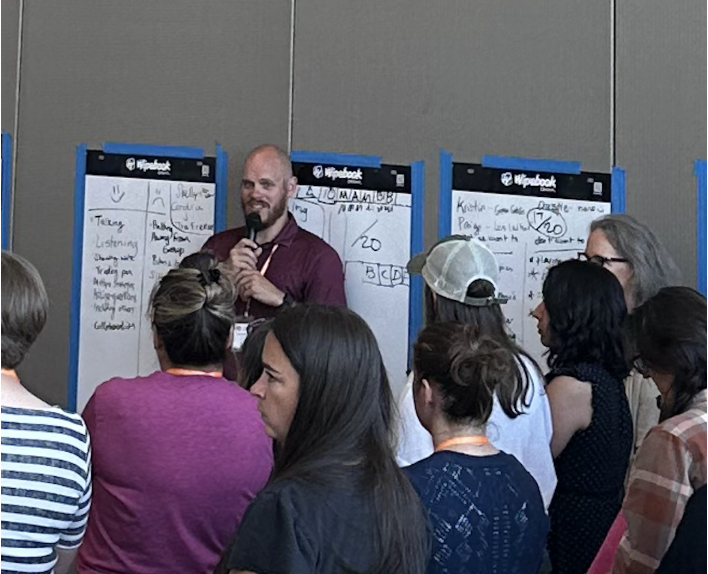
This year, I wanted to go a step further: to help students self-monitor their behavior and advocate for themselves while working at the boards. That goal took shape after attending the BTC Conference in Seattle this summer. One standout session, led by Idaho math teacher Nicholas Stevener explored how students can grade and norm themselves at the whiteboards.

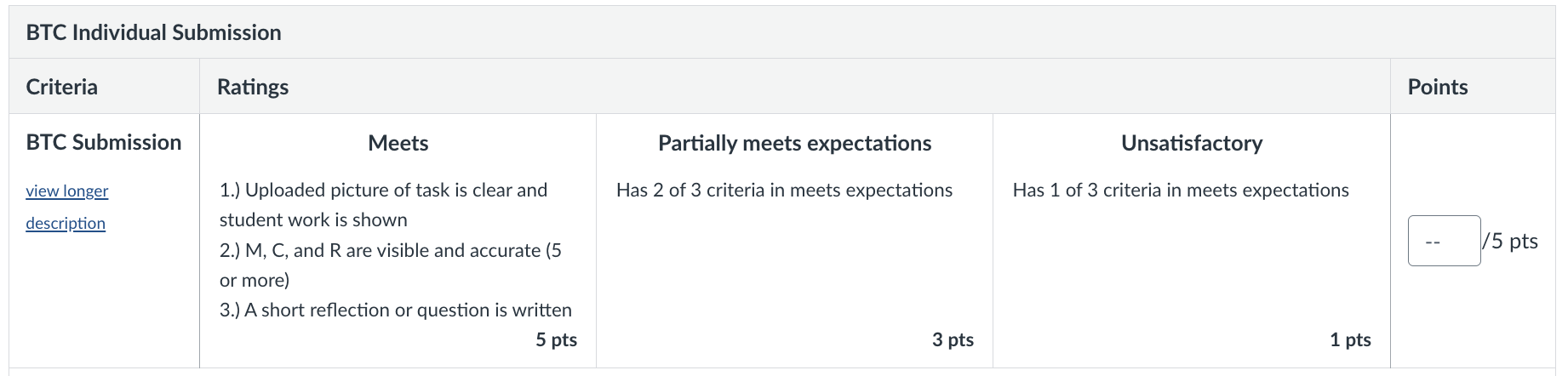
His simple coding system for reflection sparked an idea I wanted to bring home. After some non-curricular tasks to ease students into BTC routines, my sixth graders and I co-created classroom norms. Then, I introduced a self-monitoring tool called the MRC system:

  1. At the start of whiteboard time, students draw a line across the top of their board.
  2. As they work, they add letters that describe their behavior:
    • M for Marker — Are we sharing the marker?
    • R for Respect — Are we speaking and listening respectfully?
    • C for Collaboration — Are we working closely together?

Originally, I used “K” for kindness, but “Respect” offered a broader more reflective lens. As students work, I circulate and add letters too. If a group is showing strong teamwork, I’ll add a “C” If I notice they’ve drifted off track, I draw a small line and place a letter to the left — a quiet cue to refocus. It’s not designed to be punitive. It’s communication without interruption.

So far students see how their behavior evolves in real time. When whiteboard time ends, they snap a photo and submit it through Apple Classroom or Canvas. Their board becomes both a math artifact and a reflection tool.

The MRC system is still new, but it’s already doing what I hoped with helping students build awareness and action. BTC has always been about engagement, but this layer adds reflection and accountability too. I plan to refine the rubric over time, but I’m already seeing the difference: students are more thoughtful about how they learn, not just what they learn.

Teaching with BTC continues to remind me that structure and autonomy don’t have to compete. They can complement each other. When students understand what it means to contribute, respect, and collaborate, the math takes care of itself.


Written by Matt Coaty, a 6th grade math teacher in Illinois exploring ways to make student thinking visible through Building Thinking Classrooms.

Scenery, Stories, and Strategies: BTC 2025 Reflections

Last week at this time, I was in Renton, WA attending the Building Thinking Classrooms (BTC) conference and enjoying the scenic Pacific Northwest as a backdrop. I was fortunate to attend with colleagues from my district and the conversation in sessions and over lunch sparked ideas about how to take what we’ve learned back to the classroom.

After using BTC strategies for the past few years, I was especially drawn to sessions that focused on how to organize the boards for efficient time use and studentc-centered management of learning behaviors throughout the BTC process. Below are a few of many takeaways from the event.

Brian Durocher shared an idea that stood out—using student or family submitted photos over the summer as math prompts. Students analyze these personal images for mathematical concepts, either individually or in groups. It’s a powerful way to build routines, connect learning to students’ lives, and set expectations early on.

Modeling beforehand with a sample image

Jared Sliger offered insight into what strong and weak BTC task launches look like. His example involved thin slicing systems of equations across whiteboard quadrants, progressively revealing answers to promote deeper thinking. He also emphasized storytelling as a key component of effective launches.

Questions to consider before pick the task

Another theme that emerged was about setting clear expectations. Chase Orton and Aleda Klassen led a session on rubrics and first-day BTC tasks where students role-play through an activity to co-create class norms. I’m seriously considering adapting this for my first day in August.

Co-creating a BTC norms list

Nicholas Stevener’s session on grading board work gave me a lot to think about. His system allows students to earn participation points based on group behaviors—sharing the marker, working in triangles, etc.—with opportunities for teachers to adjust scores based on observation. It’s a structured way to encourage self-advocacy and accountability, though I’m still considering the logistics of implementing it.

Encouraging students to self-monitor

Now comes the challenge of deciding what’s realistic to bring back and what’s truly worth the time. With limited hours in the school day, I want to be purposeful in choosing tools and strategies that support stronger norms, meaningful tasks, and greater student ownership. It was more than nice to learn in a scenic location, be in the presence of passionate educators, and bounce ideas off of colleagues. Now comes the application phase – let’s get to work.

5 Game-Changing Takeaways from My Journey with Building Thinking Classrooms


If there’s one thing I’ve learned in two years of implementing Building Thinking Classrooms with middle schoolers, it’s this—middle schoolers are quirky. They will find loopholes in everything. Give them whiteboards? They’ll doodle memes before and after solving problems. Randomized groups? Cue the dramatic groans and a few eye rolls. My stragies of dealing with these perceived loopholes have changed over time. Through trial and error, I’ve been able to refine BTC strategies into something that works. Along the way, I’ve seen lightbulb moments, genuine engagement, and even students voluntarily doing math without cues. Students now look forward to working at the boards and I even get asked about it if we haven’t been at the boards for a while. Here are five key takeaways that have made my classroom a more productive and thinking-filled space.

1.) Enhanced Student Engagement through Whiteboard Tasks

Vertical whiteboards have been a game-changer—seriously, they should be a required supply list item in the math classroom. The simple act of standing while working transforms the classroom collaboration. Students work in groups, bouncing ideas off each other, arguing over strategies (mathematically -most of the time), and actually discussing math rather than just passively completing problems. The best part? The whiteboards are a built-in accountability tool. When their thinking is out in the open, students stay on task more and there’s visible accountability And if not? Well, nothing humbles a student like having their TikTok-inspired doodle publicly erased by their teacher. I attempt to hide my joy while admiring and then erasing the doodles.

2.) Effective Use of Randomized Groupings

If you ever want to see middle schoolers experience an existential crisis, tell them they can’t pick their partners. Randomizing groups—whether through playing cards (my favorite), number draws, or via digital means is one of the best ways to break up cliques and get students working with different classmates. It forces them to develop social and communication skills, while also leveling the playing field. Over time students adjust, and the initial “But I don’t know them!” protests turn into actual collaboration. Plus, I like to remind them: in the real world, you don’t always get to pick your coworkers—so welcome to adulthood, kids!

3.) Establishment of Clear Norms and Expectations

Ah, expectations—the thing that keeps a thinking classroom from descending into pure chaos. The biggest lesson I’ve learned? If you don’t set norms with students, they’ll set their own (and trust me, you don’t want those). I saw this in my early days of using vertical whiteboards. Taking time at the start to co-create norms has paid off tremendously. Students take ownership of their roles by referencing a rubric, hold each other accountable, and begin reminding each other of the expectations. It’s a beautiful moment when you hear a student say, “Hey, we’re supposed to be discussing strategies, not ranking our favorite chips.” (Although, in fairness, that’s also an important discussion.)

4.) Reflective Practices to Assess Group Effectiveness

We’ve all had those group work moments where one student does everything while the others mysteriously “supervise.” To combat this, I’ve made reflection a consistent part of our process. Students evaluate their group’s effectiveness using rubrics and self-assessments, which forces them to admit that “staring at the ceiling or watching birds out the window” was not, in fact, a meaningful contribution. More importantly, it makes them think about how they work together—what went well, what didn’t and what adjustments they need to make. This reflection has been key to improving not just their math skills, but their ability to collaborate in a way that’s meaningful to their math learning.

5.) Transition from Mimicry to Genuine Understanding

Middle schoolers are absolute pros at mimicking steps without actually understanding them. Many of them have learned how to play school. I’ve seen students confidently apply a formula they copied from the whiteboard—completely unaware of why it works. Math teachers feel the vibes here. So, I’ve shifted the focus from “Just follow these steps” to “Figure out why this makes sense” and communicate it to the class. Through open-ended problems, discussions, and strategies that push thinking, students start asking why (especially if the task asks students to summarize their reasoning) instead of just asking for the answer. It starts with finding or creating high-quality tasks. It’s not always easy—sometimes they resist, wanting the quick fix or try to rely on one person in the group that may know the answer. But when a student finally connects the dots and excitedly explains a concept in their own words? That’s the good stuff.

Final Thoughts

These five takeaways have made me a more reflective teacher. Let’s be honest, the best teaching strategies require constant tweaking. Some days things run smoothly and I feel like a Building Thinking Classroom wizard. Other days, I wonder if I should just become a professional whiteboard cleaner. But that’s the beauty of Building Thinking Classrooms—it’s an ongoing process, not a one-size-fits-all solution. I’m still learning and will continue to do so by digging deeper into Peter’s book and visiting conferences. One thing’s for sure—my students are thinking more, collaborating more, and even their math journey. And that is making a difference.


A new school year

We’re back! Students returned to school this past Thursday. The sixth graders entered with a mix of anxiety and excitement. The first few days of school are usually dedicated to building routines and fostering community and this year was no different, although I did change up a few things compared to previous years.

Day 1

This year students entered the classroom and picked their own seats. We have new classroom furniture, so the students were excited to choose something different from last year. I collected school supplies from the students and made introductions. The class then headed out to the hallway along with the other sixth graders so students could practice their locker combinations and organize supplies. Once we returned to the classroom we started our name tent activity. I’ve used for many years as a way to get to know students and build a positive rapport first thing. The prompt for the first day focused on events that happened over the summer 2024. After about 15 minutes we moved on to creating classroom norms. Our standard norms are: be alert, be kind, and be respectful. These are schoolwide expectations. By the time we finished discussing norms the bell rang and students headed to their second period.

Day 2

Students began the day by completing the second day of name tents with a prompt related to a hidden talent they have. We reviewed the norms we discussed yesterday and showcased a examples. Then we had a discussion about whiteboard work and Building Thinking Classrooms (BTC) activities. Students were randomly placed in groups using playing cards and began their first BTC task of the year: “In how many ways can 105 be expressed as the sum of at least two consecutive positive numbers?” I unpacked the vocabulary and students worked on this task for about 15 minutes. It was a non-curricular task for our first BTC and students had to demonstrate math stamina as they found two, three, and even four numbers that summed to 105. After completing the whiteboard task we came back together for consolidation. Students took pictures of their whiteboard work and saved the files in Notability. They then filled out a reflection task and afterwards we reviewed the norms again. The bell rang and the students left. The class will start unit 1 next week.

I’m looking forward to the new year ahead but certainly glad to have the weekend to recharge.

Moving from Mimicry to Meaningful Learning

Ever been in a classroom that feels more like a sleep-inducing seminar? I can see you raising your hand. You know the scene: students zoning out, fidgeting like they’re auditioning for a tap dance, begging for bathroom breaks like they’re fleeing a sinking ship. As both a former student and now a teacher, I’ve danced this engagement tango more times than I care to count.

But here’s the kicker that’s evident this year: engagement isn’t a one-size-fits-all deal, especially in the wild world of math classrooms. Elementary? It’s about those manipulatives and building conceptual understanding. Middle school? Cue the shorter classes and the panicked rush to cover everything before the state tests roll in. And as for high school? Well, that’s a beast I’ve yet to wrestle with, but who knows, it might be in my cards someday.

Enter the game-changer: whiteboards and math chitchat, courtesy of Peter and his Building Thinking Classroom book. Since August, my 6th grade team and I have been riding this engagement wave. And you know what? It’s working. Students are gabbing, reasoning, and proudly displaying their work like they’re auctioning off masterpieces. Math class has become more of a lively arena of self-advocacy and problem-solving prowess.

Sure, it’s not all rainbows. We’ve had our fair share of hits and misses. We’re a math team, wielding OUR, Desmos, and BTC as our trusty resources. Some tasks hit the mark, turning mundane math into whiteboard wizardry. Others? Well, let’s just say we’ve had a few duds.

But here’s the rub: engagement doesn’t always translate to learning. Case in point: my recent tests were a wake-up call. The kids were jazzed (as jazzed as they can be about multiplying decimals), but did they really grasp the concepts? I remember many lessons as a kid that I thought were amazing, but I have no ideas what was learned in the process. That’s where the consolidation struggle begins and hasn’t quite ended. Picture this: students work in whiteboard groups, snap a pic of their whiteboards, we chat briefly as a class, and then… crickets. I’ve got a handful of students keeping the convo alive, but the rest? MIA.

So, what’s the plan? I’m brewing up some ideas: group summaries, solo reflections, you name it. And those “notes to my future forgetful self” that I’ve been using? They’re due for a makeover—less procedural, less mimicky and more self-advocacy pep talk.

But hey, despite the hiccups, BTC has bene great this year. I’ve even put in a request for more whiteboards next year. Here’s to another year of math magic, with a few tweaks along the way.

First Education Math Summit with Peter Liljedahl

This past Thursday I attended the First Education Math Summit.  Peter Liljedahl was the keynote speaker and this post is designed to synthesize what I heard and take positive steps moving forward as I continue to implement BTC strategies in the classroom. As a middle school math teacher, I’ve embarked on a journey this school year to enhance critical thinking among my students. The insights I’ve gained from implementing Breakout (BTC) strategies have been interest to reflect on and I feel like have helped my practice. Takeways from the keynote are below.

The Link Between Thinking and Learning

Peter visited 40+ classrooms and noticed that the majority of students weren’t actively engaged in thinking during math lessons. This lack of engagement posed a significant barrier to effective learning. It became clear that fostering active thinking was essential for student success.

Identifying Non-Thinking Behaviors

Students often exhibited non-thinking behaviors, such as slacking, stalling, and mimicking. Mimicking, in particular was prevalent but ineffective for long-term growth. It became evident that tasks needed to be designed to encourage genuine cognitive engagement and discourage passive mimicry. This takes a change in practice as students are used to mimicking and communities look for study guides that mimic actual tests.  

Task Design for Access and Equity

To address these challenges, Peter mentioned to look for tasks with a “low floor, high ceiling” characteristic. These tasks are accessible to all students yet offer challenges for deeper understanding. Equity is often a primary goal, ensuring every student had access to meaningful learning opportunities regardless of their background or ability level.  While resources abound, they’re often underutilized or misapplied. Tasks needed to be novel and engaging to capture students’ interest and promote active thinking. Whiteboard tasks should give students opportunities to grapple with the math as an answer or specific process to solve hasn’t been given.

Strategies for Active Engagement

Peter noticed that Implementing BTC groups was a game-changer in promoting active engagement. By taking control away from teachers and making groups visibly random, most students felt included. Optimal group size was key, with groups of three proving to be most effective. Utilizing a visibily random process helped address issues of fairness and micro-bullying during group formation. That being said, I still frusturation on the faces of students when they find out they have been paired with someone outside of their peer group. I’ve gone the route of using playing cards, although the issues of students switching cards has been a problem during the last couple months.  

Challenges and Continued Growth

However, it’s important to note that negative student behaviors have impacted BTC groups. Addressing these behaviors has been an ongoing process throughout the year. By providing clear expectations and fostering a positive classroom culture, we’ve been able to mitigate some of challenges and create a more conducive learning environment.


My journey with BTC this school year has been rewarding with many ups and downs along the way.  Fortunately, I’ve had a great math team that has supported my efforts.  I’ve seen a noticeable improvement in my students’ mathematical communication skills and confidence compared to past years. This has been a journey and I look forward to seeing how it pans out for the last few months of the school year.

Still Building a Thinking Classroom

In the current school year, my team and I embarked on the journey of implementing Building Thinking Classroom (BTC) tasks. Our initial experiences were documented in a previous blog post. Since August, we have continued to employ strategies from the BTC framework, discovering valuable classroom practices while refining others through trial-and-error. This post provides a brief overview of our key practices.

Whiteboard Tasks:

Whiteboard BTC tasks, aligned with district-adopted resources, are assigned 2-3 times weekly. These tasks, sourced or created by team members (often put in a Google planning document), employ a playing cards method. Students are assigneda number corresponding to a specific whiteboard number. Students collaborate on the task for 10-15 minutes, utilizing a shared marker for each board.

Consolidation:

Upon completion (or work) of the whiteboard tasks, the class engages in two consolidation methods. Firstly, I guide the class to different boards, emphasizing diverse strategies. The class follows to the different boards during this time. Alternatively, students return to their desks for a seated discussion of the strategies on the boards. While both methods have shown promise, the latter has proven more effective due to increased student focus.

Pictures:

Following consolidation, students photograph their whiteboards, uploading the images to a Notability document. Adding captions to their pictures, students later submit them as assignments, fostering accountability and aiding in organizing their whiteboard tasks.

Checking Your Understanding:

Every 3-5 lessons, I administer assignments associated with a lesson group. This lessons are periodically worked on throughout the unit. On the due date, students review their work, compare it to a provided key, and make corrections using symbols like C, PC, or NY.

Notes to My Future Forgetful Self:

Aligned with the Checking Your Understanding assignments, Notes to My Future Forgetful Self tasks are completed independently by students. Submitted on Canvas, these notes and empahsis on vocabulary serve to review specific lesson sequences. Students sometimes include a picture of a BTC whiteboard task, providing insights in the form of captions.


Throughout the past months, our team has gained valuable insights into implementing BTC strategies. We have established a working routine and anticipate further integration of Peter’s ideas as the academic year progresses.

Reflecting on Building Thinking Classroom Routines

My middle school students have been in class for about two weeks. The first few days were spent creating a classroom community, completing name tents, and building norms related to expectations at the whiteboards. Over the two weeks students have worked on whiteboard around seven times. The first week it was all non-curriculular tasks and during the second the team shifted towards curricular-specific tasks – we are exploring area. The focus this year has been to start the year emphasizing strategies out of the Building Thinking Classrooms book. I believe classes are making progress with their whiteboard work and this post will summarize what’s been happening so far.

One of the first things that my team did related to whiteboard work was to create expectations for what was to happen during tasks. After non-curricular tasks students filled out this reflection sheet in a Desmos deck.

Students rated their engagement level and filled out a rubric. I reviewed the curated data with the class to help develop the norms, although I already had some ideas in mind. One of my math department team members found the below image while visiting social media communities related to BTC,

The ideas worked well with the norms that the class picked so we went with this. I posted a copy of this above image the whiteboards for students to reference.

For the most part, I’ve been following a similar routine with whiteboard tasks. This is a general routine and it varies depending on the lesson. Students enter the room, I take attendance, review the overarching goal, I give a brief mini-lesson on the topic and use a slide deck to introduce a specific topic. If the lesson involves manipulatives then we use them in our table groups to help build a better understanding on the topic. I then pass out playing cards ( I only use Ace-10) and show the task statement on the whiteboard. Students head to the whiteboards and begin working. The tasks last around 10 – 15 minutes before I ask them to send one spy out to review the work of others. Students return back to their groups and then finish up their work on the board. Usually I consolidate as a whole class and we visit different boards to review and reflect. Students take a picture of their whiteboard and put it in their math folder along with a caption in Notability. Then students fill a digital reflection sheet.

Wins:

Students are engaged in mathematical thinking . I’ve observed students talking with one another and debating ideas before putting the marker to whiteboard. That discussion seems to help students flesh out ideas and explain their thinking clear enough for their partners to understanding. Standing at the whiteboards seems to help student stay engaged more than sitting. Groups are sharing the markers. It didn’t start this way, but having one marker per group and sticking to that rule helps ensure that there’s more collaboration in the group as the ideas are spread. I’ve also noticed that students are increasing their mathematical thinking stamina while in groups – needed as students are now in middle school and the expecations are higher. Prolonged attempts at making sense of a problem and attempting a solution while in a group is more evident as students become more familiar with the whiteboard routines. I’ve also observed that students are becoming more comfortable with sharing their ideas with others when a spy comes to visit their group. When we first started sometimes students would hide their work. The ideas of knowledge mobility is becoming more common place and that’s a win.

Questions:

I still have questions though. Not everyone is on task and I still find some students distance themselves away from the group and allow others to do the heavy lifting. I noticed that some groups are waiting to complete all of their work untill a spy is sent out to retrieve hints or an answer. This has me questioning how often I send out the spy directions. I’m also still having issues with giving too many hints or asking students specifically direct questions to help move them in the right direction. Students are used to a different atmosphere in the math classroom so this is an adjustment. I’m aso working on becoming better during the consolidation process – especialliy when it comes to getting everyone back together and engaging in synthesis at the end of the whiteboard process. One last thing. My classes haven’t been assessed yet on the skills we’ve been addressing so I wonder how they’ll perform? My hope is that they’ll take what we’ve been learning and apply it thoroughly on the common assessment.

I’m looking forward to refining my own practice as the year continues. Feel free to ask questions or add your own experiences to this post. We’re all in this together!

Building Thinking Classrooms Conference

About a week ago, I had the opportunity to attend the Building Thinking Classrooms event in Indiana. The event spanned over two days and focused on the concepts explored in Peter’s book. Overall, the conference was refreshing and provided me with the chance to connect with fellow educators at my school. It had been a while since I last attended an in-person conference, so going with my colleagues was a refreshing experience. I believe that having this shared experience will prove beneficial as we embark on the new school year in approximately a month. I’ve had some time to process and re-read some of the book over the past week. I’m rejuvenating this blog and organizing my thoughts to translate them into actionable strategies when school resumes. Most of the ideas presented below are derived from the first few chapters of Peter’s book.

Defronting the Classroom

I have made significant changes to my classroom setup and design over the past few years. Instead of arranging students in rows, they now sit in groups, fostering greater collaboration. This shift has been particularly valuable since my district started implementing IM, which places emphasis on partner/group math discussions. I aim to maintain the group or pod structure but plan to alter the desk orientation so that the front of the classroom isn’t immediately apparent from the desk arrangement. I will position my desk near one of the middle sides of the classroom.

Visibly Random Groups

I also intend to continue utilizing random groups. In the past, I employed a digital method but I am now considering using playing cards as a means of determining the groups. Using actual playing cards will clearly indicate to students that the groups are genuinely random. By having predetermined groups, I hope to encourage students to collaborate and alleviate the cognitive burden of searching for a partner, considering the significant social aspect involved at the middle school level. Groups of three students tend to work well for middle school so that will be my plan for next year.

Vertical Whiteboards

In my previous classroom, I had several whiteboards that covered the perimeter. These whiteboards were fashioned by cutting two shower boards from Home Depot in half. While they have served me well over the years, I haven’t consistently utilized them. I aim to establish a few protocols before students use the whiteboards in the fall. My plan is to allocate one marker per group and co-create norms for using the whiteboard stations. These norms should encompass sharing knowledge by engaging students in gallery walks or sending someone to observe other boards. I need to remind students to show all their work and implement a system where they don’t erase (instead, they put a box around it and draw a single line through it) to encourage risk-taking and emphasize the process.

Observation Rubrics

I will involve students in co-creating norms within their groups which will eventually evolve into observation rubrics. I want students to evaluate the effectiveness of their groups. Although I’m unsure of the specific medium at this point, I am inclined towards a digital format that students can complete at designated intervals.


As I prepare to switch grade levels in the fall, I am excited about implementing the strategies mentioned above. The Building Thinking Classrooms event and Peter’s book have provided me with valuable insights and ideas that I’m eager to put into action. I look forward to this new adventure and the opportunities it presents for growth and learning in the upcoming school year.

Rounding Numbers

Over the past few years, my approach to teaching rounding has followed a similar path. The choice of methodology was often influenced by the adopted textbook within a school district. I would generally guide students to place numbers on a number line and determine their proximity to the nearest value. The class would focused on rounding to the nearest tens, gradually progressing to hundreds and eventually expanding to larger place values.

We would introduce a rule that involved underlining the digit to the right of the one being rounded. The rule states that if the underlined digit is “5 or more, round up; if it’s 4 or less, keep it the same.” I believe this has even been turned into a song at some point. This linear progression served as the foundation for teaching rounding at the early elementary level. 

This year brought about a change in our district as elementary teachers adopted a new resource. The emphasis shifted to exploring the value of numbers even before delving into the concept of rounding. Students were tasked with identifying the value of specific digits and ordering them, whether from greatest to least or vice versa. We incorporated the use of base-ten blocks and relied on expanded form extensively to help students develop a deeper understanding of number formation and the impact of place value on value itself. Students became more familiar with the value associated with each digit within a four or more digit number.

Students began identifying the closest multiple of a given number. For instance, they would determine the nearest multiple of 10,000 for a number like 432,000. This transition was seamless because students had already explored multiples and factors earlier in the year. Understanding how multiples relate to rounding was a novel approach and it resonated well with the students. Now, when asked to round to a specific digit, students consider the nearest multiple, which seems to make more sense to them. I am excited to continue using a similar rounding teaching strategy moving forward.