Math and Tourist Destinations

 Image by: Janoon028


Over the past few weeks I’ve been researching math activities that integrate multiple disciplines.  After visiting a number of sites on Twitter, I found an interactive Google Map.  This activity took students to a Google Maps page that gave information about various landmarks around the world.  Not only was there a social studies connection, but the majority of student work dealt with higher level math. There were links by the questions that gave students opportunities to learn more about the landmark.  Logistically, I decided to group the students in 2 or 3 and gave one iPad/laptop to each group.  The technology was needed to visit the site and find the information.
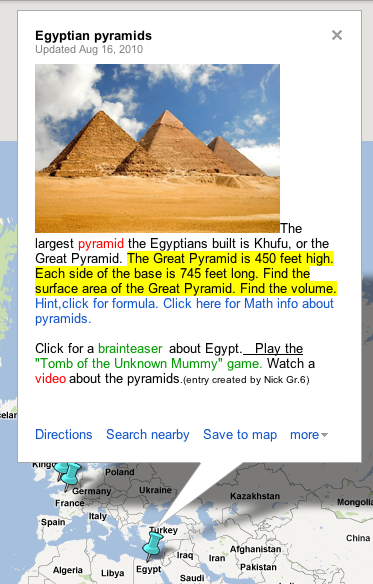
Some of the questions were quite challenging for my students.  I overheard one student saying that since they are already on the Internet they could  look up the formula.  They asked me and I told them that was fine.  Part of this activity is exploration and finding the information for application on your own.  
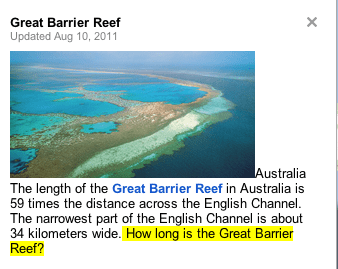
This activity is somewhat like a Webquest, but a bit more guided.  Students were asked to complete all of the problems on the site.  There was an actual answer guide near the end of the page that some students found.  I reviewed the process and answers with the students after approximately 45 minutes.  The class then completed a plus/delta chart on the activity.  Overwhelmingly, the comments were positive.  I will keep this in mind as I begin planning for next school year.  Some of the pictures from this activity are below

This slideshow requires JavaScript.

Utilizing Student Survey Results

 Image by: S. Miles


I’m currently preparing for next school year.   Part of my preparation includes the creation of a student survey.  After reading a post from @TerryFErickson I decided to create a survey (similar to this) for my current students.

I’m planning on using the survey data to make changes for next school year.   I’ve always valued student feedback via plus/delta charts, but this survey is intended to be utilized for next school year.   In order to best meet the needs of my students next year, I wanted to give my current students an opportunity to express their opinions regarding motivation.  I believe that motivation is often affected by the classroom climate.  The process I used for this survey activity is below.

1.)  Students complete the survey.  Here is the beginning of the survey:

2.)  After students complete the survey, I complied the results and displayed the data from different classes. (Click to enlarge)

3.) The class reviewed the data.

Based on this survey, the top three things that motivate my students are:

  • The teacher shows she/he cares about you and the other students in the class
  • The teacher shows that she/he really loves to teach and learn
  • The teacher uses technology when teaching

This activity took two class sessions to complete.  After a rich classroom discussion about the data, students concluded that the main factor that helps motivate them to learn is the teacher.

Why is it so loud in your classroom?

                            Image by: Isolated


When I first started student teaching I was instructed by my colleagues that a quiet classroom is the best way to maintain control.  As a student teacher, wanting to graduate, I smiled and agreed with my colleagues.  Maintaining the authority position in my upper elementary classroom was one of my first priorities.  I believed at the time that my leadership (according to my cooperating teacher) was the only thing that contributed to learning in the classroom.  I focused on classroom management and thought that the learning would take care of itself. That sounds horrible now, as I reflect on my student teaching experience.  It didn’t take me long to figure out that this method was completely wrong.  During my true first year of teaching I became more confident in my teaching ability and allowed students more flexibility in the learning process. Allowing students an opportunity to be part of the learning process enabled them to vocalize their opinions and increased their learning.  Respect is earned and modeled through example, not necessarily through words. This seems true no matter where you work, but it’s completely evident in a classroom full of students.

During my first few years of teaching I incorporated a flow chart and set the expectations in my classroom at the beginning of the school year.  I even had the students help create the rules.   As my years of teaching experience increased, the volume of my classroom did as well.  At times, I would be asked to close my classroom door because there was so much talking (I thought collaboration) going on in the classroom.  I didn’t mind because my students were learning at high levels through collaboration.  I remember a teacher (one of the colleagues in the first paragraph) asking me why my room was so noisy.  At the time I just simply responded by saying that all “that noise” was contributing to learning.

Unfortunately, I don’t think my answer 10 years ago was clear.  I’d like to to clarify my answer below.


Question:  Why is your classroom so loud?

  • Collaboration:  Students are often found in partners or small groups, discussing math problems or working in literature circles.   Often, there are between 10 – 13 conversations occurring during these times.
  • Manipulatives:  Students are putting together 3-D models, cutting out geometric shapes, using Tangrams, utilizing base 10 blocks, creating space figures with nets, measuring objects, etc.
  • Technology:  Students are using iPads or computers in the learning process.  The sound of technology can be turned completely off, but I feel that sound often reinforces learning.
  • Drama/Skits:  Students are working in groups to create skits that reinforce reading and math objectives.  There are many opportunities to incorporate skits in the curriculum.
  • Connections:  Students are making connections to the text they are reading in a variety of formats.  Making connections to the outside works is an important skill and this is something that seems to happen daily.
  • Music:  Students are listening to music while they work on different activities. Students seem to enjoy the music in the background and I think it improves the overall classroom climate.
  • Games:  Students are playing math games with each other.  The noise of the dice and talking can be intense at times, but learning through games is definitely something to look into if you haven’t yet.


I think it’s also important to note that some students need their surroundings to be quiet to focus. Understanding how a student learns best should influence the learning environment. Unfortunately, the learning environment can’t always be changed, but we can do our best to modify the climate to best meet students’ needs.

Beneficial Math Homework in Elementary School

Image by: Keatti


The issue of homework has been on my radar this school year.  Depending on where you teach or how involved you are in reading the research on homework effectiveness, the topic can bring out strong opinions.  Is homework truly beneficial at the elementary level?  Is homework given because it’s what the community expects? Where does all the homework go after it’s been graded? Back to the students, to the parents, shoved in a desk, in the garbage (see the picture above) … I hope not. I’m not able to answer these questions concisely.  Since I’m a math teacher, I believe that students need practice.  Generally, (I won’t speak for all teachers) homework is a form of practice, but the homework that is usually (once again, not for all teachers) assigned deals with repeated problems associated with a concept.  The problems are rarely practical and focus on repeated forms of one or two particular concepts.  If a student has a problem with the homework, the adult at home helps, they find help on the Internet, or the student doesn’t complete the homework. Regardless, the student isn’t showing mastery or showing what they have learned.  Should homework be graded?  Many education experts believe that homework isn’t beneficial at the elementary level.  I’ve found that homework is beneficial for some, but not for all.

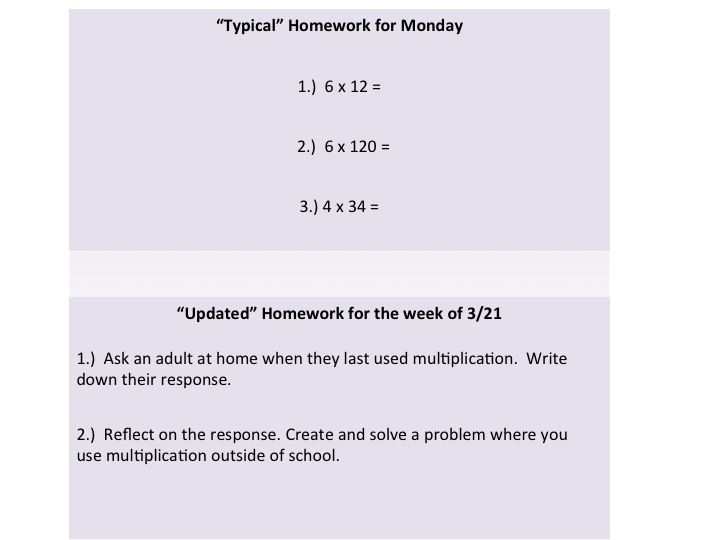
Instead of having students complete “typical” math homework every night, I’ve decided to look into an innovate approach to homework.  Instead of pages of multiple concrete math problems, the “updated” homework revolves around conversations and self-reflection.  What do I mean by this?  Here’s an example:

This is just an example, but I’m sure an educator could create multiple questions that cover an array of topics that could last for many homework sessions. Change this ideas and implement as you see fit.


So, instead of giving “typical” homework every night, the homework is assigned on a weekly basis.  The homework involves a discussion about math with an adult at home.  The discussion will be documented by the student and a self-reflection piece will be included.  Before giving this type of homework it would be a good idea to discuss this with the parents.  The idea is to connect math concepts taught in class to the practical application outside of the school. I believe that a rubric would be helpful in assessing the “updated” homework.

Math and Multiple Solutions

Image by: Krishnan


For the past few days I’ve been reviewing a math unit and have found that the lessons included have very few problems with multiple solutions.  I have nothing against one correct answer scenarios, although I feel as though students should be exposed to problems with multiple solutions.  There are cases where having one solution in math is mandatory, but there are other cases where multiple solutions are possible.  I believe the project in this blog post isn’t completely “open-ended”, although it does have multiple solutions. The concept of open-ended math is important because I believe that this idea is relevant in and outside of the classroom.  Students often seem more intrinsically motivated to complete open-ended problems, as it’s different than the norm.

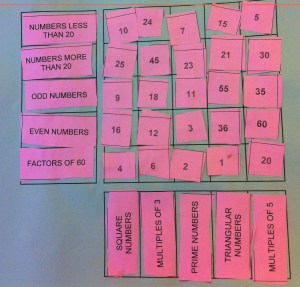
Recently, I came across a math activity designed for the upper elementary level, (although it could work at middle school) that offers multiple solutions. Since I didn’t personally create this activity, I’d like to give credit to NRICH Project for the original idea.  Multiple math concepts are found in this project.  The concepts covered in this project include a great amount of number sense concepts: factors, multiples, square numbers, even, odd, prime, composite, and triangular numbers. This assignment covers many concepts and a teacher could informally assess students in the classroom as they facilitate the learning process.

Here’s the process that I used:

1.  Download the Word documents (you can easily edit them to meet your needs).  Here is the Word file.

2.  Review the concepts of multiples, factors, square numbers, even/odd, prime/composite, and triangular numbers.

3.  Pass out the sheets to the students. (I had one of the pages a different color than the other – better for organization)

4.  Students cut out and glue the project together. (my class took approximately 30 – 40 minutes)

5.  Review the project with the students

6.  Have the students journal about their math problem solving experience.  Extension opportunities can be found here.  The reflection and assignment could be used to show growth over time and might even be useful in a student portfolio.

Here are a few possible solutions:

Additional answers may be found here.

If you use this, please let me know how this project works in your classroom.

Students That Own Their Learning

Image by:  Jscreationzs


After working on a math world problem for approximately five minutes I hear ….

“I don’t get this”

“I’m confused”

“I’m lost”

“I don’t know what to do”

I believe every educator has heard one or more of the above statements while teaching.  These statements don’t really help a student succeed in any class.  This type of student feedback is important, but the words themselves seem discouraging. When words like the above are communicated, I feel as though the classroom instruction isn’t meeting the students’ needs or students aren’t utilizing math problem solving strategies.  This post is going to focus on math problem solving strategies.

Image by:  I. Images

Teaching new math concepts often requires building on students’ background knowledge.  When students experience a challenging math problem, they generally have two options.  Students can become frustrated and quit or they can find a solution.  A discussion regarding this particular situation took place in the past after their was a major struggle with one particular math word problem.  As a class we had a brainstorming session.  The students came up with some ideas of how to overcome mathematical struggles.  We called these strategies the math tool belt.

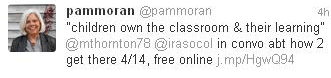
During this discussion, the students began to recognize that the teacher will not solve all of their problems.   I pointed out that giving an answer without support isn’t learning.  In fact, I pointed out that I will help, guide, and assist, but they are responsible for completing the problem.  Making mistakes and having “I don’t know” moments are part of the learning process.  Having students reflect on their learning through journal writing may also benefit the student.  I feel that students should “own” or take responsibility for their own learning as @pammoran, @mthorton78, and @irasocol indicate.

Long-term retention infrequently occurs when students are required to just regurgitate what the teacher says.  Here are some of the math problem solving strategies we decided to use when confronting a complicated math word problem:

  • Read the problem and underline important numbers or information.
  • Cross out information that isn’t needed
  • Create a visual model (chart, graph, or table)
  • Indicate what operations will be needed
  • Restate in your own words what the question is asking
  • Work backwards – keeping the end in mind
  • Write steps needed to solve the problem
  • Guess and check
  • Look for a pattern
  • Estimate and use logical reasoning to solve
  • Use manipulatives to solve (students can just grab them off the shelf and use as needed)
  • Use a formula
  • Work in collaborative groups to brainstorm what steps can be taken to solve the problem
  • Use a ratio / proportion to solve the problem
  • Ask the teacher for help
In an effort to foster resilient and responsible citizens, I ask the students what problem solving tool they used before they ask me for help.  This also reminds the students that they should be utilizing the tool immediately in the learning process.  I believe that students need to understand that their effort (not mine) leads to individual achievement.  Creating a classroom environment that encourages learning through engaging and relevant instruction is vital, but I feel as though students need to “own the classroom and their learning.”  When students are stumped or are struggling with a math problem, they need to have the tool belt readily available to power through the obstacle.  Giving opportunities to utilize the tool belt gives students positive experiences of overcoming obstacles and builds confidence. Students become owners of their learning and they find that their learning experiences are primarily controlled by how they react to the problem.  Overcoming obstacles will develop confidence so that the next time they encounter a complicated problem they will reach for the tool belt and be successful.

 Additional Resources:

Building Math Confidence in Elementary School

Image by:  DigitalArt 


 I’ve found that math confidence often starts at a young age and develops over time.  Starting on a positive note can instill in students an appreciation for math.  Encouraging students to perceive and experience math in a positive light is important.  Elementary students typically experience math through a variety of hands-on experiences/manipulatives (base-ten blocks, geometric solids, counters, etc…) and then eventually progresses to the abstract.  The more time spent using engaging manipulatives often builds confidence, enabling the students to transfer their math understanding to abstract problems.  Building a solid mathematical foundation at the elementary level can lead to an enriching and encouraging math experience in the upper grades.  If you teach a form of math at the elementary level this concept shouldn’t be unfamiliar.  Most math in the K-5 curriculum is unveiled in a specific instructional order, as federal/state benchmarks indicate.  Publishers may suggest that math is linear, although many experts in the field disagree.   I assume that most teachers agree with a concrete/manipulative (visual representation)  –>  abstract (print) type of instruction model.

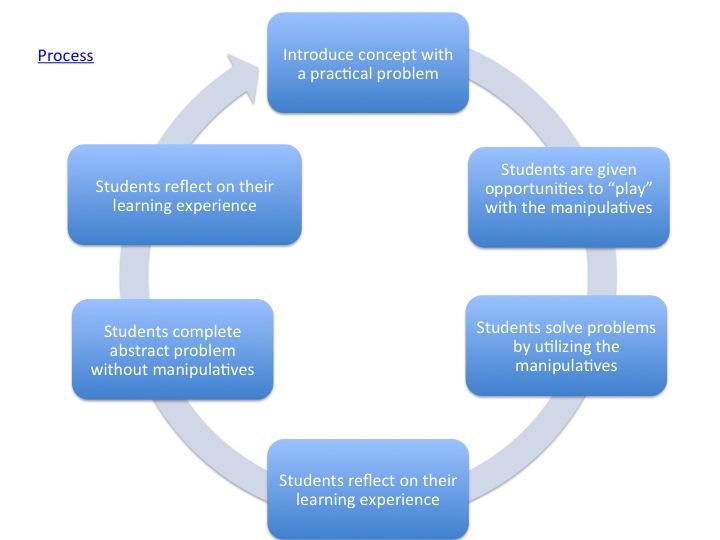
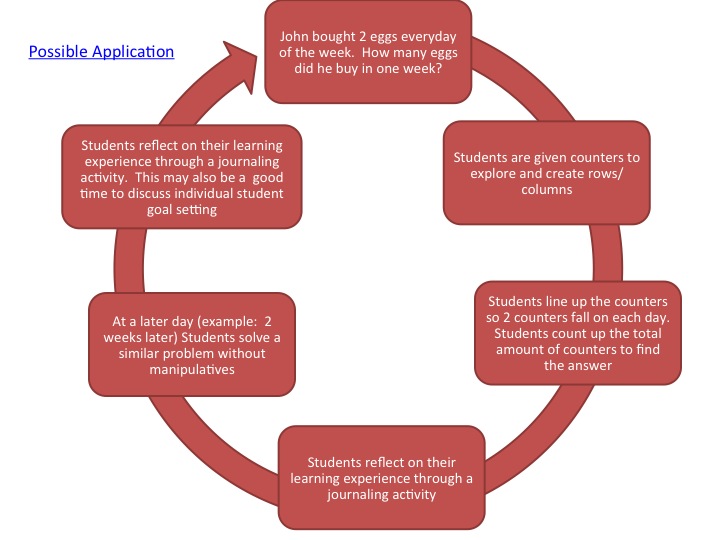
I’d like to recommend an edit in this process.  Not necessarily a change, but an addition.  Before moving straight onto the abstract, teachers should encourage students to reflect on their learning experience using manipulatives to solve math problems.  When given an opportunity to reflect on their learning, students often begin to become more responsible for their own learning.  Utilizing self-reflection math journals also allows students opportunities to connect their effort and achievement.  It may also give the teacher insight in how a particular student understands a specific concept and plan for formative assessments.  I’m not suggesting that the transfer from manipulatives to abstract should occur during the same day.  Giving ample time for math connections to fuse is important and will build a solid mathematical foundation.  I’ve found that the more engaged students are in their own learning the more opportunities that they will have to retain and apply their mathematical knowledge.  I believe the process below assists in building math confidence which will enable students to become more responsible for their own learning.  I have provided two flow charts below that may be helpful in explaining this process.

Building Math Confidence

Student Growth Mindset

Image by:  S. Miles


Students that have an intrinsic drive to learn often retain information and are able to apply their learning in practical situations.  When students develop a growth mindset, they become much more goal oriented, which is a valuable skill to learn at a young age.  When students take responsibility for their own learning and understand the pivotal role that they play, a growth mind set begins to set in.  How do we as educators promote a growth mindset?  I have provided a list of activities that can be used to inspire students to become more responsible for their own learning in order to nurture a growth mindset.

1.)  Students communicate how they feel about their learning …

  • Students  become more aware of how metacognition plays a role in learning
  • Students review their latest assignment/test and reflect on their performance
  • Students complete a plus/delta chart on their weekly performance
  • Students analyze classroom achievement data and set goals based on the results
2.)  What happens after reflecting via journaling is vital …                    


  • Students monitor their progress to ensure that they are making steady progress towards their goal
3.)  Next …
  • Look at specific areas of concern for continuous improvement

What do you do to encourage student responsibility in the classroom?

Fundamental Place Value

Image by:  D. Castillo

After analyzing a recent math assessment, I asked a group of middle school teachers in another state what particular math topic they would recommend elementary teachers strengthen.  I thought that the middle school teachers could offer valuable input regarding how the elementary schools are preparing students for middle school. After a quick discussion, each middle school teacher (all five of them) decided that place value is a fundamental concept that precedes many other high-level math concepts. After listening to the discussion, I started to think of when place value is actually taught.  According to the math Common Core, an entire math strand is dedicated to place value / base 10 concepts.  In fact the word place value is found 42 times in the Common Core Standards for Mathematics.  Obviously, place value is important, but how do teachers introduce and expand on the topic?  First of all, teachers can use visuals,such as a place value chart.

Ideas and links regarding teaching place value can be found below.

  • Place value can start before first grade – counting and identifying specific values
  • Students can be given the opportunity to utilize base-ten blocks and explore how the pieces are interchangeable
  • Place value can be viewed as a decimal or fraction
  • Use coins to show another way to view place value
  • Tactual place value activities
  • Online games or activities
  • Use a number line to show how place value plays a role in how large or small numbers become.

Geometry Birds

Most teachers would agree that making math relevant and engaging is important. Utilizing student interest in a math lesson can turn a good lesson into a great lesson. Moreover, the lesson will be memorable for the student – even after the assessment. An example of this type of lesson can be found here. Over the past year I’ve seen many Twitter posts (and publication articles) regarding how to use Angry Birds in the classroom. I understand that this game can be used for a physics discussion, but since I teach at the elementary level, I often skimmed those types of posts and looked for some type of way to integrate this extremely popular game into my classroom.

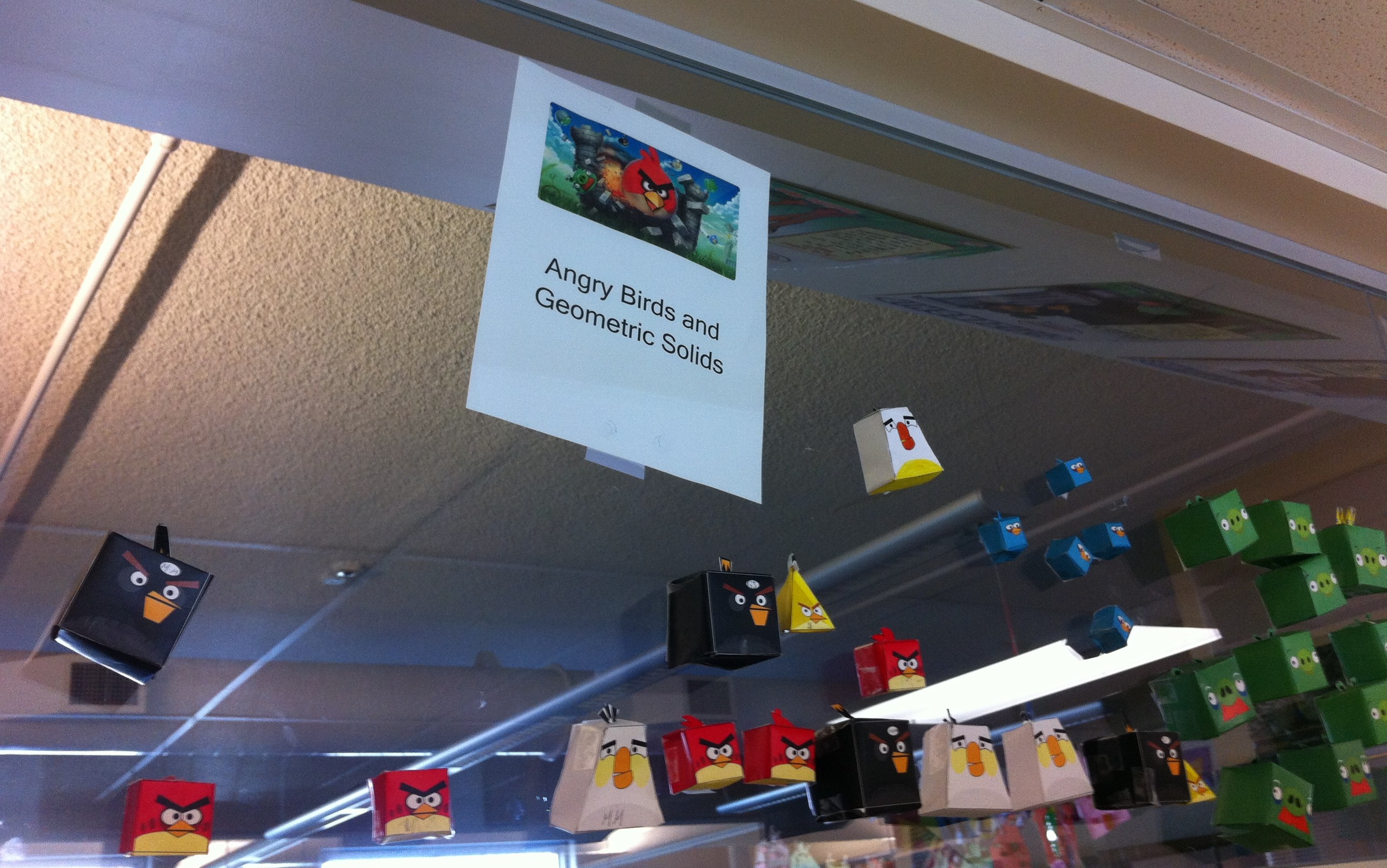
Even at the elementary level, students are intrigued and can tell me all about the game itself, from strategy to cheat codes.  I feel that part of my job is to engage students in meaningful learning.  Last weekend I came across a blog that led to this site that shows how Angry Birds can be used to teach geometry concepts at the elementary level.  The site even had colorful PDFs that I could print to make this activity realistic.  I utilized this activity for my third grade class.

Here are the steps:

1.)  I printed out the PDFs and had my students create all of the different geometric solids. Here are the pdfs (1) (2).

2.)  I showed students different types of solids.  I also brought out the manipulatives found below.

3.)  I then reviewed the following vocabulary words:  vertices, faces, edges, and surface area.

4.)  Students were given an opportunity to pick the net of one particular bird.  Here’s an example:

5.)  Students used scissors and glue sticks to build their particular bird.

6.)  Once finished, students were asked to fill out an exit card regarding the amount of edges, vertices, and faces of the particular bird that they created.

7.)  The birds were then posted in the classroom.  The pictures are below.