Addressing Local Math Misconceptions

mathconceptions

Over the past week I had time to disconnect a bit and spend time with family. I was able to stay with relatives in another state and spent most of the time catching up with people I haven’t seen in a while. It was a great time to refresh and reflect on the past year.  While relaxing one relative in particular asked me about this “new” math that’s in the schools now. I was asked why schools are changing how they teach math and why it needed to change. Specifically she spoke of the different strategies used to compute numbers.  I’m assuming she meant the extensive use of the number line and compatible numbers.  I defended the reasons for a more conceptual understanding of mathematics, especially at the elementary level. Many of the “new” strategies help build that understanding and enable students in developing a foundational understanding of numbers. The relative was receptive and asked more questions related to this topic. I felt like her understanding of the topic became clearer as we discussed the use of  multiple strategies utilized to teach computation. This was a small part of our longer conversation, but the topic had me thinking about how to provide opportunities to address misconceptions. In particular, I thought how my conversation could apply to addressing math misconceptions in schools.

I feel like one of the more important issues with student misconceptions stems from a lack of addressing them. They tend pile up and build over time. I vaguely remember having a math teacher that asked if his students had any questions. I remember looking around and wondering if I was the only one in the class that had multiple questions. Unfortunately I kept my hand down even though I was lost. The teacher then quickly surveyed the room and seeing that no one had their hands up, moved onto the next topic. I found that the less I asked questions that less comfortable I was with the current concept and the process continued until I finished the class. Looking back, I’m sure there were other opportunities to address my misconceptions and questions; I just don’t remember any of them at the time of this writing. I didn’t learn as much as I should from the class, but I started to understand that I needed additional opportunities to ask clarifying questions.

In addition to including many opportunities to address misconceptions, the classroom environment plays a pivotal role in having students feel comfortable in offering input.  The strategies below can be used in a variety of settings. I’ve had success with the strategies, although some have been more successful than others.

Classroom Math Conversations

Classroom conversations can be a powerful strategy in gaining a better understanding of students’ viewpoints. Using open-ended math question and having groups respond to the class can offer opportunities for a healthy math debate. For example, I’ve seen some teachers use Always, Sometimes, Never with great success. Math Talks can also be an avenue in which classroom conversations can develop. Through these conversations teachers can glean important information and possibly misconceptions that can be addressed later or at that time. These types of math conversations, accompanied with anchor charts can document the classroom’s learning journey.  The anchor charts can then be revisited as students construct their understanding.

Formative Assessments

These types of assessments can take different forms. Some teachers prefer to use exit cards, while others use a quiz model. Formative assessments can be used via technology means and some may take the form of a paper/pencil quiz. Regardless of the form, the student’s response can give teachers an indication of understanding. In order for the teacher to give feedback the question needs to be appropriate. Students need to be given the opportunity to explain their reasoning or steps involved in solving problems. If not, the problem is wrong/right, and the teacher is unaware of where the mishap is occurring. Using written or verbal feedback to address the misconception can lead to a more in-depth conversation at a later time. Some students may need the reinforced conversations while others may not. I believe most teachers understand their students and at what level to scaffold feedback.

Journaling

Similar to answering a question in a classroom student group, journaling can provide students a low-risk venue to showcase their understanding. Through a prompt, math journaling can allow students to explain their mathematical thinking and processes in a written form.  Students often become more aware of their growth as the year progresses.  I find that students might not know that they have a misconception until it’s brought to light.  It’s the you don’t know what you don’t know dilemma. The concept of math journaling can be used for teachers to write feedback to individual students and ask questions that give students opportunities to reflect on their writing and math process. Allowing a bit of extra time to confer with a student after their math journaling process can be beneficial as teachers may want to review specific concepts with students.


All of these strategies above seem to go well with a heavy dose of teacher feedback and student self-reflection.  Through reflection, students can help internalize and address the misconceptions.

How do you address misconceptions in the math classroom?


Educanon and Formative Assessments

Educanon and Formative Assessments

The second grade classrooms at my school reviewed subtraction strategies last week. Students were subtracting numbers on a number line and becoming more confident in using regrouping strategies. Based on pre-assessment results I felt like some of the students would benefit from additional enrichment. While talking with a few colleagues I revisited Educanon. I first heard of Educanon from Mary and I briefly used it last year. So I dusted off my username and password and logged into my account again.

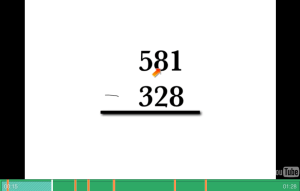
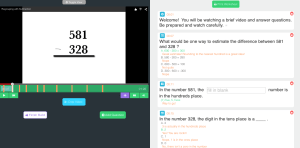
A while back I created a subtraction video using Explain Everything. I turned off the microphone function (my dog was barking when I created this) and just used the pointer and drawing functions. The video was only around two minutes in length, but had 10 questions. I added a variety of questions, including multiple choice, fill in the blank and checklists. The last question asked the students to use a whiteboard to find the difference between two numbers.

Screen Shot 2014-12-06 at 7.33.13 AM

During class students were placed in two different stations. One station was Educanon and the other was working with base-ten blocks to subtract multidigit numbers. The stations rotated after approximately 10-15 minutes. All students logged in and finished the Educanon within the time period.

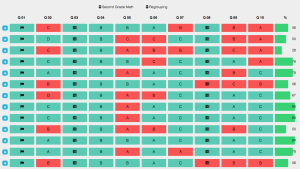
After class I was able to review the results. I felt like this data could be helpful for the teacher as well as the student.

Student answers

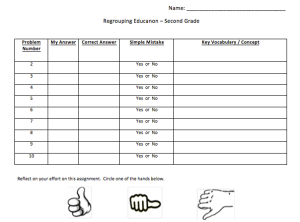
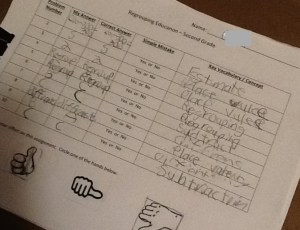
The next day I printed out the student results and compiled a reflection sheet.

Click for file
Click for file

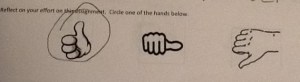
Each student’s answers were stapled to the back of the reflection sheet. As a class we reviewed each question together and students filled out their specific sheet. Out of all the categories on the sheet, I thought the “Key Vocabulary/Concept” section stood out. Students started to develop an understanding of what type of skills were being addressed from each question. This was also an opportunity to emphasize certain math vocabulary words. At the end of this reflection session, students circled their effort level on this formative assessment.

difference

Photo Dec 06, 7 18 45 AM

I thought this was a beneficial activity for a second grade classroom. Students are also starting to think more about their own mathematical thinking and learning. I’ll be using the data and student reflection in preparation for more challenging subtraction concepts later in the year.

Visual Fraction Models

fractionmodelstitle

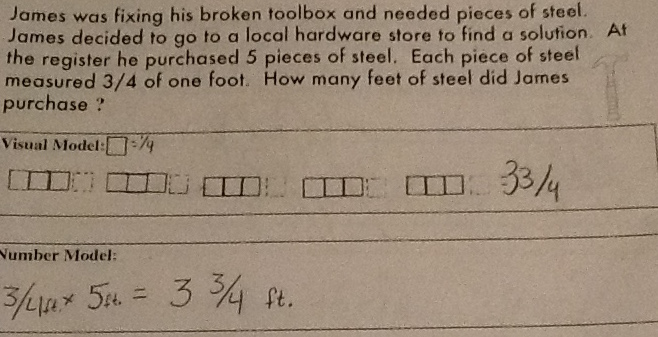
Today students explored fractions using number and visual models. Students have been practicing how to add and subtract numbers for the past few weeks. Most of the students have an understanding of how to find common denominators and add or subtract problems.  Yesterday students answered word problems involving fraction computation.

What I’m noticing is that students are understanding and compiling their number models but aren’t as comfortable with visual representations. Being able to model fractions is important and a key ingredient in understanding fractional parts. As the class progressed I felt like there was a disconnect between fraction representation and computation. Eventually, the lack of conceptual math understanding impacts a student. I’ve found this to be especially clear with fractions.  So today’s class focused on showing both, the number model and visual representation. Students worked in groups on the page below.

Visual Fraction Models
Click for file

Students worked together on the two problems. There was a lot of struggle, especially with the visual model portion of problem two. I was tempted to lean in and help the students but I wanted them to use strategies and their partner to find a solution. I let the students work and even debate strategies with each other. Near the end of the class students presented their final number models and visual representations.

Photo Dec 02, 6 19 11 PM
This student turned a pentagon into 5 triangles. Each triangle represents 18 miles.

Photo Dec 02, 6 19 27 PM

I gave them feedback and asked questions in return. Two of the better examples are above. Tomorrow the class will be exploring visual fraction models via Thinking Blocks. Overall, I felt the productive struggle was worth their time and I hope that another layer of conceptual understanding is starting to cement.

Exploring Fractions

Exploring Fractions

Fourth grade students explored fraction computation last week. Since the beginning of the year they’ve been periodically reviewing how to add and subtract simple fractions. About a month ago this same group of students used fraction pieces of a pie to show a visual model of adding/subtracting different fraction less than one. Last week students identified and compared fractions and mixed numbers. They started to convert mixed numbers into fractions and vice versa. I’m finding that as the students became more comfortable with converting fractions they’re becoming better at fraction computation. Not all the students are at this level, but many are ready to add/subtract mixed numbers.
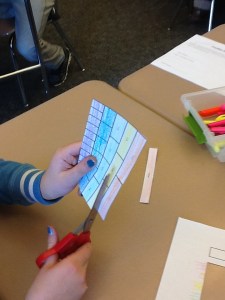
Over the past few years I’ve used a fraction computation activity that I often refer back to throughout the year. Every year I tweak it a bit more to fit better with my students. This year I felt my students were ready for the challenge. The students cut out the fraction pieces below. Students are then given time to explore how different fraction pieces are equivalent.

Fraction Blocks

Photo Nov 20, 11 10 56 AM

I asked the students to model different types of fractions with their pieces. The class came to a few different conclusions on how fraction sums were calculated. I didn’t really hear students talk about finding common denominators; instead I heard students saying the words “equivalent” “matches” “is the same as” throughout the conversation.

Students were then asked to combine their fraction pieces to find certain sums. For example, students were asked to show 1 1/2 using 7 pieces.  Students wrote the number model below their visual representation.  I was encouraged to see that some of the students showed fraction multiplication in their number model eg. (5 x 1/6) + 1/3 + 1/3 = 1  1/2 .

fraction pieces

Through trial and error students started gaining traction in finding the sums. Students had to place all the questions out on their desk and match the fraction pieces to find the sum. After all the fractions were found students taped/glued them to their paper. The class then discussed how this activity could be completed in a variety of ways. Next week students will reflect on this activity in their math journals. The activity described in this post can be found here.


Addressing Misconceptions

misconceptions-01

Students in third grade are exploring measurement this week. As students progress through the unit I feel as though they are becoming more efficient in converting Metric units. Near the end of the class today students started debating the differences between US Customary and Metric. The class than started completing an activity where they had to measure different insect lengths.  Students worked in groups to accomplish this task.
During this time I traveled to each group and intentionally eavesdropped on the conversations. Students asked me questions and I listened and asked questions back.  I then moved on to the next group. I wanted the students to work together and persevere. Some students started to talk about the measurement of different objects around the room.  I especially paid close attention to the questions that students were asking each other. This was a great opportunity to check-in on some of the misconceptions that were flying around the room.  I jotted down some of the conversations as the students came back to the large group.

We had around five minutes left in class to review the questions that I noted. I wrote the questions that I heard on the whiteboard.  I was able to clarify some of the responses and answer other questions. This time was definitely worthwhile. The students seemed to appreciate the time as well. During our next group activity I’d like to do something similar, but not completely rely on my less-than-stellar eavesdropping skills. Instead, I’m thinking of having the students periodically use Post-it notes to ask questions. This could turn into a “wonder wall” type of activity. The students could then place the questions in a bin and we can review them throughout the unit. I think this type activity is one way to proactively address misconceptions and answer questions as students grow in their mathematical understanding.

Using Multiple Strategies in Math Class

howandwhy-01

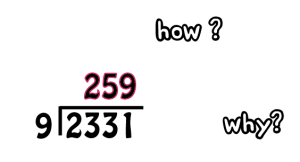
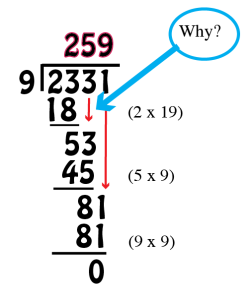
Last week a few upper elementary classes started to explore different methods to divide multi-digit numbers.  Many were familiar with repeated subtraction for numbers more than one and some even had experience with the long division algorithm.  I asked students to explain their reasoning for the steps needed to divide numbers using repeated subtraction and long division.  All of the students were able to explain the reasons for using repeated subtraction. Students gave quality answers and were able to communicate why each step was performed. Some students even related repeated subtraction to a number line.  I then asked the students the reasoning for using the long division algorithm.  I heard responses like “it’s quicker” or “that’s what I was told to use” or “you just do this and this.”  I could tell that there was a disconnect between the shortcut and having a conceptual understanding. Students understood the steps but couldn’t provide solid reasoning to why you would bring down the next number.

partialquotientswhy-01

The class then had a conversation about the importance of being able to clearly explain their mathematical thinking. The students that knew how to use the long division algorithm were getting correct answers, but couldn’t tell me why.  Blindly following procedures can lead to holes in understanding.  Explaining the reasoning behind completing a problem is important. Honestly, I don’t mind if the students use algorithms like the above picture if they already have a descent understanding.  The problem I have is that sometimes this is the only way students are taught how to divide large numbers.  The problem becomes steps –> answer without understanding.

After the class had a discussion about long division we explored the partial quotients algorithm. I explained to the students that this was another method to divide larger numbers.  As we  progressed through and explained the steps, students became more aware of how partial quotients seemed to make sense to them.  For many, this was the first time exploring the partial quotients algorithm.  The students were able to explain why each step was taken in the process.

partialquotients-01

I believe some of the students were also relieved that they didn’t have to get the partial quotient “correct” the first time.  By breaking apart the problem students were starting to see the correlation between repeated subtraction and the partial quotients algorithm.  More importantly, students were able to explain their reasoning for completing the problem with this method.

As we move forward, I feel as though students are becoming better at explaining their mathematical thinking.  It doesn’t matter to me what method the student decides to use in the future as long as they are able to justify their reasoning.  This thinking could also lend itself to just about any type of computation skill.  Last week reminded me of the need to expose students to multiple strategies to complete problems.  Providing these strategies can assist students in becoming better at explaining their mathematical thinking.

4/9/15

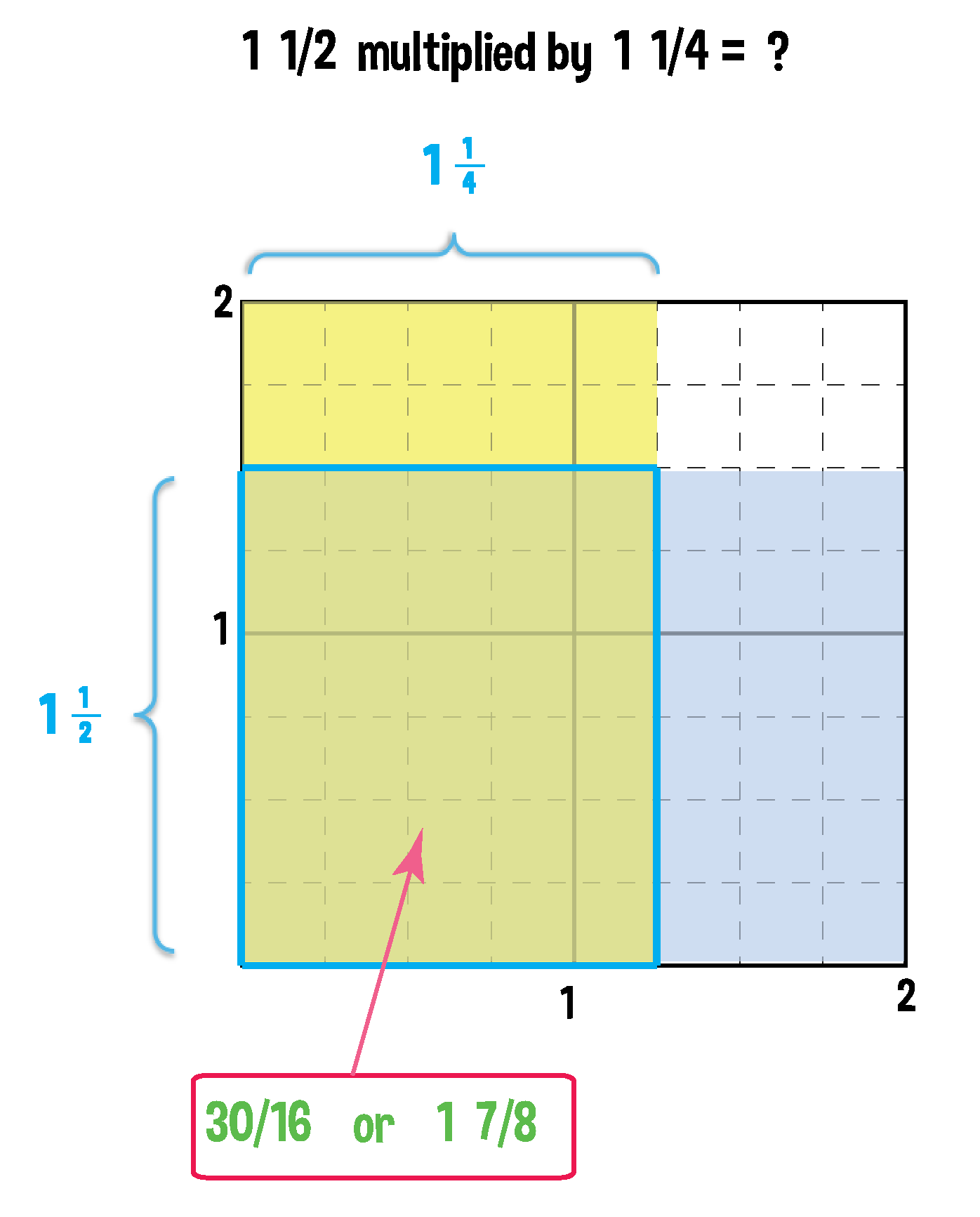
As my students progress through their fraction multiplication unit I came across another example of why using multiple strategies matters.  In the past students learned how to multiply mixed numbers by 1)  Convert the the mixed numbers into improper fractions 2) Multiply the numerators and denominators 3) Covert the improper fraction back into a mixed number.  This is how I was taught to multiply mixed numbers.  Although this method seems to work, students had trouble explaining why they completed each step.  So early this week I decided to use a different strategy in class.


muliplyingfractions-01

Students were able to visually represent this multiplication problem and the steps to solve seemed more logical.

Math Genius Hour – Research and Presentations

topofpost

This is my first year using a math genius hour model. My third, fourth and fifth grade classes all started their genius hours at the beginning of September. The beginning of our journey can be found here. Students narrowed down their question and have conducted research over the past month. The research process has been an eye-opening experience. Before beginning, I was able to set aside some time to have a conversation with students about finding appropriate resources for their project. Even though the classes were during the math block I thought discussing this was important, especially if we’re having more than one genius hour per year. I thought that having the conversation would pay a few dividends later in the year.

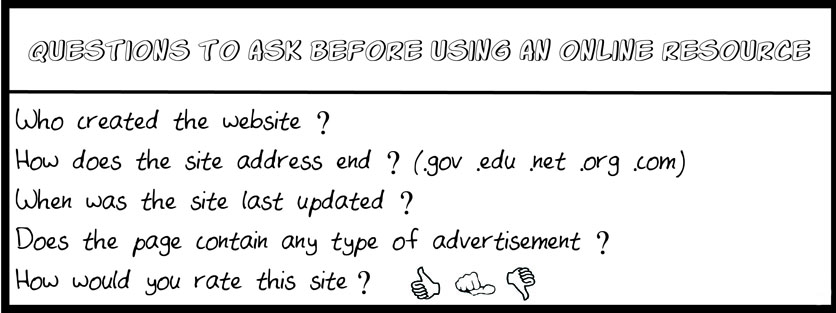
The majority of the research will be conducted online. The class discussed the importance of reviewing the ending of website addresses. We reviewed the url ending (.gov .edu .org .com .net) and how to conduct research in an effective and meaningful way.

Students used this bookmark while researching

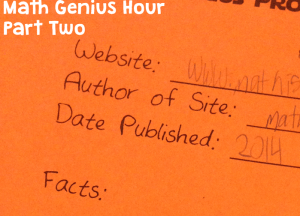
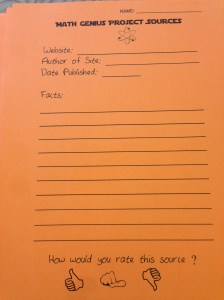
We analyzed different red herring websites (1, 2) and I believe students are getting better at identifying sites that seem legitimate. This took a large amount of time and many questions were asked.  I feel like an entire course could be dedicated to this topic. After a while, the class and I created a sheet that the students would fill out to organize their sources.

click for file
click for file

Although my district provides a facts database for students (www.facts4me.com), the majority of the research that needed to be conducted was beyond the site. So students began to explore research outside of the box. I soon found out that many students were under the impression that they could Google their question and use the first link that appeared. Students also found that Yahoo Answers wasn’t necessarily the best source either. Through a good amount of exploration, students found sites that were adequate and provided legitimate information that they could use in their project. The students became much more independent once they understood the research parameters.

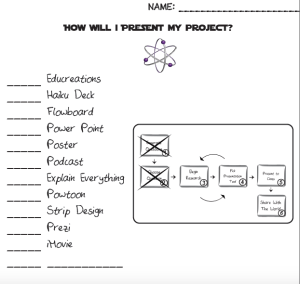
At this point students are starting to explore how they will present their project. Last week the classes took time to review different presentation tools. Many of the students used a variety of presentation tools last year so they were fairly comfortable in picking a tool. Eventually the class decided to use the sheet below to help make an organized decision.

Screen Shot 2014-11-01 at 8.00.29 AM
click for file

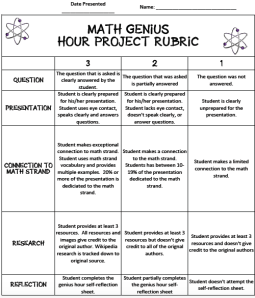
After students pick a tool they will start creating their presentation. Some students are at this point, others are not. My fifth grade classes helped create a rubric that students could follow. I wanted the rubric to be flexible in allowing students to present in a way that they wanted yet a minimum criterion was established. I wanted to also make sure that students’ creativity and voice were part of the presentation. A self-reflection piece is also incorporated into the rubric.

Screen Shot 2014-11-01 at 7.47.41 AM
click for file

Screen Shot 2014-11-01 at 7.49.11 AM

I’d like to thank Denise Krebs and the genius hour Wiki contributors for the self-reflection sheet. Addition resources on genius hour can be found in Joy’s genius hour Livebinder site.

Overall, the math genius hour is a work in progress and I’m assuming the students will present at some point in December. I continue to look forward to how this project progresses throughout the year.

Exploring Rates – Part Two

exploringrates-01

One of the primary goals this year is to find opportunities to use rates in a more practical setting. This past week my classes started to explore rates in more detail.  Students studied visual patterns and rules last week and this has led up to using/converting rates with formulas. While planning I dug out a rate activity that I used last year.

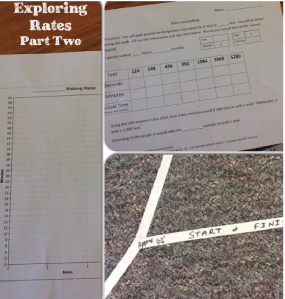
So on Monday I took masking tape and made a simple racetrack around the classroom. The track measured approximately 62 feet. Students took turns timing each other and documented how long it took them to quickly speed-walk around the track twice. We used an online stopwatch to time each student as they sped around the circuit.

Screen Shot 2014-10-25 at 7.02.08 AM

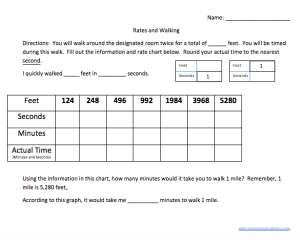
Students documented their time and started to fill out the sheet below. The sheet is an upgrade from last year and I feel like it addresses more skills.

Click for Word file
Click for Word file

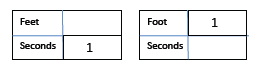
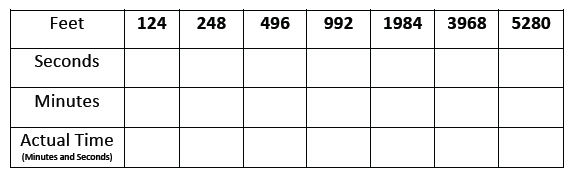
Students were asked to convert their time into feet per second and then how many feet would be traveled in one second. After the feet per second conversion, students converted the seconds to minutes. I gave students an opportunity to find this conversion by exploring and then checking their work.

Screen Shot 2014-10-24 at 9.35.26 PMScreen Shot 2014-10-24 at 9.35.14 PM

Similar to last year, this section was challenging for many. Understanding that 1.8 minutes isn’t 1:08 or 1:80 was addressed. I was proud to see students use perseverance to work through this section and use formulas to find solutions. The last section on the front asked students to find how long it would take for students to walk one mile at the 124 foot pace.

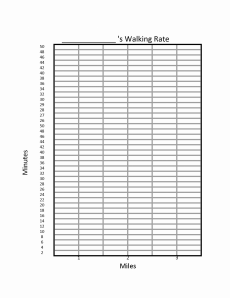
The most challenging part of this was converting the minutes and seconds to actual time.  Once students understood the formula they became pros, or at least closer in understanding rates. Some even found how long it would take them to walk 5 and 10 miles.  We shared the data as a class and found that our times per mile ranged from 9:45 – 16:00 per mile.  Then students graphed the information on the backside. I actually thought of using a graph after reading through Fawn’s visual patterns template sheets.

Graphs

Afterwards, the class had a conversation about all the different math skills that were utilized while completing this activity. We made a list that included conversions, formulas, graphing and many others. I’m hoping to reference this activity and concepts experienced throughout the year.


Transitioning to the Standard Algorithm


When should the standard algorithm be introduced?


Many of my second grade classrooms are in the middle of their addition units. The classes often teach place value and addition strategies during the months of September and October. When introducing addition strategies, teachers rarely start using the standard addition algorithm (see # 4). Manipulatives and visual representations are heavily used during the first month of school.  The process below differs per school, but I’m finding that this is often the case in many of the second grade classes that I’ve observed. Keep in mind that I’m missing other approaches, so perceive the following as a few highlighted strategies that are used during the first few months of school.


counters-01
Finding the sum of objects

Students are introduced to some from of unifix cubes or counters. Students are asked to compile the groups of counters to find the sum. For the most part students find this task quickly and are ready to move onto the next portion.  This is also a first grade skill that’s reviewed at the beginning of second grade.

circle11-01
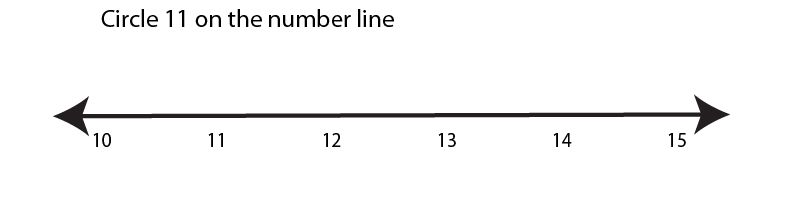
Identifying numbers on the number line

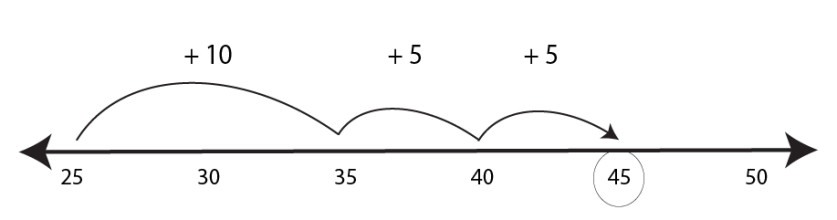
The number line usually follows the counters. Sometimes the number line makes an appearance before the counters, but it’s usually afterwards. The number line is used extensively. Students are asked to find numbers on the number line. This builds number sense and an understanding of the reasonableness of an answer. Eventually students are asked to add numbers with hops showing the addition involved.

Find the sum of 25 and 15.
Find the sum of 25 and 20.

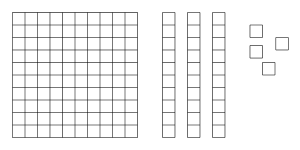
Base-ten blocks are then introduced to emphasize place value. Students are asked to combine base-ten blocks to find the sum. They are asked to find the sum of the base ten blocks and place them on the number line.

basetenblocks-01
What is the sum?

The four processes above aren’t necessarily mandates, but it’s found in the sequence of the textbook.  I should mention that the same process is used with subtraction later in the year. What I’m finding is that there’s rarely a mention of using the standard addition algorithm to find the sum. I don’t necessarily think that’s a problem, but it raises the question of when should the algorithm be introduced? In what cases should the algorithm be introduced and is it only used in certain circumstances.

Think of 200 + 198. Would your students use the standard algorithm for this?  Some might, other might prefer to use another method. Regardless of when the standard algorithm is introduced, there will still be students that would prefer to use the algorithm.  Is that the most efficient method?

The topic of this post was tackled during last Thursday’s #ElemMathChat. Most of the questions revolved around when the standard algorithm should be introduced and mistakes that occur when students focus on the steps.  There were many useful answers, but I’m not positive if one right answer climbed its way to the top.  There are many factors at play here. Some teachers feel pressured to move through the curriculum at a high pace because of testing.  They might teach the algorithm sooner, while others might not mention it and scroll through the prescribed lesson sequence.  Most teachers would like students to have a conceptual understanding of numbers and systems before moving towards a standard algorithm. How much time is spent developing that truly depends on the teacher and student. I’m not judging any teacher is these situations as we are all in this together, but I believe having this discussion is important.  I think this also plays a role in how other algorithms are introduced.


Exploring Rules and Patterns

exploringrulesandpatterns

This past week my upper elementary classes started their equations, patterns, and rules units.  The units are composed of patterns, special cases, student-created rules, and solving equations.  To be honest this is one of my favorite units and involves a good amount of pattern exploration.  Through exploration, students construct their own understanding of how mathematical rules can be developed by analyzing patterns.   Many of these activities involve manipulatives or visual representations of various patterns.  I’m going to highlight three specific activities that seemed to work well this past week.
Analyzing the Perimeter

What's the Rule?
What’s the Rule?

Students were given a handful of square geometry blocks.  They were asked to find the perimeter of one block.  This was quick as students just needed to count the sides of the block.  Four!  Students then put together two blocks and found that the perimeter didn’t double, instead it was six. Students continued the patterns and discussed with their group what the rule could possible be.  Some groups used the whiteboards to write possible solutions.  Throughout this activity students struggled at first and then came to an understanding that the rule just didn’t include one operation. After the rule was discovered the students found the perimeter of 100, 200, and even 1,000 squares put together in a horizontal row.  I believe this activity also helped establish the reason for having mathematical rules.

Rule Tables

Students used four dice, a whiteboard, iPad, and dry erase marker to complete this activity. Two of the dice were operation and they had + and – on the sides.  The other two were typical six-sided 1-6 dice.   Students rolled all four dice and created a rule.  For example, if a student rolled a 6, 2, +, and – then he/she could say the rule is + 6 – 2.  Students wrote the rule on top of the whiteboard and used one of the die to roll five numbers that would be included in the in column.  Afterwards, students were asked to find the out column using the rule that was created.  A few examples are below.

studentrules

The students then took a picture of their product and sent it to Showbie.  Later on that day the class discussed how to combine rules.  So instead of + 6 – 1 this rule could be + 5.  The students were then combining all of their rules.  This activity led to some productive discussions on how to simplify or expand rules.

Visual Patterns

visualpatterns

I came across Fawn’s Visualpatterns site a couple years ago.  This is a fantastic resource that I introduced this past week.  I printed out some of the patterns and placed them in manilla file folders.  The picture of that is located near the top of this post.  The six folders were placed around the classroom.  Student groups visited each folder and determined the rule. While in the group students worked together and filled out the sheet below.

Screen Shot 2014-10-11 at 8.44.25 AM
Modified from this site.

Students took whiteboards and started to build possible rules for the pattern. Once they accomplished this they filled out the table and graphed the relationship.   I appreciate that students are asked to graph their findings.  This could lead into so many other math topics. Students only rotated through two folder stations so we’ll continue this activity next week.  By the way, the students were stoked when I showed them the visual patterns site and not because it has the answers.  A few students even said they were going to check out the other patterns on the site.  I’m looking forward to utilizing this resource a bit more next week.


How do you introduce patterns, rules, and equations?