Spaced Retrieval Practice

Screen Shot 2019-04-25 at 6.41.25 PM

There’s around one month of school left and it feels like the home stretch.  The next month is full of changes.  The weather changes from chilly temps to sunny days (at least in the Chicago burbs), class lists and sections are starting to take form, driving to/from school with the windows down is the norm, and planning for that final month is in full swing.  The majority of my math classes just finished a unit assessment and there’s one unit remaining.  So often I find that students perceive the end of a math unit to “close out” the learning on a particular skill set.  I observe that this idea often gets pushed out as grade deadlines approach.

As my classes start a new unit I’m pausing to reflect on how my practice has changed.  Last year I read How to Make it Stick and I intentionally planned to use more retrieval practices. This year I’ve incorporated more review opportunities through online formative quizzes and by trying to make implicit connections to past learning.  I’ve often asked students how today’s objective connects to this week’s learning.

While digging through my resource materials early this year I found optional mid-year and cumulative assessments. Generally, I find that there’s not enough time to complete all of the assignments/tasks in the resource so these particular tests aren’t used frequently.  This year I decided to use them to help with spaced retrieval practice.  Instead of using a mid-year and cumulative assessment directly following a unit I decided to space out these assignments and take off the grading emphasis.  These types of assignments take multiple days to complete and I often have students work with partners to reflect on their progress.  So far I’ve seen positive progress as students this year are referring back to past skills more quickly and bridging the connections on a frequent basis.  I’m looking forward to using a similar strategy next year.

Classifying Polygons

Screen Shot 2019-04-12 at 6.59.00 PM.png

One of my classes is in the middle of a unit on geometry and measurement.  They’ve identified shapes before, such as rectangles, squares, triangles and hexagons.  Earlier in the year they found the area and volume of shapes involving rectangles, squares and triangles.  The current unit investigates how polygons (specifically triangles and quadrilaterals) are similar and the study of shapes progress as students create hierarchies.

  • CCSS.MATH.CONTENT.5.G.B.3
    Understand that attributes belonging to a category of two-dimensional figures also belong to all subcategories of that category. For example, all rectangles have four right angles and squares are rectangles, so all squares have four right angles.


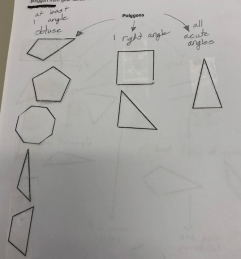
In order to dig deeper into the above standards the students starts the classification process.  This was fairly new for most of the students.  I explained what classification meant and gave a few examples related to the characteristics of triangles and quadrilaterals.  Students were given a sheet of quadrilaterals to cut out and classify.  The next question I was asked was related to how each shape should be categorized.  The class reviewed different vocabulary words associated with polygons and then I left the students create their own categories.

Screen Shot 2019-04-12 at 6.58.38 PM.png
This student decided to split up the shapes into three categories.  3-sides, 4-sides and 4+.

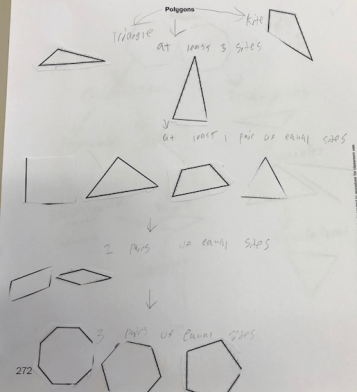
After discussing equal side lengths and parallel sides two of my students created the classifications related to those terms.

Screen Shot 2019-04-12 at 6.58.48 PM

Screen Shot 2019-04-12 at 6.59.08 PM.png

Almost every student had a different way to organize their shapes.  Students went to different tables and observed how their peers classified the shapes and then the class discussed similarities.  Next week students will classify the shapes with a hierarchy chart.  I’m looking forward to seeing what they create.

Stretching in Math Class

Screen Shot 2019-03-08 at 8.10.26 PM

This post has been marinating for a while and I’ve been waiting to write it up.   State testing is just around the corner and I feel like this is a good time to press send.

One huge emphasis that I see in schools is related to the idea of student growth.  This is communicated in schools, during teacher pd meetings, when talking about Hattie’s next best effect-size list and can even be part of teacher evaluation criteria.  I see this when school districts use MAP, state testing, or a similar type of tool that measures growth over time.

Schools, teachers, and parents want students to grow.  In schools the focus of growth primarily related to academic content.  How is that measured?  Well that depends on the teacher/district/organization.  Some teachers go the route of using a pre vs. post-test.  Others give multiple formative checkpoints and then use them along with student reflection components to show growth on the summative.  Case in point – there are multiple methods to show student learning and growth.

Here’s my not so small gripe.  In an effort to show growth some educators may feel rushed to “get through” as much content as possible.  I hear this a lot more in math classes than other content areas at the elementary level.  Math has a subjective linear vibe that I think some teachers hold onto. This idea is often reinforced through the structure of some of the adaptive standardized tests that communicate math growth to teachers and school administrators.  This can be a bit troublesome if these types of tests are used for evaluation purposes as it brings along additional pressure.

I find students make meaningful math connections when they’re given time to process and apply information.  I believe rushing through concepts or stretching to just expose students to higher-level concepts that aren’t part of the lesson isn’t as beneficial as it seems.  Moving off the pacing guide or lesson to stretch to other concepts might not be the best idea. When I first started teaching I remember having a teacher talk about exposure all the time.  The teacher would say, “If they’re just exposed… then they’ll complete those problems correct and that’ll push them to the next concept.”  This teacher was truly amazing (and made some great coffee in the mornings), but I questioned this then and still do now.  If we’re exposing students to math concepts so they’ll score well on an adaptive test then that’s another issue altogether.

If a lesson is looked through a linear math lens a teacher might feel as though they should introduce fraction multiplication if students are doing really well with multiplying whole numbers.  Is that the right move?  Should a teacher stray from the lesson plan to possibly reach a few kids that seem like they’re ready?  I’m not saying yes or no because it depends on the station and students, but I’m more in the no camp.  Stretching math concepts in a lesson/task for exposure sake doesn’t last.

Last summer I was able to reading Making It Stick and came away with some applicable ideas related to changing my study guides and how retrieval practice benefits those wanting to learn.  I find that there’s sometimes pressure to stretch to another concept for exposure sake.  Instead of stretching concepts, there should be opportunities for students to enrich their understanding through connections.  This looks different and is more challenging in my opinion than just pressing the accelerate button temporarily.  I believe that taking time for students to process, reflect and engage in meaningful math tasks will last more than a glimpse optimistic exposure that may soon be forgotten.

Decimals and Spatial Reasoning

Screen Shot 2019-01-25 at 9.43.47 PM.png

My second grade students just started a unit on decimals.  Based on the pre-assessment, most students have no problem with identifying the value and place value position of digits in the ones – hundred-thousands place.  It’s a different story for numbers to the left of the decimal point.

Earlier in the week students explored the tenths and hundredths place.  Students connected money concepts to place value and fractions.  They compared 1/2 with 0.50 and $1.50 with 1.50.    They completed similar activities where they needed create benchmarks on number lines and place numbers.  Some were still having trouble and I believe this is partially due to exposure.  Also, I was finding that their were issues with spatial awareness.  Students were looking placing able to approximate benchmarks of half, but placing 0.1 close to the half.  Student practiced using number lines and using benchmarks.  The most tricky piece was looking at the differences between the hundredths and thousandths.  This challenge reminded me of how students develop an understanding of the magnitude of numbers.

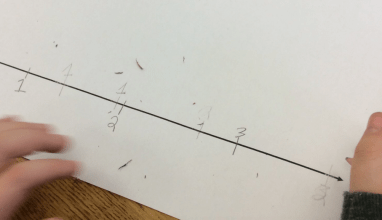
Today I grouped students into teams and they used dice to create different decimals.  The decimals ranged between 0 and 3.  Students were given a horizontal and vertical number line on a 11 by 17 paper.  This gave students room to work.  The two number lines were different sizes.  An indicator line was placed at the beginning and end of each line.

screen shot 2019-01-25 at 9.22.22 pm

After students created their decimals they started to place benchmarks.  Some students had to get out the erasers as realization set in that the maximum would be three instead of two.  Students also reevaluated their benchmark placement.  Groups noticed that the two number lines were different sizes and had to adjust their benchmarks accordingly.  I found it interesting that some students used the vertical number line top down, while other went bottom to top.

Screen Shot 2019-01-25 at 9.25.29 PM.png

We’ll be reviewing the number lines on Monday.  I’m looking forward to the discussion and we might even break out the rulers to evaluate the reasonableness between benchmarks.

More on Math Feedback

Screen Shot 2019-01-16 at 7.21.00 PM.png

Last night I was fortunate to attend ICTM’s chat on feedback.  It was a productive chat and Anne had some great questions cued up for us.  I came away with a few new tools that I need to research.  Chats like these are motivating as the frigid cold of the midwest is ever-present this time of the year and new ideas can spark my planning process.

Teachers know that student feedback is important – it’s everywhere in schools.  It’s on every teacher evaluation tool that I’ve experienced. ASCD describes it as “Basically, feedback is information about how we are doing in our efforts to reach a goal.”  Teachers give feedback all the time – most without even labeling it specifically as feedback.

The chat was still on my mind this morning as my colleagues and I were having a conversation about math units.  After reviewing multiple student papers, I started thinking about feedback in more detail.  Specifically, I started thinking about how feedback takes on different forms and the tools that are used to give that feedback can vary from class to class.  In all cases that I’ve come across, educators want students to actually USE the feedback.

Technology can be used for this although the reliability of the feedback might not match the need.  I’ve also seen cases where the automated feedback is disregarded by students in an effort to score more points.  It depends on what’s needed.  In some cases, a quick verbal prompt might be the feedback that’s needed.  For others, a conversation with a partner can help students identify misconceptions or spur thought.

Let’s take this problem:

Screen Shot 2019-01-16 at 6.37.18 PM.png

This particular students was able to identify the rule and complete everything but the bottom problem.  Being able to anticipate misconceptions can lead to better student feedback. There are a few questions that I might have before approaching the student and giving feedback.

  • How can this student divide 14 by 7, but still have trouble with the bottom problem?
  • Does this student think of “divide by two” as half of the in?
  • Was this a simple mistake?

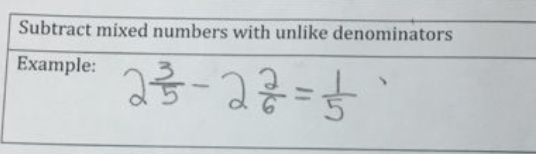
Or here’s another one:
screen shot 2019-01-16 at 6.55.58 pm

  • I notice that there isn’t any work or model here
  • Did the student notice that the denominators weren’t equal?
  • What strategy was used here?
  • Was this a simple mistake?

Last one:

Screen Shot 2019-01-16 at 7.01.29 PM.png

  • Did the student miscount the boxes?
  • Is the students missing pieces? (yes, this has happened before)
  • How did the student get 6 as the numerator?

In all of these cases a simple mistake is probable.  I’m working with K-6th grade math this year and sometimes rushing leads to simple mistakes.  I try (as much as I can) to limit that option when deciding to give feedback.  In all three of the cases I could ask the student to recheck their work.  Some students will, while others won’t.  I could also write on their paper a statement or question about wondering what strategy they used.  I could also have the students meet with a peer and discuss the problem in more detail.

There are so many ways to communicate feedback and it’s not a simple issue.  Some students are more responsive to written feedback, while other students want to have a conversation with another peer to discuss their strategies.  As students get older the type of feedback also changes.  Many of my upper elementary students prefer a brief comment on a paper or a quick underline, question mark, or specific arrow to help them move towards a goal.  Having a 1:1 feedback conversation with a student is my number one option because then I can see how receptive they are and answer any follow-up questions.  If you don’t have time to do that with every kid (who does?) then you use other options.

There are a ton (I mean a TON) of apps out there that “help” students along their math learning journey. I tend to be a bit caution when deciding to use them in the classroom. Is the feedback appropriate for their needs?  Is the feedback helping them in their efforts to reach a goal?  In some cases it may, but I think it’s worthwhile consider the ways in which feedback is given.

Continuing the Math Writing Process

Screen Shot 2018-12-15 at 7.07.33 AM.png

As some of you might already know, one of my goals this year is to find strategies to help my students write better mathematical explanations. My students have been making progress towards that goal.  I see glimpses here and there where students are putting together more concrete statements and transitioning them into coherent explanations.  It’s good news – and making progress helps the students see that growth is happening.  We all need that boost every once in a while – or even more than that. Last week, students were asked to fill out a rubric and evaluate their own mathematical writing.  I then went over and highlighted my responses in a different color.

I passed those papers back early last week and the class had a conversation about the difference between my scores and theirs.  It was a productive conversation and I believe the kids left with a better understanding of what the categories in the rubric mean.  For the next couple days the class reviewed measurement concepts and place value.

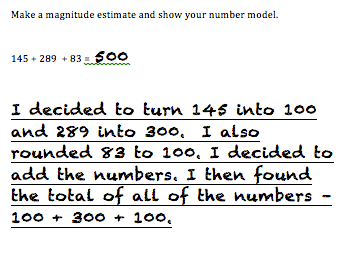
The next stage of this mathematical writing process was for students to evaluate the writing of another student.  I’m finding myself using more retrieval practice strategies for this particular process and critiquing others writing multiple times has helped (at least I believe) them become better at recognizing rubric elements in their own writing.  I also want to give students multiples opportunities that are spread out with assessing and self-assessing strategies.  I tried this before earlier with some success, but this was also before students created the writing rubric that we’re using now.  Students read the prompt on magnitude estimates, read over what the writer created and filled out the rubric.

Screen Shot 2018-12-15 at 6.58.11 AM.png

The students carefully read through the prompt and then throughly read through the response.  During this time the classroom was so quiet.  Some students used highlighters while others were very critical with the pencil.  I even had a few students ask the writer about their response on the paper – future teacher maybe?

Near the end of the class I reviewed the responses and the students voted on where they thought this writing would fit on the rubric.  I’d say around 50-60% of the students were on target with all the rubric selections.  This improvement is telling and I’m excited to see growth in this area.

Next week I’m planning on introducing a different math writing prompt.  This will be their second attempt and will be used as a formative checkpoint.  The class will then continue this journey after winter break.

  • Shoutout to the MAA site and people for helping me thinking of additional ideas for this math writing process

Math Explanations

Screen Shot 2018-12-08 at 6.49.34 AM.png

This year I’ve been working with a group of 20-25 second grade math students.  I see them daily for about 20-30 minutes.  This group has been exploring a number of math concepts related to computation, place value and measurement.  At the beginning of each unit this group is given a pre-assessment and the class investigates a number of concepts for approximately a month.  During that month that class puts together and takes apart numbers, uses math tools, reflects on our math experiences and sharpens  different computation strategies.  The unit concludes with a post-assessment.  The class then reviews the assessment, looks for trends and analyzes possible errors before moving onto the next unit of study.

Every unit assessment has some type of open response which asks students to explain their mathematical thinking.  The performance on these questions has been rough. This isn’t a new experience and I wrote about this a while back here.  Students seem to have trouble creating complete math statements that answer the open response question.  Students have noticed this trend too.  Earlier in the week I ended up having a class discussion about math statements and written responses.  Through our discussion I also realized this is something that I need to learn more about.  This opportunity also had me wondering about past assignments and how often kids are really asked to explain their mathematical writing in written form.

To me, this issue looked like a professional need as well as a student need.  I looked online for additional resources related to helping students identify quality mathematical writing.  I found a few rubrics, but they were very generic and included words like “high-quality” or “fully understands the topic” that I think are valued, but not necessarily quantifiable.  So the class had another brief discussion about what math explanations should look like.  We came up with a list of what should be included:

  • Math vocabulary
  • Restating the question
  • Number models

A draft rubric was built and students completed a pre-assessment using the new expectations.  After writing a mathematical response to an estimation problem earlier in the week, students circled where they felt they were in relation to the expectation.

Screen Shot 2018-12-08 at 6.49.03 AM.png

Screen Shot 2018-12-08 at 6.49.19 AM.png

Screen Shot 2018-12-08 at 6.49.46 AM.png

I then went through the student responses and added my own thoughts in blue. Next week I’ll be passing these back to my students. This was the first time using this particular rubric and there may be changes to this as the year progresses.  I still need to hone in on helping students recognize what “restating the question” means as I think that’s a bit fuzzy.

The good news is that we’re making progress and students are becoming more aware of their mathematical writing skills.  I’m looking forward to seeing how this evolves over time.  I’ll also be sharing this with my second grade team before winter break.

Math Visual Model Strategies

There’s power in the picture.  There’s no denying it and I think most people assume this already.  A visual has the potential to bring curiosity and often gives off a certain vibe that brings more questions or leads to someone to swipe to the next picture with disinterest.  Instagram, Pinterest and Snapchat are just a few platforms that have hooked so many people with visuals.  Many people won’t even read an article or blog post if there isn’t a picture included.

Visuals also show up in the classroom.  If you have some time, I highly recommend taking a brief look at YouCubed’s article on visuals in the math classroom. They take the form of classroom posters that are on the walls.  They’re also found in textbooks, on worksheets, on stickers, shirts, shoes, and so many other objects that people see all the time.  I think they also have a role in the math classroom and many teachers and students have used them to make sense of the mathematics that they’re exploring.  Visual models are often used to organize thoughts, make connections, and communicate understanding.  Individual meaning is often associated (although not always) with visual models and educators get to see how how the decontextualizing <–> contextualizing process works with these types of models.

I believe visual models have an important role in math classrooms.  Some students make meaningful connections by creating a map of their mathematical thinking.  Often, these maps are related to what’s introduced in class, other times maybe not.   Students might adopt certain visual models because that’s how they’re told to complete certain problems.  I see this regularly when it comes to fraction models.  The rectangle and pie area models are rampant.  This sin’t a gripe, but just an observation as the visual model might be more emphasized depending on the teacher/grade level.

I believe there’s potential with using visual models, but they’re not always the default. Communicating and having the students bring their own awareness to when/why certain models are used is important.  Rate/ratio tables and tape diagrams lend themselves well in having students organize their thoughts.  When asked to create a visual model I sometimes hear students say that they’re visualizing it in their head and then they write down the solution on paper.  Other times, students thoroughly create large models and use them to find solutions and add more than enough details.

I’m looking forward to seeing how students approach this problem tomorrow.

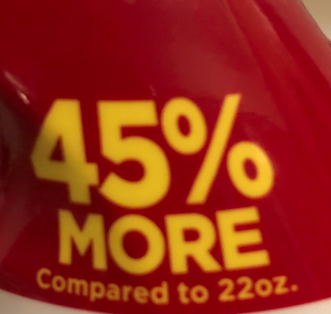
                                                                            What is 45% more?

Students are familiar with finding 50% or 10% of a number, but this is different. I’m wondering if using a visual model will be part of their problem solving process?   

Better Math Explanations

Screen Shot 2018-11-16 at 7.53.46 PM.png

One of my primary classes just finished up a math pre-assessment.  One of the questions on this assessment asked students to explain their mathematical reasoning.  Specifically, they were given a prompt, a student example, and then asked to explain in their own words what happened.  Students had a lot of questions about this problem.  Since it was a pre-assessment, I basically kept quiet and asked them to persevere.  Some did, others didn’t.

A few students dropped their faces when they saw their pre-assessment results. Many, and I mean over half of the kids didn’t meet the expectations on the written response.  Instead of putting together sentences, the majority of students created number models and that was that.  Some students even wrote that the character was wrong and didn’t explain anything further.  I was a bit disappointed, but no worries though – this is a pre-assessment.  The actual assessment won’t happen for another couple weeks.

I noticed that I needed to look more closely at how to address the math writing issue.  I also needed to clarify the expectations for written responses.  This was new territory for kids.  Most students are able to tell me (with prodding) their thinking and how it relates to the problem solving process.  It’s a different story when it comes to writing it down.  In the next few week I want to ensure that students are explaining their mathematical thinking clearly and in a way that answers the question.

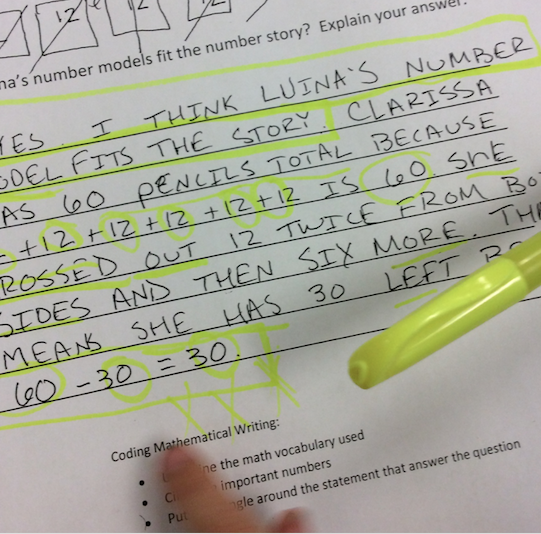
So this Wednesday students were asked to start looking for specific details in their writing.  We began by having the entire class analyze one math response from another “student” from a couple years ago (ok … maybe I created this).  Students went into teams and analyzed the exemplar and looked for key components in the response.  Students looked for an answer statement, math vocabulary and important numbers.  They then coded the response with circles, rectangles and underlining.  The student teams explained to the class what they thought qualified as an answer statement.  This was a great discussion as students came to a consensus to what qualifies as a statement that answers the question.  Students also discussed the numbers that were important and the math vocabulary that was used.

Later in the day students answered a similar prompt and then switched papers with a peer.  The other student coded the paper and then the pairs discussed what they wrote and why.

Screen Shot 2018-11-16 at 7.54.10 PM.png

The class will be meeting next week to review more examples.  Afterwards we plan on responding to a different math prompt and code our own writing.  I’m looking forward to seeing how this emphasis on mathematical writing transfers throughout the year.


Exploring Fractions – Week One

Screen Shot 2018-10-26 at 9.05.40 PM.png

My third grade students started a new unit on fractions last week.  They started the unit by learning about part-to-whole fractions and how to identify them.  Student teams explored how fractions are represented in different situations.  One of the first activities asked students to create their own version of a part-to-whole model.  The scissors came out early this week while students cut out fraction area models.

Screen Shot 2018-10-26 at 8.28.43 PM.png

They compared the pieces within the area models to create equivalent fractions.  This gave students another way to compare and observe equivalencies.  This was time consuming activity, but so worth the time.  Students made connections and played around with the circles/pieces to compare the models.  The only negative was that some students didn’t cut the fractions exactly on the line so the pieces didn’t always line up.  The next day students compared the fraction pieces using <, >, or = signs.

Screen Shot 2018-10-26 at 8.36.15 PM.png

Students were making progress in comparing fraction area models.  The fraction circles were being used consistently and then the class moved to transitioning to identifying and placing fractions on number lines.  This was a challenge.  We started with a 0-1 line and then identified half.  From there students used benchmarks to compare fractions on line.  Students had some trouble when the number line was stretched from 0-2.  The class also explored how the fractions look on a vertical number line.  A different dynamic was at play there.  Students then practiced a bit more with an Open Middle activity.

Screen Shot 2018-10-26 at 8.57.31 PM.png

Students were given opportunities to discuss fractions with their peers through a few different fraction math talks earlier in the week.  The time spent today revolved around reviewing different fraction models. On Friday, the class participated in a fraction Desmos Polygraph activity.  Feel free to use the program here.  This was one of the learning highlights of the week.  Students were asked to pick one of the fraction models that they created early in the week, while other students asked questions to help determine the fraction.

Screen Shot 2018-10-26 at 8.52.10 PM.png

At first students asked questions related to the color of the fraction.  Then they moved to questions involving less than half and more than half.  Students found that clear questions revealed better answers.

Screen Shot 2018-10-26 at 8.59.37 PM.png

I was excited to see that students were using benchmarks and part-to-whole ideas to help uncover the mystery pick.  Students spent around 20-30 minutes exploring the polygraph with a few different partners.   I even snuck in as a participant.  I’ll be keeping this idea in my back pocket for next year’s plans.

Next week, students will start to add and subtraction fractions.  I’m looking forward to seeing how students will use the experiences this week.  There’s plenty more to this unit and we’re just getting started.