Division and Area Models


Area Model-01

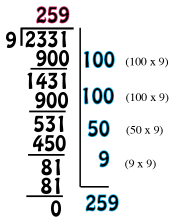
My fourth grade group just finished up a unit on division.  They spent a great deal of time exploring division and what that means in the context of a variety of situations.  One of the more interesting parts of the unit delved into the use of the partial-quotients method.

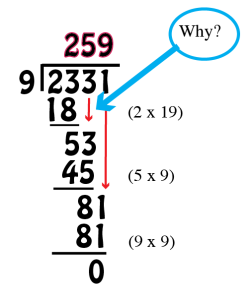
You might be a fan of this method if you’ve ever wanted to know why the traditional division algorithm works.  I was in that boat.  During my K-12 math experience I never questioned what was introduced.  I was always encouraged to use the traditional division algorithm.  It didn’t make sense to me why I was dropping zeros or setting up the problem in a certain structure.  I just played school and figured that it wasn’t worth trying to find meaning, but instead just pass the class and move on.

For the past ten years I have been introducing the partial-quotients method to students.  This method brings more meaning to why the division process works.  Students also seems to grasp a better understanding of how partial-quotients can add up to a quotient with a remainder.

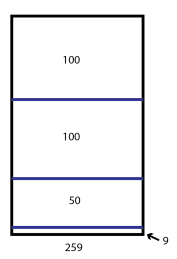
This year I introduced something different to the students.  Students were asked to use the partial-quotients method to divide numbers and then create an area model of the process.  I had quite a few confused looks as most students think of multiplication when using area models.  After modeling this a bit I noticed that students continued to have issues with appropriately spacing out their area models.  This was a great opportunity for students to use trial-and-error.

I noticed that students had to first use the partial-quotients method to find the quotient and remainder.  They then had to split up the area model into sections that matched the problem.  This spatial awareness piece is so important, yet I find students struggled with it to a point that they were asking for help.  Maybe it’s a lack of exposure, but estimating where to split up an area model to match the partial-quotients seemed to challenge students on another level.

This activity has me wondering how often students use spatial awareness strategies in the math classroom.  How often are they given these opportunities?  Reasoning and estimating strategies also play a role, but actually spacing out the partitions isn’t what students were expecting last week.

I’m looking forward to seeing how students progress in using area models moving forward.

Second Attempts and Error Analysis


Error Analysis-01.png

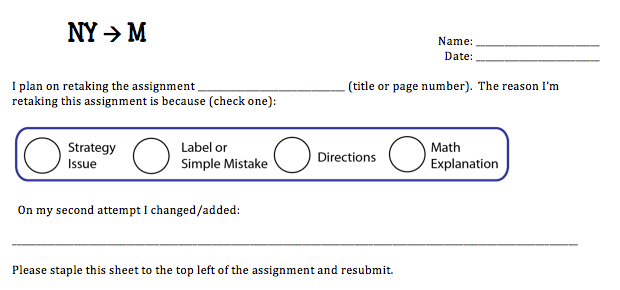
I’ve been thinking about student math reflections this week.  That reflection can take on many different forms. Giving students a second attempt to complete an assignment can give them an opportunity to reflect on their original performance. This is often (not not always) part of a standards-based-grading approach.  Some teachers allow students to redo particular assignments.  Some teachers have their students complete a paper form of a reflection and/or redo sheet when they didn’t meet the original expectations.  Students fill out the sheet, redo certain problems that need a second look, staple the sheet and finally turn the work back in.  This process has worked well during the past year, but I’m noticing that students are starting to place general statements in the blank lines.  This NY –> M process was starting to become more paperwork than individual reflection.

Screen Shot 2018-02-18 at 1.27.14 PM

Students would avoid writing simple mistake like the plague (since it explicitly says not to do that :)), but they’d write comments that were very general.  I mean VERY general.  Students would write

  • “I didn’t write the answer correctly”
  • “I had trouble with fractions”
  • “I didn’t write the problem right”

Most of the responses were general, and some students wouldn’t even thoroughly review their work before attaching the second attempt sheet.  Don’t get me wrong though.  The sheet was helpful, but I wanted students to delve deeper into their work and become better, or more aware, of where they didn’t meet the expectations moving forward.  Over the summer I was able to attend sessions and workshops related to student goal setting and student error-analysis.  I believe student reflection and error-analysis can be powerful tools for students as well as teachers.  Knowing this, I revamped the second attempt sheet this week.  Here’s the new look.

Screen Shot 2018-10-05 at 6.55.35 PM.png

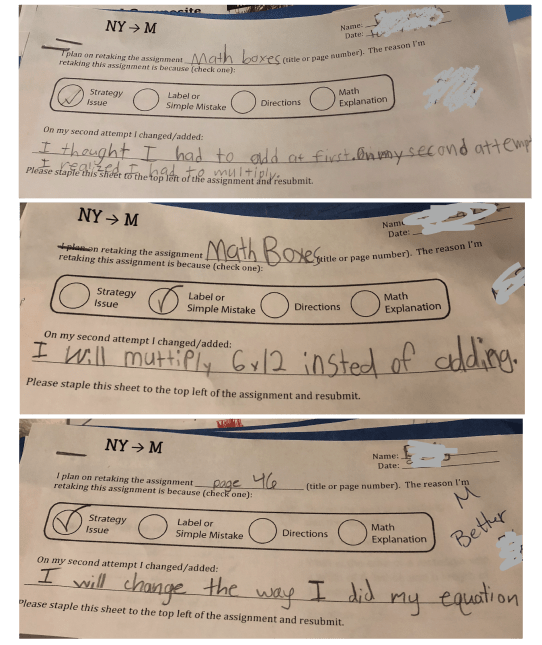
The blue circles were entered on the sheet based on the most common errors that I found on quizzes.  I made sure to model this with the class before students filled them out.  I gave examples of why someone would check each box.  After a number of questions, students felt more comfortable in deciding which circle to check – some even thought that multiple circles could be checked.  Why not?  I noticed that students would determine which circle to check depending on their perspective.  Check out the three submitted sheets below.  They all are for the same problem, but fit different categories.

MathCoding-01.png

This is interesting because students were starting to analyze their results with a more critical eye.  This is progress, positive progress.  Even with that being said, we have a long way to go.  I need to be more clear on how students should differentiate between a simple mistake and directions.  I also need to clarify and give more examples of what a strategy issue means.  I think some students have been using the updated sheet with integrity, while others might not be using them as well since their perception of the categories isn’t clear.  I believe this is more of a teacher and modeling issue than a student issue.  I’m looking forward to creating a few different activities for next week to help students becoming better at categorizing their errors and misconceptions.  At some point I’d like that awareness to lead to action and eventually goal setting.  One step at a time.

Student Self-Reflection and Common Math Errors

Screen Shot 2018-09-22 at 2.31.17 PM

My fourth grade students took their first unit assessment of the year last Wednesday.  This is the first class to take an assessment this school year.  The unit took around four weeks and explored topics such as area, volume, number sentences, and a few different pre-algebra skills.  This year I’ve been approaching student reflection and unit assessments differently.

Students were given their study guide during the first couple days of the first unit.  The study guide included questions that covered topics that would be taught throughout the unit.  At first students were confused about how to complete items that we haven’t covered yet.  Eventually students became more comfortable with the new study guide procedure as we explored topics and they completed the study guide as the unit progressed.  There were a couple of students that lost their study guides, but they were able to print it off from my school website.  I reviewed the study guide with the class the day before the test.  It took around 10-15 minutes to review, instead of around 40-50, which has been the norm in the past.

After students finished the study guide the class reviewed the skills that were going to be assessed.  Students informally rated where they were at in relation to the skill.  I decided to move in this direction as I’m finding that reflection on achievement or perceived achievement doesn’t always have to happen after the assessment.

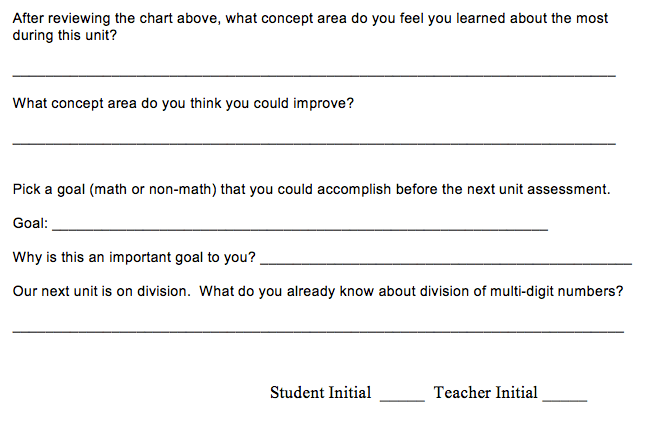
Students took the test and I passed back the results the next day.  Like in past years, I have my students fill out a test reflection and goal setting page.  This page is placed in their math journals and I review it with each student.  I decided to use Pam’s idea on lagging homework/coding and add this to my student reflections.  Last year my students used a reflection sheet that indicated problems that were correct or incorrect and they developed goals based on what they perceived as strengths and improvement areas.  This year I’m attempting to go deeper and have students look at not only correct/incorrect, but also at error analysis.

So I handed back the tests and displayed an image on the whiteboard.

mathcoding -01.png

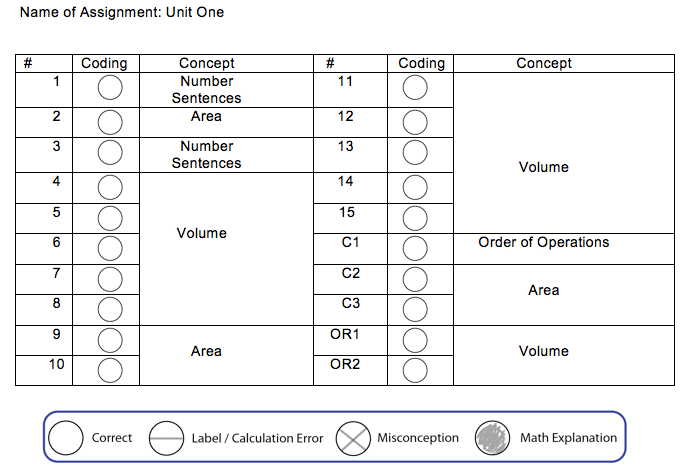
I told the students that we’d be using coding in math today.  I reviewed the different symbols and what they represented with a test that was already graded.  Each question would be given a code of correct, label / calculation error, misconception, or math explanation. I gave multiples examples of what these might look like on an assessment.   I spent the bulk of my time introducing this tool to the misconception symbol (or as some students say the “X-Men” symbol) to the students.  After a decent amount of time discussing what that looks like, students had a good feel for why they might use the math explanation symbol.

I then passed out the sheet to the students.

Screen Shot 2018-09-22 at 2.07.02 PM.png

Students went through their individual test and coded each question based on the key.  At first many students wanted to use the label/ calculation error code for wrong answers, but then they stopped and really looked at why their answer didn’t meet the expectation. In some cases, yes, it was a label issue.  Other times it was an insufficient math explanation.  Most of the students were actually looking at their test through  different lens.  Some were still fixated on the grade and points, but I could see a shift in perception for others.  That’s an #eduwin in my book.

This slideshow requires JavaScript.

After students filled out the top portion of the reflection sheet they moved to the rest of the sheet.

Screen Shot 2018-09-22 at 2.11.02 PM.png

Students filled out the remaining part of the reflection sheet.  They then brought up their test and math journal to review the entry.  At this time I discussed the students’ reflection and perception of their math journey and I made a few suggestions in preparation for the next unit.

At some point I’d like create an “If This Than That” type of process for students as they code their results.  For example, If a student is finding that their math explanations need improvement then they can ________________ .  This type of growth focus might also help students see themselves as more owners of their learning.  I’m looking forward to using this same process with my third and fifth grade classes next week.

Third Grade Math Confidence

Screen Shot 2018-09-15 at 3.06.58 PM

My third grade students have been working on rounding and estimating this week.  It’s been a challenge as these concepts are fairly new to the entire class.  We’ve only been in school for only three weeks but I feel like we’re in stride now.  Kids and teachers both are in a routines and tests are already on the schedule.

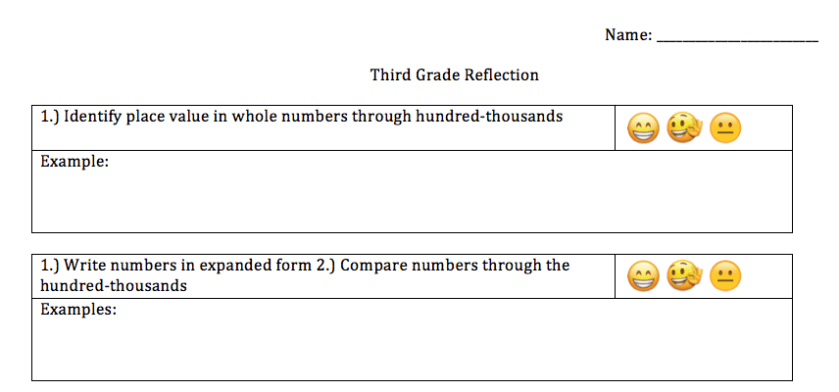
Back to rounding and estimating.   So students have been struggling a bit with these two concepts as we head towards using the standard algorithm. With that struggle comes a shake in math confidence.  Students needed to be reminded of our class expectation of “lean into the struggle” many times during the past week.  It’s interesting how a student’s math confidence changes throughout a unit, or even throughout the year.  This third grade class in particular is working on becoming more aware of their math performance compared to what’s expected.  In order to reach that goal, I dug back into my files and found a simple, yet powerful tool that might help students on this awareness math journey.

Screen Shot 2018-09-15 at 2.50.55 PM.png

Basically, students first read the top row goal. They were then given a die to create an example of the goal.  During this process students circled one of the emoji symbols to indicate their confidence level.  The extremely giddy emoji indicates that they could teach another student how to complete the goal.  The OK smiley means that you’re fairly confident, but feel like you might not be able to answer a similar question in a different context.  The straight line emoji means that you’re confidence is lacking and you might need some extra help.  This paper wasn’t graded and that was communicated to the students.

Regardless of the emoji that is circled, students are required to attempt each goal.  Some students were very elaborate with explaining their thinking, while others tried to make their answer as concise as possible.  After completing this students submitted their work to an online portfolio system so parents can also observe progress that’s been made.  So far it’s been a success.  I’d like to use this simple tool for the rest of the first unit and possibly the next.  It takes time, but as usual in education, the teacher has to decide whether it’s worth that time or not.  In my case, the student reflection has meaning and it’s directly tied to the goals of the class.  I’m looking forward to seeing how these responses change over time. Feel free to click here for a copy of the sheet if you’d like one.

Volume and Group Tasks

2examples-01.png

My fourth grade students have been exploring measurement and geometry during the past week.  They started out by learning about perimeter, area, and are now in the midst of discussing volume.  Students are working on a project where they’re building rectangular prism models and constructing cities.  They document the dimensions, cut out the rectangular prism that matches the measurements and places it on a map.

The groups have been working diligently over the past days.  What I found interesting on Friday were the student conversations.  As I peered over each group I eavesdropped on what was being said.  Students are in groups of 2-3 and there’s plenty of conversation happening.  Students are recognizing that the length, width and height all impact the volume of a rectangular prism.  Mistakes are also happening.  That’s a good thing.  Students have had to use multiple grid sheets because they either cut out the faces too large or too small.  They just grab another grid sheet and start over again.  Their perseverance and being able to “lean into the struggle” is evident and I made sure to remind them of that.  Students were even getting creative in adding sunroofs and open decks with their prisms.

Projects like this take time, but they’re often worthwhile in helping students build conceptual understanding.  I’m looking forward to adding a question component for the groups on Monday.  The questions will relate to cubic units and how the volume is found when combining multiple rectangular prisms.

I believe that this activity helps students apply volume formulas.  I want students to come away with a better understanding of why the formula V = b*h is used and have them feel more confident in being able to see geometry/measurement relationships.

After this activity students will take a brief formative checkpoint where they’ll be answering questions similar to the below image.  This is also how students will be assessed in a couple weeks.

3dcomboshape

The projects should be finished by the end of the next week.  I’m looking forward to seeing how the cities finish up and the student reflections that follow.

Math Exposure Isn’t Enough

A few months ago I remember sitting in a meeting where teachers were discussing students and their math placements.  The conversation revolved around the topic of whether students should change math placements for the next school year.  For example, should a student stay in a homeroom math class or be part of an accelerated class?  How will we provide additional math support for particular students?  These types of questions tend to occur throughout the school year, but action for the next year often takes place near the end of the school year.

The decision to change placements is based on a variety of factors, but many schools/districts narrow down their criteria using standardized assessment data.  That data is often in the form of achievement, cognitive, and/or even aptitude tests.  Each district that I’ve been in has had a different process to determine subject placements.  This placement process becomes even more apparent as students travel from elementary to middle or middle to high school. Students’ birthdates, norm-referenced test scores, and percentages often take center stage during these decisions.  Sometimes the conversation evolves into whether students would be able to transfer the skills to a more rigorous math program than the one that they’re currently attending.  The conversations are usually productive and emphasize how to best meet the needs of students.

The topic of exposure is often brought up when making these types of math placement decisions.  A quick Google search will bring up one of the definitions – “introduce someone to a subject or area of knowledge.” I have heard on more than one occasion the following paraphrased statements/ideas:

  • If students haven’t been exposed to the content then they won’t be prepared
  • Those students weren’t exposed to above grade level work so they won’t be ready for that class
  •  The reason the student scored at the ___%ile was because he/she was exposed to that skill before the test
  • If they’re not exposed to this class then they won’t take higher-level classes in high school

I feel like these types of phrases are thrown around lightly and in a way that doesn’t hit at a bigger issue  Being exposed to content doesn’t necessarily equate to applying it in different situations.  Showing a students how to complete a specific skill/process doesn’t mean that they fully understand a particular concept.  Students might understand a process, but are limited during the application stage.  Also, educators need to keep in mind whether an above grade level curriculum is developmentally appropriate for students.


I believe the bigger issue here is equity.

  • Are all students receiving high-quality math instruction?
  •  Do the tasks and math routines allow students opportunities to explore mathematics and build solid understandings?  
  • Do students need enrichment opportunities instead of acceleration?
  • Will being exposed to a new curriculum/topic/grade-level be the panacea to move students to a higher math placement?  Is that even a goal?  

So many questions are above and I’ll admit that I don’t have a solid solution for them.  I think we have to go back to what a school/district values. I do know that I want students to be curious about math and dive into its complexities.  Classrooms should develop a culture where taking mathematical risks is the norm.   High-quality math instruction takes investment from a school and district.  Ensuring that this instruction is occurring and support is provided is also important.  Mathematical tasks that encourage students to observe, create, and apply their understanding beats limited exposure any day. Exposure is the first step and it doesn’t end there.

Community Building and Content

I think it’s safe to say that I’m slowly transitioning into school mode.  It’s inevitable and happens every year, but the month of August seems to fly by as a new school year approaches.  Over the past few weeks I’ve bought items for my classroom and have started some planning here and there.  Next week I’m planning on dropping by my room and start the unpacking process (I changed classrooms).  That is unless HGTV decides to makeover my classroom over the weekend.  So right now I’m drinking coffee and being a bit reflective.  I’ve opened up my planbook and am starting to ink in the first couple days.  While doing this a few questions have crossed my mind.

Will students be receptive to the beginning of the year tasks/activities? Are the activities related to my content area and does that matter?  Will the activities be remembered one day, five days, or even five months from now?  How will the activities impact the rest of the year and how will students remember them?

Many students get excited about new tasks or activities.  I find this happens quite frequently at the elementary level. The beginning of the year often yields plenty of classroom community building activities.  These may or may not be associated with the content that’s taught.  The emphasis is on building a positive classroom environment and often helps set the stage for the rest of the school year.  During this time students often work in groups and there’s generally a reflective piece near the end where a consensus is made.  Sometimes the classes develop norms and touch on the idea of growth mindset.  Usually these activities end after the first few days of school.  As the community building time ends students know what’s going to happen next.

Screen Shot 2018-08-10 at 9.58.50 AM
Should this be the process?

A shift is approaching and then it comes.  Kids know this and so do the adults.  All of a sudden homework starts being assigned and lesson sequences arrive.  It’s no longer “community building time” and we’re now in (insert your content area) time.  It’s often expected that the norms that were established and community building will last throughout the year.  It’s been established, right?

Not so much.  I find that teachers have to revisit the community building, norms and other themes periodically – not just after a long break. Otherwise those themes become like the posters on classroom walls – ignored after a certain amount of time. Students are used to playing the game of school.  Having novel beginning of the year activities and building a classroom community aren’t mutually exclusive.  Students and teachers are often reminded that the culture of the classroom is always evolving.

There’s often a perception that teachers need to dive into curriculum as fast as possible.  This is often perpetuated with scope-and-sequence guidelines and expectations.  Why not blend the community building activities and your content area?  That’s why I’m a fan of having math as part of the community building process.  Blending in content and community building can happen and I think it helps the sudden transition that sometimes becomes apparent.  I think also revisiting some of these community building activities throughout the year can give perspective and remind everyone of the importance.

Back to School Night

My school’s Back to School night (also known as Curriculum Night) is in a few weeks. Usually this presentation creeps up on me and I end up tweaking last year’s slides for this annual night.  This year I’m trying to be a bit more productive and get my plan started before the school year begins.  It also helps that @druinok has a great #MTBoSBlaugust initiative this month so I can actual address this now!  Better now than later, as once school starts it gets a bit hectic with time management.

I generally have about 30 minutes with parents during Back to School night.  My time occurs before the principal has an annual address.  I usually have around 30-40 parents come into my classroom to hear about what the class is all about and they also sign-up for conferences.  It’s usually a rush to get a preferred time.  You’d think that we’d move to an online system, but not yet. I try to pack my room with adult-sized chairs, but there’s usually quite a few that are standing. Parents sign-up for parent/teacher conferences during this time so it’s usually a packed room.  I loop with almost all of my student for three years, so some parents sign-up for conferences because they already have an idea of the policies and procedures and head out.  Newer parents often stay to hear about the class.  I also mention earlier in the year that the Back to School Night presentation is on my website.

I start off the presentation with introductions.  I usually say this is my ___ year in the district and tell everyone to hold onto the questions until the end.   Every year someone still asks questions around the second slide.  Go figure :-).  We go through an agenda to give everyone a heads-up to what’s coming.   I review the materials that are needed for the course.

Screen Shot 2018-08-01 at 7.58.33 PM.png

These supplies generally last for a few years.  Each item gets a whole lot of use throughout the year.  The first one to go is the accordion file as students put in their homework, quizzes and sometimes even their journals in there.  I have a roll of duct tape  on hand for the accordion files that don’t hold up.  The “pro” compasses are the best and I try to get a hold of them when I find them on clearance.

The next few slides discuss the different classroom routines, tasks, and resources that will be used for the year.

Screen Shot 2018-08-01 at 8.20.12 PM

I discuss how the adopted-text that we use spirals and there’s a large emphasis on problem solving / application.  I also indicate the different resources and activities that take place during certain grade levels.  I usually have an example that I can refer to but I have to keep it to a minimum because of time.  I usually get some curious eyes when I bring up the Stock Market Game, Estimation180 and AlgebraByExample.  Around 5 – 10 minutes is spent on this particular slide.  It’d be amazing if I could have the parents actually participate in one or two the activities. Maybe during a math night at some point?

The next slide communicates the homework policy.  Basically, I state that it’s not part of the overall grade, but expect to see it come home around 2-3 times a week.  Over the years I’ve reduced the amount of homework that I generally give.  I find that the students that actually need the practice don’t complete it and I’m eventually chasing down those that don’t turn it in.  It adds some unneeded anxiety for just about every party involved.  I’m actually even thinking of dropping this down to 1-2 times.  I’m still internally debating this issue even as I write this post.  I then discuss the grading scale which is 50% tests and 50% quizzes.  I also mention how students are able to retake certain assignments.

I then mention how to access the school math resources.  I point the parents to the school website and how to access the student portfolios on SeeSaw.

At this point I have around 5 – 10 minutes left and then answer questions.

Screen Shot 2018-08-01 at 8.38.18 PM.png

I have a list of FAQ questions and  mostly relate to how parents can contact me.  I mention that the study guides will be available on my website.  This is new this year and something I’m encouraged to try after reading Make it Stick. I try to end the time on an important point.

I use Fawn’s slide and go through her points.  I generally follow the same plan for the past few years.  You can find more information about how I use this here.

Screen Shot 2018-08-01 at 8.41.38 PM.png

I feel like ending on this slide is powerful.  I want to ensure students create their own math identity in my classroom.  There’s some resistance to this (especially # 1) but I feel like parents are receptive to the idea as they see their children develop perseverance skills and develop self-confidence.

My time is generally up after this last slide.  I remind parents that they should sign-up for a conference before leaving.  I usually walk with a few parents down to the auditorium where the principal gives her address.  I’m looking forward to this night seeing that I feel better prepared now.  🙂

Study Guide Issues

Screen Shot 2018-07-22 at 9.01.21 PM.png

This past week I started working on my school website.  It’s a journey every year, but this year is a bit different since my district adopted a new math text and quite a few of my links need to change.  In the past I’ve posted homework, a few math strand practice sections, and class newsletters to my website.  I’ve decided to change a few things up for the 18-19 school year.  I’m nixing the homework section and adding a study guide piece.  The reason I’m adding a study guide section is because I’m not thrilled with how it’s currently being used.

Study guides have been a sticky issue for me over the years.  There are so many different ways that they’re used.  My class tends to give and review a study guide a day before the unit assessment.  Each teacher in my school uses them slightly differently, but the process usually follows this sequence:

1.) Students use class time to complete the study guide

2.) Study guide is reviewed by the class and teacher

3.) Students correct their answers and feedback is provided

3.) Students use the study guide to prepare for the test

It seems that most teachers use some version of a study guide or review before an assessment.  Some teachers use games, while others go the paper and pencil route.  I think it truly depends on the teacher and their students.  This study guide process works well for many students, but I think it needs some tweaks and to a certain extent, improvements.  This summer I’ve been reading Make it Stick and it affirms some of what I’m seeing when it comes to memory retrieval.  Teachers want students to be able to retain what’s experienced in the class and giving a study guide with only that night to prepare isn’t as helpful as other strategies.  I’m starting to become more critical when it comes to questioning study guide practices. I sent out a Tweet indicating my concerns.

Here are my issues:

  • Students aren’t being given enough time to process what’s being discussed on the study guide
  • Students aren’t benefiting from enough retrieval practices
  • Students solely rely on the study guide to review for the test
  • Students might not be engaged or they decide to copy the answers from their partner
  • Students aren’t aware of how to study (this could be a whole different blog post)
  • Students aren’t experiencing enough reviews throughout the unit
  • The questions on the study guide are very similar to the actual test

I’m aware that some of these issues will occur regardless of the policies or procedures that are put in place.  I’d like to specifically address the blue issues in this post.

  • Students aren’t being given enough time to process what’s being discussed on the study guide 

In order to give students more time to process the study guide I’ve decided to give the packet in advance.  This requires more planning on my part (let the uploading and copying process begin!).  I’m planning on posting the study guides on my school website and giving students a paper copy at the beginning of the unit.  Students will have 4-5 weeks to finish up the study guide before the assessment.  In addition, this will help students preview the learning, as Mary pointed out.  It’s likely that some students will lose the sheet as they’ll need to hold on to it for about a month.  That’s why I’m deciding to post the study guides.  I’m also planning on having students code their work with a few self-monitoring strategies. I really like the completed, mistake, misconception, and correct coding.  Occasionally the class will review concepts discussed on the study guide so that the class won’t have to wait until the last day before receiving feedback.

Giving students more opportunities to experience math has its benefits.  Being more  intentional in how retrieval practices look is important.  I currently have specific exit cards and review checkpoints that are used for particular units.  I’m planning on creating more and placing them strategically throughout the units.  I’d like to give students multiple opportunities to address standards and receive feedback.

  • Students aren’t experiencing enough reviews throughout the unit

Moving forward, I think students need to have the opportunity to review topics as the unit progress.  The text my district uses has reviews, but the students need more opportunities to address skills that are taught at the very beginning, middle, and end of the unit.  Like David said, I’m planning on adding deliberate interleaving of concepts to the study guide.  That may add additional questions to the packet, but I think it’s worthwhile.  I also need to keep in mind that students will have around a month to work on the packet.

  • The questions on the study guide are very similar to the actual test

I’m conflicted with this.  I think students should be aware of what skills are on the test and the format shouldn’t be a surprise.  Being unfamiliar with the questions or format can cause anxiety.  There’s already enough anxiety surrounding testing.  I think sometimes giving questions that are too similar can cause students to be overconfident.  I think there’s a balance, I just haven’t found it yet.  I’m placing this bullet point in the ‘to be continued’ section.

From here, I’m currently updating my school site to include study guide materials.  It’ll take a shift in expectations as I loop with many of my students and they’re not used to that process.  Change is inevitable and I believe being aware and making a shift will benefit students. I’m looking forward to seeing how this process plays out and will write a post about it at some point.


SaveSave

More Accurate Self-Reflections

Screen Shot 2018-07-17 at 5.07.41 PM

Improving how students reflect on their math progress has been one of my goals during the past few years.  It’s a topic that I’ve been trying to incorporate more in the classroom. That reflection piece in my classroom has changed quite a bit since starting this journey.

Last year students would take an assessment, review their scores and then fill out a reflection sheet.  Students filled out the reflection sheet the best that they could.  The students and I would review the test and reflection sheet to determine the next steps.  Some reflections were spectacular and had a lot of insight, others didn’t. Most of the time the next steps included items like studying more before the test, reviewing a certain concept in more detail, practicing specific skills, or dedicating more time to the subject.  I’ll admit that too many of the nexts steps were vague and wouldn’t match the SMART criteria.  I was glad students were creating goals and following through.  Refinement was needed, but I appreciated that students were lifting up more responsibility for creating their math identities. The students did a fine job following up with the next steps, although this was inconsistently implemented.  I’d check-in on goals during the next reflection time.

While reading Make it Stick (I’m on the second renewal from the library), I found something that I’d like to keep in mind for the new year.  In chapter five the authors discuss the Dunning-Kruger effect.  Research has shown that people (students) sometimes overestimate their own competence.  They “… fail to sense a mismatch between their performance and what is desirable, [and] see no need to improve.”  As I continued reading I found that lower-performing students were the most “out of touch” in gauging how well they were doing compared to the standard.  After reading this I started to think about how students accurately reflect on their math progress.

Students are often asked to compare their work to the criteria for success.  The points/letter on the top of graded work is generally perceived in black and white.  Students either view themselves as doing great or poor.  There’s nothing in the middle.  I rarely have a student that says they had an average test.  This becomes even more evident when students complete the reflection and goal setting sheets.  I’ve had a number of instances where students can’t come up with a goal for themselves.  Through probing questions I’m generally able to help students create a goal that is worthwhile, but this doesn’t always happen.  I believe math confidence and adopted math identities play a role here.  The perception is stuck on the score and it’s challenging to move beyond that number.  Maybe it’s because students aren’t as familiar in gauging how they’re performing compared to the standard? I’ve used different methods to encourage students to look at skills compared to points and this has helped, albeit the success using the table has been inconsistent.

Screen Shot 2018-07-17 at 5.24.03 PM.png

The authors of book discussed an experiment where poor performers improved their judgement over time.  These students received training specifically on the test concepts before the assessment. That time spent improved their self-reflections and they were more in-line with reality.  Basically, the students are better able to show sound judgement during self-reflection if they understand the concepts.  Accurate self-reflection becomes an uphill battle if they don’t.

Moving forward I’d like to spend more time discussing error-analysis and misconceptions with the class.  When students are aware of how these specifically exist then they’re better able to analyze their performance.  Pre-loading that meta-cognition piece is something I want students to keep in mind during the self-reflection process.  I think it will deter students from making statements like “I don’t know what goal to make” or “I need to work on everything.”  These types of statements are disheartening.  I think having exemplars might help instead of just diving in and asking students to reflect.  Having a clearer direction and possibly having a reflection time that occurs more frequently could also help.  Math isn’t always perceived as a subject where students are asked to create some type of narrative and connect to the text/content. I find that students rise to the challenge when I give them an opportunities to do so.  I believe that giving students opportunities to analyze, reflect, and set goals for themselves will empower them to create more accurate math identities.