Inservice Days

Many district are is in the midst of planning their 2016-17 inservice/institute days.  These days, sometimes called PD days, often include communicating initiatives aligned to district goals.  Sometimes school goals are included in this process.  As far as I can remember inservice days have always been part of my school year.  The content is sometimes applicable to what’s happening in a particular school, other times it’s more aligned with a district goal. Most teachers have experienced successful and unsuccessful sessions.

Last night I came across this Tweet:

David asked an important question.  I’m not an expert in the field of PD, but I’ve experienced some amazing and not-so-amazing sessions in the past.  I’ve also put together plans for PD and other sessions.  Through this experience I’ve been able to evaluate PD sessions a bit better.  Below are four questions to consider before putting together a PD session:


Are there clear expectations?

Being intentional in communicating expectations is key.  I’m not necessarily talking about listing the objectives of the session. I’m more concerned in what participants should be able to do with the information after it’s been delivered.  How will this impact teaching and learning?  Having a clear understanding of what’s expected and a timeline can help avoid confusion.

Is there an explanation of why?

I think this is sometimes missing from PD sessions.  Why are we learning about guided math, reading workshop models, grading practices, etc.?  Giving the why can help people understand the reason for a particular session.  If it’s not explained than staff may feel as though the reason is directly associated with someone not in the school, which may or may not be a good thing.

Will there be opportunities to revisit this initiative?

Educators aren’t generally fans of participating in a PD session that communicates that what’s being discussed will be fully implemented but it doesn’t happen. If the expectations is that all classrooms need to do x, y z than that should actually happen.  Starting an initiative and abandoning it halfway through the year doesn’t help with rapport or climate.  A successful PD session allow opportunities for additional help and follow up as needed.

Is there a reflection opportunity?

This may be more of a matter of personal opinion.  I tend to learn best by reflecting on what I’m learning and finding ways to practically put it into practice.  That reflection can happen after the session but embedding it in the session can be a valuable.  Sometimes a reflection opportunity can reveal itself through follow up conversations.  It also keeps the conversation going to ensure that consistently is occurring in a school/district.


When creating a PD session I tend to consider the questions above.  The questions aren’t always applicable, but it’s a place to start.  Would you add any other questions?


Reflection

mirror-01

It’s official.  The 2015-16 school year has concluded.  The final bell rang last week I’m starting to look at my summer book list. My reading takes on different forms during the summer.  I have a few books on hold at the local library just for that purpose.  I’m looking forward to digging into those later this week.  Before reading these I enjoy catching up on blogs that I missed during the last hectic month of the school year.  This year I’m also looking back at my personal goals for this past year.

As I reflect back on the school year I often categorize how classes went that year.  Were the classes successful?  How did students learn?  Did I create an environment that optimized student learning and their curiosity?  Did I leave a lasting impact that students will remember?  How many of these students will invite me to their graduation.  Okay, the last one was a joke.  Kind of.  I tend to reflect back on these questions as well as others.  Last August I wrote a post about the goals that I had for the new school year.  This post is designed to reflect on those goals.


1.  I plan on taking the first few days of school to engage students in community building activities. The class will be completing a “get to know you” survey and set expectations for the class. We’ll also be completing the marshmallow challenge and have some rich conversations around math and mindset. I feel like instructional strategies make little impact if students have a fixed mindset. The same could be said for teachers. Before delving into content I want to ensure that the classroom community is moving in the right direction.

Looking back, I was ambitious with my planning.  At the time I thought this was a realistic goal.  I started off the school year with community builders.  We completed the marshmallow challenge and other activities.  I didn’t actually survey the students.  Instead, students wrote in their journals about math experiences.  I reviewed their journal entries and had brief conversations with each student.  The students felt comfortable in the classroom and seemed to develop rapport with each other.

I didn’t get into the rich discussions about math mindset as much.  Having a growth mindset has been emphasized in my district but the practice of it in individual classrooms vary. This is also a byproduct of the mindsets coming from other students, at home and at school. Honestly, it was challenging to not dive into content immediately.   Regardless, the classroom community was set on a sound foundation.  That foundation played a pivotal role throughout the rest of the school year.

2. I‘d like to make learning more visible in the classroom. I’m planning on having students use math journals to reflect and document their learning journey. I’m also planning on using effect size data to show student growth over time. To do this I’ll need to create additional pre-assessments to analyze pre/post data. I’m also planning on moving away from letter grades on unit assessments. Instead, I’m going to have students reflect more on the skills being learned in class.  This is a change from past practices so a lot of modeling may be needed.

I had students use math journals this year.  I intentionally had students use them to reflect on assignments/projects throughout the year – more so at the beginning of the year.  I also dabbled with students using foldables this school year.  The foldables were used primarily for process-oriented skills involving conversions.  These were glued or taped into the student math journals.  By the end of the school year the math journals were thick and looked like scrapbooks.  I’m looking at changing this format next year.

I used effect-size with one of my classes this year.  Students took  a pre-assessment and explored a particular concept for around three weeks.  After the three weeks, they took the same pre-assessment.  I calculated the effect-size and placed the data in a spreadsheet that was shared with my teaching team and administrator. I felt like this was good practice as my district is moving towards effect-size next school year.  Students received both the pre-assessment and assessment back at the end of the unit to see how much progress was made.

My unit tests didn’t include letter grades on the top of them.  This seemed to bother some students as they wanted to know their exact grade.  By the end of the year, all some students weren’t as concerned about the percent/grade.  I emphasized, as much as I could, that the skills were the focus.  I believe progress was made in this area and I’d like to keep this practice intact for next year.


I tend to agree with the philosophy that deep reflection can lead to growth.  I’m looking forward to the new school year in August and have some new goals that I’d like to put in place.  For now, it’s time to reflect and recharge before the new school year comes around the bend.

Google Forms and Presentations

Google Forms

My 3-5th grade classes are finishing up their math genius hour projects this week.  Fittingly, it’s the last the week of school so we made it just in time!  I have two days to fit in 15 project presentations.  This last round of projects lasted around two months and the final projects will soon be revealed.

Students created questions, found a math connection, researched and are presenting this week.  During the last two years students present their projects and the audience asks questions about the topic. This technique seemed to work but I tended to have the same students ask the presenter questions.  Around five or so of the same students asked the presenters questions.  In a class of 25 that’s not ideal.  It was great that the students were asking questions, but five or fewer was disappointing.  Bottom line – the audience wasn’t as engaged as they should be.  So this year I decided to give the audience more of a voice in the process during genius hour presentations.  This actually stemmed from a class that I took this spring about using Google tools in the classroom.

One of the assignments required students to create a Google Form that could be used in class.  My first thought was to create a student rubric for presentations.  I decided to create my own after dabbling around the Internet for a few examples. Initially the form was going to be used by the teacher to evaluate presentations.  After starting the form I changed my thinking.  I thought about possibly having all of my students use the same form to evaluate the presenter.  The genius hour feedback form was built from that idea. Click the image below for the form.

Feedback Form

This week my students have been using the form to evaluate their peers.  Students are asked to present their projects while the audience listens.  At the very end (not at the beginning as some students want to get a head start) students take an iPad and scan a QR code to access the Google Form.  Individual students evaluate the speaker and submit their response.  It’s not confidential as students have to pick themselves (the evaluator) and the presenter.  I tell the students that this information will not be revealed to the presenter.  So far it’s been working well.  The last presentation took less than 2 minute to collect 21 feedback submissions.  Another bonus is that you can have a class conversation about the overall quality of the presentations.

Data

I then export the file to Excel, hide the evaluator column and then print out the sheet for the student.  The student is then able to reflect on the data at a later time.

Photo May 31, 1 38 29 PM

The form needs some work as I’m thinking of making some of the questions more clear.  I’d also like to add a section on the form where students can ask the presenter questions.

Rates and Pizza

Photo May 20, 9 27 29 AM.jpg

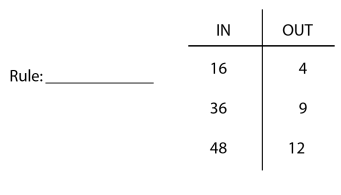
My third grade class is studying unit prices this week.  They investigated in/out tables on Monday and determined how to find missing values.  During this process students started to explore strategies to solve function machines.  The class transitioned to unit prices on Wednesday.  This was more challenging, especially when students needed to find the price per ounce.  Being able to round answers and place the decimal in the appropriate place seemed to cause some issues.  Students knew what operation to use but had trouble placing the decimal.

On Friday students started off the day with a brief activator involving price per ounce.  Students were given three Starbuck cup sizes.  They had to find the price per ounce.  Students worked in groups and experimented with different strategies to find the right place to put the decimal.  The groups checked their reasonableness by multiplying their unit price answer to find the total price.  This took around 10-15 minutes.  Click here to find the template.

Screen Shot 2016-05-20 at 7.25.27 PM

After this activity the class formalized a process to find the unit price of an item.  We then moved to the main project for today’s lesson.

Students were given iPads and asked to visit a pizza site.  The site was up to the student.  Students visited Papa Johns, Pizza Hut, Giordano’s, Dominos and Lou Malnati’s websites.  They were asked to customize one large pizza.  Students put together their dream pizza and found the final price.  In order to be consistent students were told that each large pizza has around nine pieces.

Photo May 20, 9 30 54 AM.jpg

Photo May 20, 9 18 19 AM

Students took a screen shot of their fake order and saved it to their camera roll.  They submitted their screen shots and added a caption that included a number model of the unit price.

Screen Shot 2016-05-20 at 8.22.06 PM

I’m reviewing the student screenshots tonight and am finding that students are becoming better at understanding unit rates.  Next week we’ll be looking at better buy problems.


Reasonable Answers

Photo May 13, 10 48 46 AM.jpg

This week my third grade class started to learn about measurement.  Measurement is one of those topics that doesn’t see much light of day.  Number lines and computation are very prevalent in elementary classrooms, not so much with measurement.  This is especially the case when it comes to metric measurement.  Every grade level teaches a form of measurement, but conversions aren’t discussed on a regular basis.

As I was looking for ways to review I came across a gram measurement set in my school’s storage room.  I was looking for a digital scale but couldn’t fine one.  I dusted off the tiny weights and also found a balance.

Photo May 13, 10 45 53 AM

Winner!  So I brought them back to class.  The next day my third grade class had a discussion about how to calibrate a balance and use small weights to find measurements.

While reviewing I started to find that students struggled with the reasonableness of their answers.  They had trouble identifying what a gram, 100, or even 100 grams really looked like.  They had an easier time with conversions, but that is more of a process and not an understanding.  So I brought the class to the back table and found an empty container.

Photo May 13, 10 46 05 AM

It measured exactly 510 grams.  It was empty so students knew that it couldn’t be that exact amount Students took turns and added the weights to see if they could balance the equation items.

Photo May 13, 10 46 40 AM
Not balanced

Students were excited to add/deduct the weights to find balance.  It seemed like a puzzle to them.  The balance was even at 41 grams.

Photo May 13, 10 50 04 AM
Even steven

It took a small amount of time before students calculated that the oats would weight approximately 510 – 41 = 469 grams.  This also led to a quality discussion about the weight of products vs. the container that it fits in.

This was decent activity to bring out a better understanding of what a gram really is.  Next week we’ll be exploring kilograms.

Circles and Area

Photo May 06, 7 29 02 PM

My fourth grade crew started to explore circles this week. They looked at the circumference, diameter, radius and area of circles. They’ve had a bit of experience with them earlier in the year during Pi Day. That day was long forgotten this week. The class started with a large dose of reviewing the concept of area and circles. I noticed that some of the students wanted to immediately use the formula to find the area of a circle. For a few, the process of giving the formula to the kids has caused a headache down the road. They know the formula and some even have it memorized. When asked to define the area of a circle they revert back to formula. When asked what the formula means some of the students repeat the formula back to me. This is a red-alert in my mind – indicating a lack of conceptual understanding.

The class went back a few steps to the area of rectangles and triangles on a grid. After a brief review I observed that students were able to 1) describe what area is 2) Use a grid to count squares to determine the area. Students then said it would be much easier to use the formula. So we used the formula and then went back to circles.

Instead of jumping to the formula like I said earlier, the class took out centimeter grid paper. Students traced circular items onto the grid paper and counted the squares.

Photo May 06, 7 28 55 PM.jpg

This seems boring looking back and as I write this but it was a worthwhile activity in retrospect. Students then found the radius of the traced item. It was fairly easy as students could count the centimeter squares.  They used the radius, multiplied it by itself and found the product. They then multiplied that by 3.14, which is our abbreviated version of Pi.

The goal was to get our answers between three and four centimeters. Many of the students had trouble at first but refined their counting methods to be more accurate. I could see some of the students making the connections between using the formula and an understanding of the area of a circle. Eventually students started checking their work by using the area of a circle formula.

Near the end of class students started asking what happens when we can’t actually count the squares of an object. Another student mentioned that we use the formula. That brought out a quality discussion about understanding the formula and why it works.  We’re making progress.

Formative Assessment Gems

FormativeImage-01.png

My own formative assessments have changed over the years. Being able to quickly assess where a student is at in relation to the standard helps me make decisions. These decisions impact classroom lessons and activities. I’ve always been a fan of exit slips and quick review checkpoints that see if students understand what was discussed during a particular lesson. Most of these take on a paper form. In fact, one year my district’s math committee spent almost an entire year working on these types of formative assessments. I still use some of these and find them valuable. These exit slips are usually split into a half-sheet with a small amount of questions related to the skill for that day. Students complete it in around 5-10 minutes.

This year I’ve been relying a bit more on digital formative assessments. These projects involve having students explain their math reasoning through some type of digital recording.  Lately I’ve been using Recap (Thanks Kirk!) and Explain Everything for this. Students generally follow a rubric and submit their file to me via SeeSaw or Showbie. In my experience, audio or video formative checkpoints are much more valuable than other formative assessments. Not only can I view these checkpoints at a later time, I can also check for vocabulary use and hidden misconceptions that a student may have adopted along the way. I generally can’t uncover that as easily with an exit card.  Moreover, students and parents can review their recordings over time.

I believe all formative assessments have some type of value. The extent of the value depends on how it the checkpoint is used. Blending formative assessment strategies has its advantages. I want to be able to gauge student understanding and give feedback that helps connect understanding. This isn’t always possible with standard curriculum guides.   Looking beyond the traditional blackline masters may yield better results.

Open House Questions

School-01

My school had its official open house last week.  This anticipated annual event invites parents to visit the school for to take a look at what’s happening in the classroom.  This is not a time for parent conferences but an opportunity for parents to visit the school, meet teachers and get a glimpse of classroom happenings. It’s a busy night.  Students often become tour guides and they lead their parents through the classroom that they’re in throughout the day.  Parents often look forward to this night as they can see their child’s work.  Each teacher puts their own spin on the night.  Some grade levels work together and have the same theme or activity while other teachers have a school scavenger hunt.

For teachers, it can be a whirlwind of a night. Setting up activities, organizing work and finding ways to hang up student work is usually all part of this night.  The focus is on showcasing student work.

I believe having an open house night is one way to help build the community and school connection.  It’s beneficial although I always leave these nights with questions of how to make this connection better.

For the majority of parents this is one of the few times that they’re able to  walk the halls of the school and actually see student work from multiple classrooms.  I believe that these types of open house nights strengthening the school and community connection.  Parents leave the night with a better understanding of what their child is doing in school.  While meeting with parents I overheard a few conversations.  I heard parents making positive comments of what their child is doing in particular classrooms.  This is all good news but I wonder if there’s a better way to improve this connection.  While thinking of this I started to put together an informal list of what some teachers are doing to address this.

There are a few teachers at my school that use social media to improve this connection.  I know of three teachers that have their own classroom Twitter handle.  They Tweet out pictures,activities and/or projects that students complete.  A few teachers at my school also use student digital portfolios to showcase student work. Parents are able to view student work and comment on their child’s work through this platform.  From what I hear and see, parents in these classrooms seem to have a better understanding of what’s happening in those classrooms.  All teachers send out classroom newsletters twice a month.  The letters are often used as a general curriculum communication tool. I believe in a balanced approach to building the connections between schools and the community.  It’s obvious that teachers aren’t able to showcase everything that’s happening in their classrooms, but what’s happening shouldn’t necessarily be hidden either.

Let me know what you think.  How do you strengthen the school and community partnership?


Our Minecraft Club

2016-02-27_17.04.15

My school’s first elementary Minecraft club ended this week. It’s been quite a journey since January. The club started back in January with 25 students in grades 3-5. 11 weeks later the club concluded. Mary, Tara and I sponsored the club this year. This post is designed to show the progression of the club.

Sessions 1-6

Students were placed into different teams. Some groups had two students, while others had three. Each team was asked to build a certain room in the school. The teams started on the first floor of the building since the foundation was built prior to the first session. Students went to the rooms that they were asked to build and took pictures. They took the pictures back to the classroom and started to build. Students built the rooms with the blocks available in MinecraftEdu. Students used their background knowledge to combine blocks to create desks, chairs and tables. Students placed sign posts outside of the areas of the school that they created.

Screen Shot 2016-04-15 at 8.15.54 PM

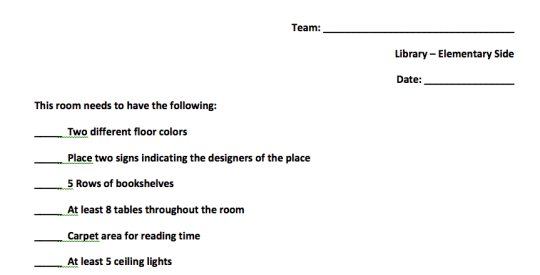
The second session involved a bit more structure in the building process.   I started to find that some of the rooms were starting to look vastly different than others. Carpet, tiles, ceiling and outer walls were different blocks. The teachers decided to give student teams rubrics that allowed consistency across the school.  It also gave students a clear objective of what was needed for particular areas.

Screen Shot 2016-04-15 at 8.10.55 PM.png

The ceiling, walls and window placements were the same in all the classrooms. Students were given opportunities to create the classrooms based on the current setup. Teachers checked the team rubrics and gave them new ones. The entire first floor of the school was constructed during the first six sessions. Two teams were asked to build staircases to the second floor of the school. Another team worked on the gymnasium, which included two stories and the roof. Once the staircases were built, teams started to work on the second floor classrooms.

Sessions 7-10

Student teams were switched. The second floor was completed quicker since students were used to the format of the first floor. During this time students continued to visit different areas of the school first, and then build it in the virtual world. Teachers continued to check off completed rubrics. Some of the areas of the school were larger and took more time to complete. One team worked on the front entrance of the school. This included pathways, landscaping and creating roads. Another team designed the back of the school, which included a playground and parking lot.

Screen Shot 2016-04-15 at 8.27.42 PM.png

The cafetorium (yes that’s right, a cafetorium and auditorium combined) took a tremendous amount of work. Four different teams worked on this as it was two stories tall. The media center was also created during this time. Students added their own creative touches to these places by putting in murals, dispensers and lights. It was amazing to see how students hid electrical lines through the use of redstone.

Hiccups

There were a few hiccups. Being a brand new club we all were learning after each session.  Around session three students started using potions. This caused issues as haste and invisible potions were thrown around. I had to freeze students during this time to address the use of potions. It was addressed one other time later in the club, but it was a minor issue. Also, some students inadvertently broke blocks. This caused a few issues but they mostly ended up with apologies because of a misunderstanding.

Session 11

The last session was designed for students to review their progress. Students completed a scavenger hunt in the newly built virtual school. Most of the students were able to complete around ¾ of the scavenger hunt. The club ended and a video was sent out to the parents.  The club and video was well received by both the parents and students.  The team is looking forward to building on this success at some point next year.

Volume and Capacity

coffee

My fourth grade students are studying volume and capacity this week. As I introduced the topic earlier in the week I started to observe that students had a minimal understanding of volume. They remembered the l x w x h formula.  They remembered creating cities last year and finding the volume of different rectangular prisms. So I brought out my supply of centimeter cubes and the class built different rectangular prisms. Being able to replicate rectangular prisms with centimeter cubes was a great way to start off the lesson. Students reconnected (as we studied this last year and I kept on reminding them) the concrete and abstract models of rectangular prisms and volume. At this point the class started to explore the volume of different 3d shapes.   We had a few volume estimation drills with objects in the classroom. Students seemed to do well with triangular prism estimation (1/2 of the rectangular prisms) but had trouble with cylinders.   I had students work in groups to estimate the volume of a cylinder in the classroom.

They made their estimates in cubic centimeters. I thought that the centimeter cubes that I had on my desk would help students visualize the volume better. Students were given the formula to find the volume a cylinders but were still quite a bit off with their estimates. The class then calculated the actual volume.  After their first attempt the class started to pinpoint the errors. We made a list:

  • Adding the radius twice instead of multiplying ß most errors fell into this category
  • Using incorrect number for Pi
  • Used the diameter instead of the radius
  • Estimated using incorrect units
  • Rounded the measurement incorrectly

Keeping these errors in mind, our second volume attempts were closer. Not all, but most groups were on the right track and could visualize an approximate volume of the second cylinder. After all the results were collected the students and I measured the exact dimensions of the cylinder. I had a few students look astonished that the cylinder could “hold that many cubes.” They couldn’t believe it and didn’t think it was reasonable. So we went back to a different representation. I put the container under the document camera and we created an approximate layer of cubes on the bottom of the cylinder.

layer

Finding the radius wasn’t used for this demonstration. We added a few more cubes to add for the tiny spaces. The class found the height and used it along with Pi to estimate the volume.

height

That estimate was close to the actual measured amount. I could sense that students were developing more confidence as we moved into the next part of the lesson.  This seemed to make sense to the students. Being able to quickly backtrack to a different representation helped students see volume differently.

The next day students explored the similarities between cubic centimeters and milliliters. This was a challenge for some of the students and some didn’t believe that 1 cm3 was 1 ml. Part of the reason is that students are often used to working with volume and capacity in completely different situations. Liquid and solid measurements are often separated into different lessons and units. Rarely are they combined at the elementary level so this was fairly new to students. While researching a few different options in helping make connections I settled on using an activity that mimics this video.

I passed out the assignment and students were placed in groups.  I modeled how to start the assignment and answered questions.

volumeandcapacity.jpg


Students worked in groups and were given options in how to showcase their understanding of cubic centimeters and milliliters. Students filled up their graduated cylinders to specific levels and I added a small bit of food coloring. It’s so funny how fourth graders can get so excited over this. Note to self:  buy extra food coloring.  Students added actual centimeter cubes to the graduated cylinder and watched as the water level rose.

Students reviewed the difference between the water levels after cubes were dropped to the bottom of the graduated cylinder. Students then recorded their explanation to what happened and how cubic centimeters are equivalent to milliliters. We finished up the day with an exit card on volume.