Visual Patterns

#mtbos post three
Patterns and Algebra

My third #MTBoS post is about the visual pattern resource, visualpatterns.org.  Generally, patterns (numerical and object-based) are some of the first concepts taught to introduce algebra and number characteristics.   Initially, patterns may seem simple, but they often allow opportunities to enrich and extend instruction into more challenging concepts

My third grade class has been studying patterns and rules during the past two weeks.  One of the activities that we used can be found here.   We’re using math tasks to uncover different type of numerical patterns.   I’ve had the opportunity to visit this site multiple times during the algebra unit.  One of my classes tackled the problem below last week.

Visual Patterns

The students loved that this problem was created by a sixth grade student.  I think this added to their motivation and bonus! … also had them thinking of how they could create their own problems.  The students were given whiteboards and worked with a partner to find the fourth pattern. During that time I asked questions that helped guide the students towards a solution.  With enough time, most groups were able to find a solution.  The class then had a discussion on how the solution was derived.  Then came the fun part …  the partners decided to answer “How many lego pieces are in step 43”?  Student groups then presented their answers to the class.

At some point I’d like to have my students create and submit their own patterns to visualpatterns.org.

Geometry Explorations

Compass
Geometry Explorations               #mtbos post two

My fourth grade class is now studying geometry.  Geometry at the elementary level allows opportunities for students to get out of their seats and learn while using their compass and protractor.  Last week my students dusted off their protractor and compass in preparation for the geometry unit.  Throughout the years I’ve added different geometry explorations to this unit.  Some of the activities in this post have been modified from the curriculum and others I’ve created or borrowed from some amazing teachers.  I’m going to highlight four specific geometry explorations that I find valuable.


1.

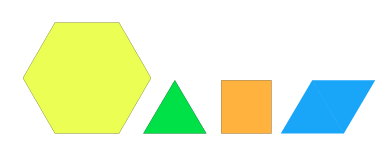
Students are given different types of polygons and asked to find interior angle measurements.   I tend to group the students and have them work collaboratively to find a solution.  Students can use any method to find a solution.  I find that some groups use a protractor, while others find the measurement of the triangle and use it to find the interior angles of other regular polygons. Near the end of the session the class creates an anchor chart that shows similarities/differences between the polygon shapes and their sum of measures.

Polygons

Polygon Angles

2.

I pass out a notecard/piece of paper to each student.  Students are asked to make an arc on each corner of the sheet.  The arcs don’t have to be the same size.  The arcs are cut out and put together to form a circle.  Essentially, students use a rectangle and turn the rectangle into a circle and both have the same interior angle measurements. Students are then asked what conclusions can be made by completing this activity.

Circle

3.

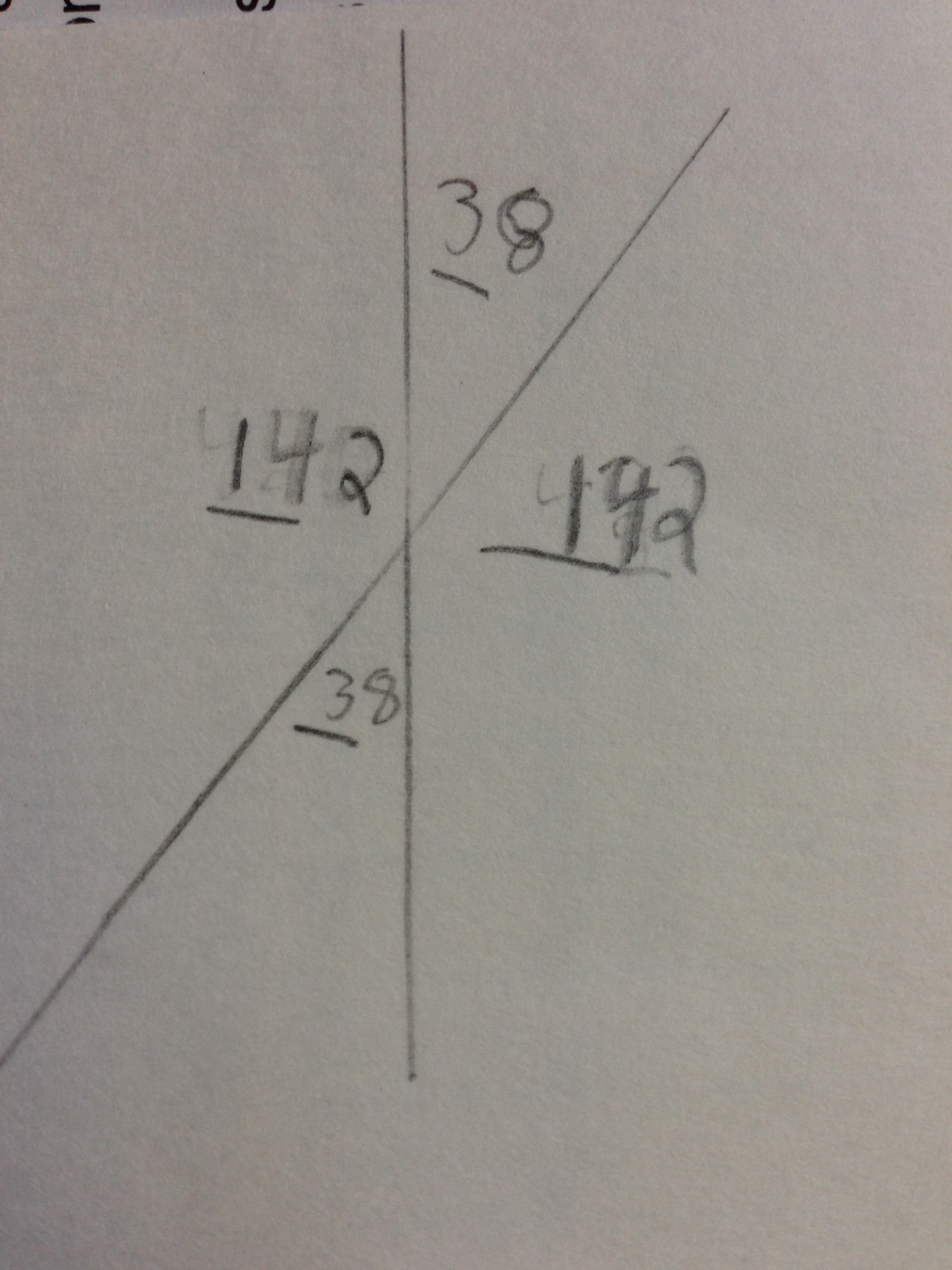
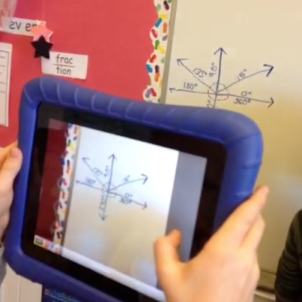
I generally use this activity before teaching about adjacent and vertical angles.  Students are asked to draw and label two intersecting lines.  This should be review, but most students haven’t been using angles in math class for about eight months.  Once the angles have been created, students measure each angle.  Students are then asked what they notice about the measures of the angles?  Do they notice any similarities?  This is a great opportunity to fill out an anchor chart indicating what angles are close in measurement.

IMG_2352

4.

After all the above activities take place I give students a quick formative assessment.  It looks like this:

Finding Angle Z

Students are asked to find and explain the reasoning for the measurement of angle Z.

Overall, these exploration activities allow opportunities for students to engage in math in unique ways.  Math manipulative and explorations often open doors that ignite interest in many students.

The Math Struggle

I’ve been using different math prompts for the past few years.  I usually introduce the prompts and give students time to work in a group to find a solution.  Students often work together, struggle, and eventually come to a solution.  It’s expected for students to document their journey in solving the problem in the prompt.  Last week I gave this prompt to one of my upper elementary classes:

math task

When I first introduced the problem the students had a million questions.  The questions were mostly related to what operations to use and hoping that I’d give away a few hints.  I want the students to succeed, but I also want them to become more responsible for their own learning.  I answered the questions related to the directions, but intentionally didn’t give away any information regarding what procedures/operations to use.  The students were then divided into groups and given 20 minutes to find a solution and present the answers to the class.  The next 10 minutes or so were challenging.  Challenging may be an understatement.  The students struggled, period.  They had a tough time knowing where to start after finding how many dollars fit in a ream. The less I spoke the more the students seemed to flounder.  Students began to look at each other and within to find a solution.  After the initial 10 minutes, the groups began to click.  Students started to find that their solutions were working. The students were beginning to make progress. The students were pumped and I tried to hide my own excitement for them as some groups were still struggling.  Groups were gaining momentum and near the 20 minute mark most groups were finished or partially finished.

The students then presented their journey in problem solving and the process used to find the solution.  Each group solved the problem (or came close to solving the problem) in a different way, but all the groups learned from each other during the presentations.

Following the presentations, the class had a discussion related to the math prompt.  The groups reflected on how challenging it was to persevere through the struggle of not knowing how to solve a problem.  I’m glad that the students were able to experience the struggle.  Moreover,  I’m glad that some of the students were able to use math problem solving strategies and look within and to each other to persist.

Exploring Number Rules

Number Rules and Perimeter

This week I introduced function machines to one of my primary classes. The activity yesterday revolved around the concept of number patterns and perimeter.  Student groups were given a pile of square geometry blocks.  The groups were asked to find the perimeter of one square. The perimeter was quickly found, which ended up being four inches.  Students then found the perimeter of two squares connected.

measurement

and then three squares …

Measuring

Students started to recognize a pattern as they filled out their in/out table.

in/out table

Students were then asked to explain a rule for finding the perimeter of the square shapes. Many of the student groups attempted to find a rule, but found a single digit addition or multiplication rule that didn’t work for all the numbers. The groups started to struggle in an attempt to find the rule.  One group finally came up with a rule indicating (in x 2 )+ 1 = out.  Students were excited that they were on the right track.  After a few minutes another group came up with a different answer (in + 1) x 2 = out.  A couple of the groups asked how can there be more than one rule?  This allowed an opportunity to have a conversation about equivalent rules.

After students found the rule(s), they were asked to find the perimeter of 423 blocks.  I told the student groups that I didn’t have 423 blocks, so they will need to use a rule to figure this out. Students began to understand the usefulness of math rules.  Even more, I was glad that they were able to explore the advantages of having math rules on their own.

Standards Based Grading Journey

I’ll admit it, I’m changing my policies again.  I’m moving more towards a standards based grading approach this year.  This is a big step.  I’m not completely using SBG, but I’m making subtle changes in my practice like removing homework grades and focusing more on content mastery. I’m removing a few traditional practices and adding others.  I still grade projects with a rubric, specific quizzes, and unit assessments.  Beyond the projects, quizzes, and tests, students are reflecting on assignments and working towards mastery. I’m finding that SBG is a step in the right direction although it isn’t the norm at my school.  I believe a systematic approach towards moving to SBG is in the future, but for the time being grading policies are created by individual teachers.

Over the past few weeks I’ve been assigning less homework.  I didn’t make it a goal to assign less, but focusing on student reflection and providing multiple attempts in class to master concepts have decreased the homework load.  Students were surprised at first that I wasn’t “grading” the homework.  I heard comments like “why do we need to complete this if it’s not for a grade?” and “so this isn’t mandatory?”  Too many times I find that students focus on the grade and not necessarily the learning process.  I communicated at my back to school night that homework is designed to be practice and I won’t be grading practice.  After a few weeks of SBG policies, student comments questioning the change have decreased and have been replaced with a more reflective tone.  Communicating SBG practices can be challenging at times, especially if students/parents expect traditional grading practices. Here (123)  are a few different ways to explain SBG benefits and policies to stakeholders.

Another change that I’ve made is increasing the amount of formative assessments that take place in class. In my class formative assessments are a tool that’s designed to offer direct and meaningful feedback to students.  Here’s an example:

I gave my students a quiz on central tendency (mode, median, range).  I reviewed the results and found that many students didn’t have a clear understanding of median.  Students weren’t ordering the numbers least to greatest first.  So, on each paper I gave specific feedback regarding how to find certain data points.  In the past I would’ve probably graded the assignment and handed it back to the students and move forward.  The reflection piece would’ve been the responsibility of the student.  This year I pasted this modified reflection sheet in students’ math journals.  It’s in a Word document if you’d like to edit it for your specific class.  Students completed the sheet to analyze their mistakes and looked for ways to improve in the future.

Assignment Correction Form

So far this SBG journey is paying out benefits.  Students are beginning to understand that reflection plays an important role in the learning process.  I believe that this is an #eduwin.  I think many teachers can see the benefits of SBG, although I continue to be concerned with the long-term sustainability as students move on to middle/high school where grades heavily influence grade point averages.


Top photo credit: Old Shoe Woman via photopin cc

Introducing Fractions

Fractions

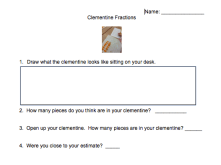
Today’s second grade math lesson included an introduction to fractions.  In the past I’ve introduced our fraction unit with pie manipulatives.  They work great, but I was looking for a  more hands-on lesson that motivated as well as provided opportunities for enrichment.  While thinking about how I could make my fraction lesson more engaging, I decided to research a few different options.  Specifically, I wanted to find a way to incorporate a lesson with multiple answers.  I thought what’s healthy (district wellness plan), easy to peel, has different sectional pieces, and is relatively easy to clean up?  I ended up deciding on purchasing a bag of clementines.  I also put together this sheet for the activity.

Sheet

The lesson went well and it’s definitely one that I’ll keep in the repertoire.  Students estimated the amount of slices, identified fractional pieces, found the numerator/denominator, turned the fraction into a mixed number and finally ate the clementine.  A few pictures are below.

How do you introduce fractions?

Teacher Feedback Tools

Lending your voice to give feedback
Feedback

This school year I’m emphasizing the importance of offering students meaningful feedback.  By meaningful, I mean that the feedback gives students opportunities to reflect and make better or more informed decisions in the future.  This type of feedback is especially important in math as it allows the teacher to correct misconceptions and help guide students through mathematical processes.   Feedback can come in a variety of forms, such as informal, formal, written, verbal, and even digital.  I’ve found that helping students discover mathematical processes can be accomplished through guidance and timely feedback.

I’ve made a goal this year to give meaningful written feedback to every student more often this year.  In an effort to give more direct feedback, I’ve redesigned my class schedule to include more of the following:

  • Increase student-led math conferences
  • Increase student collaboration opportunities
  • Increase writing in student math journals
  • Increase writing opportunities in math class

I believe that these events not only increase student ownership, but also give opportunities to listen and give feedback to individual students.

Record

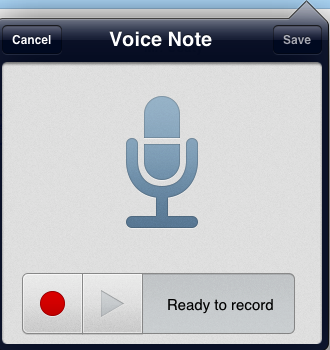
This week’s #mssunfun post is about “one good thing” this school year.  So for this week I’m going to showcase my newest student feedback tool.  I’m excited to use the Showbie app (free) this year to give student feedback.  Once students complete their digital projects, (e.g. Educreations project) they submit their project through Showbie.  I’m then able to view and give students verbal or written feedback on their project.

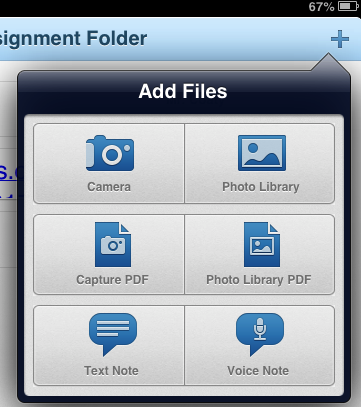
You can offer feedback using any of the options above

Once logged in to their Showbie account, students are then able to hear their teacher’s feedback from an iPad, iPhone, or computer.

Recording

It’s been two weeks since I introduced Showbie to my students.  I’ve received mostly positive feedback from my students and their parents.  My students continue to look forward to receiving verbal feedback.  What’s nice is that I can record the feedback anywhere and the students access the recording at a later time.  I’m probably going to grade most of their digital work through Showbie’s voice and camera functions (like taking a picture of a finished rubric).  Students and parents can then access grades and feedback on assignments throughout the year.

Student Content Creators – Educreations

Showing our learning through content creation

During the past few days my class has had elaborate discussions regarding the importance of student ownership and the learning process.  The class agreed that being able to explain our mathematical thinking is important.  Many of the math projects that I assign focus in on the eight mathematical practices and highlight the ability to articulate the “how” and “why” certain steps are/were taken.  That process can enable students to understand math concepts more clearly and apply their learning.  The class then discussed how applying our learning can lead to innovation.  That conversation then cascaded into the importance of being an innovator today and how modern-day technology often evolves through the refinement of ideas.  These ideas may come from inventors or entrepreneurs that take a risk and create a new product/idea.

One of my goals this year revolves around the concept of enabling students to be digital content creators.  Digital content creation happens all the time and there are many examples (positive/negative) of this.   I want to encourage my students to create ideas, projects and connections this year.  So earlier this week I noticed that @mwhitedg posted a tweet with the #dg58learns tag about how his class is now using the Showbie app to turn in digital content.  This idea intrigued me as one of my focuses this year is to have students create digital work for their eportfolios. One of the main problems that often exist at the elementary level is that students aren’t allowed/don’t have email addresses, so emailing work to the teacher can be problematic. It seemed that this particular app might help solve this problem.  I discovered the Showbie app that night and started to look at what student content creation apps exist. I found plenty and many content creation apps that I haven’t heard about. Click the below image to access the site.

Showbie
Showbie

I’m familiar with the app Educreations and used it as a primary whiteboard in the past; not delving too deep into it’s capabilities.   After finding Showbie, I begin to upload my student roster into the Educreations site and started to find that the app has potential.  The next day I modeled the app with the class and showed students how to login and send assignments via Showbie.  My students were asked to compare prime and composite numbers (4th grade) and compare a kite and rhombus (3rd grade) with Educreations.  I allowed the students to explore the different functions of the app.  Most students found a comfy and quiet place in the room to record their lesson.  Without even telling the students, some started taking pictures of objects in the classroom and importing them into their lesson.  After 20 minutes, all students were done and submitted their videos.  As a class, we reviewed the videos and made a plus/delta chart on the quality of the projects.  Below you will find some sample screen shots of the projects.

We learned a lot about the Educreations app and how to position the iPad while speaking (hint: don’t cover the microphone or move the iPad with force). The class also had a conversation about the importance of having guidelines during the creation process.  In the future we’ll be using a form of this rubric and possibly work in groups to create a number of projects this year.  This may change though, depending on the quality of the projects and learning experiences that are in our future.  The students were extremely excited to view their content and thrived on the idea of being able to create their own work.  Moreover, I found that five students actually went online and viewed their creation video over the weekend.  Becoming a responsible digital creator is an important skill to have and I believe we are starting to make headway.

How do you encourage student creation at the elementary level?

Student content creators is a blog post series.  Click on the links that follow to find additional posts related to how EducreationsInstacollageHaiku Deck, Playback and Prezi can be used in the classroom.


photo credit: zetson via photopin cc

Factoring in Classroom Math Games

Factors


Today was unofficially factor day in my fourth grade math classroom.  The lesson focused on factors, prime/composite numbers and prime factorization. For some students, the lesson reinforced preconceived notions, while others were introduced to a fairly new concept.  The goal of the lesson was for students to develop a deeper understanding of factors and the role that they play in mathematics.  I decided to use a variety of math games to review the concept, as well as to extend the concept of factors. One of my favorite methods to review and enrich the learning experience is to use math games in the classroom.  Math games often encourage students to take risks and use strategies in an attempt to win.  In the process they often have to work together to ask questions and clarify their mathematical understanding.
Today began with a brief mini lesson on factors.  I then split up the class into stations.  Each station was designed to reinforce and provide enrichment opportunities.  Students worked in partners at every station.  In some stations they worked together, while in others they were competitors.  Here are the stations:

Factor Captor
Factor Captor

Factor Captor – This is a staple game in my classroom. There are three different levels and students progress to the next level when they feel ready. To play this game students need to be able to identify prime and composite numbers. Here’s a short video of the game in process.  A template with sheets can be found here.

Divisibility Dash
Divisibility Dash

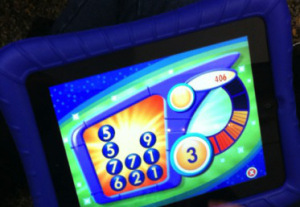
Divisibility Dash – This iPad app is designed (at least for me) for students to work in groups to identify various factors.  I found this app for free about a year ago and took advantage.  Many McGraw Hill apps are free during special times of the year.  Students record their scores/factors on a separate sheet of paper.

Sliding Factors
Sliding Factors

Sliding Factors is a computer game that encourages students to find factors of composite numbers.  There’s a two player function, which definitely comes in handy.  While browsing the #mathchat tag I saw @Richard_wade post a link to this game.

  • I should also mention that one section of the classroom was designed to be an “exit card” station.  Students completed a quick three question formative assessment and I discussed the answers with them.  This is another opportunity to give direct feedback that may help the student clear up misconceptions and help them make mathematical connections.

When used correctly, math games can truly benefit students.  When the students are in stations I like to sneak by the groups and listen in on the math talk that’s happening.  The math talk often gives students an opportunity to defend their mathematical thinking.  Students often correct each other, but are generally respectful in the process.  Tomorrow the class will be writing up a quick reflection of the station/factor experience in their math journal.

How do you use math games in the classroom?

Math Classroom Setup

Classroom


This Monday students will be entering my school for the 2013-2014 school year.  Classrooms have been buzzing with movement all this week.  The sound of  bulletin boards being put up, desk being moved, pencils being sharpened, and some major cleaning has all happened during the last few days.  Friday’s in-service day covered the topics of security and community.  This year the district and state have decided to focus on social/emotional learning standards and making sure students feel like they belong, not just attend school.  It looks like eventually school AYP will be connected to school climate data.  Teachers were asked to keep this in mind when starting the school year and setting up their class.  Generally I’m not a fan of filling in all my wall space before school starts.  I like to leave some major room for student work as the year progresses.   Below you will find a few photos and short explanations of my class setup this year.

desk setup

I decided on changing my desk setup after reading  this inspirational post.  My class now includes connected rows and group tables.   Students usually pick their own desk to start the year.  Students randomly switch seats approximately once per month.  I find that a combination of rows and tables is conducive for a lot of group work that takes place in class.

procedure wall

As soon as students enter the classroom they take a sharp right turn and see what’s in the picture above.  Students turn in their homework/notes and pick up their math folders.  Students then sit down in their desks and work on individual assignments in their folder or directions that are displaced on the whiteboard.

Procedures

Community building and procedures are emphasized during the first few days of school.  I’ve used the right and left charts in the past to remind students of the procedures used in class. The middle poster is a percentage/stats/probability that’s used with my math curriculum.  Using the arrival and departure charts helps maximize instruction time and learning.

We all fit in

This blank canvas is filled with a completed puzzle by the end of the first week. (example)  The puzzle is cut out by the teacher and each student fills out their own puzzle piece.

puzzle template

On each puzzle piece, students put their name, favorite math topic, one activity that they participated in over the summer and whatever else you’d like them to write.  Students then put the puzzle together and it fits right on the blue tarp for the remainder of the year.  This activity also gives insight to the group dynamic makeup of your class.

grid

I put my excess tarp into use as a bulletin board.  The lines were actually constructed with thin duck tape. This grid will be used throughout the year for our algebra units.


At some point I want to have some type of “genius board” in the classroom where students can ask questions about math topics.  Eventually the questions will spur topics that will lead to our genius math projects.