Fraction Blocks and Strategies – Part 2

photo-jan-24-10-41-47-am

Last week my second grade crew explored fraction blocks.  They cut out and used the blocks to compare fractional pieces.  Students enjoyed the trial-and-error component and they started to visualize fractions in a different way.

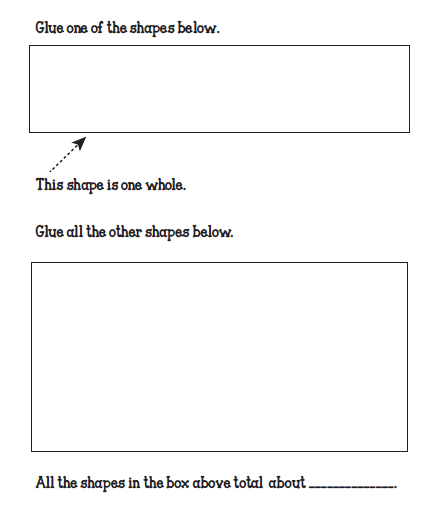
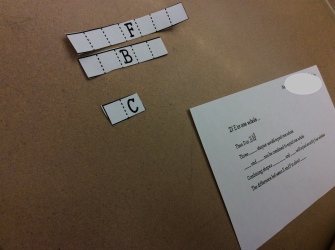
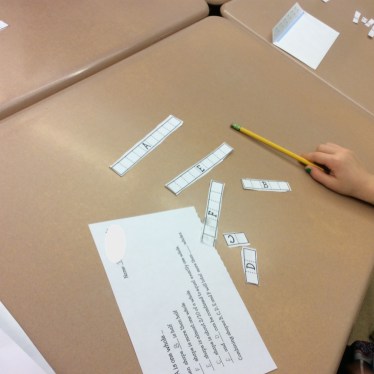
I decided to use a similar activity with my third graders. Instead of labeling the bars, I decided to leave off the label. This initially confused the students as they expected to see the label. Students moved beyond the confusion when they were given the value of one of the blocks.  They then used that value to compare all the other blocks. Students were asked to cut out the blocks and start comparing them.  I didn’t give them any directions beyond that.  After about 4-5 minutes I placed the sheet below on the overhead projector.

screen-shot-2017-01-21-at-8-12-34-am

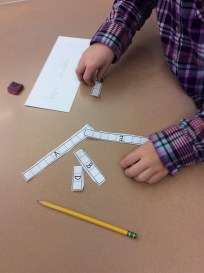
We completed the sheet as a class.  I used the document camera and students compared the pieces on their own desk. It took multiple attempts and a number line, but eventually the class was able to finish the sheet.  Students were then off on their own to find the whole or part of certain blocks.  Students used many different strategies since they couldn’t rely on the label.  screen-shot-2017-01-28-at-7-53-24-am

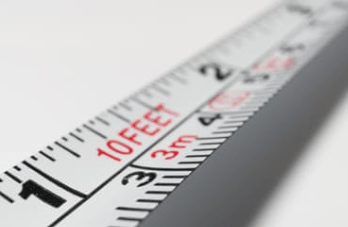
While the students were working I went to the different tables and observed the strategies. Almost all the students compared the shapes to one another to find one whole.  Other students created a number line and placed where they thought each shape would be located.  I had a few students take out a ruler and measure the blocks.

photo-jan-24-10-49-14-am

I collected the sheets once everyone was finished, marked them up with feedback, and returned them the next day.  I used the NY/M model for this assignment. Every student in the class needed to make some type of correction.  After a brief review, I gave the students back their sheets and they made corrections.  There were few perfect scores after the second attempt, but everyone improved – an #eduwin in my book.

Download the file for this activity here.

Next week we’ll be learning about equivalent fractions and how to find common denominators.

Fraction Blocks and Strategies

cover.jpg

My second and third graders started a unit on fractions last week.  Students are used to identifying typical pie fraction pieces.  Generally, I find students are introduced to fractions using this type of visual representation.  Students then count the amount of pieces and place that number as the numerator.  I find moving towards mixed-numbers has some students changing their strategy as they can’t just count the pieces, but they have to recognize that a certain amount of equal parts are one whole.  Based on their pre-assessment results, it seems as though my second grade and some of my third grade students are at this point.

Using a number line has helped.  Placing the fractions on the line has brought a better understanding of the placement of fractions in relation to a whole number.  Currently, students can identify certain benchmark fractions on a number line.  We’re working on bolstering this skill and connecting it to fraction computation in the near future.  Before that happens I want to ensure that they have a decent understanding of mixed numbers and where they fall on a number line.

On Thursday and Friday I introduced students to a fraction block activity.  Students were given a sheet with fraction parts.  Each block was split into a certain amount of equal square parts.

Screen Shot 2017-01-21 at 8.10.45 AM.png

Each student was given an envelope to put their pieces in once they were finished with the activity.  Students cut out each block and were asked to put them in order from least to greatest value.  Students were able to complete the task.

photo-jan-17-9-26-40-am

We then had a conversation about quarters, halves and wholes.  I then gave each student the card below.

Screen Shot 2017-01-21 at 8.12.34 AM.png

Students placed the A block near the top of their desk and started comparing the different blocks.  The class completed the first question together.

LetterA.jpg


I then gave students time to work on the rest of the problems.  Students were then given time to use trial-and-error to find which blocks worked for each problem.  I went around to the different table groups and asked students questions about their strategies. Students ended up matching the squares with other shapes to determine what was a quarter, half, almost a half, and what happens when you combine shapes.  After about 10 minutes the class reviewed the sheet and found that some problems could be answered with multiple solutions.  Students put the sheets in their envelopes since we ran out of time.

The next day students completed some more challenging half-sheets involving their blocks.

screen-shot-2017-01-21-at-8-22-58-am

Students struggled a bit with this as they had to look at A as half instead of one whole.  This changed the value of all of the other blocks.  I allowed students to work in groups for about five minutes and then independently for another five.  This gave them an opportunity to gain another perspective and a different strategy.  Afterwards, I reviewed the possible solutions with the class.

Next week I’m taking this activity one step further and using the blocks without markings.  I’m borrowing this idea from Graham’s post on defacing manipulatives.

Screen Shot 2017-01-21 at 8.29.05 AM.png

Students will complete similar half-sheets, but without the evident markings. I’m looking forward to seeing how students’ strategies change and the math conversations that follow next week.   Click here to download the activity that I used.


Reasonable Solutions


screen-shot-2017-01-12-at-10-21-50-pm

I believe teaching multiple grade levels within the same day has value. Being able to observe how students think about numbers and the strategies that they use over time gives teachers a different perspective.  It also shows some of the linear progression of math skills and strategies. I found this especially evident as I read through Kathy Richardson’s book during July. I currently serve as a math teacher for students in grades 2-5.  I get to see how students progress over time and what tends to trip them up.  I also see the problems that emerge when students start to rely on tricks and formulas before having a deep understanding of a particular concept.  One thing that I also continue to observe is that students sometimes struggle to be reasonable with their estimates. Part of that may be due to an over-reliance on algorithms and the other part may relate to exposure. Students aren’t given (or take the) time to reflect and ask themselves whether the answer truly makes sense or not.  This tells me that students are relying on a prescribed process or algorithm and reasonableness comes second.

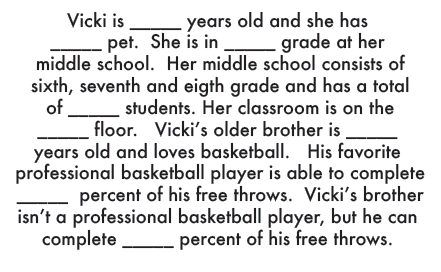
In an effort to move towards reasoning, I’ve been using Estimation 180 on a daily basis.  I feel that the class is become better at estimating and their justification has improved.  Making sense with number puzzles also seem to be helping students create reasonable estimates and solutions.  Basically, students are given a story that has blanks.

screen-shot-2017-01-12-at-10-08-28-pm

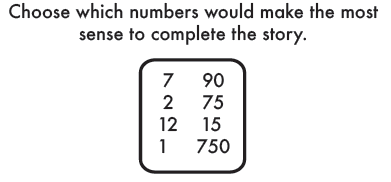
Students are then are given a number bank. Sometimes too many numbers are in the bank.

screen-shot-2017-01-12-at-10-11-12-pm

Then students have to justify why they picked each answer.  This can be completed in verbal or written form.

screen-shot-2017-01-12-at-10-13-36-pm

Usually I have students explain their reasoning with a partner.  The class has completed a number of these types of making sense with numbers puzzles.  I can say that students are now looking more closely at the magnitude of the actual numbers before estimating or finalizing an answer. That’s progress and I’m confident that students are more willing to use that strategy along their math journey in the future.

Random Sampling

Before break my students tackled the challenging topic of random sampling.  I feel like it’s challenging because some students tend to view their opinion as one that applies to other people around them.  It can be a tough concept for students to wrap their heads around. When I introduce this topic students have many questions.  Usually they follow along the lines of …

  • why can’t you ask everyone?
  • who determines if the random sampling is accurate?
  • how many people do you need to ask?
  • is their always bias involved in random sampling?

Some of these questions are more challenging than others.  Some I don’t even approach and let students make their own determination.  In the past, I had students create questions and ask a random sampling of students.  Students would then create charts and indicate whether they truly sampled the students fairly.  For the most part the activity hit the objective, although the sampling available at my school was minimal.  Students were able to ask questions about our school and students within.  Issues came up because of the lack of age groups and diversity.

Last Monday I participated in #msmathchat.  The conversation surrounded the topic of teaching about data and statistics.  Elizabeth sent out the Tweet below.

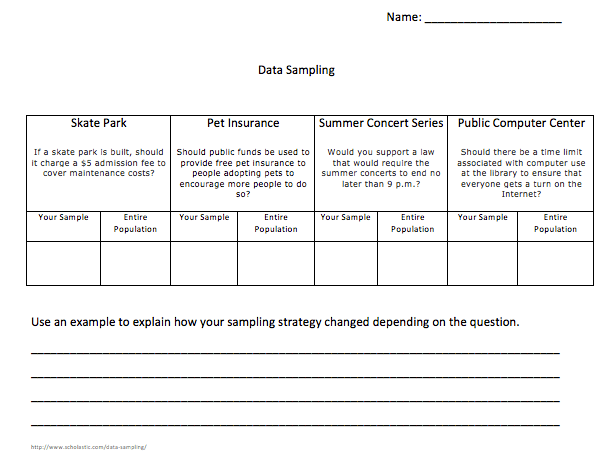
I saved the Tweet for later as my students are in the midst of their data unit.  I looked at it later that evening and thought I could immediately use it with my kids.  I put together a template that students could use as they progressed through the site.

screen-shot-2016-12-24-at-8-15-28-am
click image for file

The next day students started at the skate park activity and used three random sampling techniques.  Afterwards, students were able to see the how their actual results compared to the entire population.  Students then moved on to complete the rest of the scenarios.  For the most part students started to change the way they asked the questions to get a better estimate.  This was a better activity than what I’ve used in the past.  The students responses to the last question brought a better insight to how students perceive random sampling.  I believe they’re making headway.  I’m hoping that the class can reflect back on this activity after break and they can take the benefits of that experience moving forward.

Two Different Camps

screen-shot-2016-12-13-at-7-06-58-pm

My school has six days of school left before break.  Between now and then I’ll be giving a unit assessment to my fifth grade crew.  We’ve been studying angle relationships for the past few weeks.  To be honest, it’s been a great unit but it’s also been challenging.    There’s been a good amount of struggle in this unit. It’s the good type of struggle.  Right now I feel like students are in one of two camps.

One camp is focused on the measurement and precision component.  When given a question about angles they want to take out a protractor and start measuring.  They want to be precise and get an exact answer.  I’d say that some in this camp perceive this type of geometry as a measurement skill, rather than a looking at it as a problem associated with angle relationships.

screen-shot-2016-12-13-at-6-38-09-pm
Where’s my calculator?

The other camp is all about looking at the angles and the relationships that exist.  They’re at the point of not even bothering to use their protractor.  They also look at the lines, rays and line segments that make up the construction of a shape.

screen-shot-2016-12-13-at-6-38-09-pm
A quadrilateral is 360 degrees and a triangle is 180 so …

Getting both of these camps on the same page has been an interesting adventure.  Both have positive aspirations and have been showing a tremendous amount of effort. I believe it’s important for students to use mathematical tools to solve problems, but that’s not what this unit is about.  For so many years students have been asked to be specific and precise when calculating and finding math solutions.  This is still the case, but students are now asked to use their understanding of angles and shapes to come to conclusions.

We had a classroom discussion last week about this very issue.  I asked students to put away their protractors and calculators.  They were asked to identify specific shapes and describe the characteristics of them in detail.  The class then explored the different polygons on the Illuminations site.  Click on the image to visit the actual site.

screen-shot-2016-12-13-at-6-50-50-pm

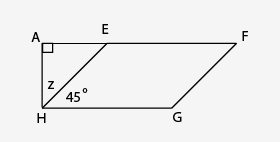
Students were allowed time to play and create connections.  The focus of the exploration was targeted towards sum of the angles in polygons.  The students in the first camp started to put their protractors away while the students in camp two looked at how the angle measurements changed when the triangle was stretched.  Looking back, this was such an important period of time.  Afterwards, students were given time to review angle relationships without using a measurement tool.  They were using their prior knowledge of shapes and relationships solve problems.  This was a bit of shift.  So, I decided to build upon the first task and added a reasoning component.

screen-shot-2016-12-13-at-6-56-59-pm
Getting camp one and two on the same page

I’ll be grading the task above tonight.  Including an “explain your reasoning” component added a bit for vigor to the task.  Based on the class conversations I heard today I’m thinking that students looked at precision as well as angle relationships while tackling the problem.  After grading them at some point tonight, I’ll review the results with the kids tomorrow.

Coding and Positive Changes

Our school is in the midst of the Hour of Code.  This year more than ever, I feel like there’s more of presence of how technology, coding and the curriculum are connected. This is due to a number of factors.  A new superintendent, technology coaches and additional teachers are all playing a positive role with this connection.

This year I intentionally looked for ways to incorporate coding into my math classes.  In the past, the coding was fun and beneficial, but it felt as though it was disconnected from the actual scope and sequence of the curriculum.  It was great during the Hour of Code, but then the whole idea faded once school hit winter break.   While searching for curriculum connections, I came across Brian’s fantastic blog.  I started to find direct curriculum connections that I could use for the Hour of Code.  The two different videos that I used are below. Both were used for a fourth and fifth grade classroom.

Both were great in connecting basic coding and measurement skills.  It was interesting to have kids use their schema, as well as trial-and-error to find out how to calculate the area and circumference.  I gave students an overview of the Scratch blocks and let them figure out the solution.

Screen Shot 2016-12-06 at 8.14.30 PM.png

I feel like this was useful as Scratch helped reinforce skills that we’re exploring in class.  I look forward to incorporating it a bit more as this week progresses.

Side note:  Earlier in the day one of our technology coaches sent the elementary teachers a Google Doc of different coding QR codes (first and third) that can easily be used with an iPad.  This information is available for all teachers to use as needed.  Some teachers need a starting point and this may provide just that. This is one of the positive changes that I noted above.

What’s your strategy?

screen-shot-2016-12-01-at-6-33-06-pm

My fourth grade crew has been exploring fractions for the past two weeks.  Students have been making some amazing connections between what they’ve learned before and what they’re currently experiencing.  Last year the same group of students added and subtracted fractions with unlike denominators. The process to find the sum and difference was highlighted and that’s what students prioritized.  That was last year.    Although the process was and still is important, this year’s focus in on application.  How do students apply their fraction computation skills in different situations?  That takes a different skill set.  Being able complete a simple algorithm doesn’t necessarily help students read a problem, identify what’s needed and find the best solution.  More so, I feel like the application and strategy piece trumps the actual algorithm process at this stage.

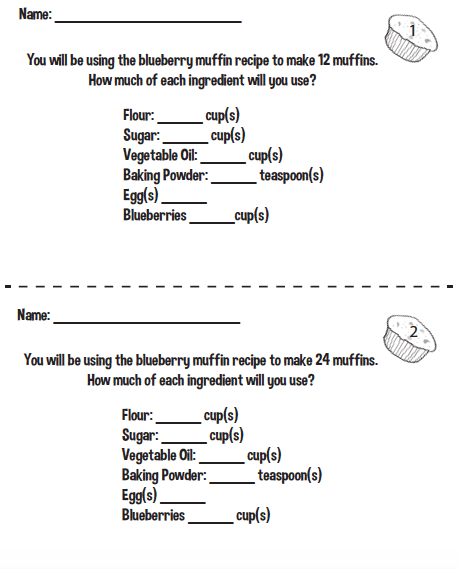
So, I brought out a fraction recipe problem from last year.

screen-shot-2016-02-26-at-5-26-13-pm Similar to last year, students had to change the recipe based on the amount of muffins needed.  Unlike last year, I didn’t introduce the fraction multiplication or division algorithm.  I had students work in groups and document their strategy to find a solution.
screen-shot-2016-12-01-at-6-15-18-pm

Students had to indicate whether the number of muffins increased or decreased, by how much and how to change each ingredient.  The group conversations were fantastic.  Groups had a brief conference with me to discuss their strategy once they arrived at a solution.

2016-11-29-15-29-39

The conversations that occurred during my 1:1 meetings with student groups were beneficial.  Students took what they wrote as a strategy and elaborated with different examples.  I’m thinking that students will write in their math journals about their experience tomorrow.  I’m assuming that this will also help transition students towards understanding why the fraction algorithms work.

screen-shot-2016-12-01-at-6-32-08-pm
Can you tell that I like my new stamps?

Estimating as Part of the Process


screen-shot-2016-11-18-at-9-35-44-pm

My fourth and fifth grade classes explored fraction models this week.  I enjoy teaching about the concept at both of these levels concurrently.   I can see the linear progression of skills associated with fractions and the different perceptions of fractions.  My fourth grade crew is finding equivalent fractions while my fifth graders are multiplying/dividing fractions.   Both groups are finding success, but I’m also seeing similar struggles.  Students are fairly consistent with being able to convert mixed numbers to fractions and combine fractions. Issues still exist in being able to estimate fraction computation problems and determining which operation to use while completing word problems

This year I’ve been focusing in on making sure students are using estimation strategies.  This is especially important when dealing with fractions and eventually decimals.  Unfortunately, I tend to find that time spent on the process (algorithm) trumps the reasonableness (estimate) from time to time.  Part of this is due to past math experiences and time management.  After the last assessment on fractions, I started to look for additional ways to incorporate estimation within my fraction unit.  I came across Open Middle last year and I’m finding their fraction resources to be a great addition.  Both, my fourth and fifth graders completed a few different Open Middle fraction problems this week.

I’m finding that students are estimating a lot more when they are involved in these types of activities.  The tasks I use from OpenMiddle emphasize the need to estimate first and calculate second.  These types of puzzles are interesting for students.  They are low-risk, but yet have a high ceiling.  I also found this to be evident with an activity that I found out of this book. I can’t say enough good things about the ideas and resources found within that resource.

photo-nov-14-6-02-35-am

Students had to find the missing numerator, denominator or variable.  In both, the Open Middle and Make it True activity, student worked in groups of 2-3.   I gave them about 10-15 minutes to collaborate.  The sheet below was adapted from the book above.

screen-shot-2016-11-18-at-9-39-39-pm
Fifth graders worked on this for 10-15 minutes.  Class discussion followed

They shared ideas, estimated and came to a consensus on what the solution should be. I had the student groups write their answers on the board and the class discussed all the different solutions afterwards.  The class conversation incorporated a decent amount of review and also gave an opportunity for students to ask for clarification.  I’m looking forward to having more classes like this. The class conversation component that occurs after a collaborative effort is starting to become an even more valuable piece of my math instruction.

Angle Relationships

screen-shot-2016-10-19-at-4-57-26-pm

My fourth graders are just about finished with their unit on geometry and measurement.  They classified angles earlier in the week and are now looking at angle relationships.  This is one of my favorite topics to teach as it involves logic and an understanding of basic geometry.  I’m finding that students are becoming better at measuring angles using a protractor.  Using Angle Tangle has helped in that process. They’re able to identify and measure acute and obtuse angles comfortably.  Reflex angles still give them issues, although this is improving as students are able to subtract an acute or obtuse angle from 360 to find the measurement.

Students then moved on to angle relationship skills. When asked to find the missing angle in a triangle they immediately started to look for their protractor.  Students wanted to find the actual measurement without looking at what types of relationships actually exist and if a protractor is needed.  So on Tuesday the class reviewed interior angles.  Students found through patterns that they could split a convex polygon into triangles and find the sum of angles.  This was eye-opening for some students and you could tell that they were relieved in seeing that they wouldn’t have to measure all of the interior angles.

One of the assignments called students to create  polygon and find the sum of angles without actually measuring each interior angle.  Some students were stumped while others students looked at how a triangle’s sum can aid in finding the sum of other polygons.  The student projects turned out well, although some had to redo them as the drawing actually started to get in the way of creating triangles.  This is one of the better projects.

screen-shot-2016-10-19-at-4-57-35-pm


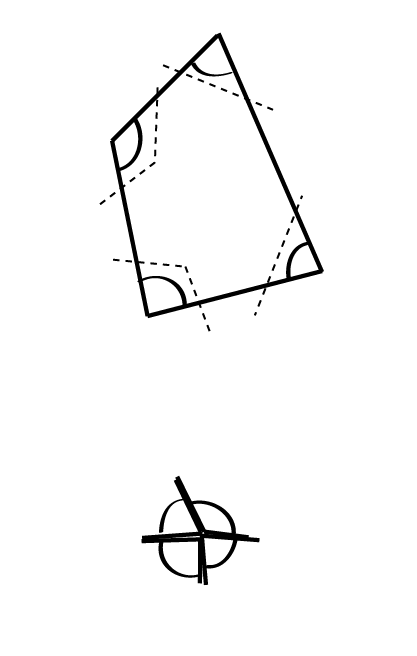
I could tell that students needed a bit more practice with using angle relationships to their advantage.  On Thursday I asked students to create a qudrilateral using a straightedge.  Students drew arcs to indicate the angles on each vertex.  The quadrilaterals were cut out and the sides of the shape were torn off.  Students lined up the sides and the class had a brief discussion on what they noticed.

polygonaction-01.png

Right away, some students noticed that the arcs didn’t line up.  They also noticed that the four corners actually created a circle. Some even said that the total was 360 degrees. Students checked their work by using a compass to add all of the angles together.  Their prediction rang true.  This was a winning moment as I could tell that students were starting to grasp this concept better.  I gave each student some tape and they tapped together their circle to their folder.  I’m hoping it stays on their folder and in their memory banks.

photo-oct-18-1-19-18-pm


What’s My Rule?

My third grade class ended their unit on data analysis and computation last week.  We’re now onto our next adventure of exploring patterns and number rules.  This last week the class started to identify number patterns.  The class observed how they could develop rules to find the perimeter of connected squares.  This was a bit of a challenge because students had to combine two different operations to find the actual rule.

Screen Shot 2014-10-11 at 7.54.13 AM
What’s the perimeter for three connected squares?

We used this activity that I discussed a bit more in detail last year.  They looked for consistency and investigated with trial-and-error what the “rule” might be.  The class used a Nearpod presentation to see how a function machine transforms numbers.

screen-shot-2016-10-09-at-12-49-18-pm
Click for presentation

Eventually the class moved towards creating their own rules using dice and a whiteboard.  It was during this time period that students started to dig a bit deeper into how rules impact a table.

screen-shot-2016-10-09-at-10-51-31-am

One issue came up with the consistency of the numbers on the “in” side of the table.  A few students were confused with the idea that numbers didn’t necessarily have to be in order on the “in” side of the table.  A few examples helped address the issue but I thought it was interesting as most students are so used to a specific 1:1 scale.  I wonder if this is something that’s emphasized more at the second grade level and it just continues with our third graders.

Later in the week I brought out a digital function machine.  The kids had a great time placing numbers in and watching at they transformed into something different.

screen-shot-2016-10-09-at-10-53-59-am


I highly recommend the PheT simulations. Feel free to check out other simulations that they’ve developed.  Next week the class will be working on creating and identifying true or false number sentences.