Using Excel to Explore Rates and Proportions


My fifth graders are currently studying rates and proportions. Earlier in the week they explored rates by looking at unit prices and solving problems with some type of cross-multiplication strategy.  Although they’ve made progress I still feel as some many still need to cement their understanding of a ratio and proportion. So it was time to switch up the instruction model.

I decided to go with using a spreadsheet. In this case, the spreadsheet would be in the form of an Excel document. Each student grabbed a laptop and opened up Excel. The students used Excel earlier in the year so they were familiar with some of the basic functions.

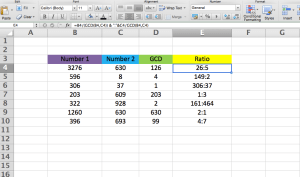
After entering a few text cells, students were asked to put a random number above zero in cells B4 and C4. Then the class discussed what GCD stood for. Most of the students said “greatest common denominator.” That response made sense because that’s heavily emphasized in fourth grade as students add and subtract fractions. In this case, GCD means greatest common divisor. The class then discussed what that meant when comparing two numbers and the helpfulness in finding the GCD when exploring equivalent fractions. The discussion then transitioned from equivalent fractions to finding ratios.

Students entered in the formula =GCD(b4,c4) to find the GCD of the two different numbers. Students observed how the GCD changed as they updated their numbers.

Screen Shot 2015-04-17 at 7.30.47 PM

The next part was a bit tricky. I asked the students to write a formula to express the ratio in simplest form. The class used the GCD and trial and error to come up with the ratio formula. Once students wrote the formula and placed it in E4.  Students then explored how the ratio changed when their numbers were updated.

Screen Shot 2015-04-17 at 6.51.42 PM

The class then reviewed why the formula actually worked.  The class discussed that basically the formula took each number and divided it by the GCD of both numbers. What was great was that students were starting to connect the reasoning behind the creation of a ratio. Instead of just cross-multiplying, students are starting to show a deeper understanding of how ratios are constructed and the process used to simplify. The students were able to save and print out their spreadsheets for later review.

Resources:

Excel Template

Example for Class Use


Math Menu Boards

mathmenu-01


My fifth grade group has been learning about probability for the past few weeks. Our class discussion have revolved around probability trees and likelihood concepts. The summative assessment on probability is coming up around the corner so last week I was scouring my resources to find a way to review some of the concepts taught earlier in the unit. One of my colleagues and I had a conversation about the idea of using a menu board. I heard of using them through #msmathchat but haven’t used them much. I’ve always thought that giving students a choice in their assignments matters. I feel like an assignment menu encourages student choice and often increases engagement.

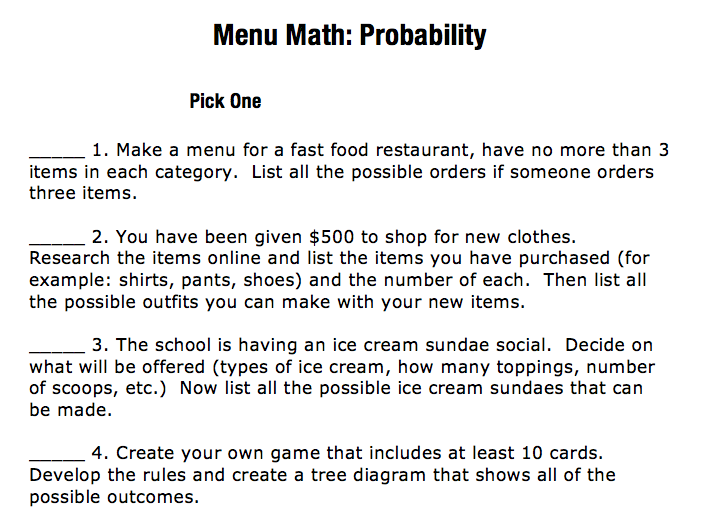
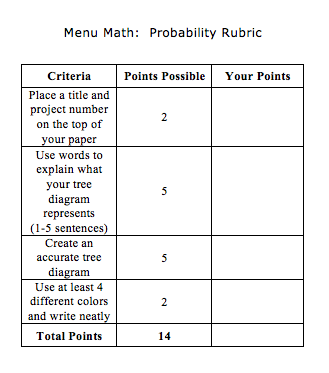
So I found a probability menu resource and decided to use it with my fifth grade crew. I added a rubric and a few other options to Yuliana’s template.  Here is the template that I adapted and used for this project.

Screen Shot 2015-04-06 at 7.33.21 PM

Screen Shot 2015-04-06 at 7.30.23 PM

After explaining the directions I fielded a few different student questions. During the question time some students needed more clarification than others. A group of students were confused to what the expectations were.  Many of them are used to playing school and expect the teacher to tell them what assignment or what to do to get all of the points on an assignment.  I feel like menu boards, to a small extent, help students become more self-directed in their learning journey. It was encouraging to see some of the students take the reigns and be assertive in deciding which menu option to complete.   After all the questions were answered I gave students time to complete the project.  Students completed the work in just over two class sessions.  After reviewing all of the projects I decided to reflect on the entire process. Here’s what I need to remind myself the next time I have the students create a menu board project:

  • Students need time to brainstorm before creating. I had a few students that immediately started working on their project just to throw it out five minutes later. These particular students didn’t brainstorm or organize their ideas before starting a final copy. On the opposite end, I had students that took out scratch paper and started to write out a few ideas before carefully crafting their project.
  • Students need checkpoints along the way. Throughout the project I had to remind students to check the rubric and generally check-in with students to answer questions and provide feedback. During this time I also had to ensure that I had the technology in my classroom ie. iPads and computers. Next time I assign a similar project I’m thinking of having students fill out a work log to help keep us all on time.
  • Students need time. They need time to put together their thoughts, create and produce a product that follows the minimum guidelines. Some of the students took around two class periods while others took longer. Ensuring that other assignments are in place after the project is important. Having additional work afterwards is important. It also helps eliminate the dreaded “what do I do next?” questions.
  • Review the projects. I reviewed each project with the students. I tried to limit my own talking, which was difficult, and let the students explain their project. During that time I filled out the rubric with the student. The time spent discussing the student project was vital. Students came ready to speak to me on what they created and what they thought was important. Some of the student projects were amazing and other projects needed a bit more work. The majority of students put a decent amount of effort into the project and met the minimum criteria.

This project took a good amount of time and had students create a product that was aligned with different probability standards. I thought it was worth the time and I’d like to bring out the project at some point next year.

Exploring Subtraction Computation Strategies

During the past few weeks my second grade class has been taking apart and putting together two and three-digit numbers. In the process students have been developing a better understanding of numbers.  They’ve been exposed to using a variety of computation strategies to find the sum and differences of numbers.  Through all of this I’m finding that the students are becoming more confident in their ability to use these different computation strategies more fluently.   Although they’re confident they tend to gravitate towards using one specific strategy for computation.  The traditional algorithm is usually the primary method that they use.  Even though students can add/subtract using that method I found that they weren’t expanding their understanding of other computation strategies.  This was a bit of an issue for me because students started to look at computation as the shortcut and not delve into the understanding of why it works.

After speaking with a few other teachers I decided to use a math task found in this book.  I briefly reviewed the different strategies that we’ve learned this year and gave the students this prompt.

Screen Shot 2015-03-31 at 7.12.46 PM

I wanted to make sure that students showed two different strategies and provided some type of written explanation.  The template I copied also had fields for a number model and explanation boxes.

Screen Shot 2015-03-31 at 7.18.53 PM

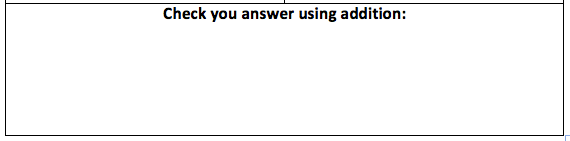
The bottom of the sheet was designed for students to be able to check their work using addition.

Screen Shot 2015-03-31 at 7.21.40 PM

I gave the students about 10-15 minutes to complete the formative assessment.  Most of the students tried out the standard subtraction algorithm but had a bit of trouble with the second strategy.  After a few moments students started to dig deep and think of how to take apart numbers using different strategies.  Some of the  students truly had trouble using a different strategy and this was evident in what they produced.  I was impressed with some of the different strategies that students used.

This slideshow requires JavaScript.

I wrote feedback on the papers and handed them back to the students the next day. Afterwards, I removed the names off of the papers and shared some of the results with the class.  As a class we decided on the following:

  • Students remembered many of the different computations strategies that were discussed earlier in the year
  • Some of the students invented their own strategies on this particular sheet
  • Students need to strengthen their written explanations
  • Students had some trouble explaining what regrouping means

Next week the class will be setting goals in improving our written responses.  Overall, I feel like this activity helped showcase different computations strategies while bringing awareness to areas the need improvement.  I’d like to use this template with a few other classes later in the year.  Feel free to download and edit this file for your own classroom.

Exploring Discounts and Amazon Prices

Exploring Discounts, Percentages and Amazon
Exploring Discounts, Percentages, and Amazon

Today one of my classes explored discounts and percentages.  This particular class reviewed how to convert fractions and decimals yesterday.  Today’s step was to introduce students to the idea of taking a percentage off of a set number.

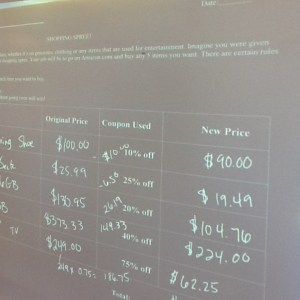
So I dug through some of my resource from the past and came across a sheet asking students to go on a shopping spree.  Yes, that caught my attention.  A shopping spree not only sounds fun but could be a great way to connect discounts and percentages.  From there I edited the document and decided that the students will be given a specific amount of money to spend and a site to visit to find the items.  Amazon.com wasn’t blocked by my school district so I went with that store.  Students were also required to use coupons (10%, 20%, 25% …) to purchase the items.  The winner of the contest will be the student that has a sum closest to $500.

Click for file
Click for file

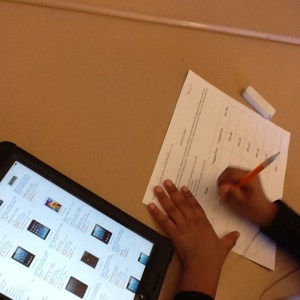
Students could buy whatever items they wanted.  I’m sure this could be repurposed and have the students buy items for a specific reason.  After I explained the directions each student was given an iPad or computer and asked to visit Amazon.com and find five items.

Students initially started looking at whatever caught their interests.

Screen Shot 2015-03-17 at 6.57.43 PM

Some students looked at shoes while others were finding flying drones.  Yes … I said drones. Thankfully all the searches came up without being blocked by the firewall.  Students then found the original price and calculated the discount.  Their sale price was documented and students went to the next item.

Photo Mar 17, 1 09 42 PM

I found that students started to have a challenging time with the last couple of items.  They had to carefully consider the coupon before writing down their options.  You could tell that they were trying to account for the discount. Understanding the magnitude of the discount started to take priority in the students’ minds.

Not all the students finished, but they will tomorrow.  I’m looking forward to comparing the total dollar amounts tomorrow and see who’s closest to $500.  Overall, this activity helped students see discounts from a different perspective.  This may be an activity that I’d like to edit and use with my other classes.


The idea in this post was adapted from this product.  Feel free to download and use for your own classroom.


Meaningful Math Practice


practice-01

Last week many of my students took a pre-assessment on an adaptive app. This particular app gave students questions in a certain math strand area and sent out a grade level equivalency score (GRE). Once students finished the pre-assessment they were given question at the GRE. If a student answered a question incorrectly they were sent to a help screen. The students were asked to watch a video about the concept. Some of the students watched the video while others made more attempts at finding a solution. Even after watching the video students still answered the question incorrectly. Every incorrect question asked student to watch a video and try the question again.  Some of the students became frustrated and quit.

Most of the student were finding that the video wasn’t a helpful for math practice. This type of math exposure/practice wasn’t meaningful to the students. After observing this I started to analyze my school’s math practices. I started to question how many math exposures we truly give to students and how many of those opportunities are truly meaningful to students.

I find that students at my school are exposed to math in a variety of settings. Students are introduced to the idea of a particular math concept through a parent, teacher, nature, workbook, video, and many others. This experience is usually followed up with additional practice at some point. Students need to be given time to practice and apply what they’re learning. This often leads teachers to give students multiple exposures to specific math concepts. These exposures or practice opportunities give students time to experience math in different ways and through this I feel like students are able to comprehend/apply the math at a higher level.

Providing those multiple exposures is important. The form that the practice takes is just as important. While I’m in and out of different classrooms I find that the additional exposures sometimes take the forms below.


Worksheets

Although it may benefit some it’s not the only solution and I wouldn’t categorize this type of practice as extremely meaningful.  Primarily, I find student math journals or worksheets used for math practice. I believe both of these have a role in practice but changing the exposure model has benefits and often those two mediums are used for homework. In my district student will at some point have to show an understanding of numbers on a worksheet. Generally these types of worksheets are found on unit assessments. I should also mention that digital worksheets fall into this category as well.

Activity/Projects

These are some of the more memorable experiences in class. Giving students a problem with multiple solutions can be refreshing and give insight to what students are thinking as they create a solution.  This can also take the form of having students create projects with their peers.

Manipulatives

Taking out the pattern blocks can lead to some great learning opportunities. Fractions, base-ten blocks, algebra tiles, 3d Shapes, and many other manipulatives play a vital role in the classroom. Eventually these manipulatives take an abstract form on a worksheet/screen.

Games

Games are exciting. Blending math concepts, games and a bit of competition can lead to learning opportunities. I find this especially evident when the teacher or student helps explain their mathematical thinking in the process.

Videos

Watching a brief video about a particular concept can be a great opportunity for students. Pausing and offering commentary or asking questions can help students delve deeper into a particular concept.

Class Discussions

Having a classroom discussion about a particular math concept can be powerful.  Often these types of conversations can expand understanding of math concepts.  Hearing other students’ experiences or strategies many benefit the class.  It may also be helpful to document the class ideas and refer to the learning at a later time.

Reflections

Giving students opportunities to reflect on their learning can pay dividends throughout the school year. I find this to be especially beneficial as students look back at their progress to observe their own mathematical growth. The reflection can take place after any of the strategies shown above.


Math practice takes on many different forms.  How do educators make it a meaningful experience for students?

Class Math Discussions

conversation-01-01
Making time for quality math discussions

A few years ago I remember my school district emphasizing the need to use more of a math workshop approach in the elementary classrooms. The school district even invited a math workshop specialist to present on all the different ways to set up groups and organize guided math.  Some of the teachers gleaned the information and used parts of the model in their own classroom.   The consensus was that some of the guided math approach was better than none at all.

As the years passed the idea of math workshop started to change. Teachers started to change the math instruction block to incorporate small group instruction. Whole group instruction still occurred, just in shorter bursts. The small groups consisted of around 5-6 students and rotated every 10 – 15 minutes.   The groups didn’t meet everyday – that’s almost impossible. I remember barely making it through two rotations 2-3 times per week. The organization involved seemed overwhelming, but doable. This workshop model was modified depending on how the teacher organized their math class. After a couple of years the district changed it’s focus to emphasize reading instruction. One small part of the reading instruction is designed for students to share their understanding with others. After hearing about this type of model I decided to merge this type of model within my math classroom.

conversation-01

As the district changed its initiatives my math model also started to change. Instead of fully devoting time to small group math practice, I decided to incorporate a math discussion within the teacher group for a portion of the time. Half of the time in the small group was used to work on direct problems associated with a standard, while the other time was set aside to discuss the math concept in detail. Over time the conversation started to eat up a larger potion of my small group time. This discussion component ended up becoming more formal after I found the conversations started to impact students’ understanding of math.  The questions that I asked were often related to vocabulary or about a particular strategy that was used to find a solution. Students were given opportunities to answer the question and ask each other questions in the process. For the most part students were on task, but I’d have to reign in or rephrase responses as needed.  I also found myself planning questions to intentionally ask during the small group time. I had to use some type of timer system to rotate groups at the right time. Most of all I felt like students were able to offer their input in a low-risk environment and discuss math while receiving some type of feedback from everyone involved. Also, students were starting to use some of our more formal math conversations in their written explanations. What I’m finding is that I need to be more intentional in creating opportunities for these classroom conversations to happen. They seem to open up additional learning opportunities that were closed off before. I feel as though slowing down the pace and delving deeper into math concepts has brought about this opportunity

Side note: I’ve also used this strategy with a whole-class discussion.  Although it’s benefiting students I need to refine the logistics of using this strategy for the entire class.  Also, I’ve experimented with Math Talks this year – definitely something that I want to explore a bit more in the next few months.


Connecting the Math Curriculum

Connecting the Math Curriculum

A few months ago I informally asked a group of elementary students what they think of when they hear the word math. I heard many responses from the students.   First and second graders focused on the words adding, subtraction, shapes and money. Upper elementary students emphasized multiplication, division, money (again!) and fractions.   Often, the student responses were directly related to the last few units that were taught.

I find that the perspective of math changes as kids move grade levels. My own perspective of math has changed over time.  I used to dread talking about fractions when I was in middle school.  My perspective switched gears when I started to see the different uses of fractions outside of the classroom.  When I started to see fractions as less abstract, my notion that they were evil started to dissipate. Events similar to this affected me and my teaching style during my first few years of teaching.

My first teaching job out of college started in an empty fourth grade classroom. I was placed on a team with a two veteran teachers.  I remember being given a curriculum guide and told to teach math in specified units that were often separated into math concepts.  I don’t believe there’s anything specifically wrong with this, but wonder now if the idea could use some tweaking. This type of unit lesson planning lasted throughout the year. During those units, the lessons were directly related to a particular standard and didn’t deviate much from that path.   My team was extremely supportive, although we didn’t question the sequence or the curriculum.  Once students took the unit test, the class moved to the next unit of study, which was generally a different math strand. For example, fractions were out and division was in. This process was repeated throughout the school year without revisiting past strands. Of course there was review, but the units didn’t seem connected in any way. As students moved through the units they often had a challenging time applying skills taught earlier in the year. The gap between the content in the units seemed to widen as the year progressed.

I bring this up because it relates to a book that I’m reading.  Over the past month I’ve been participating in a math books study with some amazing educators. We’ve been discussing this book over GHO every other week. One of the passages that peaked my interest came from page. 74

“Structuring units – and – lessons within the units – around broad mathematical themes or approaches, rather than lists of specific skills, creates coherences that provides students with the foundational knowledge for more robust and meaningful learning of mathematics.”

As math educators plan units I feel as though the above is sometimes a missing component. Planning opportunities for students to discover how math concepts are connected can be a powerful learning tool. It also shows students that math is not defined as a checklist of singular concepts or “I can” statements.   As students switch their mathematical lenses, they see the connected aspects of math, as I read on page 76.

“When they teach the sequence of lessons that they have prepared as a team, the teachers will continually ask students to switch the lenses that they use – from looking at a situation algebraically to exploring how it connects with geometry that they have been studying.”

This year I’m more intentional in planning lessons and activities that connect math strands. I follow the curriculum, but in addition to that I’m finding that activities and lessons that blend math strands gives students more opportunities to cement their mathematical understanding. Problem-based learning projects often lend themselves well to these types of lessons. Even showing students the sequence of the curriculum can prove beneficial as students see where they are starting and the expected finish.  It also helps students to be able to view math beyond the abstract. That connectedness can bring a new appreciation and possibly a renewed math perspective.


photo credit: Hyperlink via photopin (license)

Higher-Level Math Tasks

A few days ago I started reading Principles to Actions Ensuring Mathematical Success For All as part of a book study. As I was reading in preparation for our first session I came across a few ideas worth highlighting. Pages 18 and 19 discuss the four levels of cognitive demand in math classes.   Along with expectations, these demands are often revealed in tasks or assignments that students are asked to complete.

The book describes lower-level demands as tasks related to memorization and procedures without connections. Memorizing rules/formulas and following procedures is often related to lower-level demands. Students often understand what’s expected when lower-level demands are required. Generally one answer or procedure is evident with this type of task. Worksheets that have students practice rote computation skills without words could fall into the lower-level demand category. Higher-level demands are procedures with connections and often require considerable cognitive effort to achieve. Anxiety is often a part of higher-level demands, although this may be because students don’t see these types of tasks as often.

After reading this page and looking at the different examples I started to reflect on how elementary math classrooms are organized. Math practice is needed, but students should also be given time to explore, discuss and make connections in a low-risk environment. I find more lower-level demands in math classrooms than higher-level, but an ideal ratio is challenging to ascertain.

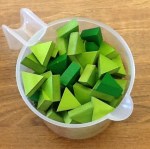
So after reading pages 1-35 I decided to use an example of a higher-level demand activity with a fifth grade classroom. This particular class is learning about fraction multiplication and division. Students have learned in the past to multiply the numerators and denominators to arrive at a solution. To delve a bit deeper in their understanding I decided to use and adapt one of the tasks in the book. I first grouped the students into teams and gave each team 12 triangular blocks and a whiteboard marker.

Photo Jan 22, 9 45 43 AM

Students were asked to show a visual model of 1/6 of 1/2. Some students knew the answer already but seemed unsure of how to show the answer visually. Many of the groups weren’t quite sure on how to approach the construction of the fractions. They understood the abstract and procedural but had a challenging time visualizing the fractions.

After seeing the students struggle a bit I’m glad that I decided to have them work in pairs. Students started to build models of 1/2 using the 12 triangles. Some of the groups came to a conclusion that two different sets of six triangles shows half. Then from there students started to think of what’s 1/6 of the 1/2. Students took out 1/6 but then debated on the value. Some groups said that the answer was 1/6 while others were confident that it was 1/12. Eventually the students decided that 1/12 was the correct solution.


I went around the classroom and took some pictures of the different creations. Not everyone created the same type of model. This was a great opportunity to highlight some of the different models that arrived at the same solution.


This slideshow requires JavaScript.

Afterwards, I thought that offering exactly 12 triangles helped but limited the choices for a visual model. The student models were somewhat similar as a result of the level of scaffolding. As students reflected on their actions in this activity I heard some interesting conversations. Students were aware of the procedure to multiply fractions less than one, but started to visualize the model through this activity. I thought this might be one way to introduce fraction multiplication at the fourth grade level.  I also thought that this activity was well worth the time and I’m looking at incorporating additional high-level cognitive demand activities in the future.

Student Shape Books

TITLE

Last week I introduced one second grade class to Christopher’s Which Shape Doesn’t Belong book.  After hearing about its success on Twitter I decided to use it with one of my classrooms. After downloading the pdf I displayed the images in front of the class and asked the students to think of which shape didn’t belong. Just about everyone in the class raised their hands. Students overwhelmingly decided that the unfilled shape didn’t belong. Students were ready for the next page of shapes when I saw a hand raise from the back of the classroom. That particular student said that wasn’t the only answer. Quite a bit of the class raised their eyebrows and their voices in saying that the unfilled shape was the answer. The student raising his hand said that the triangle doesn’t belong because it only has three vertices. Other students started to raise their hands with additional solutions. Through this process students started to find more solutions.  The student input became contagious. I would sum up what happened during the next 10 minutes here. Words like vertex, diagonal, side, symmetry, and angles were starting to be part of our class conversation.  I also was able to identify misconceptions and ask questions to think about their responses.  This led to more student responses and questions.  This conversation wasn’t planned but I felt like it was worth the time and fit in perfectly with my geometry unit.  I was going to move to the second page of the book when our class ran out of time.

So the next day the class started the day off with page two of the book. Again, students found different solutions and the class continued the conversation. After a brief amount of time I introduced a shape book activity.

Click for pdf
Click for pdf book

For this activity students were asked to create a personal shape book similar to Christopher’s book. In addition to creating a which shape book, students were asked to include particular shapes in their book.

3D_Shape_Activity

Screen Shot 2015-01-18 at 7.13.46 PM

Students were given guidance on the first page. I explained the directions, what was expected for the assignment and answered a few questions. I included a formative assessment on the last page of the booklet.  Students worked diligently in creating the initial parts of their books for the rest of the class. Most of the time was spent on the reasoning pages.  The gallery below will show some of our progress from last week.


This slideshow requires JavaScript.

I’m planning on having students share their books with the class next week.


Sample Size and Reliability

Sample Size and Reliability

Monday was my school’s first day back from break. The students had two weeks off and many students and teachers are still getting back into school mode.  The teacher coffee machine was is still working overtime.  The first day tends to ease students back into the concepts taught back in mid-December. One of the better ways to transition is to debrief with the students about their break. This is also an opportunity for students to make connections and reconnect with their peers.

After debriefing with the students about their break one of my classes delved a bit deeper into a data analysis unit. This class studied different types of graphs back in December. We explored stem-and-leaf plots, bar graphs, pie graphs and even took a look at box plots. One of the objectives of the lesson on Monday was to explore the relationship between sample size and the reliability of the results.

This lesson was actually adapted from a fifth grade Everyday Math lesson. Before class I decided to use different colored unifix cubs to represent candy colors. I’d prefer to use regular candy but we have so many allergies and a wellness policy that nixes the use of candy in the classroom. Anyway, I took 100 unifix cubes and split them up into 50 being chocolate, 30 cherry, 10 lime and 10 orange. I didn’t tell the students how many cubes there were or the color allocation.

Unifix Cubes
Setup before class


Before digging into the manipulatives the class discussed why using sampling was important. Students discovered how sampling is much less time-consuming compared to surveying all people/objects. We then discussed how much of a sample is appropriate. Students were all over the place with their estimates. Throughout the conversation I was attempting to sett the stage for students to make some connections and find clarity on the concept through this activity.

Students were placed in groups of two for this activity. Each partner randomly chose five unifix cubes.

Random Sample

The groups then combined their cubes and documented their total. About 80/100 cubes were taken after all the students documented their total. Each group reported out their findings. Some groups had almost all chocolate while other groups had zero orange or lime. It was interesting to see how the students reacted as other groups reported out their results. It seemed like they wanted to question their own results.  Students were then asked to make a prediction of the actual results based on the sampling.  The class then combined the results of the groups and shared the results.

I brought the students to the back table in the classroom and dumped the cube container. We counted each color to see how accurate our class sample was to the actual result. Students then compared their group results to the class and then to the actual results.

sample
Better than what I expected


I then gave the students an opportunity to reflect on the comparison as a class. Some groups were very close to the actual percentage while others were way off.  I explained that this is part of the sampling process.   Students were then asked to journal about their experience and the class will explore this topic in more detail later in the week.