Math Acceleration or Enrichment

Acceleration v Enrichment
Acceleration vs Enrichment

A while back I was asked a question about student acceleration and differentiation.  The question related to different types of acceleration opportunities for students that master math content before others. This question is often at the heart of differentiation for high achieving students.  I thought awhile about the question and started to brainstorm what opportunities truly exist or if acceleration is needed in those circumstances.   In an education setting acceleration is often associated with a curriculum that is moving faster or happening at a quicker pace than the norm.

In math at the elementary level, concepts are usually built upon one another and acceleration seems to be valued. Similar to a lattice fence, once one concept has been mastered, teachers often move the student to the next row/concept.  The goal is to continually move students in an upwards trajectory towards the next concept on the ladder.

expectations
Upward trajectory

When acceleration is the focus, students are asked to master and then move to the next numerical concept. For example, If student A has mastered 2.0A.A.1 they automatically move to the next concept, 2.0A.B.2.  Keep in mind that mastery is often defined by the author of the assessment.  Mastery could be correctly answering a few abstract problems in a row or answering 90% of the answers correctly.  In the author’s mind, the faster this process occurs over time the more the student learns.  This isn’t always the case and the perceived notion of learning might not actually be occurring. This is especially prevalent with online adaptive software programs. This type of philosophy often facilitates minimal understanding and can lead to problems down the road.  Also, students that are accelerated are often asked to answer questions more on an abstract level rather then explore mathematics constructively.  Creating a personal level of mathematical understanding is valuable.  Focusing in on only the abstract doesn’t always lead to a learning experience or a better understanding of math.

I believe acceleration has a place in the elementary classroom, but I don’t think that it should be the default.  Honestly, I feel like accelerating is easier than providing opportunities for enrichment. Instead of acceleration why not emphasize enrichment for students that have already demonstrated mastery? I think the word enrichment gets caught up in buzzword land, so here’s a formal definition:

Miram-Webster defines enrichment as the process that improves the usefulness or quality of (something) by adding something to it.

Enriching math instruction doesn’t necessarily mean that students quickly move from one concept to another, but instead it may focus on practical application and problem solving.  Developing strong problem solving skills enhances the usefulness of mathematics.  I find that students benefit when given opportunities to enrich their understanding of mathematics.  In addition, enrichment provides opportunities for students to practice relevant skills that become immediately useful.  Logical thinking, abstract reasoning, and problem solving can all be part of the enrichment process.  All of the skills that are practiced through enrichment activities can be used cumulatively throughout a math curriculum sequence.  The picture below is just one example.

enrichment
Enrichment

Students often need to have a foundational understanding of mathematics to be successful at the middle and high school levels. Logical thinking and abstract reasoning skills tend to contribute to the background knowledge for algebra and geometry concepts.  Problem solving is a skill that’s used throughout school and life.  Enrichment opportunities encourage students to use the math learned and apply it to practical situations.  It also enables students to solve problems using trial and error and find multiple solutions.  Perseverance skills are also practiced during math enrichment opportunities.  Instead of completely emphasizing the upward trajectory of concepts, students that experience enrichment opportunities develop skills laterally and may cement a more solid mathematical foundation in the process.  It may also enable students to see mathematics in a new light, not just a lattice of concepts placed in chronological order.  Feel free to review MathwireNRichMaths and Andrew Stadel’s Math Acts,  for a few different examples of how to incorporate math enrichment opportunities.

There isn’t really one right answer to the question found at the beginning of this post.  The solution includes a possible combination of acceleration and enrichment, but immediately leaping to acceleration might not be the best option.

How do you use math enrichment in the classroom?


National Governors Association Center for Best Practices & Council of Chief State School Officers. (2010). Common Core State Standards for Mathematics. Washington, DC: Authors

Enrichment. 2014. In Merriam-Webster.com.Retrieved July 21, 2014, from http://www.merriam-webster.com/dictionary/enrichment

photo credit: Filter Forge via photopin cc

Professional Development Conversations

1

Yesterday I was able to participate in a SAMRiCamp teacher workshop.  Similar to last year, DG58 hosted the event and it was well attended.  It’s great to see so many educators and administrators taking time out of their busy schedules to attend this professional development opportunity.  There were many sessions available and facilitated by educators and administrators in the area.  The sessions provided educators with a variety of options to choose from. For the most part, the facilitators of the sessions had organized presentations displayed on whiteboards that were shared through Google Drive. As usual, the entire conference was paperless.  Discussion generally followed the presentation with the audience sharing feedback with the group.  The majority of the sessions included a hefty dose of teacher conversation.

I find that this type of teacher development model is different than the norm.  This type of model can benefit educators in ways that weren’t possible a few decades ago.  My past teacher trainings generally consisted of specific workshops for teachers within a particular district.  The presenter spoke for the majority of the time with a handout and limited audience participation.  Instead of having one district provide training for their specific teachers, the SAMRiCamp teacher camp model encourages more of the conversation element with participants from multiple districts.  Different perspectives, programs and ideas can be heard when participants offer responses in the sessions.  Gathering teachers and administrators from the local area/state can reap benefits for all participants.

The conversation and collaborative part of this type of professional development is important. Including time to discuss, ask questions and share ideas can evolve into teacher reflection opportunities.  During these teacher-led conversations, teachers can experience affirmation and may also meet constructive feedback from others that they can bring back to their school.  Pushback, or asking deeper questions that lead to justifying a response can also play a role during these conversations.  Discussions can lead to deeper connections with other teachers outside of their district.  This action also provides opportunities for teachers to expand their personal learning networks.  Being able to candidly discuss matters related to education with other professionals can improve practices. Since many districts are represented, different instructional models and ideas can be brought to the table for discussion. Since educators are both introverts and extroverts, the discussion doesn’t necessarily have to always be verbal.  The conversations and questions could take the form of a shared Google Doc. I believe all teachers have something to share and getting comfortable enough to share can be a positive tipping point in the professional development conversation.  Taking the risk to share/present and receive feedback can benefit all stakeholders in the room.  At the same time, I think it’s important for teachers to be able to say that they don’t have all the answers. The unanswered questions can often help develop an atmosphere of brainstorming, which inturn helps the group.  Reflecting on past practices and sharing/learning from others can lead educators to change their practice for the better.  Feel free to review the #SAMRiCamp tag for a brief overview of what was discussed.


Bridging Procedural and Conceptual Understanding

Yesterday I was putting together a few math projects when a Tweet caught my eye. The Tweet below started a short conversation that I thought was interesting.

David’s Tweet had many responses.  Most responses revealed that educators tend to side with solving one problem ten different ways rather than having students solve ten similar problems.  I started to reflect on how teachers give assignments that ask students to complete repetitive problems that often reinforce procedural mathematical thinking.  I also started to think how in an effort to provide practice, teachers may focus on procedural aspects first and then move towards practical application.  I find this happens frequently with math concepts at the elementary level.  What I don’t find often is the viewpoint that practicing procedural aspects can be embedded in solving specific problems multiple ways.  This type of thinking reminds me of number collection boxes.

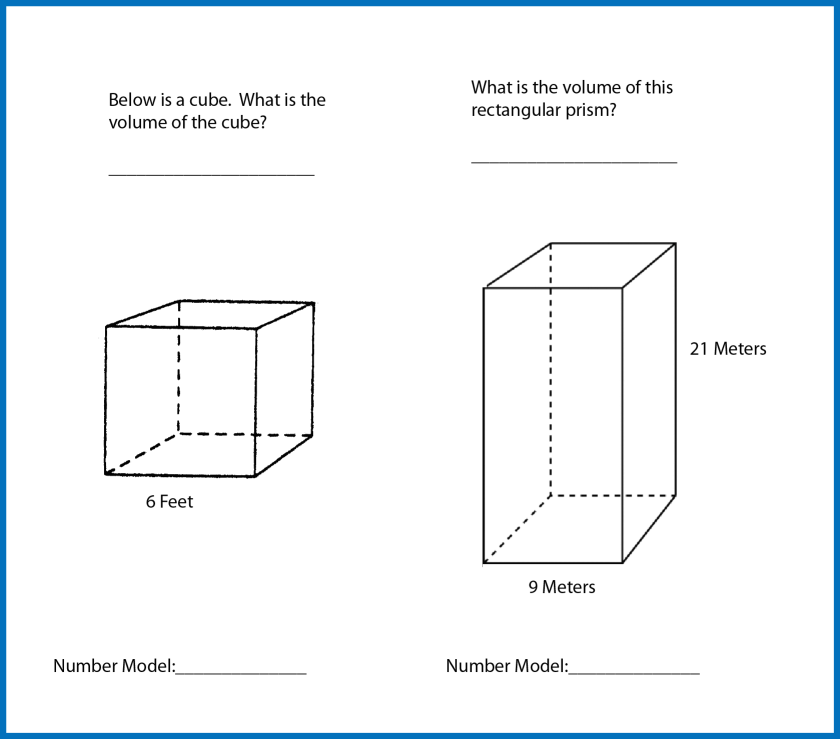
Regardless of the assignment I want to be able to give specific feedback.  A larger problem that involves multiple steps can provide opportunities for teachers to pinpoint where misconceptions are and give direct feedback.  This isn’t always possible with ten similar shorter problems.  Below is an example of a few problems that you may find in a fifth grade classroom.  I don’t condone using these types of problems as they are definitely utlized, but I think we need to ask what’s being assessed when students complete this type of problem?  Students are simply asked to find the volume and show a number model.  I appreciate how the problems ask students to show their number model, but these types of problems seem to measure procedural understanding.  Do students know the formula?  Yes, well then they can answer many of these problems, even 10 in a row.

Procedural


I think the above problems have a place in the classroom, but shouldn’t necessarily be the norm.  Usually these types of problems are found on homework sheets.  The problem below which was adapted from a recent fifth grade test is more challenging, but gives students opportunities to showcase their own mathematical understanding and persevere.  Some would say that these two problems are completely different.  I would agree, but similar concepts are being assessed.  They do look different and the second requires more skills to complete.  Students need to be able to use their procedural understanding and apply it to the situation.  Also, one key element that’s missing from the first problem is the student explanation.  Students are required to show their mathematical thinking in the second problem.  This is big shift and can reveal student misconceptions more clearly than the first problem.  I struggled with the decision, but eventually had students work in groups to complete the problem below.  Students were allowed to use any of the tools in the classroom to find a solution.

newadvanced


At first, all groups struggled with this problem.  Near the end of class all the groups presented their findings.  What’s interesting is that all the groups had different answers and ways in which they came to their conclusions.  I was able to offer opportunities for students to see and ask questions about different math strategies.  During the next class I was able to pull each group and give feedback.  This activity took a good amount of time to complete, but I feel like it was worth the commitment.

Through this experience and others I’m continuing to find that it takes a “bridge” to connect the procedural and application pieces.  At times I feel like there’s an assumption that if students are able to answer 10 similar procedural problems that they will be able to simply apply that knowledge in a multi-step problem.  This isn’t always the case and sometimes the bridge doesn’t fully form immediately.  Performance tasks, similar to the problem above can be one way in which teachers can help the transition from procedural understanding to practical application.  Being able to apply that knowledge to a math performance task can be a challenge for some students.  When teachers focus so much on the procedural, that’s the only context that students see and practice.  A blend between procedural and application needs to be established within the classroom.  I feel like activities like this help bridge this gap.


How do you bridge mechanical and conceptual understanding?

Classrooms that Encourage Risk-Taking Strategies


Creating a Classroom Environment
Encouraging Risk-Taking in the Classroom

A positive classroom environment often plays a pivotal role in student learning.  Fostering a classroom climate that promotes the learning community can reap benefits for all stakeholders involved.  Feeling a sense of belonging to an organization can increase participation and build confidence.  Primary and elementary grades often spend a good part of the first few days of school focused on creating a classroom community. Building that classroom community can take many forms.  Joy Kirr’s Livebinder provides many classroom community building activities that I found helpful.  A focus on team building, sharing and reflection can all aid in building a productive learning environment that will set a strong foundation for the school year.

This isn’t necessarily easy as there’s always curriculum to cover, but setting aside time to create a classroom climate is worthwhile.  Once established and continually reinforced, it can be a driving force in which students take academic risks in the classroom.  Whether its student council, clubs, art class, or whatever, that sense of belonging often enables students to participate at higher levels as they feel that their voice is truly valued. When I speak of risk, I think of the term in a positive way.  The risks that I’m speaking of often help students move beyond taking a stagnant stance with their education.  Student risk can take many forms in the classroom.

Taking a risk could mean that students:

  • Answer/ask questions more often
  • Are more open to feedback given by peers and teachers
  • Are able to collaborate with others
  • Show perseverance when approaching challenging tasks
  • Take more ownership of their learning
  • Able to explain their mathematical thinking in more detail
  • Take pride in their work more often
  • Reflect on their performance and set goals
  • Rise above their own personal expectations
  • Start to develop leadership skills

For some students a risk is to raise their hand in class. For others, students might engage in mathematical conversations with their peers or use feedback as a learning tool.  Another student might want to take what was introduced in class and start an enrichment project.  Personal risk is truly determined by the student. To make sure that students take academic risks they need to feel as though their community supports them.  Modeling how to approach risk-taking in the classroom is important.  Sharing personal stories and continually reinforcing that making mistakes is part of the learning process can help create opportunities for students to take risks on their own. Teachers can start by creating low-risk opportunities in the classroom (See Reed’s post for examples).  These tasks can be powerful and foster a positive classroom climate in the process.


How do you create a classroom that encourages risk-taking?


Reflections from Digital Leadership

Digital Leadership Takeaways

About a month ago I started to read Digital Leadership by Eric Sheninger.  His book is full of leadership strategies that are applicable at any school level.  Specifically, he speaks of how to integrate technology in schools and the reasoning to do so.  While reading I took out of my highlighter and it was busy as they’re many gems in the book.   I thought the topics on the role of technology in the classroom and student content creation opportunities were especially intriguing. I’ve outlined my takeaways and reflections below.

1.  Combining pedagogically experienced educators with technology-savvy students can be beneficial

Students often come into the classroom with an average to above average understanding of how to use technology.  Their understanding of technology can benefit a classroom and the learning experiences within.  I like the concept of being able to combine background knowledge of technology-savvy students and pedagogically experienced educators.  Weaving instructionally sound teachers and technology can reap dividends.  Both parties bring an understanding to the table.  Merging both can can turn technology into a tool for learning.

2. Students need to be aware that technology tools are for learning  

I believe that students are aware of the capabilities of the devices that they use, although understanding how they can be used for learning is another story.  I think this is where it’s essential for pedagogically experienced educators to seek avenues to combine  the capabilities of the device with learning opportunities. The transition from a perceived consuming/gaming device to a learning device may take time.  Due to corporate marketing and education success stories, I believe that transition is taking place in the field of education.  Naming them as learning devices also reinforces the concept that technology in schools can contribute to the learning process.  Regardless of the device, the opportunities for learning exist.  Educators and students can benefit from revealing this possibility.

 3.  Students’ learning experiences become more meaningful when they use real-world tools to show conceptual mastery

It’s becoming clear that technology devices can be utilized to showcase conceptual mastery. This year my students created online tutorials and various projects to demonstrate their learning of mathematical concepts.  Based on my end-of-year survey, students found the content creation projects meaningful.  Seeing that they were published online and available for comments provided opportunities to showcase their projects for an authentic audience.  To be honest, not all projects were optimal and I’m going to make changes for next year, but I was encouraged to see students use real-world tools to demonstrate learning.

4.  The aim is that students move towards creating an actual product.  They need opportunities to show what they’ve learned in a variety of forms

Students in many classes are expected to show mastery of particular concepts through worksheets, usually categorized as unit assessments.  Many times this is mandatory, in the form of district summative testing or state-wide standardized assessments.  Students should be afforded the opportunity to showcase their learning beyond worksheets. Technology devices and apps offer presentation tools that didn’t exist before.  These student content creation tools also give students opportunities to infuse their projects with voice and creativity. This aspect brings student ownership and an opportunity to extend their learning beyond the requirements.  I’ve found that student content creation can showcase learning while providing a lead to engage students in their own curiosity regarding a particular concept. With flexibility and clear expectations, this  type of product can show learning and at the same time be a publishing opportunity for students.


photo credit: Jamais Cascio via photopin cc

Math and M.C. Escher


Math and M.C. Escher

During the last week of school my students started to explore topography concepts. Topography usually isn’t the first thing that is thought of when someone mentions the word math. That’s why I find it so interesting.  I truly enjoy teaching this topic because it often brings out the best from my students.  I find that most upper elementary students tend to thrive when given geometric shapes and asked to explore, rotate, translate or even turn them inside out.

I generally introduce the unit with M.C. Escher.  The class learns a bit about the life of Escher and his contributions to the world of art.  Moreover, we discuss how art and math are related. This is often a deeper conversations as students start to expand on the notion that mathematics can be found throughout our world.  Topics like the golden ratio and Pi often get brought up during this time.

After learning about Escher’s life and his influencers, the class looked at his different artistic creations. Usually my students recognize at least a few different creations.  Students seem to gravitate towards his optical illusion pieces or the famous Waterfall work.  As each work of art was discussed the more students found mathematics as an integral part of Escher’s work. After reviewing the different pieces of lithograph art, the class watched a short video on how Escher’s design and math are connected.

After the video the students were asked to have a conversation about how math can be found in most art.  The words symmetry, rotations, slides, translations, reversals, surfaces, and perspective were all brought up during the discussion.  What’s nice is that the vocabulary was brought up naturally as students spoke to one another.   I was able to highlight the words and facilitate the discussion as needed.

Eventually the discussion ended and the class moved to the next activity.  I planned to have the students create their own Escher-like artwork.  The students reviewed how to have “Escher-like eyes” when creating their own pieces.  I was proud of the student responses and the imagination that came forth during this discussion.  The class then reviewed the directions to create their own Escher-like creations.

www.mathwire.com
http://www.mathwire.com

The students went through the directions and asked questions.  Once the expectations were clear I passed out a 8 inch by 8 inch square to each student.  Students created their own tessellation template.  In the future I’m probably going to cut the square dimensions in half so the patterns become more evident.

This slideshow requires JavaScript.

Eventually the students used the template to create an Escher-like creation.  Students showcased their work to the class using the vocabulary mentioned above.  The students were able to bring their work home on the last day of school.  All in all, this is a lesson I’m intending on using next year and a definite #eduwin in my book.


How do you incorporate art and math?


Using Badges in the Elementary Classroom

digi


During the last #msmathchat the topic of digital badges was brought to the forefront.  The idea of badges in the classroom has always interested me.  I was first exposed to the idea of using badges in the classroom by @mrmatera last summer at a Downer’s Grove PD event. Michael used a form of a digital badge/achievement token while integrating gamification in his own classroom.   His idea spurred on a brainstorming session with another colleague which resulted in the creation of badges for my own classroom.

Looking back, this past year was the first year I decided to use a form of badges within my classroom.  Back in September I decided to research a few different options for using badges.  After much review I decided to use the badge philosophy without a digital component.  Even though there are many digital badge sites, I wanted to start small and simple and using paper badges seemed like the right move.  I decided to create a simple badge template.  The one below is for the app Prezi.

Screen Shot 2014-06-15 at 11.25.48 AM

The  badges were going to be used to show milestones or proficient use of certain skills.   One larger theme in my classroom revolved around the idea of student content creation.  My students were using a variety of apps to showcase their learning through digital means. Since students were using content creation apps, the badges would show proficient use of specific apps.  I found some blank Avery mailing labels around the house and created a simple badge template and then imported it into Word.

Flowboard Badge Label
Label Template
Label Template

The title of the class was on the top and the name of the app was on this inside of the logo. Students received a badge when they successfully created a math product with a particular app.  Students decided to put the labels/badges on their personal folders. Individual student folders started to fill up with badges as the year progressed.


Student folder w/badges

Not only were the students proud of their accomplishments in creating mathematical content, but they were able to reflect back on all their badges and growth since the beginning of the school year.  It was encouraging to hear how excited the students were to receive a badge once they finished their project successfully.  Even more powerful was the reflection component that the students recognized as they wrote their final reflections at the end of the school year.  I’m still brainstorming how this idea could transfer to mathematical concepts without turning this into student competition.  Regardless, I’m looking at using a form of a digital badge next year, but using labels is my first step in that journey.


How do you use badges in the classroom?


End of the Year Survey Data

At some point during the last week of the school year I generally have my classes take a survey.  The survey is designed to provide feedback and to reflect on learning experiences that have occurred throughout the year.  The survey is composed of questions about the class in particular, favorite memories, different learning experiences, and feedback on how I’m perceived. For the past few years the classes and I review the survey data together before the students write their final reflections. For this post I took out the learning experience pieces and am focusing in on teacher perception.

Survey Directions:

Screen Shot 2014-06-09 at 6.41.22 PM

I read through the directions with the class and answered a few clarifying questions.  Students weren’t required to submit their name.  Students took about 20 – 30 minutes to complete the survey.  I averaged the classes together and the results are below.

Results

I’ll be showing the class the chart above tomorrow.  Before doing that, I’m going ask the students what they think are the top 3.  In the past I usually compile the list into the “top 3” and then the class discusses the results and implications on how these categories impact learning in the classroom.  This is always a rich discussion that evolves into an understanding that feeling safe and respected in a classroom often encourages academic risk taking. Here are the top 3 we will be discussing tomorrow:

  • The teacher is fair to all students in the classroom – 1.154 / 10
  • The teacher uses technology to teach the class – 1.179 / 10
  • The teacher shows that she/he really loves to teach and learn – 1.359 / 10

I’ll then show the bottom 3:

  • The teacher gives choices to complete an assignment – 5.39 / 10
  • The teacher allows opportunities for students to reflect on their learning – 3.256 / 10
  • The teacher gives assignments that connect to the real world – 2.821 / 10

During this time the class will be tackling questions about what’s important in a typical classroom.  The class discussions during this time are so important.  This type of reflective thinking is purposefully planned to encourage students to take part in understanding how their environment and mindset plays a pivotal role in the learning process.

My takeaways

I think teachers can be extremely critical of their own practice.  I tend to focus more on the areas of improvement, but I think it’s important to share this data with the students as one way to model a growth-mindset.  I was surprised to see that reflecting on learning scored lower than others. By low, I just mean it wasn’t rated as highly as others. This year I’ve utilized student reflection sheets, but only really using them after assessments.  I feel like I need to merge more opportunities for students to reflect throughout a math unit of study, not just at the end.  I’m also willing to explore different avenues to reflect.  Instead of using the same sheet, possibly using multiple forms of reflection may help.  This is something I’m going to work on over the summer and have in place for next school year.

Also, what’s interesting is that as grade levels progress from lower elementary to upper elementary, assignments connecting to the real world decrease.  I’m not totally surprised as there’s a large emphasis on algebraic equations for my upper elementary classes.  The algebra concepts and practices are often disconnected from practical use. Again, I’d like to find a way to change this perception.

I’m excited to see that students feel safe and feel like I’m fair in the classroom.  The environment and having positive rapport with students can go a long way in having students exceed their own expectations.  Also, even though it wasn’t in the top 3, I’m proud to see that students feel that they can use technology to demonstrate their learning.  This has been a huge emphasis this year with my student content creation theme.

Overall, using student survey data can be a valuable experience.  The transparency that it provides can encourage students to take additional risks.  Looking towards next year, I might want to give a similar survey earlier in the year and then closer to the end.  That way we can look at the growth of the class.  Regardless, I feel like the moments we have to reflect on our learning experiences and survey data are well spent.  This time can can help revisit learning experiences and offer an opportunity to cement an authentic enjoyment in understanding mathematics.


Exploring Rates in the Classroom


Exploring Rates in the Classroom

The topic of mathematical rates was introduced earlier this week.  Personally, I tend to find this unit enjoyable as there are many opportunities to connect the topic outside of the classroom.  To introduce the topic my classes go home and find examples of rates in their kitchen’s pantry.  The next day the class shares out what they found. This usually leads to an in-depth conversation about rates and patterns.  After our conversation I felt as though more examples and experiences were needed.

That evening I found some masking tape in my desk.  I decided to create a race path around the classroom.  The path varied in width and it purposely had a few sharp turns.  A roll of masking tape was used as well as a few proactive comments to the janitorial staff to not pick up the tape overnight.  When students came into the room the next day they saw this:

The raceway
The raceway

When the students walked into the room they were surprised.  A few started to jog around the track and ask questions about the room.  Already I was fairly excited as the students were pumped to see what I was up to.   I explained to the students that we were going to use the track to discuss rates, patterns and measurement.  The class then measured out the track and found that it was 66 feet long.  We had a conversation about how this track could be used to emphasize rates. I then introduced the students to the sheet below.

Screen Shot 2014-05-31 at 7.43.43 AM
Rates Sheet

Students were starting to see the big picture of this activity.  Students then took turns and quickly walked the course.  While they walked I had a few students become referees to make sure that no one stepped outside of the path.  I used an online counter and displayed the results as students quickly walked.  Once all the students completed their route and wrote down their results the class reviewed how patterns can be developed with rates.  Students were able to find the amount of feet traveled per second and then used that information to find how fast they walk one foot.  I was finding that students were trying out different mathematical strategies to find a solution. I gave them opportunities to work with each other to find solutions.  I asked clarifying questions when needed, but for the most part the students were on track. When the class finished this part of the sheet I gave them the second part.

Screen Shot 2014-05-31 at 7.57.21 AM
Converting feet to miles

This portion of the activity was more challenging.  Students were able to find the total amount of seconds, but converting the seconds to minutes was a struggle.  Many students asked how they could convert 12.9 minutes to minutes and seconds.  I was proud to see that students understood that 0.9 doesn’t mean 9 or 90 seconds.   This was a great opportunity to explore the concept of converting decimals to actual minutes.  The class used different calculations and found that 12.5 would actually be 12 minutes and 30 seconds.  As progress was made students started to find a conversion strategy to correctly convert the decimal to seconds.

Photo May 28, 2 52 56 PM
Click for Word template


As a class we shared our results and found patterns and the mean.  This activity worked so well that I used it with a few other classes this week.  I’m finding that students are developing a better conceptual understanding of rates while participating in a learning experience that I hope they don’t forget too quickly.

How do you introduce rates in the classroom?


Student Choice in the Classroom

studentchoice


I continue to find that student choice is important.  Giving students a choice in the classroom is a shift from some classroom models, but this change that can make a large difference.  My journey with student choice began many years back.  During my first year of teaching I started to ease into giving students options in completing specific problems on assignments.  Students were able to pick 5 out of the 20 problems on a particular page.  From there I started to give students choices in what assignments to complete.  I limited the option to two assignments and then progressed from there.  As I gave students choices they became more engaged and took more ownership.  I took this as a sign to continue. From once a month, to twice a month, to once a week, I gradually was giving up some my control to allow opportunities for students to choose their assignments.  Students started to ask for additional choices as the year continued.

For the next few years I taught a different grade level.  Another colleague and I started to use student choice for a math presentation assignment.   We gave a list of concepts to students and they created a presentation on one of the topics with a Power Point presentation.  The assignment was a success and we decided to use a similar strategy the following year.

A big shift happened when I started to give students choices in how the classroom was setup.  I remember the class had a discussing on how the learning environment plays a pivotal role in the learning process.  After the discussion students offered feedback on how our classroom could be improved to optimize learning.  Students decided on how to group the desks, move the classroom library, and modify the arrival/dismissal process.  Each change was agreed upon keeping in mind that the change helped create a better learning experience. Students started to take initiative, take risks and offer solutions.  Students that were less enthusiastic about student choice with their academics took full advantage and offered their opinion on classroom design.  Students created floor plans on where the desks should be placed and how table groups should be created.  The learning spaces were changed every few months depending on the feedback I received from the students.

This year my students created digital math projects.  Students are self-selecting topics within units and creating presentations to showcase their learning.  The tool was standard but the topic choice varied.  Some students created presentations on algebraic expressions, while others showed examples of how to use the order of operations.  Rubrics were created for each presentation.  For the first few presentations I created and gave the rubric to the students.  Eventually the students became part of the rubric creation process.

Screen Shot 2014-05-25 at 7.59.29 AM

As the year progressed the quality of the projects increased.  Students began to independently research their chosen topics.  Students started to use different research tools to find information about specific mathematical concepts.  Various Internet sites, student reference books, math journals, and manipulatives were all used to research math topics to create a presentation.  Students were also starting to use apps simultaneously to create final products.

Importing picture into presentation
Importing pictures into a presentation

As my classes enter the last few weeks of school our final content creation project is in its early stages.  Last week I gave students a choice on what tool to use and what concept to cover within the unit.  I was encouraged as all the tools that have been introduced this year will be used by the students.

Tool Selection
Tool Selection

Next Steps:  Eventually I would like to incorporate some type of math genius hour.  I’m still brainstorming ideas on how to use this for next school year.


How do you offer student choice in the classroom?