Math and Gallery Walks

Screen Shot 2017-10-06 at 6.32.08 PM

My fourth grade students are exploring exponents this week.  Students are learning how to write numbers in exponential form and covert the numbers to standard form.  For the most part, students have had a productive week learning how to write very large and small numbers.  Later in the week, I decided to have students complete a team task enrichment project. Students were asked to compute large numbers.  Here’s the Freight Train Wrap-Up prompt:

Brianna loves freight trains.  She learned that in 2011, there were about 1,283,000 freight cars in the United States.  Brianna wondered whether all those train cars, lined up end to end, would wrap all the way around the Earth.  Help Brianna answer her questions.  Could a freight train with 1,283,000 cards wrap all the way around the Earth?

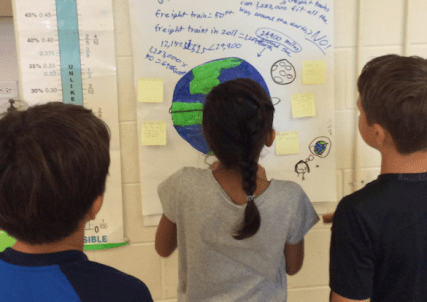
I reviewed the criteria for success with the students and then placed them in teams.  Students were asked to use an anchor chart to show their mathematical thinking.  They could use markers, and other materials to showcase their solutions.  Students were given around 20 minutes to work in their teams to find an answer.  Some students drew pictures, while others decided on writing out equations.  I heard a number of groups argue about the solution and what to compute.  After about 15 minutes, most groups were close to finishing.

After the time was up, I brought the students to the front of the room.  I briefly communicated all the different solutions that were evident.  Students were asked to participate in a gallery walk.  Gallery walks are used as a standard default activity for district meetings so I decided to try it out with my own class.

Screen Shot 2017-10-06 at 6.25.42 PM.png

Students were then given three different Post-it notes.  Each note was intended to ask students to indicate whether the chart that they were viewing answered these questions: 1) Did the team show their work? 2) Was there a solution? 3) Was there a visual representation?  The note also indicated a question or an agreement.

Screen Shot 2017-10-06 at 5.54.13 PM.png

Students efficiently traveled from group to group.  They gave feedback and mostly agreed with what the other groups came up with.  Students weren’t allowed to give feedback on their own anchor charts.

Screen Shot 2017-10-06 at 6.27.32 PM

I then brought the students back to the front and we went through the problem together. We discussed the numbers, operations needed, and possible solutions.  Students then went back to their original charts to read the feedback.  Some students were surprised at the comments while others wanted to debate them immediately.  I was able to touch base with each group and discuss what the constructive criticism might have meant.  Students spend a decent amount of time talking with one another about their chart and process.  Afterwards, students went back to their seats and prepared to leave.

This type of activity went well.  After thinking about it I might consider doing something like this once every month or so.  Also, I might need to think about how to get my hands on more anchor chart paper.

Cracking the Code

Screen Shot 2017-09-21 at 9.14.31 PM.png

My third grade students explored different addition and subtraction algorithms this week.  It’s been a challenge.  In the past, students used number lines to add or subtract by the highest place value first and then slowly move towards the lowest.  Moving towards a  standard algorithm has been a process this week.  Students started by using the partial-sums method.  This was similar to what they were used to and mimicked the number line models.  Students seemed fairly comfortable in using this method.  The column addition method was next on the docket.

Many students come into my classroom already knowing how to use this method.  It’s often referred to as the traditional/standard addition algorithm.  Students complete the steps and out comes an answer.  Does it make mathematical sense to my third graders?  In some cases the answer is no. So, in an effort to bring a bit more meaning to why it works I decided to use a code activity to reinforce the idea of base-ten and place value.

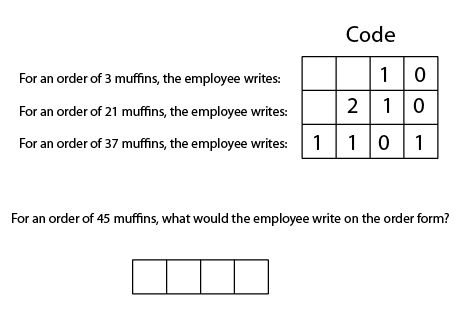
Cracking the muffin code is an activity found in the Everyday Day math curriculum. A quick Google search will also bring up many different threads related to this activity.  I’ll be paraphrasing the lesson throughout the post.  Basically, students are given a scenario where they’re in charge of a muffin market.  At the market the muffins are packed into boxes.  The boxes only hold a certain amount of muffins.  When someone asks for muffins, an employee fills out an order form.  That order form contains a code.  The largest box needs to be filled first and the employee needs to send boxes that are full. Here’s an example that I paraphrased from class:

Screen Shot 2017-09-21 at 8.49.18 PM

I had students work in groups to figure out the code.  I gave them around 10 minutes and at the end of time a few groups were fairly confident with their answer.  We discussed the code and students started to notice a pattern.  They used trial-and-error to figure out which column matched the box size.

Screen Shot 2017-09-21 at 8.59.12 PM.png

There was a lot of excitement in the air as students solved the puzzle. Afterwards, students connected this to the idea to place value for the next problem.  This puzzle was designed differently. Now, students were asked to pack boxes of granola bars. The packages hold 100, 10, or 1 bars.  The employee uses a coding system.  Here’s another example:

Screen Shot 2017-09-21 at 9.04.30 PM

Almost immediately, students were able to see that the first column was designed to package one bar.  The second was for ten, and the third, one hundred.  I gave time for students to look at the similarities and differences between the granola and muffin codes.  Students were then asked if the base-ten system was similar to the granola code.  Students nodded their heads and I even had a student say that when we regroup numbersit’s like adding another package.  Another student stated that sometimes not all the numbers fit in a package so we have to find another place for them.  Students were making connections to how the base-ten number system works and why regrouping is sometimes necessary.

This was an eye-opening experience for some students as they started to look at the place value positions as bins or containers.  This lesson had students talking about how place value can be perceived as “containers” or “boxes” for numbers.  Each box needs to be filled to it’s capacity until a new one can be used.   I’ll be referring to this activity throughout the year as it seemed to help students make connections when exploring the base-ten system.

Afterwards, students used the column addition algorithm with a bit more confidence.  Next week we’ll be discussing multidigit subtraction.


Volume and Missing Blocks

Screen Shot 2017-09-12 at 9.10.54 PM.png

On Monday my fourth grade crew worked on tasks related to perimeter and area.  Today they discussed volume. The volume discussion began when I brought out a large container filled with water.  I asked the students what they thought volume was.  Was it the amount of substance contained in an object or the space inside of the object?  It was interesting to hear their perspective.  I wrote down their thinking on the whiteboard. Some students were positive that volume measured how many cm cubes that could fit into the cylinder.  Another student stated that there wasn’t anymore volume left because the water took up the space.  I then took the same cylinder and dumped the water out.  Another student mentioned that you didn’t need to use cubes to fill up the cylinder.  You could’ve used sand instead to measure the volume.  Throughout this class conversation I thought students were testing their understanding of volume and not just regulating it to filling up objects with cubes. The class then made a math journal entry and created a t-chart of examples and non-examples of volume.

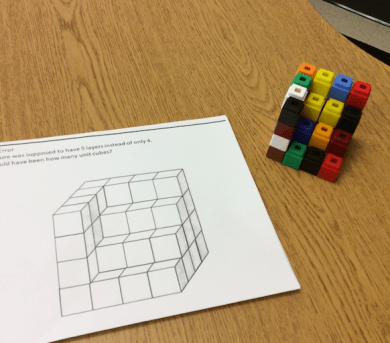
Afterwards, students went back to their table groups to discuss volume and I used Steve’s image from the tweet below.

I asked students to think about the shape and how many cubes might need to be added to create another layer.  Students were confused at first, but then gradually came around to thinking about how to add another layer.

Screen Shot 2017-09-12 at 9.10.43 PM

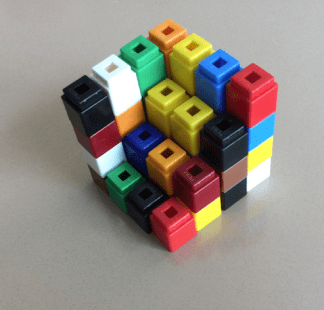
Some students wanted to add a layer on top, but then realized that making that top layer would mess up the stair sequence.  Eventually, after some major perseverance, I asked students to create a model.

Screen Shot 2017-09-12 at 9.10.50 PM.png

That model proved helpful as students could see and start thinking about how many blocks could be added to the bottom.  I noticed that students started to think of arrays and how helpful they were in creating another layer.

Screen Shot 2017-09-12 at 9.10.54 PM.png

At that point class ended.  We’ll be discussing this problem again tomorrow.  I’m looking forward to seeing what the students discover, their solutions, and what strategy they end up using.

Making Plans and Reality

Screen Shot 2017-08-25 at 6.47.18 PM.png

Three days are in the books. Students arrived on Wednesday and it’s been organized chaos for the last few days. Maybe not organized chaos, but it surely has been hectic and fast-paced. With all the scheduling, drills, trainings and professional development it can be challenging to find time to sit down and reflect on what has happened.

A few weeks ago I made my first day plans. The plans indicated a number of different activities and beginning of the year strategies.  Here’s what actually happened:

Day 1

I planned to have the kids for an hour, but that didn’t work out. Instead, I had around 30-40 minutes with my third and fourth grade classes. My fifth grade class was involved in expectations training so I missed their class on Wednesday. I ended up having students come into the classroom, find a seat, and use the “get to know you” and “get to know your teacher” activity.

Both of these activities were great. Students caught up with their peers and learned a lot of new information about their teacher. Even though I’ve had some of the students for five years, many were left guessing.  Major Kudos to Sarah for sharing this idea. I’ll be using it again next school year. Even more, the students were straight-up giddy about creating a quiz for their teacher.

I ended up having a very short amount of time to review the arrival/dismissal flow charts. By then, the time was gone and students had to move to their next class.

Day 2-3

During the second day I had students follow the arrival routine and sit in the same seats that they occupied yesterday. I randomly grouped students for their assigned seat for the first unit. Students graded their quiz and I was lucky to get a couple answers right on each page. I learned a ton about each student though.

Screen Shot 2017-08-25 at 6.29.38 PM.png

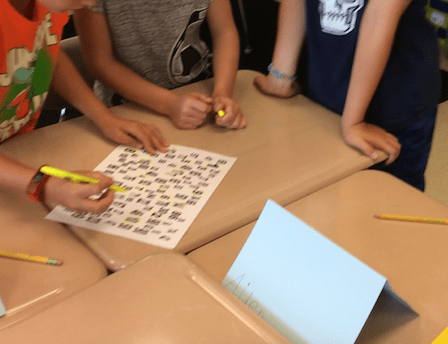
The class moved into the Number Trouble game. Their new seats already grouped the students into table teams. I distributed the 100 paper to the teams and explained the instructions. Each group had two minutes to find all 100.

Screen Shot 2017-08-25 at 6.36.38 PM.png

At the end of time every group found around 15-30 numbers. I gave the groups time to look for different strategies/patterns and create a plan. They were given an additional two minutes. Most groups had between 50-90 the second time around. One group made it to 100. I later found out that one of the members of the group used this activity last year.  Afterwards, I brought the classes to the carpet and we discussed what went well and what didn’t. The class created a list of positive behavior interactions and then that discussion spilled over into what the expectations should be for the school year.

Students signed-off on the expectations and then went back to their seats.

I then introduced the name tents and feedback forms. Students wrote their names on the front and I explained what students should do on feedback side. Students weren’t quite sure what to write, but eventually they jotted down what came to their mind. Time was up after this activity and the second day was finished. Later that evening I wrote back to each student.

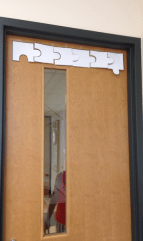
Students also started their puzzle piece. This is a bit different than in past years. Most students haven’t finished and that’s something that we’ll work on next week. We’re making progress, but I’m hoping when it’s all said and done, the door will be outlined with the student pieces.

Screen Shot 2017-08-25 at 6.40.38 PM

This was my puzzle piece trial.  Eventually, each student will receive one puzzle piece and it will should make a border around the door.  If any remain, I’ll most likely start filling in the border.

I’m looking forward to planning a few lessons and recharging over the weekend.

Math Class – Day One

Screen Shot 2017-08-08 at 7.29.16 PM.png
Updated on 8/11


My school officially starts in about two weeks.  I’m in the process of editing my digital files and revamping them for the new school year.  It’s a process that I tend to complete every year around this time.  Part of me is already thinking that summer is finished (even though I know it’s not), while another part is excited for the new year.  To be honest, I haven’t fully turned the switch to school mode.  I’m gradually moving in that direction though.

I’m putting together this post to collect my thoughts, reflect on what’s worked before and become a bit more organized with my planning.  In the back of this browser I have a bunch of documents open. My Evernote is in my second tab as well as Tweetdeck.  Each document is somewhat related to an ideas of what I can potentially use during the first few days of school.  Some are activities that I’ve used in the past with success and others are brand new to me.

I usually stick with a similar plan for the first few days of school. I generally play it conservative during the first few days.  I’ve used similar activities during the past five years or so.  After all, building the classroom community and creating a math atmosphere is so pivotal in laying the groundwork for a successful year. Right?  So I tend to use activities that I’ve found successful in the past.  That’s interesting because I tend to try out many new activities/tools as the year progresses, but I keep those first few days standard.  This year I’m planning on doing a few things differently.  I’ll be keeping some of the routines the same, while adding a few newbies (to me) in the process. I have to also keep in mind the fire drills and other logistical pieces that are often required during those first few days.

I know that I’ll be seeing at least three classes on the first day of school.  Each class will last about one hour long.  It’s never really an hour long because of commuting time, lockers, materials, and other reasons.  So I basically get around 55ish minutes for the first day.

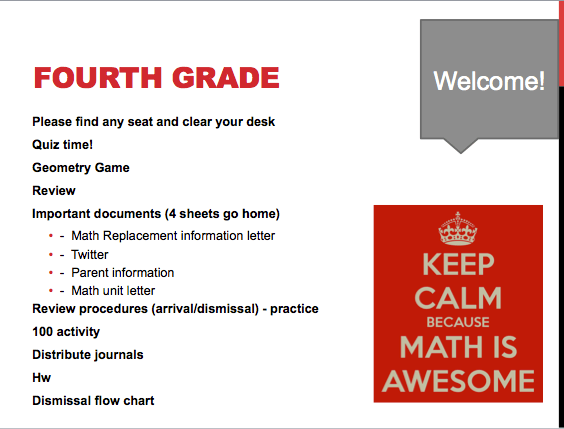
I’m planning on having a slide on the whiteboard when students enter the classroom.

Screen Shot 2017-08-08 at 5.18.57 PM

This slide is still a work in progress.  I’d like the students to find any seat that they want.  The tables are already setup in groups of three or four.  Generally students gravitate towards their friend crew, although I have a limited amount of seats so that isn’t always possible.  I’m also thinking about giving kids a card and that’s associated with a particular table.  Still mulling around this idea.  My fourth and fifth graders have had me as a teacher before so they’re usually expecting what they saw last year.

After they all sit and quiet down (which is usually so quick on the first day) I’ll review the agenda.  I’ll introduce myself.  I’m not going into details this time.  Usually I say that I’m Mr. Coaty, a Harry Potter fan, live in Illinois, am a swimmer, and so on…  Instead of doing that, I’m borrowing from Sarah and using a “Getting to know Mr. Coaty” quiz.  I don’t have questions yet, but will in a couple days.  We’ll review the quiz as a class and then the kids will give me a multiple choice quiz.  I’ll basically copy Sarah’s amazing idea and have them put this together and turn it in before the end of the class.  I’m thinking this quiz activity will take around 15 minutes or so.  I’m planning on taking the quizzes after students leave.  I think this a fantastic way to get to know your students and is also a positive step towards building rapport.
After the quiz the class will play a game or two of the geometry game.  It’s similar to Simon Says, but with geometry and number terms.  For example, when I say acute angle, students make an acute angle with their arms.  I show the students the motions associated and then we’ll practice.  This shouldn’t take more than five minutes.  This game is revisited throughout the year as more vocabulary is introduced.

I’ll then pass out the standard “beginning of the year” papers.  At one point I almost went  completely digital with this, but I had issues getting back all of the documents.   My information letter explains the curriculum, policies and all of the other formal pieces.  The Twitter letter explains how the class uses Twitter and how to follow the class on our journey.  The parent information letter is homework for the parents.  Parents fill out their name, contact information and any other comments that they feel I need to know about their child.  I tend to get everyone of these sheets back.  About half have comments and sometimes a couple are more than a page long.  I appreciate hearing from the parents – it gives me a different perspective. The last part of the packet is the math unit letter.  The letter comes from Everyday Math and explains what’s included in the first unit of study.  I’ll review the entire packet with the kids and then ask for questions.  Students put this away and we move on.

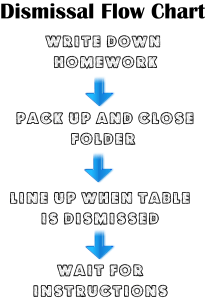
This is where I’ll explain the arrival/dismissal flow chart.  I will (hopefully by next week) have flow charts hanging up in my class explaining what to do during arrival and dismissal.

dismissalchart1

I try to make this as concise as possible.  The class will practice the arrival process.  We’ll go in the hall and then enter back into the classroom.  I find elementary students need this practice at first.  I’ll give examples and counter-examples.  I go a little overboard with the counter-examples, but I think the kids have a good understanding of what’s expected.  I’ll do the same with the dismissal flow chart.  This takes a good 10 minutes.

If we have time, my plan is to start Sara’s 100 numbers activity.  The students will already be in groups, so I’ll plan on following Sara’s example that she showcases on her blog.  I’m hoping to have students start to see the positive benefits of working in groups. I’ll be taking pictures and videos that the class can discuss afterwards.  I think this will be a good lead-in to when the class discusses appropriate critiquing later in the week.  This will probably take at least 20-30 minutes.   I might even have to extend it into the next class period.

Near the end of the class I’ll pass out the student consumable journals.  We’ll review the dismissal flow chart and I’ll send my kids to their next class.  I might end with a teaser about how we’ll be looking at math puzzles tomorrow.  I realize that this is a lot to accomplish in one class session.  I’m flexible in moving the 100 activity to the next class if needed.


Update:  8/11

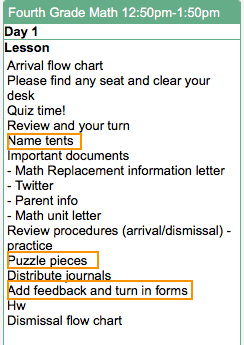
After thinking about it and talking with a number people on Twitter, I’m going to switch up some of these activities.  We’re allowed to change our plans, right?  I guess this post is a living a document.  : )  I boxed the changes.

Screen Shot 2017-08-11 at 2.58.31 PM.png

I decided to give students the opportunity to create name tents.  This is straight out of Sara’s post.  The back will have a daily feedback form for the first five days.  I’ll probably start asking them questions by the time days 3-4 roll around.  I’m going to give a lengthly amount of time for this during the first day.

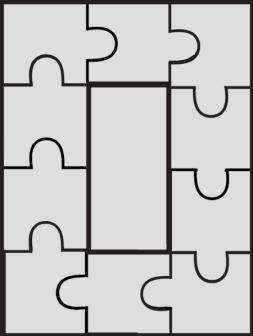
So I decided to move the 100 activity to day two.  I’m afraid that the class won’t have enough time to complete that entire activity in the limited time that we have.  I’d rather have students complete that activity in its entirety, instead of splitting it up into multiple days.  I think it loses some of it’s bang if it’s split up.  The puzzle activity will replace the 100 activity.  Students will each be given a puzzle piece.  Students will fill them out and the pieces will be compiled to border the class door.

Screen Shot 2017-08-11 at 2.56.28 PM.png

I just need to remember to give out an appropriate amount of pieces to each class so it actually makes a rectangular border.

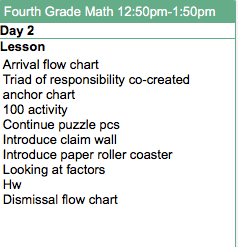
The second day looks like this:

Screen Shot 2017-08-11 at 3.24.01 PM

This is what’s scheduled to occur, barring any fire drills or expectations meeting.  I read about the triad of responsibility chart about a week ago through Caitlyn’s blog and thought this would be another great way to emphasize classroom community.  It also emphasizes the math component.  I think this anchor chart has a place in my classroom.  It’d be great to have the class co-create it and then it can be referred to throughout the year.  Major kudos to Caitlyn for writing about her experience at NYC Math Lab.  I could see this working really well with my own classroom.

Another piece that I added this year is related to a math claims wall.  I’d like to use a full bulletin board for this and claims will be added and the modified as the year progresses. Something similar to this:

Since I teach multiple grade levels I might split up the board into three parts.  This is my first year trying a math claim wall out so it’ll be interesting.  🙂

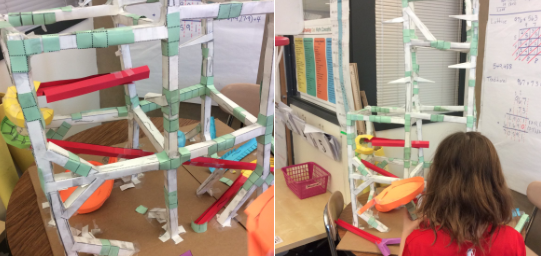
I’ll be introducing the paper roller coaster on day two.  Usually my third graders complete this. This is one of my students’ favorite activities and it usually lasts for the majority of the year.

Screen Shot 2017-08-11 at 3.47.57 PM.png

For the past few years I’ve bought one set and used it as a math station.  Students work on creating a base and foundation for the coaster.  They have to cut and score the card stock and eventually create around a five foot roller coaster.  I’ll only have time to introduce the project, but it’s a real exciting time as students enjoy the creative aspect of this activity.

We’ll end day two with the tent feedback forms and a look at factors.  Over the next few days the class will start Estimation180, write in their math journals and work on the first unit of study.

I’m looking forward to what this new year brings!

Math Bell Ringers

My school officially opens up for students in about three weeks.  Teachers can enter in about a week or so since the floors are being waxed and cleaned.  Like many educators during this time of the year, I’m starting to plan out what my first few days are going to look like.  I had a chance to review my schedule and it looks like I’ll be teaching math to students in grades K-5 next year. Right now, all of my materials are in about 30 boxes in my new classroom.  I had to relocate over the summer because of enrollment and extra sections.

As I was looking over the #TMC17 and #MTBoS tags this weekend I started to notice other teachers are also persevering through the planning process.  I also had a chance to catch up on a few blogs yesterday. Reading other peoples’ reflections ignited my own reflection process and I started putting together this post.  One part of my school day that I’m planning out relates to my advanced math class bell ringers. For me, bell ringers have been an ever-changing process from year to year.  A bell ringer is what my students complete during the first 10 minutes of class.  I have a 60 minutes math block for my 3-5th grade classes.  I tend to have students come into my class at different times because of band, orchestra, or other circumstances.  Usually I get all of the students in my class within the first five minutes.  Some students are waiting outside my door at the exact time the math block starts, while others are not.  When students come into the classroom they follow the flow chart and take a look at the agenda that I have projected on the whiteboard.

I tend to use bell ringers to review math concepts that were taught earlier in the week.  I used to use brain teasers and different math games, but they weren’t exactly related to what was being taught.  Each grade level (3-5) uses a different type of ringer and some work better than others.  I’ve been looking at more quality ringers over the summer.  The first 5-10 minutes of class is so valuable and I want to make sure the ringer has students thinking about math in ways that benefit them.  Here’s what I have planned so far:

Third Grade –

I’m going to use Estimation180 as my bell ringer.  Students will come into the classroom, follow the flow chart, open their folder and begin working on the daily E180.  Last year my third grade class was able to make it to around 140 days.  This was something that my kids enjoyed and it was a low-risk activity that had them engaged from the start.  While students look at the day they filled out something similar to this sheet. This year, I’m thinking of having students complete open number lines for some of the days.  It might take a little bit more time, but I’m thinking it’ll be worth it as the year progresses.

Fourth Grade –

My fourth graders have been using Scholastic’s Dynamath for the past few years.  It’s been a great extension for some students, but not all.  I generally assign specific pages and then we review them as a class. I’m still in the process of looking for additional ways to use this bell ringer time more effectively.  I was thinking of possibly using VisualPatterns.  Maybe one pattern per week or something like that.

Fifth Grade –

Last year my fifth grade students used Math Magazine for their bell ringer.  Similar to Dynamath, Math Magazine is designed to reinforce skills taught and also extends into areas that aren’t as familiar.  The publisher designed this particular magazine for middle school math students, but it works well with my math class. At times, students needed to look up different skills to complete this magazine.  I’m thinking of having students use SERP’s AlgebrabyExample.  I started using it last year for a couple months.  I love the variety of problems and that students have to find and correct mistakes.   It also helps that it’s free, unlike the Scholastic resources. This is much different than what students are accustomed to doing in math class.  I’m thinking that students can complete one page per week.  What’s nice is that I can match the skills with a topic that the class is currently exploring.


I’m sure I’ll refine this before school starts, but it’s a start.  What do you use for math bell ringers?

SaveSaveSaveSave

SaveSave

Math Intuition

Screen Shot 2017-07-18 at 3.52.50 PM.png

Over the past two days I’ve been reading and rereading chapter 8-9 in my summer book study. Chapter eight discusses how mathematicians connect ideas.  From what I see in classrooms, this connection of ideas is often directed by the teacher and involves some type of classroom discussion that helps students construct understanding.  Intentionally setting aside time to have math discussions and connect ideas from students is worthwhile.  The prime example of Debbie (the teacher) allowing time for Gunther (student) to put the calendar in the shape of a clock was especially a memorable portion of this chapter.  That opportunity wouldn’t have occurred if the teacher didn’t take the initiative to intentionally plan to use manipulatives to have students construct their own understanding through a math discussion.  Having these student math discussions gives educators feedback in whether students are attempting to make/create connections and whether their overgeneralizing. Creating opportunities for student to make these connections is important.

Chapter nine emphasizes the need for mathematicians to use intuition. I appreciate how the chapter indicates that math is often perceived as a very logical content area.  It’s truly not, but the perception still exists.  Tracy states in the chapter that she’s come to see “mathematics as a creative art that operatives within a logical structure.”  I had to reread this a couple times to let it sink in. I’ve heard it over and over again that someone is “not a math person.”  What I find interesting about this is that mathematical intuition is developed.  Since it’s developed over time it can change.  I tend to tackle this issue quite a bit and address it at the beginning of the school year during Open House. Providing students with opportunities to develop this personal intuition can be a game changer.  It’s up to the teacher and school to create memorable experiences for students to develop math intuition. That’s a responsibility that each teacher takes up when they open their classroom doors. By increasing their math intuition, students may also increase their math confidence. Educators need to carefully think about the different math experiences that we provide for our students.  Those meaningful experiences aren’t always found in general textbooks.

After reading these two chapters, I started to think of what perceived/real barriers stop teachers from intentionally creating these opportunities.

I think sometimes teachers feel as though they’re required to follow word-for-word the scope-and-sequence that’s provided by a district.  This can be the case when a newly adopted text is revealed and teachers are highly encouraged to follow it to a tee.  Some texts even tell teachers what to exactly say, what questions to ask, and predicted student responses.  I’ve been though many different math text rollouts and this occasionally happens.  I see it more at the elementary level though. Having common assessments with a specific timeline that everyone needs to follow can also provide pressure for teachers to fall in line with a particular lesson sequence.  Deviating from that sequence may cause issues. I find that there’s a balance between what a district curriculum office deems “non-negotiable” and room for academic freedom within a sequence.  I’ve been told in the past that a district text is a resource, but for new teachers it may be more than that.  There can be a lot of anxiety, especially if certain parts of your instruction model have to follow a pre-determined sequence and is used for evaluation purposes.

Teachers need to feel comfortable in giving themselves permission to use their own intuition.  That may be easier said than done and it depends on your circumstance.  Despite good intentions, a published text won’t meet the needs of all of your students. I believe that’s why open source resources are frequently shared within the online teacher community. Supplementing or modifying lessons/questions with resources that match the learning needs of your students happens on a daily basis.  Dan’s Ted talk hits on that point.

I believe educators have permission to do this while still meeting a strict scope-and-sequence.  Teacher confidence also plays a role with how willing someone is to try resources outside of the textbook.  Elementary math teachers need to feel empowered to be able to use resources accordingly without feeling as though it’s going to be detrimental in their evaluation.  I think that sometimes teachers don’t exercise their academic freedom to the highest potential because it’s perceived as going against a district’s plan.  Having math coaches available and supportive administration is also important in changing this perception

The work that we do is important.  Creating mathematical intuition happens through repeated experiences.

Photo Jul 18, 3 25 46 PM.jpg
p. 212

Sometimes those experiences are beyond the textbook/worksheet and educators have the ability to make them meaningful.  I’ll be keeping this in mind as I prepare for the new school year.

Look Who’s Talking

Screen Shot 2017-07-06 at 12.50.29 PM

I’ve been able to check off a few books on my summer reading list.  I’m now in the process of reading one book in particular.  It’s been a slow process through this book, but worthwhile as I’m actually thinking of how this applies to my practice.  That takes time. Yesterday, I was on a reading tear and made it through chapter seven.  This is where I ended up paying most of my attention. The chapter is related to asking questions in the math classroom.

In the eyes of most students, questions are often given to them, not something that they get to ask other students or even the teacher.  The ratio of questions they’re required to answer far outweighs what they ask.  I’m not arguing that there’s something wrong with that ratio, but Tracy and others in this chapter make a case to why educators should allow more opportunities for students to ask, wonder, and notice.  I think there’s value in providing these opportunities, although the management involved in that process seems challenging at times.  While reading, I came across a terrific quote by Christopher.

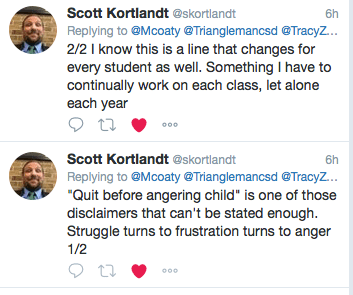
One of the bigger issues is the last highlighted sentence: “Quit before angering child.”  When I read this I actually laughed out loud and then started to realize how often this happens in the classroom.  Ideally, all students would be willing to make a claim, be receptive to what others have to say and then change their claim accordingly.  Some students are much more willing to engage in this type of math dialogue, while others would rather not.  There are different activities and procedures that can help move students towards being more receptive to asking questions during claim dialogues.  Notice and Wonder, 101questions, problem posing, riffing off problems and independent study options can help students ask more questions and encourage them to be a bit more curious.  That curiosity can spur students to ask more questions.  All of those are great resources, but there’s an important piece that needs to be put in place beforehand.  I believe Scott makes a great point.

Screen Shot 2017-07-06 at 12.28.43 PM

Each child has their own tolerance for struggle.  That struggle can turn into frustration quicker for some more than others.  This happens with children and adults. I think most educators have been in situations where a student makes a claim and then retracts it after its been shown that their response wasn’t quite right.  That student then disengages and it’s challenging to get them to be assertive afterwards.  How can this be avoided or is it possible to avoid these types of situations?  I don’t know the exact answer to this, but understanding the level in which a student can struggle without frustration is important.  Struggle is part of what happens in any math class. That productive struggle is what’s often needed before students construct their own mathematical understanding.

Enabling students with tools and models can help in these struggling situations.  I’ve also seen this struggle occur during whole class guided math conversations. Some students shut down when they are called out by another student.  They think that disagreement means that they’re being challenged or attacked. That’s not the intention, but it may be perceived that way by other students. It may be helpful to model what appropriate math dialogue looks like.  After the modeling, practicing that type of math claim dialogue and providing opportunities for questions can help smooth out the process.

I also believe some students are not used to making a claim in a verbal format.  Students are definitely used to talking.  Ask any teacher.  Also, they’re probably familiar with providing reasons why they agree/disagree on paper, but communicating it in a verbal format can cause some issues. Providing these students with sentence starters, using technology that can be shared with the class, or using other appropriate means can help students engage respectfully in a productive math dialogue.

I’ll be keeping these ideas in mind during my planning process.


Attending to Precision

Screen Shot 2017-06-26 at 8.58.02 AM.png

Last week I read through chapter five of Becoming the Math Teacher You Wish You’d Had.  Reading this chapter made me wish that school was still in session.  There were times when I was reading that I stopped and reflected on how I manage expectations in the classroom.  Specifically, I thought about how I emphasize the need to be precise during math lessons.  More often than not, the precision aspect is related to computation mistakes as well as issues related to missing or incorrect units.  I address this so many times during the year.  So many that I can’t count the amount of times that it’s mentioned.  I think most math teachers have been there.  In most cases I’ve observed students being able to show their understanding of a particular concept, but they don’t show it on assessment.  A label might be incorrect or a one-digit calculation completely changes an answer.  I see this all the time with adding units related to linear, square, and cubic measurements.  A student may get the answer correct, but the label doesn’t match.  I have issues when students place cm^2 when the label should be cm^3.  There’s a big difference there and it has me questioning whether the student understands the difference between area and volume.  There has to be a better way than just reminding students to check for errors or make a reasonableness check.

A couple of the examples that were showcased also emphasize using precise language.  Avoiding the word “it” and being specific are highlighted.  I find myself repeating certain phrases in class.  Not using “it” to describe a particular unit would be on my repeat list.  Instead of using that devil of a word, teachers can emphasize and have students label the ambiguous “it” into something more accurate.  Incorrect labels are a killer in my class, so this is something I continually emphasize.

Estimating can also play an important role in attending to precision.  My third grade class uses Estimation180 just about every day.  We made it all the way to day 149 last year.  We were pretty pumped about that much progress.  It was a productive struggle and heartening to see how much progress was made.  As time went on students became more accurate with their estimates.  That thought process transitioned to other aspects of math class.  I asked the students to have reasonableness checks before turning in an assignment.  The check doesn’t always happen, but when it does it’s a golden opportunity.  I’ve had some students use a checklist to record whether they’ve estimated first to see if their answer is reasonable.  Again, it’s not always used but I believe it benefits students.

Games can be great opportunities for students to be reminded to attend to precision.  Some games are great for this, others aren’t and bring an anxiety component to the table.   I was reminded of the negative impact of timed tests and elimination games.  I’m not a fan of timed fact tests in the classroom and haven’t used them for years.  More recently, I’ve used timed Kahoots or other elimination games.   Some students are more engaged when there’s a competition component.  This chapter brings awareness to how emphasizing speed can be damaging.  Most of the time these games are low-risk, but they do bring anxiety and can cause some students to withdraw.

Guided class activities like pattern creation can be helpful in reminding students to attend to precision. Using student-created patterns ( ___, ____, 56, ____, _____ ) to develop unique solutions can be utilized to show understanding of numbers.  Students can create a multitude of patterns with this.  It also challenges students to find a pattern that no one else has.  I’ll be keeping this in mind as I plan out next school year.

It seems that students will always need to be reminded to add correct units, review their work and attend to precision.  Having strategies and tools available to address this will be helpful moving forward.

Making Math Mistakes

Screen Shot 2017-06-17 at 9.53.23 PM

This summer I’ve been reading a few different books.  One of them is Becoming the Math Teacher You Wish You’d Had.  It’s part of a book study that started a few weeks ago.  Kudos to Anthony for helping start the study.  I’m slowly making my way through the book, following the tag and listening to people’s comments on Voxer.  My highlighter has been busy.  I appreciate all the different teachers that Tracy showcases.  I’m currently in chapter four, which is related to making mistakes in the math classroom.

I believe making mistakes is part of the math learning process.  I don’t think I’ve always communicated that enough.  Some students that I see come into the classroom with an understanding that mistakes are evil.  They’re not only evil, but I’ve seen them used to humiliate and discourage students and peers.  I believe these types of behaviors tend to crop up when the culture of a classroom isn’t solid.  Of course there are  many other variables at play, but a classroom culture that doesn’t promote risk-taking isn’t reaching its potential.

Tracy showcases different teachers in chapter four.  All the educators highlighted seem to be able to communicate why it’s important to look at mistakes as part of the math journey.  This chapter is full of gems.  A couple takeaways that I found are found below.

  • The math teachers that are highlighted seem to understand that mistakes are opportunities.  When they happen, teachers have a choice to make.  Modeling and showing students different ways to react to mistakes is important.  Students need to be able to understand and be accustomed to making mistakes in stride.  This can be a challenge since some students stall or immediately stop when they run into a mistake. Mistakes shouldn’t be perceived as failure. If a student makes a mistake they need be able to have tools and strategies to move forward.  They need to also find the underlying reason to why the mistake or misconception happened.  Having a misconception investigation procedure in place for these instances is helpful.
  • Using classroom language that creates safety is key.  Teachers need to be able to have phrases in the bank that empower students to participate and take risks.  I found that the teachers highlighted in the book often ask questions related to students explaining their reasoning.  They also set up the classroom conversation so that students build upon each others’ responses.   Students speak their mind about math in these classrooms.  They’re not afraid to respectfully agree or disagree with their peers and explain their mathematically thinking.
  • I noticed that the teachers played multiple roles during the observation.  Teachers often gave students time to work with partners/groups to discuss their mathematical thinking.  This time of group thinking and reporting happened throughout the lessons.  Teachers often anticipated possible misconceptions and guided the classroom discussion through students’ thinking.  The teachers asked probing questions that required students to give answers that displayed their mathematical thinking.  Teachers didn’t indicate whether an answer was correct or incorrect.  Instead, educators asked students to build upon each others’ answers and referred to them as the lesson progressed.

I can take a number of the strategies identified in the observations and apply them to my own setting.  I see benefits in having a classroom conversations where students explain their math thinking.  That productive dialogue isn’t possible unless the culture of the classroom is continually supported so that students feel willing to speak about their thinking.  Students aren’t willing to take risks and explain their thinking to the class unless a positive culture exists.  That type of classroom needs to have a strong foundation.  That doesn’t take a day, or a week.  Instead, this is something that is continually supported throughout the year.  Next year I’m planning to have students use the NY/M tool again.  I’d like to add additional pieces to this tool.  I’m also planning on using more math dialogue in the classroom.  I believe students, especially those at the elementary level, need practice in verbally explaining their mathematical thinking to others.  That verbal explanation gives educators a glimpse into a student’s current understanding.  I also believe that giving students more opportunities to speak with one another about their math thinking will help them develop better explanations when they’re asked to write down their math thinking.

I’m looking forward to starting chapter five on Monday.