Surface Area and Conceptual Understanding

Surface Area

My fourth grade class has been exploring a measurement unit for the past few weeks. We’ve been discussing the difference between area and volume. This has been a bit challenging as many students can apply area and volume formulas but struggle when finding surface area. Students were confusing area and volume and weren’t sure when to use a specific formula.  The idea of area being squared and volume cubed has been emphasized but still not cemented.  It seemed that students knew much more about the formulas and not as much about the conceptual understanding. To strengthen students’ understanding my class started a surface area activity late last week.  Click the image below for the template.

Sheet

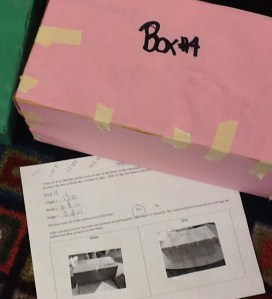
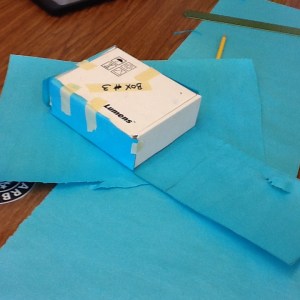
Students were asked to pick one box in front of the classroom. I had many different boxes to choose from. Many of them were board games or boxes I borrowed from other teachers. It’s near the end of the school year and some teachers are moving classrooms so there were plenty of boxes. All of the boxes were rectangular prisms. Once students picked a box they took a picture and then found the dimensions. Students then took one piece of butcher paper and created a net based on the dimensions found earlier.

Photo May 20, 11 22 59 AMPhoto May 20, 11 23 08 AM

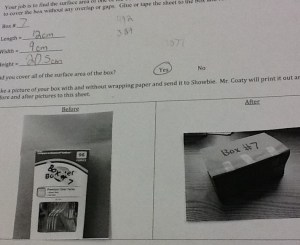
Students created the net and then wrapped up the box. Students were able to immediately identify whether their measurements were off or on target. It took some groups multiple attempts to find a correct solution. After students wrapped up their box they took a picture. Before and after pictures were sent to me via Showbie. I printed them out and the students placed them on their sheets.

final

It would have been great to print these out in color, but at this time of the year our school’s color printer is out of ink.  After the activity students reflected on how their perception of area has changed over the past week.  After listening to a few student reflections I’m deciding to keep this activity for next school year.

Creating Common Assessments

Focusing in on Common Assessments

Yesterday was a teacher institute day. Along with middle and high school teachers I took part in a session dedicated to discussing common assessments. The session covered topics of what role common assessments play and why they should be given. We discussed what qualifies as a common assessment and the need for teachers to be involved in the creation process. As we delved deeper into conversations I found that many of middle and high school colleagues create their assessments since there isn’t really a textbook that covers all the standards that they teach.

This often isn’t the case at the elementary level. In math, I find that the content publisher creates assessments and teachers rely on giving that piece to students in the form of quizzes/tests. Although the publisher-created content is decent, it can sometimes provide little value to the teacher beyond writing a score in the grade book. In addition, the teacher may have been required to give the assessment per district protocol.  In many cases teachers might not have any type of ownership to the pre-created content.

Later in the session the participants were given the opportunity to create their own common assessment. During the process we filled out a common assessment mapping tool. The mapping tool included fields for the learning objective, item number and type (i.e. multiple choice, short answer …) , item domain (i.e. informational or skill item), item depth (i.e. recall, understanding, strategic thinking, evaluation/creating), and point value.

While filling out the map we had to keep in mind what type of question was being asked. We eliminated some of the multiple-choice questions and decided to add questions that give students opportunities show their mathematical thinking. After picking the questions we looked at the item depth. The item depth determines the depth of understanding that the teacher is seeking. At the end of each question the team decided on a point value for that assessment item. Near the end of the session our mapping tool looked something like this:

mapping tool

I could see my team using this mapping tool for additional common assessments. Not only does it give our team more information that can be used to adjust/inform our instruction, it’s also valuable to the student. After completing the common assessment, students can reflect, set and make goals.  Creating common assessments may also provide opportunities for teachers to take more of an ownership role because they helped in the creation process.

Student Empowerment and Learn Like a Pirate

Screen Shot 2015-05-09 at 8.12.35 AM

Over the past few weeks I had the opportunity to read Paul Solarz’s book, Learn Like a Pirate. Through his book, Paul takes readers on a field trip into his own classroom. His experience as a classroom teacher is insightful and I feel as though many educators can relate to this book. As I read through the book I found moments of personal affirmation and times where I questioned on how to better my own practice. One of the main themes in the book revolves around the need to empower students to collaborate, lead and succeed in the classroom.

As I read through the book I started to examine my own practice. Ideally, I’ve always thought that students learn best when they’re are invested in their own learning. When invested, students often feel empowered and that sometimes produces results beyond expectations. Throughout my experience I’ve found that putting that into practice consistently can be a challenging task and needs to be built from day one. Giving students responsibility can change how they view their role in the classroom. I find that as students take on more responsibility they start to monitor their own actions in relation to the expectation.

As this school year comes to a close I’m reflecting on how to incorporate more student empowerment opportunities in my school and classroom.  These opportunities happen on a daily basis and I feel as though they’re some components that need to be cemented first before student empowerment can take shape.  Creating a classroom community from the beginning of the school year helps students feel comfortable in voicing their opinions. Along with a classroom community, I believe other management components need to be implemented strategically for empowerment to begin.  Each classroom is different, but I believe the component below will assist in building a foundation to help students become more responsible for their learning.  The list below indicates a few items that I’d like to address for the next school year.

Increase clarity and consistent expectations

Missed expectations cause roadblocks and disappointments for teachers and students alike. I believe that the majority of missed expectations results from unclear or miscommunication. Clearly communicating expectations and allowing opportunities to model them improves understanding, and in-turn, establishes a clear goal for students. At the beginning of the year my class uses a flow chart and the expectations are clearly evident. Although the class might not always follow the flow chart, a quick reminder of the procedure helps keep the class on track. Being consistent with expectations also reinforces the need for students to take on the responsibility to meet the expectation.

Student choice

Giving students a choice in how they show mastery can be powerful. Beyond showing mastery, I feel like projects involving choice-elements enable students to become more intrinsically motivated to complete tasks. Choice doesn’t necessarily have to be limited to academics. Students can build processes that help the classroom run more smoothly. Next year I’d like to give students additional time to reflect more on their progress and create individual goals. Periodically checking in on those goals can lead students to create additional goals and the productive cycle continues.

More feedback

I need to beef up this part of my teaching practice. I tend to give feedback, but the form isn’t very diverse. My feedback is usually found in verbal or written form. Since my district requires teachers to use grades, I tend to ask students questions on their graded papers. The questions are designed to have the students reflect on the process of understanding a concept. Next year I’d like to be more specific with my verbal and written feedback.  I haven’t used this much, but feedback can also be from the students. At the end of each school year I give students a survey about their learning experiences.  In the future I’d like to collect feedback from the students on a trimester basis.

The three components above are not the end-all, but I feel as though focusing in on those areas will help build a solid foundation for the remainder of the school year.  My hope is that the foundation will yield dividends that will help students become more successful in and outside of the classroom.

Exploring Volume

Photo Apr 28, 1 07 42 PM

This week my third grade class explored volume and surface area concepts. Last week they used centimeter cubes to build a number of structures. Students transitioned from counting centimeter cubes to using a formula to find the volume of a rectangular prism.

Screen Shot 2015-05-02 at 3.37.10 PM

The next few math sessions in the week revolved around the concepts of identifying faces, edges, vertices, nets, and how all of those characteristics play a role in the volume of prisms. During the next day I asked students to create a net of a rectangular prism using 1cm grid paper. This was a struggle for some students. Being able to visualize the net, cutting it out and creating a prism was challenging. My class went through a LOT of grid paper during this process.  Students started out using trial-and-error and moved closer to a formula method.  After multiple attempts and some major perseverence, I decided to frame the next few lessons with a project.

I decided to dig into my Evernote account and combined a few projects that I’ve used or found through my PLN. I also spoke with a few colleagues in my school for feedback.  The project was going to take some time. I decided that although the project may take more time than individual lessons it was worth the time and gave students opportunities to learn more about the math concepts that were scheduled to be explored.

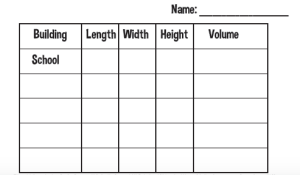
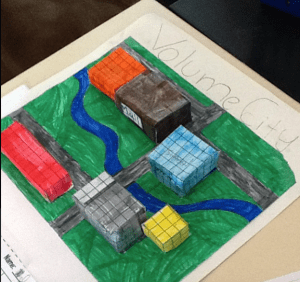
The project is called volume city. Students were given directions, a model map, 1 cm grid paper and a rubric. You can find the files that I used here. Essentially, students were asked to create a model city using rectangular prisms as buildings. The city had to have at least four basic buildings and students could add more if they desired. Students were required to write the dimensions of the buildings: length, width, height and volume.

Screen Shot 2015-05-02 at 6.46.44 PM

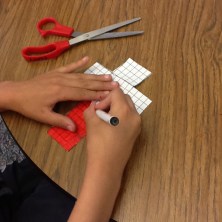
Students then used the grid paper to draw and cut out the net for that particular building.

Photo Apr 29, 1 17 39 PM

This was probably one of the more challenging aspects of the project, especially when the building wasn’t shaped like a cube.  Students had trouble drawing nets with different heights. Students were given more grid paper as needed. I think every group had to redraw or recut their nets two or more times. This was good in my mind, because it demonstrated that they made a mistake, but were trying again in an attempt to make improvements. The concept of visualizing the net and the action of creating them accurately started to combine as the project continued. I even had a few students decide to create the largest possible net using the entire grid paper.

Volume_City

So after students created the nets they decorated them and glued/taped them on the map sheet. Students filled out the dimension sheet as they created their prisms. Here’s one that’s almost complete.

Screen Shot 2015-05-02 at 6.13.11 PM

Not all of projects are complete, but the next phase of the project is for students to find the total volume of their model city. This will most likely take place as students will start taking the PARCC test next week and our math block is shortened. At some point we’ll also be exploring rates in the next unit. During that time we might use some type of stop-motion video of our model cities to look at the frames-per-second in our film.

Standards for Mathematical Practices in the Elementary Classroom

Standards for Mathematical Practices

This year my school district adopted a new K-5 math text. This new text is more aligned to my state’s standards and emphasizes number sense strategies much more than in the past. It’s been a change from what’s been used over the past few years. One of the major shifts involves the use of using multiple strategies and visual models to put together and take apart numbers.  Although they aren’t explicitly taught in our newly adopted math text, the Standards for Mathematical Practices (SMP) are highlighted as part of the CCSS.

Just like many educators, I have a child-friendly SMP poster hanging around my classroom. As the months passed I feel like I haven’t been referring to the SMP as much as I should. This is a missed opportunity. The poster has started to fade (literally) and students haven’t been referring to them since the very beginning of the year.  I doubt students notice it anymore since it’s basically blending into the wall.  One of the benefits of using the SMP is being able to refer to them while teaching.  Perseverance, using the right tools and attending to precision happen just about every day.

So after introducing the concept of pan-balances, I decided to have the students revisit the SMP.  I felt like the students were having a challenging time persevering.  Okay … that’s an understatement.  They were struggling and were very willing to tell me about it.  I stopped the class and we had a brief discussion on the meaning of being able to persevere in math class.  The talk on perseverance lead to discussing the SMP in more detail. I wanted students to internalize their meaning and see how it applies to their math learning. The class had a conversation about the different mathematical practices and how they’re used. The math discussions that followed were amazing. Students started to find examples in their own lives of how the SMP connect to what we’re doing in class.  The class finished the lesson on pan-balances with a renewed approach.  A few days later I had students complete an activity related to the SMP.

I printed out eight sheets with a standard practice statement on each one.  Students were grouped into pairs and asked to draw a picture that represents a particular SMP.  The picture also needed to include some type of caption or written statement. Students first put together a rough draft, refined their idea and created a final product. The final product was cut out and glued onto our SMP board. A few examples are below.

This slideshow requires JavaScript.

Thursday night was my school’s annual open house. Parents and students come into the school and visit the classrooms during this time. It was great to see my students become tour guides and show their parents the role the SMPs play in their learning and how they approach math.

Students cut out and placed their SMP    visualization  on this board.
Students cut out and placed their SMP visualization on this board.

Overall, I thought the activity  brought more awareness to the SMP and what role they play.  I’m hoping to revisit this board throughout the year.

Using Excel to Explore Rates and Proportions


My fifth graders are currently studying rates and proportions. Earlier in the week they explored rates by looking at unit prices and solving problems with some type of cross-multiplication strategy.  Although they’ve made progress I still feel as some many still need to cement their understanding of a ratio and proportion. So it was time to switch up the instruction model.

I decided to go with using a spreadsheet. In this case, the spreadsheet would be in the form of an Excel document. Each student grabbed a laptop and opened up Excel. The students used Excel earlier in the year so they were familiar with some of the basic functions.

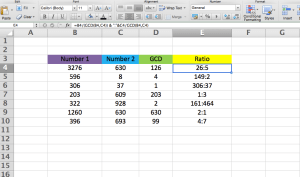
After entering a few text cells, students were asked to put a random number above zero in cells B4 and C4. Then the class discussed what GCD stood for. Most of the students said “greatest common denominator.” That response made sense because that’s heavily emphasized in fourth grade as students add and subtract fractions. In this case, GCD means greatest common divisor. The class then discussed what that meant when comparing two numbers and the helpfulness in finding the GCD when exploring equivalent fractions. The discussion then transitioned from equivalent fractions to finding ratios.

Students entered in the formula =GCD(b4,c4) to find the GCD of the two different numbers. Students observed how the GCD changed as they updated their numbers.

Screen Shot 2015-04-17 at 7.30.47 PM

The next part was a bit tricky. I asked the students to write a formula to express the ratio in simplest form. The class used the GCD and trial and error to come up with the ratio formula. Once students wrote the formula and placed it in E4.  Students then explored how the ratio changed when their numbers were updated.

Screen Shot 2015-04-17 at 6.51.42 PM

The class then reviewed why the formula actually worked.  The class discussed that basically the formula took each number and divided it by the GCD of both numbers. What was great was that students were starting to connect the reasoning behind the creation of a ratio. Instead of just cross-multiplying, students are starting to show a deeper understanding of how ratios are constructed and the process used to simplify. The students were able to save and print out their spreadsheets for later review.

Resources:

Excel Template

Example for Class Use


Math Menu Boards

mathmenu-01


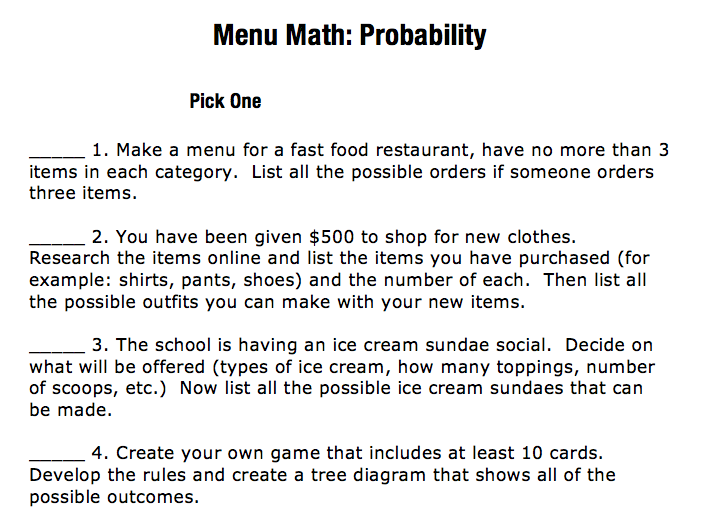
My fifth grade group has been learning about probability for the past few weeks. Our class discussion have revolved around probability trees and likelihood concepts. The summative assessment on probability is coming up around the corner so last week I was scouring my resources to find a way to review some of the concepts taught earlier in the unit. One of my colleagues and I had a conversation about the idea of using a menu board. I heard of using them through #msmathchat but haven’t used them much. I’ve always thought that giving students a choice in their assignments matters. I feel like an assignment menu encourages student choice and often increases engagement.

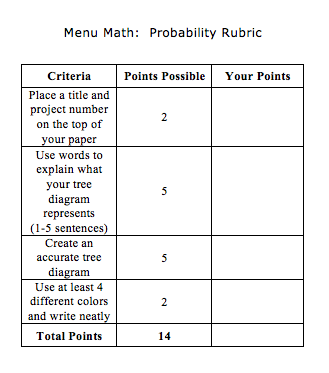
So I found a probability menu resource and decided to use it with my fifth grade crew. I added a rubric and a few other options to Yuliana’s template.  Here is the template that I adapted and used for this project.

Screen Shot 2015-04-06 at 7.33.21 PM

Screen Shot 2015-04-06 at 7.30.23 PM

After explaining the directions I fielded a few different student questions. During the question time some students needed more clarification than others. A group of students were confused to what the expectations were.  Many of them are used to playing school and expect the teacher to tell them what assignment or what to do to get all of the points on an assignment.  I feel like menu boards, to a small extent, help students become more self-directed in their learning journey. It was encouraging to see some of the students take the reigns and be assertive in deciding which menu option to complete.   After all the questions were answered I gave students time to complete the project.  Students completed the work in just over two class sessions.  After reviewing all of the projects I decided to reflect on the entire process. Here’s what I need to remind myself the next time I have the students create a menu board project:

  • Students need time to brainstorm before creating. I had a few students that immediately started working on their project just to throw it out five minutes later. These particular students didn’t brainstorm or organize their ideas before starting a final copy. On the opposite end, I had students that took out scratch paper and started to write out a few ideas before carefully crafting their project.
  • Students need checkpoints along the way. Throughout the project I had to remind students to check the rubric and generally check-in with students to answer questions and provide feedback. During this time I also had to ensure that I had the technology in my classroom ie. iPads and computers. Next time I assign a similar project I’m thinking of having students fill out a work log to help keep us all on time.
  • Students need time. They need time to put together their thoughts, create and produce a product that follows the minimum guidelines. Some of the students took around two class periods while others took longer. Ensuring that other assignments are in place after the project is important. Having additional work afterwards is important. It also helps eliminate the dreaded “what do I do next?” questions.
  • Review the projects. I reviewed each project with the students. I tried to limit my own talking, which was difficult, and let the students explain their project. During that time I filled out the rubric with the student. The time spent discussing the student project was vital. Students came ready to speak to me on what they created and what they thought was important. Some of the student projects were amazing and other projects needed a bit more work. The majority of students put a decent amount of effort into the project and met the minimum criteria.

This project took a good amount of time and had students create a product that was aligned with different probability standards. I thought it was worth the time and I’d like to bring out the project at some point next year.

Exploring Subtraction Computation Strategies

During the past few weeks my second grade class has been taking apart and putting together two and three-digit numbers. In the process students have been developing a better understanding of numbers.  They’ve been exposed to using a variety of computation strategies to find the sum and differences of numbers.  Through all of this I’m finding that the students are becoming more confident in their ability to use these different computation strategies more fluently.   Although they’re confident they tend to gravitate towards using one specific strategy for computation.  The traditional algorithm is usually the primary method that they use.  Even though students can add/subtract using that method I found that they weren’t expanding their understanding of other computation strategies.  This was a bit of an issue for me because students started to look at computation as the shortcut and not delve into the understanding of why it works.

After speaking with a few other teachers I decided to use a math task found in this book.  I briefly reviewed the different strategies that we’ve learned this year and gave the students this prompt.

Screen Shot 2015-03-31 at 7.12.46 PM

I wanted to make sure that students showed two different strategies and provided some type of written explanation.  The template I copied also had fields for a number model and explanation boxes.

Screen Shot 2015-03-31 at 7.18.53 PM

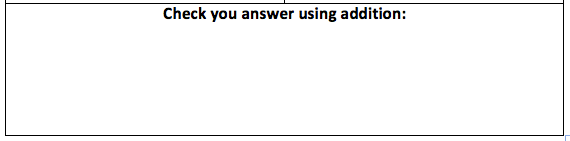
The bottom of the sheet was designed for students to be able to check their work using addition.

Screen Shot 2015-03-31 at 7.21.40 PM

I gave the students about 10-15 minutes to complete the formative assessment.  Most of the students tried out the standard subtraction algorithm but had a bit of trouble with the second strategy.  After a few moments students started to dig deep and think of how to take apart numbers using different strategies.  Some of the  students truly had trouble using a different strategy and this was evident in what they produced.  I was impressed with some of the different strategies that students used.

This slideshow requires JavaScript.

I wrote feedback on the papers and handed them back to the students the next day. Afterwards, I removed the names off of the papers and shared some of the results with the class.  As a class we decided on the following:

  • Students remembered many of the different computations strategies that were discussed earlier in the year
  • Some of the students invented their own strategies on this particular sheet
  • Students need to strengthen their written explanations
  • Students had some trouble explaining what regrouping means

Next week the class will be setting goals in improving our written responses.  Overall, I feel like this activity helped showcase different computations strategies while bringing awareness to areas the need improvement.  I’d like to use this template with a few other classes later in the year.  Feel free to download and edit this file for your own classroom.

Exploring Discounts and Amazon Prices

Exploring Discounts, Percentages and Amazon
Exploring Discounts, Percentages, and Amazon

Today one of my classes explored discounts and percentages.  This particular class reviewed how to convert fractions and decimals yesterday.  Today’s step was to introduce students to the idea of taking a percentage off of a set number.

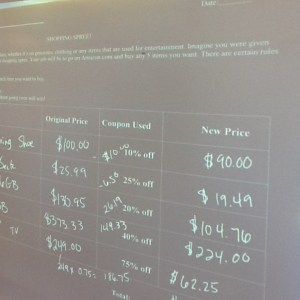
So I dug through some of my resource from the past and came across a sheet asking students to go on a shopping spree.  Yes, that caught my attention.  A shopping spree not only sounds fun but could be a great way to connect discounts and percentages.  From there I edited the document and decided that the students will be given a specific amount of money to spend and a site to visit to find the items.  Amazon.com wasn’t blocked by my school district so I went with that store.  Students were also required to use coupons (10%, 20%, 25% …) to purchase the items.  The winner of the contest will be the student that has a sum closest to $500.

Click for file
Click for file

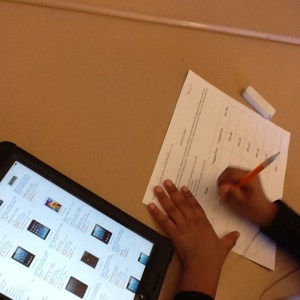
Students could buy whatever items they wanted.  I’m sure this could be repurposed and have the students buy items for a specific reason.  After I explained the directions each student was given an iPad or computer and asked to visit Amazon.com and find five items.

Students initially started looking at whatever caught their interests.

Screen Shot 2015-03-17 at 6.57.43 PM

Some students looked at shoes while others were finding flying drones.  Yes … I said drones. Thankfully all the searches came up without being blocked by the firewall.  Students then found the original price and calculated the discount.  Their sale price was documented and students went to the next item.

Photo Mar 17, 1 09 42 PM

I found that students started to have a challenging time with the last couple of items.  They had to carefully consider the coupon before writing down their options.  You could tell that they were trying to account for the discount. Understanding the magnitude of the discount started to take priority in the students’ minds.

Not all the students finished, but they will tomorrow.  I’m looking forward to comparing the total dollar amounts tomorrow and see who’s closest to $500.  Overall, this activity helped students see discounts from a different perspective.  This may be an activity that I’d like to edit and use with my other classes.


The idea in this post was adapted from this product.  Feel free to download and use for your own classroom.


Meaningful Math Practice


practice-01

Last week many of my students took a pre-assessment on an adaptive app. This particular app gave students questions in a certain math strand area and sent out a grade level equivalency score (GRE). Once students finished the pre-assessment they were given question at the GRE. If a student answered a question incorrectly they were sent to a help screen. The students were asked to watch a video about the concept. Some of the students watched the video while others made more attempts at finding a solution. Even after watching the video students still answered the question incorrectly. Every incorrect question asked student to watch a video and try the question again.  Some of the students became frustrated and quit.

Most of the student were finding that the video wasn’t a helpful for math practice. This type of math exposure/practice wasn’t meaningful to the students. After observing this I started to analyze my school’s math practices. I started to question how many math exposures we truly give to students and how many of those opportunities are truly meaningful to students.

I find that students at my school are exposed to math in a variety of settings. Students are introduced to the idea of a particular math concept through a parent, teacher, nature, workbook, video, and many others. This experience is usually followed up with additional practice at some point. Students need to be given time to practice and apply what they’re learning. This often leads teachers to give students multiple exposures to specific math concepts. These exposures or practice opportunities give students time to experience math in different ways and through this I feel like students are able to comprehend/apply the math at a higher level.

Providing those multiple exposures is important. The form that the practice takes is just as important. While I’m in and out of different classrooms I find that the additional exposures sometimes take the forms below.


Worksheets

Although it may benefit some it’s not the only solution and I wouldn’t categorize this type of practice as extremely meaningful.  Primarily, I find student math journals or worksheets used for math practice. I believe both of these have a role in practice but changing the exposure model has benefits and often those two mediums are used for homework. In my district student will at some point have to show an understanding of numbers on a worksheet. Generally these types of worksheets are found on unit assessments. I should also mention that digital worksheets fall into this category as well.

Activity/Projects

These are some of the more memorable experiences in class. Giving students a problem with multiple solutions can be refreshing and give insight to what students are thinking as they create a solution.  This can also take the form of having students create projects with their peers.

Manipulatives

Taking out the pattern blocks can lead to some great learning opportunities. Fractions, base-ten blocks, algebra tiles, 3d Shapes, and many other manipulatives play a vital role in the classroom. Eventually these manipulatives take an abstract form on a worksheet/screen.

Games

Games are exciting. Blending math concepts, games and a bit of competition can lead to learning opportunities. I find this especially evident when the teacher or student helps explain their mathematical thinking in the process.

Videos

Watching a brief video about a particular concept can be a great opportunity for students. Pausing and offering commentary or asking questions can help students delve deeper into a particular concept.

Class Discussions

Having a classroom discussion about a particular math concept can be powerful.  Often these types of conversations can expand understanding of math concepts.  Hearing other students’ experiences or strategies many benefit the class.  It may also be helpful to document the class ideas and refer to the learning at a later time.

Reflections

Giving students opportunities to reflect on their learning can pay dividends throughout the school year. I find this to be especially beneficial as students look back at their progress to observe their own mathematical growth. The reflection can take place after any of the strategies shown above.


Math practice takes on many different forms.  How do educators make it a meaningful experience for students?