Using Benchmarks

My third grade students have been exploring how to convert decimals, fractions and percents this week.  Many students are beginning to feel comfortable converting fractions to decimals.  Some problems are starting to arise when converting a decimal to a percent.  I’d estimate that around 50% of the students come in with prior knowledge of “move the decimal two to the right” technique.   This can be challenging because students might not exactly move the decimal the correct amount and have problems when the percent is less than 1%.  So this week I spent a good amount of time looking at different strategies to convert fractions and decimals to percents.

Later in the week students started to find discounts.  They were asked to find the percent discount of items on Amazon.  I used this activity but added additional scaffolding for a third grade group.  Students first tackled a few discount problems in groups before I gave them an individual project.  Students seemed to have a decent grasp of how to take a discount amount and find the percent off.  Students used calculators to find the percent off.  Some of the students were able to check their work to ensure that their discount was correct.  Other students seemed to come up with  a percent by dividing numbers in their calculator.  When pressed, the students were confident that their answer was correct.  They thought that the procedure was correct, therefore the answer was correct.  This is where I found myself looking at student answers that weren’t reasonable.  For example, a student wrote that 15% off of $120 was $8.  This student was adamant that it was $8 and then proceeded to tell me that he divided to find the answer.  I soon found that he actually completed 120/15 to get 8.  I started to notice that other students were having similar issues.  I asked students to turn in their work as it was the end of class.

That night I reviewed the student answers.  Around a third of the students were coming up with solutions that weren’t reasonable. I decided that the class was going to discuss benchmarks and the reasonable of their answers.

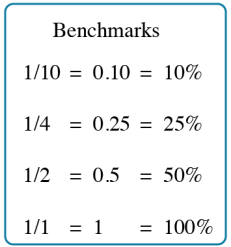
So the next day the class had a conversation about the reasonableness of some of their answers.  After some reflection, it was become ever-increasingly evident that students were relying much more on the procedure, rather than checking whether their answer was reasonable.  The class discussed how benchmarks could be used to help determine whether their answer was in the correct ballpark.  We discussed how fraction benchmarks can help us create estimates.  Students connected this to how they multiply and divide numbers with decimals.  They estimate first, use an algorithm to find a solution and then check to see if their solution is similar to the estimate.  The class co-created an anchor chart that looked similar to the image below.

b2-01-01-01

I asked the students to recheck their assignments.  Students changed up their answers and placed estimates next to them.  I used the 15% off of 120 for the example.   I modeled a few different examples and students practiced similar problems.


b2-01-01


All students put an estimate next to their answers while some changed their actual answers.  For the most part students moved beyond the idea of just using the procedure and keystrokes on a calculator to checking their solutions using benchmarks.  Having this small step beforehand seemed to help students identify whether their answer was actually reasonable or not.

Pick Three

Over the past few years I’ve transformed how I give quizzes.  The format and what I expect from students has also changed.  I’m finding that students are expected to explain their reasoning more frequently.  They’re also asked to showcase multiple strategies when solving complex math problems.  This shift has caused my own formative quizzes to change.  It’s also led to some great discussions with my teaching team as we design assignments.

I give quizzes throughout each math unit.  These “review checkpoints” are used to assess where each student is in relation to a particular math standard.  The checkpoints indicate whether students are meeting the standard and if they need additional support or enrichment.  Students also understand that they can make a second attempt if needed.  One things that I’ve done differently this year is to give more choice with these quizzes.  The objective is still the same, but students have an opportunity to have a choice in what problems or response to to complete.

So what does this look like?  In the past I’d give students a worksheet or half-sheet and have them complete it as a quiz.  This year I’ve expanded student choice with my quiz format.  Students are still given a sheet, but I give them a few options.  I tell the students that they can pick 3 out of the 10 problems to complete.  At the beginning of the year students weren’t exactly sure what do with that directive.  They first started to look for the easiest problems that they could find.  I feel like their attitudes have changed over the school year.  Now, students look at each problem and pick a problem that they feel comfortable addressing.  I feel like this is due in part partially because students are aware that they can retake the quiz.  That aspect loosens up some anxiety and helps some students approach more challenging problem.  I’ve also noticed that students have performed better using this technique.

Ideally, I’d like to offer more student choice in the classroom when it comes to being able to show mastery.  I feel like this is one small step in moving towards that goal.

Retakes at the Elementary Level

2ndattempt-01

Over a week ago my fourth grade class explored discount using Amazon.  The lesson went well and the students explored discounts and percents.  Students turned in their task and were given a second attempt.  Some of the students decided to redo their project and improved their performance the second time.  This impromptu redo process seemed to give students another opportunity to show mastery.

On Monday my fourth grade students completed another task.  This task was related to discounts and sales tax.  This was a challenging assignment for fourth graders.  Students were asked to find a discount and calculate the sales tax.  Students worked on this assignment for about 15 minuets and then turned it in.  That night I reviewed the task and found around 30% of the students didn’t achieve mastery.  I decided to use the same strategy as I did with the Amazon task.  I wrote down questions and had students use that feedback to attempt the assignment a second time.  Again, the scores improved and I took the higher score.

I’m seeing potential in using a second attempt strategy.  I feel like it might be one way to move towards a standards-based grading strategy.  This can’t be done with all assignments but I used it with the last two tasks.  Actually, it might be possible to expand this but there are hurdles surrounding the idea of allowing retakes.  The idea of standards-based grading has been discussed in my district but it hast been fully implemented.  Some teachers at the middle school have used models with some success.  It hasn’t been discussed at the elementary level. This may be the direction my district is moving.  Personally, I feel like retakes have a place in elementary schools.  I’m planning on expanding a redo policy for the other grade levels that I teach.

I’m encouraged to see the benefits of using this technique in the classroom. This is all good but I’ve run into a few issues.   Some students that didn’t perform well decided to not take advantage of a second attempt.  They decided that a 1/5 or 2/5 was fine.  Also, I’m finding that timing for the second attempt is starting to become an issue.  Creating time for students to retake the tasks can be challenging.  Those that truly want to retake the assignment find time at some point during the day to make a second attempt. Other students need consistent reminders.  Another thing that I noticed is that some students want to retake the task a third time.  Is this reasonable?  These are a few points and questions that I’m considering while planning out the last third of the school year.

I’m interested in hearing your perspective.


Discounts and Amazon Prices

Minecraftone.jpg

My fourth grade class is learning about discounts. Over the past few years I’ve used so many different activities related to percent off and discounts. This year I decided to use Amazon and shopping prices to help reinforce how to calculate amount saved and discounts. I printed off five different items that were intentionally picked from Amazon. I picked items I thought the students might be interested in. I erased the percent saved and percent off sections that are usually displayed on Amazon. Students were asked to find both of these items and explain their thinking in the process.

Minecraftone.jpg

Minecraftzoom.jpg

Before starting, the class discussed the process used to find percent discounts. This mini-lesson took around 5-10 minutes.   During this time I found that the class had a few different misconceptions on how to find the discount after the percent of the number was found. Some students subtracted this from the sale price, while other students wanted to deduct the amount from the original price. After the mini-lesson students went back to their seat and I randomly passed out the sheets to students.

Students were pumped, as they weren’t sure what they’d get. It was great to see the anticipation and soon they got to work. Students took out their calculators and started to find the discounts. Students were able to quickly find the savings, but had some trouble with the percent. Students had a few questions during this process. For some, they used trial-and-error, while others used a precise process to find a solution. Some students had questions about their answer and I questioned the reasonableness of their percent. Students turned in their responses and moved on to the next activity.

clock

I graded the sheets that night and started to notice some trends. The majority of problems seemed to occur during the dividing process. Students were either dividing the decimal by the sale price or regular price to find the discount. Also, some students had percent discounts that weren’t reasonable, such as 1% compared to 10%. I decided to give all my feedback in question form. The idea for this actually originated from one of Fawn’s posts on using a highlighter to give feedback. If students mastered the concept then I indicated that on top of the paper. If not, I wrote questions related to the misconception and didn’t assign a grade on top of the papers.

The next day I gave students the papers back without a grade and asked for students to make a second attempt. This was about half of the class. The rest of the class had a different assignment during this time. I told the students that their first attempt was important but not their final grade for the assignment. Some students were confused but seemed relieved after I communicated that the questions were there to help guide them during the second attempt. I also told the students that their second attempt should be in a different color so I can see the changes that were made. Students completed their second attempts in about 15-20 minutes.

Photo Mar 04, 12 01 17 PM.jpg better

During the next day I passed back the papers and around 90% of the students achieved mastery on this particular assignments. Good news. I had a number of questions from the students related to if we’ll be having second attempts in the future. Not sure yet, but this seemed like a positive step. There were still some students that needed help but the second attempt was a success for most. This second attempt with questions strategy is something I might use in the future. I’ll be selective with it but I feel like it seemed to help students move towards mastering the objective.


Fraction Multiplication and Division

Screen Shot 2016-02-26 at 5.47.33 PM.png

My fourth graders are deep into a unit on fractions.  They’ve been multiplying common fractions and tiptoeing into fraction division.  That was until Wednesday of this week.  On Wednesday students explored different ways to divide fractions.  Students used visual models to divide, but that didn’t seem to help students understanding them better.  They encountered abstract problems and used the “flip” method to find the quotient.  This still didn’t help improve much in the conceptual understanding department.  Students wanted me to show the exact process of what to do to solve fraction division problems.  I wasn’t thrilled.  It was evident that students needed more exposure and practice with fractions. So I took a step back and reviewed fraction multiplication.

The class reviewed fraction multiplication and scenarios that are needed to find products.  Students were aware of many different situations where they might need to multiply fractions.   They were able to show visual models and computation strategies to find solutions involving multiplication.  I had a few students also indicate that it’s important to simplify the product.  So the class was rolling in a  positive direction and I decided to bring the lesson back to division.  The break through moment occured when the class connected fact families to the current lesson.  Similar to addition and subtraction, multiplication and division fact families can also contain fractions.  This helped students make connections.  Students wrote out different fact families using unit fractions (1/2,1/4,1/3…).  Students then changed the fact families related to only multiplication and division.  The class was starting to wrap their heads around fraction division with a bit more ease.  I felt as though students were ready for the next activity which was related to food.

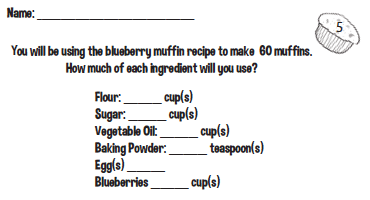
Students were placed in teams of three and given a blueberry muffin recipe.

Screen Shot 2016-02-26 at 5.26.13 PM

Students reviewed the sheet and wondered where this was going.  Each group then received a sheet related to the original recipe.  Each half-sheet asked students to modify the recipe based on the serving size.

Screen Shot 2016-02-26 at 5.37.12 PM
Recipe modification


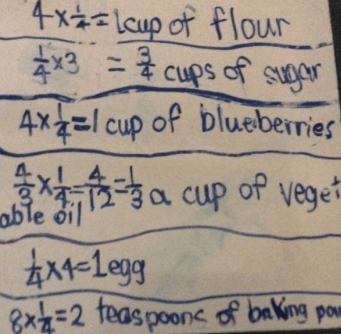
Some students were asked to make 12 muffins, while others said 36, 24, 60, 96 or 72.  I felt as though some students were relieved when they were asked to half or double the recipe.  Other groups tackled the problem with some major perseverance.  Students were asked to show their number model and explain why their answers were reasonable.  Some students wrote number models that multiplied fractions by the recipe amount.

Screen Shot 2016-02-26 at 5.35.39 PM
Showing number models

Screen Shot 2016-02-26 at 5.45.30 PM

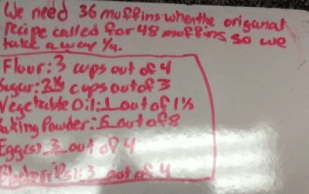
Groups also used fraction division to show a number model.  The majority of groups connected how multiplication and division of fractions can be part of a fact family.  This was especially apparent when students started to see that 1/4 * 4/1 = 1.  I feel like this is laying groundwork for next year’s class when we start pre-algebra equations. Having a solid understanding of how to “undo” operations is a great tool to have in the math toolbox. Once students found the fractional reduction or addition they changed each ingredient accordingly.  After showing their work, students took a picture of the whiteboard and recorded their voice.  Student groups explained how they found each answer and why it was a reasonable answer.  Some student groups were amazing when communicating their reasoning.  They actually explained that the ingredients needed to be increased by a factor of 4.  Other groups were very general with their reasoning in saying that the recipe increased because they were asked to make more muffins.  I can tell this is an area that’ll need strengthening throughout the year.

Overall, this activity seemed to help reinforce skills taught earlier in the year.  The most complicated part was where to start.  Students had trouble knowing what do do with the problem at first.  Students seemed comfortable with the number model and computation components.  Explaining their reasoning needed some tweaking, but that might also be an expectation that needs to be set more in the future.

Exploring Scale Models, Perimeter and Area

Screen Shot 2016-02-20 at 8.39.15 AM

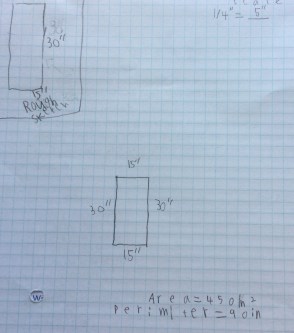
This past week students started to explore perimeter and area. I’ve observed that most students arrive into third grade with an understanding of perimeter. They can find the perimeter around polygons with a ruler or when measurements are given. When polled, the majority of students said perimeter is basically the measurement around something. After discussing perimeter, the class measured the distance around objects in the classroom. Once the class reviewed the perimeter the class moved on to area.  We used scale drawings to emphasize the concept of perimeter.

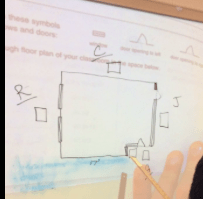
On Thursday students investigated how to create a rough sketch of a floor plan.

Screen Shot 2016-02-20 at 8.26.53 AM.png

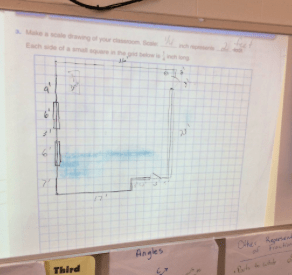
The class used the classroom as an example. Students started by creating a rough sketch of the dimensions of the classroom. Student teams were assigned walls of the classroom to measure. After around 15 minutes students came back and wrote their measurements on the board and in their math journals. Students then transferred that rough sketch data into a scale model. This took time.   We spent around 10 minutes deciding on what ¼ of an inch would represent on a grid. This was time consuming. The class had an amazing conversation on what could be an appropriate scale model that would actually fits paper. Students made the connection between a scale model and how to writer intervals on a graph. Although this was time consuming, it gave students an opportunity to use trial-and-error with different scales. Eventually the class decided on using ¼ of an inch to represent two feet in the classroom.

Screen Shot 2016-02-20 at 8.26.38 AM

The class constructed the scale drawing and put in place the windows, doors and walls. The perimeter was found and then students counted the squares inside to find the area. This was a bit challenging for some as the concept of perimeter and area are different.  During this process students started to identify their own misconceptions about area.  Some of the squares were full while others were halves. Students had to combine the halves to find the total area. Students worked in groups to find different ways to find the area of the classroom. Besides counting the squares, students explored other strategies, such as multiplying the length and width or using some type of array model with squares.

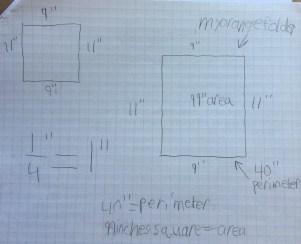
The next day students were asked to find an object in the classroom with a rectangular face. Students found many different objects in the classroom (folder, journal, Kleenex box) while others picked objects that they couldn’t bring back to their desk (window panes, cabinet doors, desk face). Students measured the face uo the nearest inch or half-inch. They created a rough sketch and a scale drawing on grid paper. Students used the grid paper to find the perimeter and area of the item.

Photo Feb 20, 8 15 31 AM

Photo Feb 20, 8 15 41 AM.jpg

Next week students will be sharing their projects with the class. Each student will share their findings and the class will have a conversation about the similarities and differences between perimeter and area.

Math Instruction and Book Studies

book-01

Over the past year I’ve had opportunities to read books related to math instruction. I volunatarily chose to read these books.  They weren’t part of a college class or assigned by my school. Some of the books I found via Twitter while others were recommended by colleagues in my PLN. Two books in particular have impacted my teaching practice this school year. Both books were used in a math book study conducted through Google Hangouts. Anthony helped lead and encouraged others to join these particular studies.  The discussions that happen during these books studies are valuable.  Through this post I’m going to highlight two books in that’ve helped influence my planning this school year. I believe that the planning has helped produce better instruction and learning experiences for my students.

Teaching Student-Centered Mathematics

I’ll admit that I’m not completely finished with this book. I’m going to recommend it anyways. What I’ve covered so far has been directly applicable to what I’m teaching. The book was recommended to me by a multitude of math coaches and teachers. Their positive experiences helped egg-on my purchase once I heard that this book was going to be used for a book study. So I took a leap, purchased and have been slowly reading it over the past two months. Nuggets of greatness exist inside this book related to instructional design and how to promote student math understanding. The first few chapters emphasize the reasons to differentiate, assess, and how to work with parents. Part II is where I’m finding the most value. The authors’ take apart different math strands and explicitly show a variety of strategies to introduce or engage students in the learning process. A heavy emphasis on using visual models and building a concrete understanding of mathematics is demonstrated throughout the book. I appreciate the examples of the visual models and practical examples. Some of them were brand new to me. As I progress through the book I’m finding useful strategies to have students think more critically about math tasks.  This is taking more time in class but I feel like it’s worthwhile. I’ve used the chapter on fractions more prevalently than others.

How the Brain Learns Mathematics

This was another book that was used for a book study. I skimmed through the first few chapters and found I needed to delve in deeper to get substance. I had to re-read many parts because of the content related to brain science.  Most of the information related to neurons and retention fascinated me.  These were highlight-worthy for me. I thought much of this should have been introduced during my undergraduate studies. The information about how science relates to math instruction helped me see the connections between how students process numbers and what’s developmentally appropriate for students. There were quite a few affirmation opportunities as well as times where I questioned what I’m doing. I love a book that makes me ask better questions.  One of the take-aways that I found helpful was related to how I organize my lessons and that timing plays a pivotal role in retention. All the time involved in math instruction is precious. With that being said, the “prime” time minutes (first 10-15) and (last 10) are very important in how students remember their math experiences. After reading this I started to analyze how I structure my 60 minutes with students. I became more aware of the use of the first and last minutes of class. Another piece that I came away with dealt with the time needed for students to process information. Students need time to process, reflect and create connections about the math concepts that they’re experiencing. I don’t necessarily think that happens as much as I’d like.

Looking forward, I’m hoping to carve out some time to read a couple new books on my shelf. As I’m writing this I have Number Talks waiting for me.   At some point I’m going to crack these open and look for ways to improve my own practice.

Minecraft and Math Strategies

Photo Feb 05, 1 35 30 PM

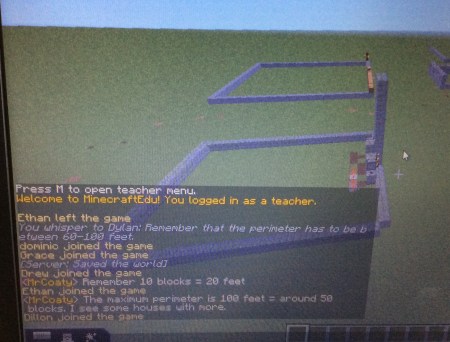
A few weeks ago my students started using MinecraftEdu during math class.  You can read about our first experiences here.  I used a similar activity with my fourth grade students this Friday.  Students were expected to build a house in MinecraftEdu.  Students followed these instructions.  During the process students will be practicing measurement skills related to fourth grade  math standards.

minecraftedu

Additional components were added to the project.  Instead of working in teams, students built their own houses.  I also added blanks for students to show their number models and other information.  What I found more interesting this time around was the strategies that students seemed to use.  Students started with the first direction:

Screen Shot 2016-02-05 at 8.55.00 PM.png

Students tried a number of different strategies.  Some students started laying out blocks in a square pattern and decided to multiply that measurement by four.  Other students created a rectangle and then eliminated blocks to match the measurement.  I would say that the majority of students had to use trial and error to create a perimeter that matched the criteria.

Screen Shot 2016-02-05 at 8.55.37 PM

Some students decided to create dimensions that met the area criteria first and then addressed the perimeter.  Almost all the students had to break blocks and change what they originally made.

Screen Shot 2016-02-05 at 8.56.09 PM

Students then started to create the height of the house.  About half of the students started by creating pillars.  The pillars stopped at a height that students determined.  Students then filled in the pillars, added in windows, created a door and double-checked their measurements.  Students then started to work on designing the inside of their houses.

Photo Feb 05, 1 31 16 PM

Next week students will revisit this project and continue to work on the interior.  At some point roads or paths will be created to connect this community.  Additional math skills will be added as the class continues to create this virtual math world.  I can see angles, volume

Representing Fractions

During the past few weeks my students have been studying fractions. I feel like the class is making a decent amount of progress.  The class has moved from identifying fraction parts to adding the pieces to find sums. Pattern blocks have been especially helpful with adding fractions. I feel like students are becoming more confident with the computation and we haven’t used the word common denominator yet.  I don’t want students to by relying too much on just the algorithm.  Throughout this process I’m noticing that students are struggling with fraction word problems. Students are having trouble identifying what the fractions represent in the problems.

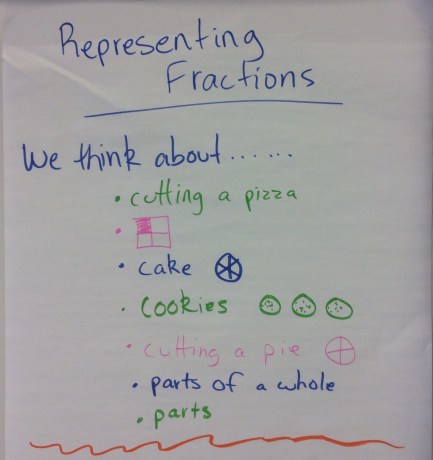
Yesterday we had a class meeting to discuss this topic. This fit in well with a book that I’ve been reading.  Chapter 8 emphasizes how to teach fraction concepts and computation.  The chapter begins with misconceptions and the different meanings associated with fractions. The class reviewed all the different ways that they view fractions. We documented the class ideas on an anchor chart.

Photo Jan 28, 9 17 09 AM

Do you notice any trends? The class looked at the list and had no complaints. This is how they visualize fractions. When asked how they use fractions they came back to this list and didn’t have anything to add.  Keep in mind that this is from a group of third graders.  The next step in the class conversation was to discuss different ways that fractions are represented in problems.

Screen Shot 2016-01-28 at 9.01.22 PM

I started with part-to-whole representations. Most kids were familiar with this type of model. After all, students have been using this model for the past week and most of last year. I then moved onto how fractions can be used to measure objects.  Students nodded their heads in agreement and asked questions as I went through the other representations. Connections were made through this process.  Students created examples of each representation in their math journals.

Photo Jan 28, 9 17 29 AM

Students are planning to revisit the word problems that I discussed earlier in this post.  They’ll be reading the question and match the context to the representation.  I’m looking forward to having students use this strategy moving forward.

Visualizing Fractions

Screen Shot 2016-01-23 at 8.42.19 AM.png


My third grade students started a new unit on fractions this week.  They’ve explored fractions before, but more along the lines of identifying different types of fractions and adding/subtracting with common denominators.  This new unit involves students finding fractions of sets and a heavy dose of fraction computation.  Students need to have a deep understanding of fractions to be able to add them and show a visual model.  So on Friday  the class practiced skills associated with finding fractions of sets.  Students were given this prompt:

Draw four different ways to show 3/4 in the box below.

The student models fell into a few different categories.

  • A number line
  • Pie, rectangles, squares
  • Dots or arrays
  • Angles


Screen Shot 2016-01-23 at 8.23.07 AMScreen Shot 2016-01-23 at 8.23.25 AMScreen Shot 2016-01-23 at 8.23.36 AMScreen Shot 2016-01-23 at 8.24.09 AM

The class reviewed the results and we had a discussion about the different ways to represent fractions.  Next week the class will be combining these models to add and subtract mixed numbers.