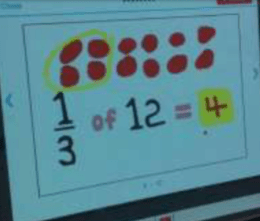
During the past few weeks my students have been studying fractions. I feel like the class is making a decent amount of progress. The class has moved from identifying fraction parts to adding the pieces to find sums. Pattern blocks have been especially helpful with adding fractions. I feel like students are becoming more confident with the computation and we haven’t used the word common denominator yet. I don’t want students to by relying too much on just the algorithm. Throughout this process I’m noticing that students are struggling with fraction word problems. Students are having trouble identifying what the fractions represent in the problems.
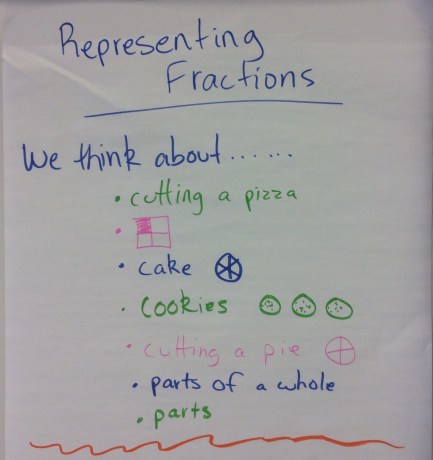
Yesterday we had a class meeting to discuss this topic. This fit in well with a book that I’ve been reading. Chapter 8 emphasizes how to teach fraction concepts and computation. The chapter begins with misconceptions and the different meanings associated with fractions. The class reviewed all the different ways that they view fractions. We documented the class ideas on an anchor chart.
Do you notice any trends? The class looked at the list and had no complaints. This is how they visualize fractions. When asked how they use fractions they came back to this list and didn’t have anything to add. Keep in mind that this is from a group of third graders. The next step in the class conversation was to discuss different ways that fractions are represented in problems.
I started with part-to-whole representations. Most kids were familiar with this type of model. After all, students have been using this model for the past week and most of last year. I then moved onto how fractions can be used to measure objects. Students nodded their heads in agreement and asked questions as I went through the other representations. Connections were made through this process. Students created examples of each representation in their math journals.
Students are planning to revisit the word problems that I discussed earlier in this post. They’ll be reading the question and match the context to the representation. I’m looking forward to having students use this strategy moving forward.
My third grade students started a new unit on fractions this week. They’ve explored fractions before, but more along the lines of identifying different types of fractions and adding/subtracting with common denominators. This new unit involves students finding fractions of sets and a heavy dose of fraction computation. Students need to have a deep understanding of fractions to be able to add them and show a visual model. So on Friday the class practiced skills associated with finding fractions of sets. Students were given this prompt:
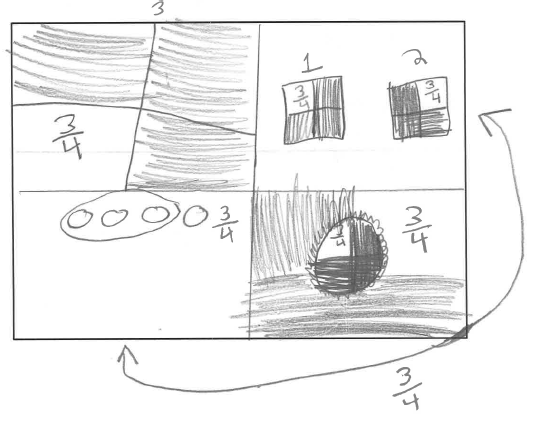
Draw four different ways to show 3/4 in the box below.
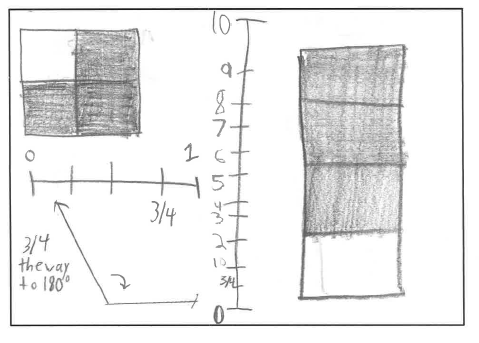
The student models fell into a few different categories.
A number line
Pie, rectangles, squares
Dots or arrays
Angles
The class reviewed the results and we had a discussion about the different ways to represent fractions. Next week the class will be combining these models to add and subtract mixed numbers.
Last week my students started to plot points on coordinate grids. They were identifying different quadrants and becoming more confident with drawing shapes on the plane. While reflecting on last week’s activities I noticed a Tweet that was sent our replying to one of my blog posts.
I’m a rookie when it comes to Desmos. Most of the stories I hear involve middle or high school students. I needed to find something that worked with my elementary kids. So I started to research and did a little bit of exploring to see how this could be used with my third grade class. I ended up looking up some of the templates but had a bit of trouble finding an extremely basic rookie-like coordinate plane activity for my students. I decided to go the route of creating a template and having students manipulate created points for a project. Click here for the template.
I quickly found that students had no idea how to use Desmos. I gave the students 5-10 minutes to orient themselves. Students were asked to move the points to certain coordinates on the grid. As they moved the points students started noticing that the tables on the left side of the screen changed. Students started connecting how the tables changed and this helped reinforce concepts learned last week. After this introduction time, students were given a rubric that contained the following:
Move the points on the grid to create two angles
The angles need be located in two different quadrants
The angles need to be acute and obtuse with arcs located in each one
Indicate the measurement of each angle
Students were then given 15-20 minutes to create their projects.
Students created their angles by moving the points around the grid. Students then shared their projects with the class.
Students took a screenshot and then added the degree measurements to the angles. The class reviewed the projects and students explained how they plotted the points. This project seemed to help students make the connection between points and the x and y-coordinates. It also reinforced skills related to angle classification and measurements. I’m looking forward to expanding on this project next week.
My third graders started to explore coordinate grids this week. For many, this was the first time that they’ve used them. Some of the students have played Battleship or some other game that involves a grids. Playing off that background knowledge, I used a road map to show how people can find certain locations by using a coordinate grid. This made sense to some of the students but a few still were unsure of what axis was used first to determine where to plot a point. This was a reoccurring theme throughout the lesson.
During this process I remembered a strategy that another colleague suggested a few years ago. She borrowed the idea from another teacher and it seemed to work well in her classroom. A colleague of mine used (3,2) as an example of the “go into the building” – first number (right 3) and then “go up or down the elevator” (up 2) method. I decided to use that strategy and a few more students started to grasp the process. The next activity in the paragraphs below seemed to solidify a better understanding for the rest of the class.
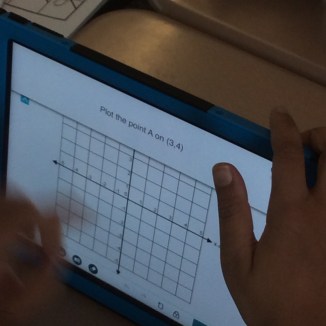
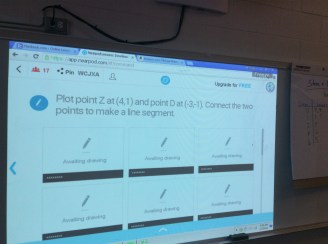
Earlier in the day I created a very short Nearpod lesson involving mostly pictures of coordinate grids. I handed out a iPad to each student. Students logged in and given a picture of a grid and asked to draw and label points.
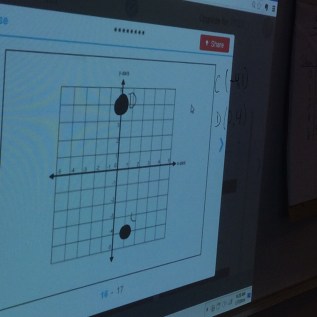
I then revealed the pictures to the class on the whiteboard. The names of the students were hidden so that we could analyze each response without throwing judgement lightning bolts towards a specific individual. As the class went through each picture they started to notice trends.
Some were switching up the x and y-axis numbers
Some were not creating a point
Some were not creating a letter for the point
Some were confused by the negative sign in front of the numbers
Students observed these issues from the first question and grid. After a decent discussion on the above trends, the class moved towards the second grid and question. I gave the students that same amount of time and the results seemed to initially improve.
Students started to become better at finding their own mistakes before submitting their creations. I used the same strategy as earlier and displayed the results to the class. There were a few that had some of the same misconceptions, but not as many. In fact, many students vocalized the class improvement since the last question. One of the evident misconceptions revolved around students having trouble plotting negative numbers on the coordinate grid. The class discussed this and completed the third question and grid. The student responses from this question were much better than the prior two. Students were starting to develop some true confidence in being able to correctly plot points on a coordinate grid. I kept a list of the trends that students noticed and will bring it out later in the unit as we’ll be revisiting coordinate grids next week.
After our Nearpod lesson (which was about 15-20 minutes) students played a Kahoot on identifying points on a coordinate grid. I felt like this was helpful as students identified the points and were able to gauge their own understanding compared to the goal.
Earlier in the school year a group of three teachers at my school wrote a grant expressing the need to incorporate Minecraft in the classroom. The idea actually started last summer when a colleague and I attended a professional development event in Downers Grove. During one of the sessions I met two teachers from nearby school districts that used MinecraftEdu in a school club. What they had to say caught my interest and two other teachers and I decided to start a school club in 2016. We wrote the grant and it was accepted. Last week the licenses were purchased and I’ve explored the potential of using the program in the classroom setting.
Before the school year started I knew very little about how to use Minecraft. I decided to purchase a copy and explore the Minecraft world over the summer. I quickly learned the controls and watched a number of YouTube videos to become a better rookie. I’m still a rookie. I found the MinecraftEdu community online and started posting questions to the forums. Moderators answered my questions and I started feeling more comfortable using the program on my own. The forum has been especially valuable in giving me ideas to use in the classroom.
I downloaded a few world templates and started brainstorming. I then bounced a few ideas off of colleagues and decided to start using the program for a math scavenger hunt. The goal was to have students get used to using the program in an education setting while reviewing fraction math concepts in the process. Most students already understood the controls and the game but weren’t used to using it for a different purpose. I wanted to start simple and I thought a scavenger hunt would be an easy way to start incorporating the program in my math class.
Math scavenger hunt – third grade
Students entered into the fraction world that I created. Once they entered into the world I froze all of them. I explained the goal of the world and answered questions. The goal was to explore the world and find the signs that were posted. Students were using the MinecraftEdu version where they weren’t able to build or keep inventory of items. Trap doors, caverns and bridges were all part of this simple world. Each sign had a particular math problem on it and students were expected to solve the problem. I then passed out a sheet that went with the scavenger hunt. The sheet had spaces for students’ number models and solutions.
I then unfroze the students and they were off to the races. Students split up and started exploring the area. They soon found that working in teams seemed to be more efficient in finding the signs. All students were finished with the scavenger hunt in 30 minutes. Afterwards the class reviewed the answers.
House building – fifth grade
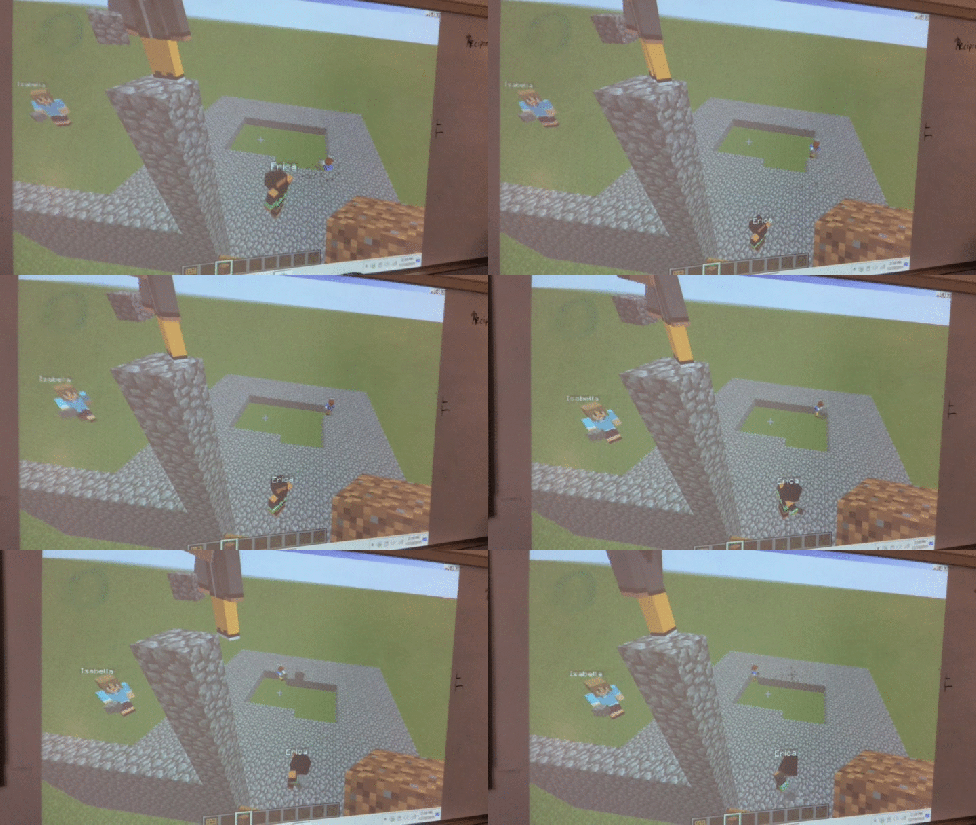
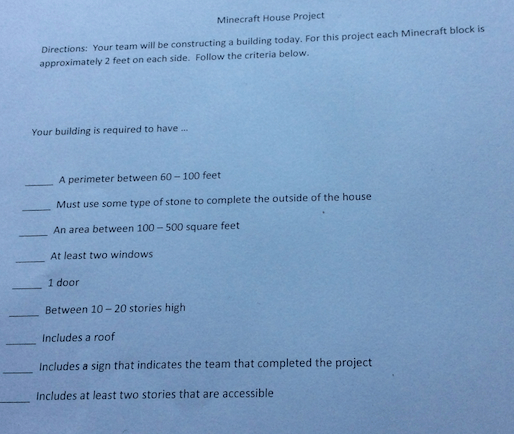
I created a completely flat Minecraft world for this activity. Students were grouped into teams and given a task related to concepts that we’ve been discussing. The fifth grade class has explored area and perimeter and will eventually be investigating volume in January. Each group was asked to create a building that met a certain criteria. It was stated that each Minecraft “block” was exactly 2 feet on each side. Those measurements were used to meet the criteria.
Students worked together and started building their houses. A few groups had to restart as they found out that the perimeter and area didn’t meet the criteria. After around 30 minutes students are about 50% complete with their houses. I’m assuming that another 30-40 minutes and the students will be finished with their projects. At some point after break the class will be presenting their buildings to the class.
In January my school will be offering a Minecraft club to around 25 elementary students. We’re planning on building our actual school from scratch using some type of scale model. The students are already excited to be using this program in school and I’m looking forward to what students create and the process involved in that creation.
This school year I’ve been given the opportunity to work with a select group of second grade math students. Since early October I’ve been seeing two groups of around 20 students for approximately 30 minutes twice a week. These 40 students were selected based on unit pre-assessment scores and teacher recommendations. The second grade students that I see tend to be in need of enrichment of the math skills that they’re exploring in class. This enrichment can take on many forms, but mainly I’ve been looking at have students develop a better understanding of numbers and patterns. I’ve been asked to expand on the unit being taught in class and report back progress that students have been making. The groups that I see are designed to be flexible and change depending on a particular math unit.
Here area few things I’ve observed as the year has unfolded:
1.) 30 minutes twice a week is a short time period. I’m all for packing in as much instruction as possible, but 30 minutes goes by very quickly. I’ve had to redesign many of my lessons to overlap the two days in a week. Retention can also be an issue with this. I spend each session with a bit of review and that has seemed to help.
2.) I’ve had to incorporate my own pre/post-assessment to show student growth. At first I thought this was extremely time consuming as students only have a small amount of time in my class and I want to make sure that the class time is being used appropriately. This year many of the classes in my school are using the same pre-test as the post-assessment. I’m using that model right now but it may change as the year progresses.
3.) I’m not able to meet with the second grade team every week so we decided to use Google Docs as a communication tool. My students’ pre/post assessment scores are located in the shared doc and can be assessed by any of the second grade teachers. I also attached a copy of the pre/post assessment to the document so teachers are aware of what topics I’m addressing.
4.) I’ve been using effect size to show student growth. I learned about effect size in more detail after attending a Visible Learning conference over the summer. I feel like this has been a useful tool and has shown some insight into student gains in my class. This tool has also been important as it brings some finality to the units that I teach and can be used as one data point in transitioning students in/out of my class.
5.) Student reflection is key. This year I’ve been giving students a copy of their pre-assessment stapled to their post-assessment. Students are then able to review their growth and ask questions. The focus is on student growth and not necessarily on point value or grade. Thankfully at second grade students aren’t used to traditional grades yet.
I’m looking forward to seeing how this enrichment opportunity develops over time and the positive impact it has on students.
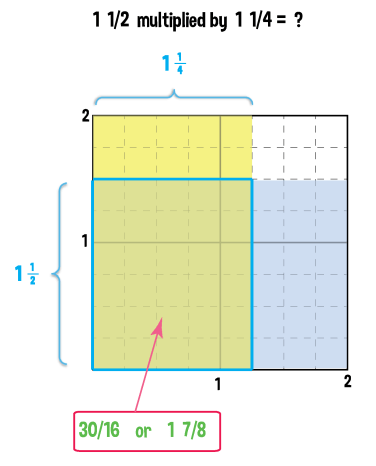
My fifth graders started off the week learning more about fractions. On Monday students used a visual model to multiply mixed numbers. The visual model was a bit challenging for students to grasp. Many of the students knew parts of a multiplication algorithm, but not necessarily how to show the computation visually.
It took a decent amount of modeling and experimenting, but I believe completing the visual models increased students’ understanding of fraction computation. After a decent dose of the visual model, students were introduced to a fraction multiplication algorithm. I tried to make the connections between the algorithm and visual model as apparent as possible. Many students made the connections, but not all.
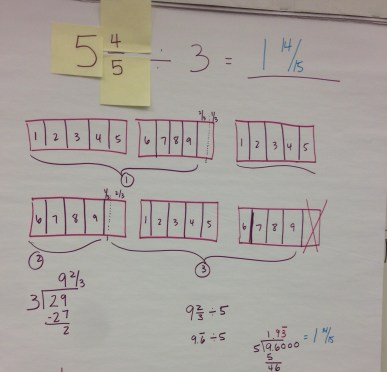
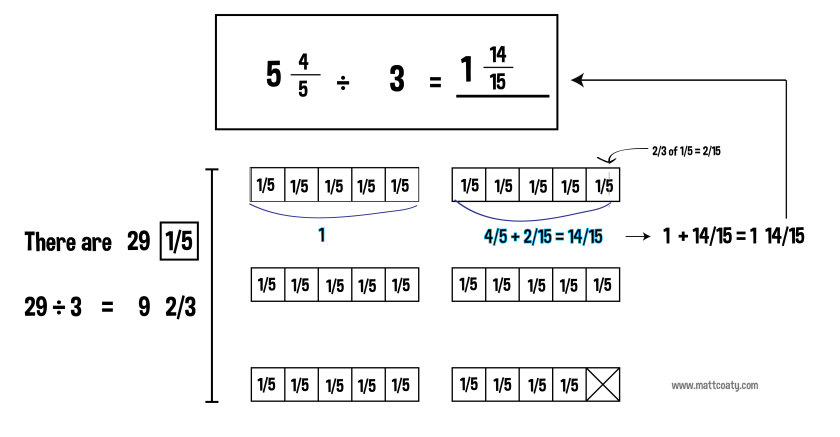
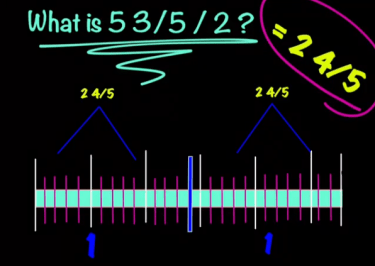
Around mid-week students started to divide fractions. Again, I started off the discussion around using a visual model to show the division.
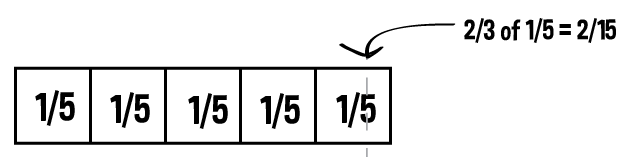
This time students were more confident in creating the visual models, although some wanted to jump to the standard algorithm. This stopped once I included the visual model as part of the steps required to solve the problem. Some of the students that had trouble creating the visual model for fraction multiplication started to become more comfortable with the division model. This was good news. The most challenging part for my students was finding a fraction of fractional pieces.
This was solved once students realized that “of” meant to multiply and then they were able to find a solution. The class had many light-bulb moments as students made connections between the visual model and standard algorithm. Also, one of the additional benefits was observing students look at the reasonableness of their answers. This was more apparent when students created a visual model first. The class will be sharing their models next week.
I’m finding that there’s power in using visual models. The opportunity to use trial-and-error with visual models has many benefits. It’s a low-risk opportunity that allows for multiple entry points. Students are making sense of fractions before moving to the standard algorithm. It might not be the most efficient way to compute fractions (as students continue to find out), but I believe students will have a better understanding when they can visualize fractional pieces and then use a process to find the solution. At some point students will be shown a visual model and be asked for the computation. I feel as though students were steadily building their conceptual understanding of fractions this week.
Lately I’ve been reading David Sousa’s book and have come across some interesting (at least to me) observations. Humans have an innate ability to subitize. That subitizing can lead to estimation and through appropriate practices this leads to bettering number sense skills.
After speaking with a few middle school teachers this summer I’m finding that one area that tends to need strengthening is found in the overarching umbrella of math skills: number sense. Without adequate number sense skills, students flounder when asked to complete higher level math concepts. Year after year I find some students have a decent understanding of procedures, but fall apart when it comes to explaining their reasoning for completing particular math problems. Students are able to identify and repeat processes (usually copying the teacher), but not understand why they’re using that strategy. I find this particularly a concern when students don’t question the reasonableness of an answer. In my mind, I think finding a reasonable answer or estimation shows a form of number sense. This isn’t always the case, but I tend to find it when students blindly follow only a set of procedures. I believe that this can lead to more problems down the line.
This is especially a problem with larger numbers. Researchers Carmel Diezmann and Lyn English found that the activities below seem to help students develop multidigit number sense. All of these activities can be used at the elementary or middle school levels. The headings in bold are found in David’s book and highlighted in Diezmann and English’s research. My narrative is below each heading.
Reading Large Numbers
Placing an emphasis on place value when reading large numbers is important. Being able to identify and see the value of each digit can help students read large numbers more accurately. I find that students in kindergarten and even first grade start to combine place values when speaking of large numbers (e.g. one hundred million thousands). Giving students opportunities to take apart these large number by digit value can help reduce this issue. I find comparing standard and written forms of numbers can also help students start to recognize the place value of large numbers.
Develop Physical Examples of Large Numbers
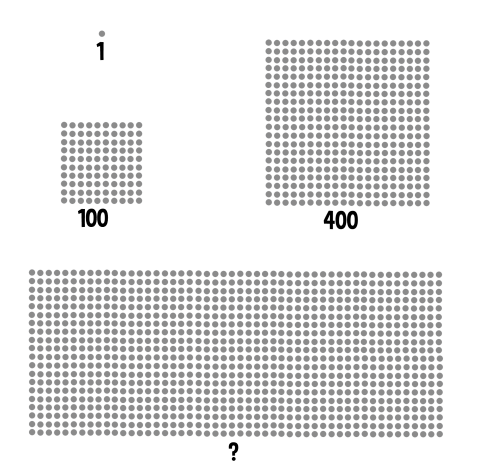
Visually observing 100 and 1,000 dots can show students the physical difference between large numbers. There’s so much math literature that can help with this. 100 Angry Ants,Really Big Numbers and How Much is a Million can be used with manipulatives to show examples of large numbers. If you teach in an elementary school, I recommend adding these books to your math library. Using unifix cubes, base-ten blocks, or replicas can also be used to show a physical example of large numbers. Having the physical example can benefits students as they start to question if their solution to abstract problems are reasonable. A number line with 1:1 correspondent is also one way to showcase large numbers.
Appreciating Large Numbers in Money
Kids tend to like to talk about money. Showing how $1 compares to 100 $1 bills can show students a visual scale between the amounts. Visual representations of money in dollar and coin forms can lend itself to having students become more aware of how place value impacts the value. A problem that tends to always get students curious relates to how much money will fit in a briefcase. Will $10,000 in $5 bills fit in a 20″ x 18″ briefcase? These types of questions can have students start visualizing money and the reasonable of their answers.
Appreciating Large Number in Distance
Maps can be useful here. I remember having students use Google Maps to calculate the distance from one particular destination to another. Also looking at the distance from one continent to another, or even from Earth to another planet. I find that a good amount of scaffolding is needed to help students experience large numbers in distance/measurement. Comparing skyscrapers to distances can also play a role with this as well. If you stacked one Willis Tower on top of another, how many would it take to reach the moon?
They’re many ways to have students observe and interact with large numbers. I’d like to add appreciating distance in relation to time to the the list. Time can also be used highlight and compare large numbers. I’m thinking of the dates in history and the Science involved in evolution. Many of these activities can be interdisciplinary as connections between curriculum content exist. Digital and physical forms play a role in having students conceptualize an understanding of large numbers. Students should be given opportunities to recognize large numbers in a variety of contexts. By doing so, I believe students should be able to better question whether their answers are reasonable or not.
By the way, the answer to the top image is 1,000 dots.
Yesterday I was able to dive deeper in my summer reading. I’ve been reading David Sousa’s book on how the brain learns mathematics. I’m finding the chapter related to making meaning interesting. David says that there are basically two questions that determine whether an item in the memory is saved or deleted.
Does this make sense?
Does it have meaning?
I believe students ask these questions on a daily basis. Some of the asking is mumbled under their breath, while other students will down-right ask the teacher. I find myself asking these questions as I sit in professional development sessions. Students want to know how this new learning applies to their life. Students are better able to retain what they’re learning when it makes sense and can be connected to past experiences. Those past experiences can develop into having meaning for students. What’s also interesting is that experiences that have an emotional component present have meaning for students. Past experiences that are clear in my memory are often related to some type of emotional component. I feel like this is similar with students. Those experiences are more likely to be stored in long-term memory.
This chapter in particular emphasizes the need to spend more time creating opportunities for students to develop meaning. Without meaning, students often use formulas to compute numbers. Their confidence falls on the formula and the student doesn’t necessarily understand the concept. Students eventually become so skilled at computing numbers that they find answers without thinking of the context. Most teachers have had conversations with students about their answers and if they make numerical sense? In those cases students understanding the procedural aspect (formula) but it’s not in relation to the context (meaning). In order to create meaning, students need time to connect and personalize the content. In addition, they need time to explore, reflect and practice. Writing in math class is one way for students to practice and create meaning.

I’ve been a long time advocate for using writing in math class. My students in 2-5th grade have used math journals in the past. They reflect on their past performance and set goals moving forward. Writing in math class gives students time to process information. That processing can lead to personal meaning. Writing in math class can take many different forms. I believe interactive notebooks and foldables can also provide opportunities for student to process and make meaning. By writing, students are required to organize their thoughts and find sense and meaning in their learning. Using math notebooks/journals can assist in giving students a way to also communicate their current understanding of the material. Having a component where the teacher responds to the students’ writing can also provide another opportunity for feedback. Regularly writing in math class can also provide students with an outlet to create a record that they can look back at to review their growth. Something that I need to keep in mind is that the math writing doesn’t have to be on paper. Writing through a math blog or in some other digital format can also play a role in making meaning.
Yesterday I was able to get outside and walk around a local park. While soaking up the sun I started to notice a variety of patterns on the sides of the path. The patterns changed depending on the vegetation and location. As I searched for additional patterns I started to find more and and then looked for consistency among the sequences. I took out my phone and started taking pictures of the patterns that I saw thinking that I might use them next school year. After collecting a few I started thinking about how this connects to the math strand of algebra.
How does symmetry play a role in the pattern?
Taking the pictures had me thinking of a class I had a few years ago. I remember reading a district-adopted fourth grade text that introduced pre-algebra to students as patterns and solving for the unknown. This simple kid-friendly definition was explained to elementary students in a short paragraph. After thoroughly discussing the definition of a pattern (yes, that took time), students took that definition and ran with it. They started to find patterns (number and otherwise) in and outside of the classroom. If a pattern didn’t seem to exist, students would make a prediction based on the prior sequence. A completed pattern seemed to make sense and an uncompleted sequence didn’t have meaning. Students started to put on their “pattern glasses” to identify sequences. Students would argue whether something was a pattern or not. I distinctly remember one student saying that to complete the pattern you need to find the missing puzzle piece. These discussions were interesting to observe as students were developing their own rules to the patterns and offering their suggestions to others.
Additional pictures and questions:
What type of pattern exists? Do multiple patterns exist if you zoom in on the picture? Would you consider this a pattern?
After uploading the pictures from the walk I started to think of how students make meaning out of patterns. This past year my students were able to find patterns in nature, use Which One Doesn’t Belong, and then transition that idea to Visual Patterns. Understanding the rule or rules behind the pattern can lead to different levels of pre-algebra moving forward. It’s amazing when students start to realize that there can be more than one rule to a pattern or question. Simple patterns can allow students multiple entry point to access pre-algebra concepts. Before the school year starts I’ll be pondering the question below.
How do students identify patterns and does that help them become better problem solvers?